You Can’t Understand East Tennessee Homes Without Understanding the Ground
When I review reports from our inspector working in East Tennessee, foundation performance almost always traces back to one thing: geology. In this part of the state, houses don’t just sit on the ground—they respond to it, shift with it, and sometimes fight against it for decades.
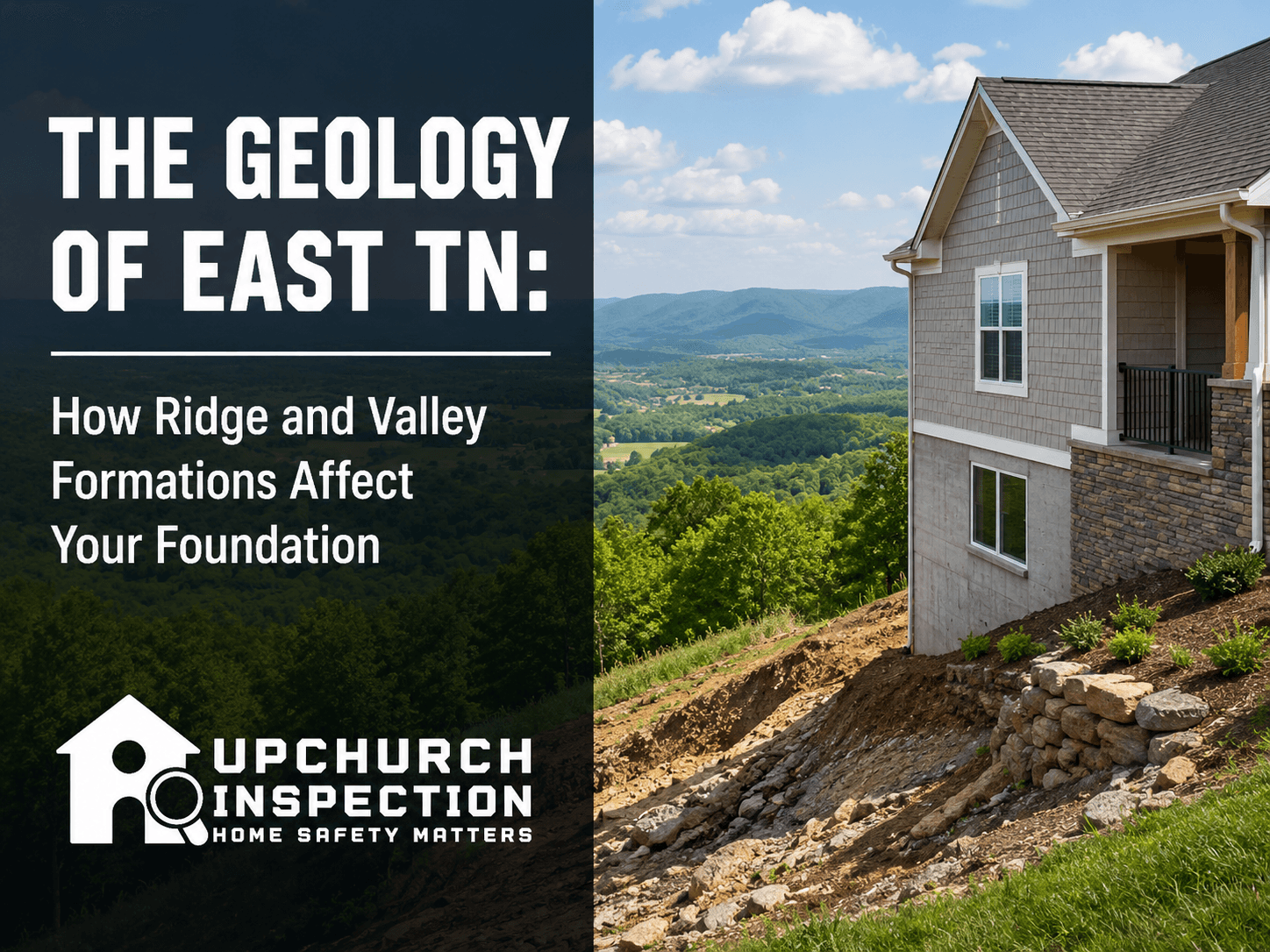
East Tennessee lies within what geologists call the Ridge and Valley Province, a landscape defined by long, parallel ridges separated by broad valleys. This formation isn’t just scenic—it dictates soil composition, groundwater movement, and how foundations behave over time. In places like Knoxville and the surrounding region, this geology quietly shapes nearly every inspection finding we document.
What the Ridge and Valley Province Actually Means
The Ridge and Valley Province is made up of alternating bands of limestone, dolomite, shale, and sandstone that were folded and faulted millions of years ago. Over time, erosion carved softer rock layers into valleys while harder layers remained as ridges.
The result is a repeating pattern of:
- Ridges with thin soils and shallow rock
- Valleys with deeper soils, higher moisture retention, and more variable bearing capacity
Homes built across this terrain experience very different conditions—even within the same neighborhood. A house on a ridge may sit almost directly on bedrock, while a home just a few hundred yards away in a valley may rest on deep, moisture-sensitive soils.
From an inspection standpoint, this variability is critical.
Limestone: Strength With a Catch
Limestone is one of the dominant rock types in East Tennessee, and it’s a double-edged sword. On one hand, limestone provides excellent load-bearing capacity. Homes founded directly on limestone often experience less vertical settlement than those built on deep clay soils.
On the other hand, limestone is soluble. Over long periods of time, groundwater slowly dissolves it, creating fissures, channels, and voids. These features allow water—and soil gases—to move efficiently beneath and around foundations.
Our inspector regularly documents foundation cracking patterns in Knoxville-area homes that align with subsurface limestone features rather than surface soil movement. These cracks are often narrow but persistent, reopening seasonally as moisture conditions change underground.
Shale and Clay Layers Add Complexity
Between limestone layers lie bands of shale and clay-rich soils. These materials behave very differently. Clay expands when wet and shrinks when dry, while shale can degrade and soften with prolonged moisture exposure.
In valley areas around Knoxville, homes are often built on soils derived from weathered shale. These soils hold water longer and respond dramatically to seasonal moisture swings. Our inspector frequently sees:
- Differential settlement between interior and exterior foundation walls
- Sloped floors that worsen during wet seasons
- Cracking concentrated near plumbing penetrations where moisture is highest
These conditions aren’t random defects—they’re predictable responses to soil behavior influenced by underlying geology.
Why Two Homes on the Same Street Perform Differently
One of the most confusing experiences for homeowners is seeing similar houses age very differently. In East Tennessee, geology explains much of that discrepancy.
A house on the uphill side of a street may sit partially on rock with good drainage. A house across the street may be downhill, collecting runoff and resting on deeper, wetter soils. Even if the homes were built by the same builder in the same year, their foundations experience entirely different stress profiles.
When I review inspection reports from our Knoxville inspector, the strongest ones connect foundation performance to site position, not just construction quality.
Groundwater Movement Is Constant Here
East Tennessee’s geology creates efficient groundwater pathways. Rainfall doesn’t just soak in vertically—it moves laterally along rock layers, often emerging at lower elevations or against foundation walls.
This is why some basements and crawlspaces take on water even when surface grading appears adequate. The water isn’t coming from the yard—it’s moving underground along geological planes.
Our inspector routinely finds moisture intrusion at basement walls that face uphill slopes or ridge lines. These areas often show:
- Efflorescence on masonry
- Damp foundation walls after rain
- Sump pumps that cycle frequently even in dry weather
Understanding subsurface water movement is essential to diagnosing these issues correctly.
Sinkholes and Subsurface Voids: Rare, But Real
While catastrophic sinkholes are uncommon in urban Knoxville, smaller subsurface voids are not unheard of. Limestone dissolution can create voids that slowly migrate upward, leading to localized settlement.
Our inspector has documented cases where foundation settlement was concentrated in a specific area of the home, with little movement elsewhere. In these situations, the pattern often aligns with localized subsurface features rather than general soil failure.
These conditions don’t always require immediate structural intervention, but they do warrant careful monitoring and, in some cases, further evaluation.
Crawlspaces Reflect Geological Conditions Clearly
Crawlspaces are extremely revealing in East Tennessee. They provide a direct window into how soil and moisture interact beneath the home.
In ridge areas, crawlspaces may be dry but shallow, with exposed rock near footings. In valley areas, crawlspaces are often deeper and more humid, with soil that remains damp long after rainfall.
Our inspector pays close attention to:
- Soil moisture consistency
- Evidence of subsurface water intrusion
- Pier settlement patterns
- Deterioration of support elements
These observations often tell more about foundation performance than interior cracks alone.
Basements: Where Geology and Construction Collide
Basements in East Tennessee face unique challenges. Excavation often cuts directly into mixed materials—rock on one side, soil on the other. This creates uneven pressure against foundation walls.
In Knoxville inspections, our inspector frequently sees basement walls that perform well structurally but show chronic moisture issues. These problems are often tied to subsurface water flow along limestone layers rather than surface drainage failures.
Improperly designed perimeter drains or missing drainage layers exacerbate the issue, allowing water to accumulate against foundation walls.
The Role of Human Modification
Development has altered natural drainage patterns throughout East Tennessee. Cut-and-fill construction, terracing, and retaining walls change how water moves across and through the landscape.
In some neighborhoods, homes were built by cutting into ridges and using fill to level lots. Fill material behaves very differently from native soil or rock. Our inspector often documents settlement in filled areas, particularly where compaction was inconsistent or drainage was not properly addressed.
These issues may not appear for years, making them difficult for homeowners to connect back to original construction practices.
Why Foundation Cracks Need Context
In East Tennessee, not all cracks mean the same thing. A crack caused by soil shrinkage behaves differently from one caused by subsurface rock movement.
When I review Knoxville-area reports, the most useful ones explain:
- Crack orientation and location
- Relationship to known geological features
- Evidence of active vs. historic movement
This context prevents overreaction while still identifying conditions that warrant further evaluation.
Radon, Moisture, and Geology Are Linked
The same geological features that affect foundations also influence radon levels and moisture intrusion. Limestone fissures provide pathways for soil gases, while valley soils trap moisture that elevates humidity beneath homes.
Our inspector often correlates foundation findings with radon test results and crawlspace conditions. These systems don’t operate independently—they’re all part of the same subsurface environment.
Why Local Geological Knowledge Matters in Inspections
A foundation inspection in East Tennessee without geological context is incomplete. Two inspectors can look at the same crack and draw very different conclusions if one understands the Ridge and Valley Province and the other does not.
Our Knoxville inspector’s familiarity with local terrain, rock types, and soil behavior allows findings to be interpreted accurately rather than generically.
Putting It All Together
Homes in East Tennessee don’t fail because the ground is “bad.” They age in response to a complex geological system that’s been shaping this region for millions of years.
When I review inspection reports from Knoxville and surrounding areas, the strongest ones don’t just list defects. They explain why those defects exist in the context of Ridge and Valley geology.
Understanding that context helps buyers, owners, and investors make informed decisions—without fear, without guesswork, and without mistaking normal regional behavior for catastrophic failure.
In East Tennessee, the ground beneath your home is active, layered, and constantly interacting with water. A good inspection doesn’t fight that reality—it explains it.