When buyers hear “multi-state inspection company,” they often imagine distance—someone unfamiliar with local construction, local soils, or local quirks. In reality, the opposite is true when the company is built around local inspectors rather than centralized shortcuts.
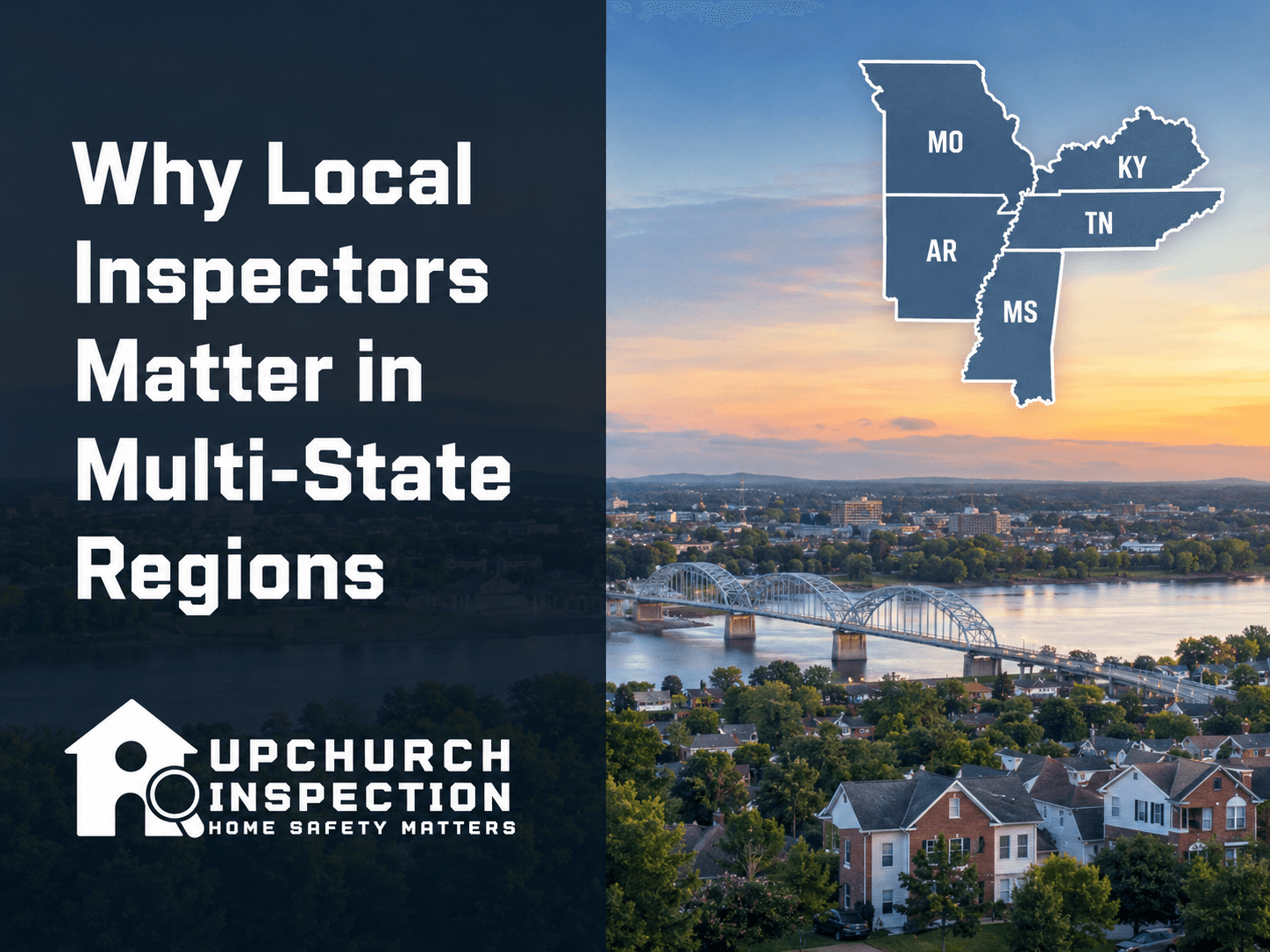
In regions like ours—stretching across West Tennessee, Central Arkansas, Northeast Arkansas, Southeast Missouri, Middle Tennessee, and Central Kentucky—local knowledge isn’t optional. It’s the difference between recognizing a normal condition and mislabeling risk, or worse, missing it altogether.
At Upchurch Inspection, operating across state lines hasn’t diluted local expertise. It’s reinforced why it matters.
Homes Don’t Behave the Same Across Borders
State lines don’t change physics, but they often mark real shifts in housing behavior.
A foundation condition that’s routine in Memphis clay soils may carry different implications in Louisville’s basement-heavy neighborhoods. Drainage patterns that are manageable on flat Jonesboro lots behave very differently on the rolling terrain outside Nashville. Freeze-thaw cycles that subtly stress masonry in Cape Girardeau don’t show up the same way in Central Arkansas.
Local inspectors don’t just know what they’re seeing. They know how it usually plays out where that house actually sits.
That difference shows up in how findings are explained, prioritized, and contextualized.
Local Experience Shapes Judgment, Not Just Observation
Inspection isn’t about spotting defects—it’s about interpreting them.
Two inspectors can observe the same crack, moisture stain, or aging system and reach very different conclusions depending on experience. Inspectors who work locally understand what’s typical, what’s transitional, and what’s genuinely unusual in that market.
In Central Kentucky, especially around Elizabethtown and Louisville, inspectors see how basements respond to seasonal groundwater changes. In West Tennessee, they learn how crawl spaces tell the story of long-term moisture management. In Little Rock, they recognize how grading decisions affect homes years later, not just on inspection day.
That judgment doesn’t come from manuals. It comes from repetition in the same environments.
Multi-State Doesn’t Mean One Inspector Everywhere
A common concern buyers raise is whether multi-state companies rotate inspectors unfamiliar with the area. That model exists—but it’s not how we operate.
Local inspectors are embedded in the regions they serve. They live with the same weather patterns, the same soil behavior, and the same construction trends as the buyers they work for.
Being multi-state doesn’t mean sending someone in cold. It means supporting local inspectors with broader regional perspective, not replacing them with generic coverage.
Why Local Insight Reduces Overreaction
One of the quiet risks in inspections is overreaction—treating normal local behavior as a major defect simply because it looks unfamiliar.
Buyers relocating from other regions are especially vulnerable to this. What feels alarming in one market may be routine in another.
Local inspectors help prevent that disconnect. They explain when a condition is typical, when it deserves monitoring, and when it truly warrants action. That clarity protects buyers from unnecessary stress and misplaced negotiation.
Local Inspectors See Long-Term Outcomes
Perhaps the most important advantage of local inspectors is continuity.
They see the same houses years apart. They inspect neighborhoods repeatedly. They watch which repairs hold and which ones fail. That long-term exposure shapes how they advise buyers today.
An inspector who has seen how similar homes in Elizabethtown or Memphis age over a decade brings far more value than one who’s only passing through.
Regional Companies Still Need Local Accountability
Operating across multiple states increases responsibility, not distance.
Buyers expect consistency, professionalism, and follow-through—no matter where the home is located. A regional structure allows for shared standards and quality control, while local inspectors provide the accuracy that only lived experience can deliver.
That balance is what protects buyers in complex, overlapping markets like ours.
Looking Ahead Without Overclaiming
As Upchurch Inspection continues expanding into adjacent areas like North Mississippi and Western Kentucky, local knowledge remains the priority. Housing patterns don’t reset at borders, but they do evolve—and respecting that evolution is what makes expansion responsible instead of reckless.
Future growth only works when it’s grounded in local understanding, not just geographic reach.
The Practical Reality
In multi-state regions, buyers don’t need inspectors who know everywhere.
They need inspectors who know here—and understand how “here” fits into the bigger picture.
Local inspectors bring context.
Regional experience sharpens judgment.
When those two work together, inspections stop feeling generic and start feeling relevant.
That’s what actually protects buyers—no matter which side of the state line they’re on.
Related reading