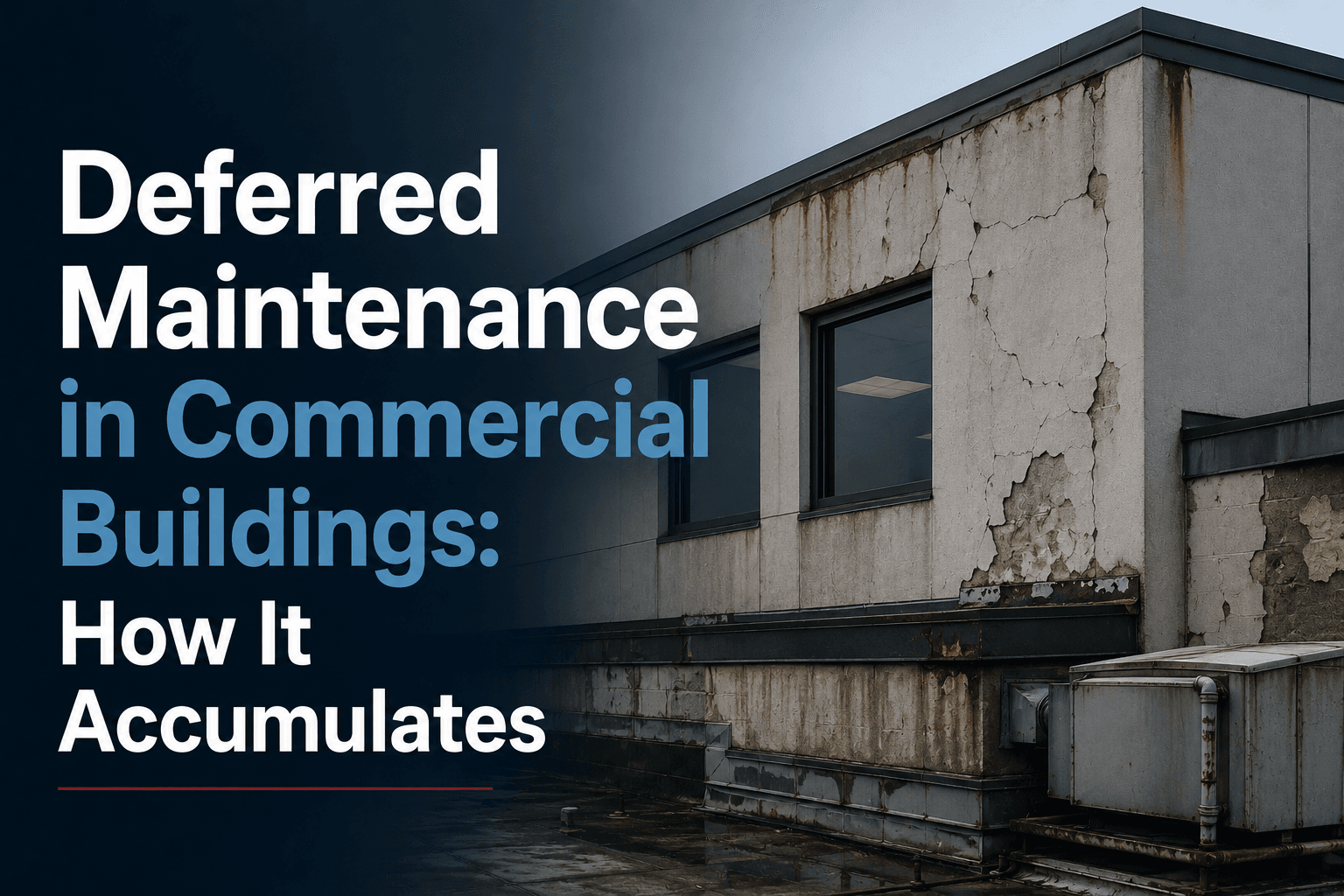
Deferred maintenance is rarely the result of neglect. More often, it’s the result of rational decisions made one at a time. A repair gets postponed because the system is still working. A replacement gets pushed because the budget needs to close a deal. A temporary fix becomes “good enough” because nothing failed afterward.
Over time, those decisions stack.
In commercial inspections, deferred maintenance isn’t just a condition—it’s a pattern, and understanding how that pattern forms is one of the most important parts of evaluating risk.
Deferred Maintenance Rarely Starts With Big Problems
Most commercial buildings don’t fall into disrepair suddenly. Deferred maintenance almost always begins with small, reasonable compromises.
A roof repair instead of a replacement.
A component swap instead of a system upgrade.
A control issue tolerated because occupants adapt.
Each decision makes sense in isolation. The problem is that commercial buildings don’t forget those decisions. They carry them forward.
Inspectors pay attention to where those compromises show up repeatedly, because repetition is how deferred maintenance becomes systemic.
Commercial Systems Age Together, Not Independently
One of the reasons deferred maintenance becomes so expensive in commercial buildings is that systems don’t fail alone.
Roof drainage affects walls.
Moisture affects structure.
Electrical capacity affects mechanical performance.
Mechanical inefficiency affects tenant comfort and equipment lifespan.
When maintenance is deferred, these systems stop aging independently and start aging in clusters. A commercial inspection looks for those intersections—places where one deferred decision has quietly increased stress elsewhere.
That’s where cost multiplies.
Patchwork Is One of the Clearest Signals
Inspectors are trained to notice patchwork, not just damage.
Repeated sealant applications, mismatched materials, layered repairs, and inconsistent upgrades often tell a clearer story than a single visible defect. Patchwork doesn’t mean the building is failing—it means ownership has been managing symptoms instead of addressing root causes.
In commercial inspections, patchwork raises questions:
- How often has this been addressed?
- Why was a permanent solution avoided?
- What happens if this stops holding?
Those questions matter far more than the patch itself.
Deferred Maintenance Changes Failure Consequences
In residential settings, deferred maintenance usually affects comfort. In commercial buildings, it affects operations.
A marginal HVAC system may still heat and cool, but it may not recover quickly after downtime. An aging electrical system may still power the building, but it may have no capacity for tenant improvements. A worn roof may still shed water, but one storm can turn it into a business interruption event.
Deferred maintenance doesn’t just increase the chance of failure. It increases the impact of failure when it happens.
Inspectors Look for Maintenance Trajectory, Not Just Condition
Commercial inspections aren’t trying to determine whether a building is currently usable. They’re evaluating where it’s headed.
Deferred maintenance shows up as:
- Systems at or beyond expected service life with no replacement planning
- Maintenance access that’s been restricted or improvised
- Inconsistent upgrades across similar components
- Temporary fixes that outlasted their purpose
- Documentation gaps that suggest reactive care
None of these individually mean a deal should stop. Together, they shape how ownership will feel over the next five to ten years.
Why Deferred Maintenance Often Hides During Showings
Commercial properties are often presented well. Clean floors, functioning lights, and quiet systems create a sense of stability. Deferred maintenance rarely announces itself during a walkthrough.
That’s why inspections focus on:
- Service records
- Installation quality
- System age relative to use
- Repair history patterns
- Evidence of repeated intervention
Deferred maintenance isn’t about what’s visible in a single visit. It’s about what the building has been working around for years.
Deferred Maintenance Isn’t a Moral Failing
It’s important to understand that deferred maintenance isn’t a judgment on prior ownership.
Markets change. Tenants change. Cash flow fluctuates. Owners make decisions based on available information at the time. Deferred maintenance is a financial reality, not a character flaw.
The role of a commercial inspection isn’t to criticize those decisions—it’s to reveal their cumulative effect so the next owner can plan accordingly.
How Buyers Should Use Deferred Maintenance Findings
Smart commercial buyers don’t treat deferred maintenance as a surprise. They treat it as a planning input.
Inspection findings related to deferred maintenance are most useful when they’re used to:
- Adjust purchase price
- Establish repair escrows
- Phase capital improvements
- Renegotiate lease expectations
- Align reserves with reality
Deferred maintenance doesn’t mean a building is a bad investment. It means the building is asking something specific from its next owner.
The Practical Reality
Deferred maintenance accumulates quietly, predictably, and logically. It rarely looks dramatic until it becomes expensive.
Commercial inspections don’t exist to shame buildings for their history. They exist to show buyers how past decisions have shaped present risk—and what that means going forward.
When buyers understand deferred maintenance as a pattern rather than a flaw, inspections stop feeling adversarial and start functioning the way they should: as tools for informed ownership, not emotional reactions.
Related reading