One of the biggest misconceptions buyers have about inspection companies—especially those that operate across multiple regions—is that the process must be the same everywhere. Same checklist. Same language. Same conclusions.
That’s not how real houses work, and it’s not how Upchurch Inspection operates.
While the standards of practice stay consistent, the interpretation of what we see changes based on where the home is located, how it was built, and how it’s likely to age in that specific environment. Our approach adapts because houses do.
Standards Stay the Same. Context Does Not.
Every inspection we perform follows the same professional standards. That’s non-negotiable. What changes from market to market is how findings are understood, explained, and prioritized.
A crack, a moisture condition, or an aging system doesn’t mean the same thing everywhere.
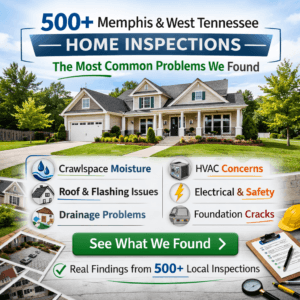
In Memphis and Jackson, expansive clay soils and humidity cycles shape how foundations move and how crawl spaces behave. In Little Rock and Central Arkansas, drainage efficiency and grading decisions tend to matter more than dramatic settlement. In Jonesboro, flat terrain changes how water lingers and where moisture shows up first.
In Central Kentucky—especially around Elizabethtown and Louisville—basements, masonry construction, and freeze-thaw exposure introduce a different set of behaviors entirely.
Our job isn’t just to document conditions. It’s to explain what those conditions mean here.
We Adjust Focus Based on Regional Stress Points
Different markets stress different systems.
In West Tennessee, crawl spaces and moisture management are often the foundation of long-term performance. In Middle Tennessee, mixed construction eras and renovation density change how inspectors read framing and system compatibility. In Louisville, inspectors spend more time interpreting basement walls, masonry behavior, and drainage around older foundations. In Elizabethtown, transitional housing—older cores with newer edges—requires careful evaluation of how additions and updates interact with original construction.
Because we work across these markets regularly, we don’t treat findings in isolation. We interpret them through the lens of local behavior we’ve already seen play out hundreds of times.
Market Experience Shapes How We Explain Risk
Two homes can have the same defect and carry very different levels of risk depending on location.
A minor foundation crack in Memphis may be typical and stable. The same crack in a Louisville basement wall may deserve closer attention because of lateral pressure and seasonal freeze-thaw cycles. A drainage condition that’s manageable in Jonesboro may escalate faster on a sloped Middle Tennessee lot.
Upchurch Inspection doesn’t use generic language because generic language doesn’t protect buyers. We explain risk in terms of likelihood, behavior, and consequence, based on how homes in that market usually perform over time.
That’s experience talking—not speculation.
We Don’t Overreact Just Because a Market Is Different
Approaching markets differently doesn’t mean sounding alarms unnecessarily.
In fact, regional experience often reduces overreaction. Inspectors who only work in one area sometimes flag normal local behavior as unusual. Inspectors who work regionally learn what’s actually common—and what truly stands out.
That’s especially important in markets like Nashville and Louisville, where buyers moving in from other regions may misinterpret normal conditions as serious problems.
Our role is to ground those reactions in reality.
Boots on the Ground Still Matter
Being regional doesn’t mean being distant.
In Central Kentucky, Upchurch Inspection maintains active, on-the-ground coverage in Elizabethtown, while also serving the larger Louisville market. That combination allows us to understand both day-to-day housing behavior and big-market variation without guessing.
The same principle applies everywhere we work. Regional structure supports consistency. Local presence supplies accuracy.
Our Reports Reflect Market Awareness
You’ll see this approach reflected directly in our reports and conversations.
Instead of vague warnings, buyers hear:
- “This is common for homes of this age here.”
- “We see this regularly in this part of the region.”
- “This behaves differently in this market than in others.”
That kind of explanation reduces confusion and helps buyers make informed decisions without fear.
It also builds trust—because buyers can tell when an inspector knows the area versus when they’re just reading from a template.
Why This Matters More as You Cross State Lines
Homes don’t respect state borders, but regulations, construction eras, and development patterns often shift near them.
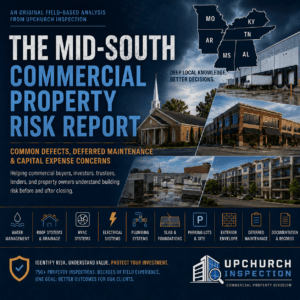
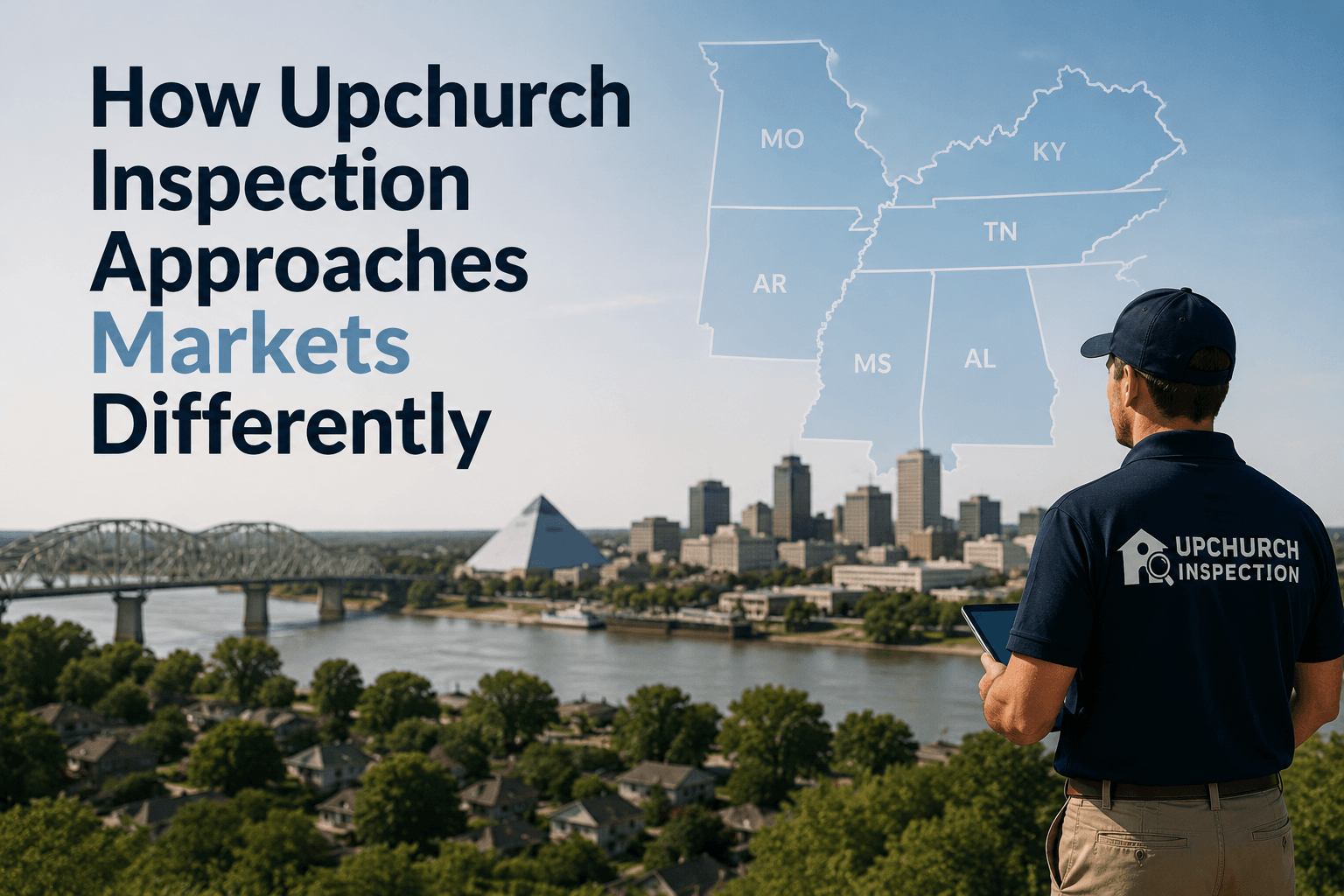
A company that inspects across Tennessee, Arkansas, Missouri, and Kentucky learns where those shifts actually matter—and where they don’t. That knowledge prevents misinterpretation and adds nuance that single-market inspectors may never develop.
As Upchurch Inspection continues expanding into adjacent areas like North Mississippi and Western Kentucky, that regional continuity becomes even more valuable. Housing patterns don’t reset at the county line. Experience carries forward.
The Practical Reality
Approaching markets differently isn’t about changing standards. It’s about applying judgment.
Upchurch Inspection brings the same professionalism to every inspection—but we don’t pretend every house lives in the same environment or ages the same way.
By understanding how homes behave across West Tennessee, Arkansas, Missouri, Middle Tennessee, and Central Kentucky—including major markets like Louisville and grounded hubs like Elizabethtown—we give buyers something more useful than a checklist.
We give them context.
And in home inspections, context is what turns information into understanding.
Related reading