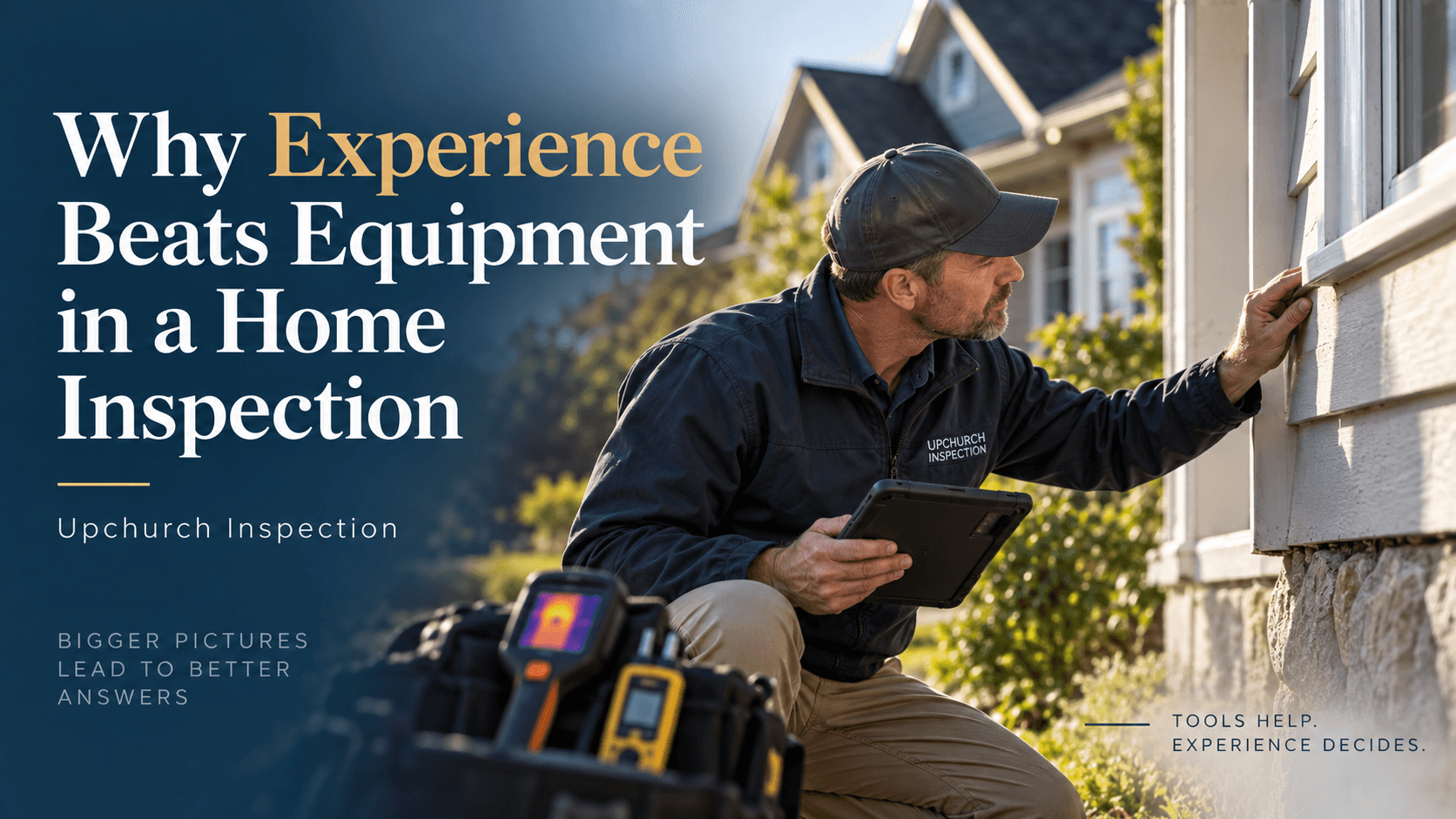
Thermal cameras, moisture meters, drones, gas detectors—inspection technology has come a long way. Buyers see inspectors arrive with cases full of tools and assume that the tools themselves are what make an inspection thorough.
The reality is less flashy and far more important: equipment doesn’t find problems—experience does.
At Upchurch Inspection, we use professional tools every day. But tools are only extensions of judgment. Without experience guiding where, when, and why to use them, they don’t add clarity. They add noise.
Tools Don’t Know What Matters
A thermal camera can show temperature differences. A moisture meter can register elevated readings. A drone can capture roof images.
None of those tools can tell you:
- Whether a condition is normal or concerning
- Whether a pattern is typical for the region
- Whether a reading reflects a real problem or a temporary condition
- Whether an anomaly deserves follow-up or simple monitoring
Those decisions come from experience—specifically, experience inspecting hundreds or thousands of similar homes in the same markets.
A tool produces data. An inspector decides what that data means.
The Wrong Tool at the Wrong Time Misleads Buyers
One of the biggest problems we see in inspection reports elsewhere is overuse of tools without interpretation.
A moisture meter reading gets flagged without explaining why moisture might be present—or whether it’s abnormal for that location. A thermal image is included without context, creating anxiety over a temperature difference that’s actually expected given airflow or sun exposure.
Inexperienced inspectors often rely on tools to “prove” something is wrong. Experienced inspectors use tools to confirm or rule out concerns they already understand.
That distinction matters.
A Real Example: Thermal Imaging Without Context
Thermal cameras are powerful when used correctly.
We’ve seen reports where a thermal image shows a cold spot on a wall, labeled as a possible moisture issue. No explanation. No confirmation. No context.
In reality, that cold spot may be:
- Air leakage from an unsealed cavity
- A framing member conducting temperature differently
- A temporary effect from weather conditions
An experienced inspector knows when to verify, when to explain, and when not to escalate.
The camera didn’t make that decision. The inspector did.
Experience Teaches You Where to Look Before You Look
Seasoned inspectors don’t wander through homes hoping to stumble onto problems.
They move deliberately.
They know which walls tend to hold moisture in this climate. They know which roof penetrations fail most often on homes of a certain age. They know where builders in this region typically cut corners.
That knowledge guides tool use. Instead of scanning everything indiscriminately, experienced inspectors focus tools where they’re most likely to provide meaningful insight.
That’s how inspections stay accurate instead of overwhelming.
More Tools Don’t Mean Better Inspections
Buyers sometimes assume that the inspector with the longest list of gadgets must be the best.
In practice, excessive tool use can create:
- Overreporting of benign conditions
- Alarm over normal variation
- Confusion about what actually matters
A good inspection doesn’t impress with equipment. It clarifies with judgment.
Why Experience Is Harder to See — But More Valuable
Experience doesn’t show up in photos or marketing claims the way tools do. It shows up in how calmly issues are explained, how patterns are recognized, and how well findings hold up over time.
Experienced inspectors:
- Know when not to speculate
- Understand which issues escalate locally
- Can explain tradeoffs clearly
- Prepare buyers for ownership, not just closing
That’s authority buyers feel months later, not just on inspection day.
How We Use Technology at Upchurch Inspection
We use tools intentionally—not performatively.
Technology helps us:
- Confirm suspected moisture behavior
- Verify insulation and airflow issues
- Improve access and visibility
- Document conditions accurately
But technology never replaces judgment. It supports it.
We don’t chase anomalies. We explain them.
What Buyers Should Pay Attention To Instead of Tools
Instead of asking what tools an inspector uses, buyers are better served asking:
- How often do you inspect homes like this one?
- What issues do you see repeatedly in this area?
- How do homes of this age typically behave here?
- How do you explain risk, not just defects?
Those answers reveal expertise far more reliably than any piece of equipment ever could.
Tools are easy to buy. Experience has to be earned.
A strong inspection isn’t defined by what the inspector carries—it’s defined by what the inspector understands.