Let’s get something straight right out of the gate.
Most “hunting cabins” in Hardeman County are just sheds that somebody decided to sleep in. And that’s fine—until you try to convince yourself it’s a house, insure it like a house, or buy it thinking it’s going to behave like one.
I’ve inspected a lot of these places around Grand Junction and Hickory Valley, and I’m going to be blunt: rodents don’t care about your weekend getaway, and gravity doesn’t care that it’s “just a cabin.”
If pests don’t get it first, the foundation usually will.
Shed vs. Cabin vs. House — Words Matter
People use the word cabin to make themselves feel better.
Here’s how I break it down in the field:
- Shed: No real foundation, minimal framing, zero pest control, built to store stuff
- Cabin: Slightly better framing, maybe utilities, still built light
- House: Engineered foundation, continuous load path, real envelope
Most hunting cabins live squarely between shed and cabin—but get treated like houses.
That mismatch causes problems.
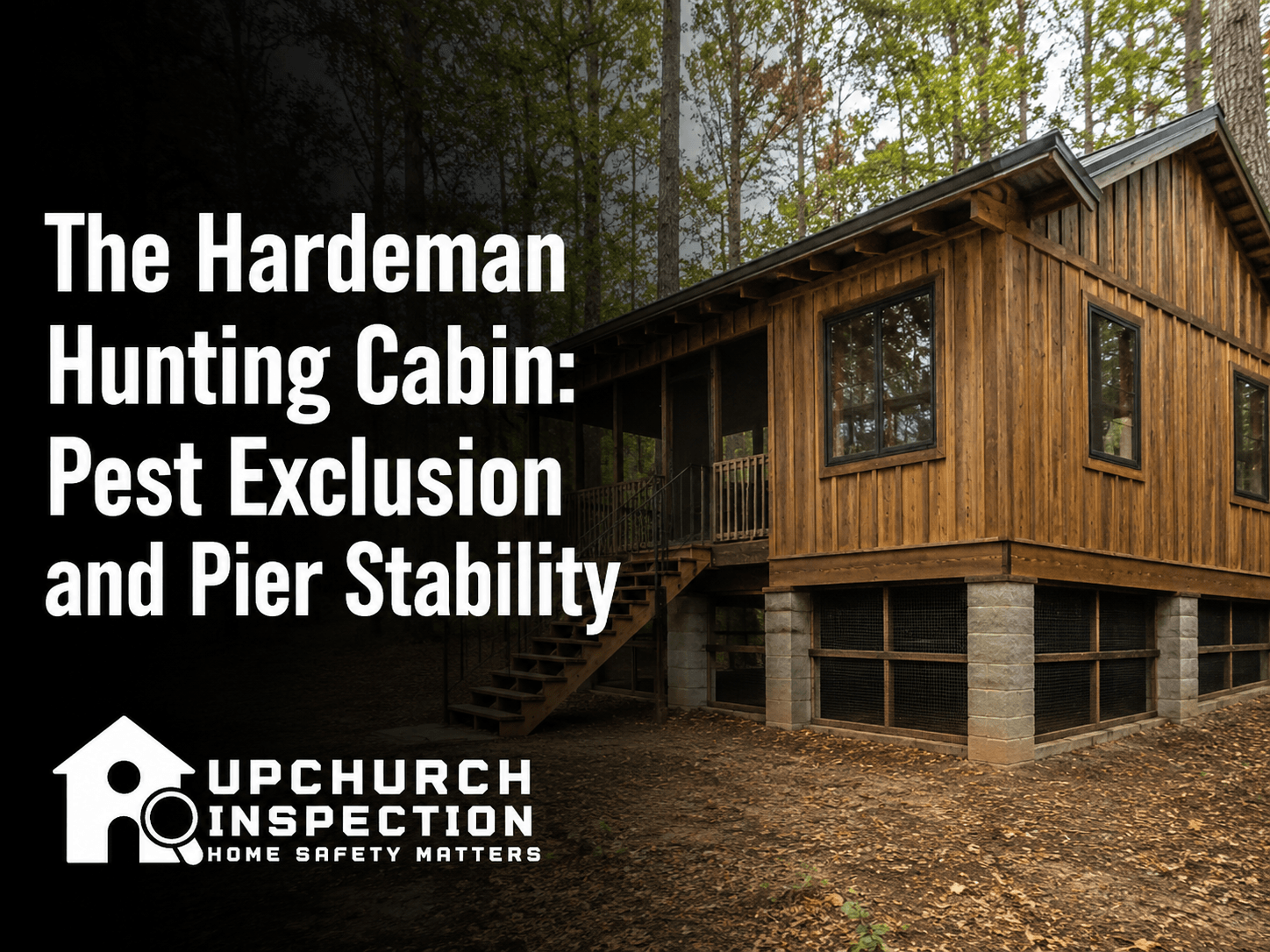
Pier-and-Beam on Sloped Ground: The Usual Setup
In Hardeman County, especially in wooded or sloped terrain, most hunting cabins sit on pier-and-beam foundations. That makes sense—until it’s done cheaply.
What I usually see:
- Concrete blocks stacked dry
- Piers sitting directly on dirt
- No proper footing
- Shims everywhere
- Uneven spacing because “that’s where the ground was”
That’s not engineering. That’s hope.
Gravity Always Wins on a Slope
Sloped terrain looks great until water starts moving.
Once water moves:
- Soil shifts
- Piers settle unevenly
- Beams twist
- Floors slope
- Doors stop closing
Nobody notices at first because it’s gradual. Then one day you walk inside and think, “Huh… the fridge didn’t used to roll.”
That’s your sign.
Pest Exclusion Is a Joke on Most Cabins
If mice can get in, they will. Period.
On hunting cabins, I routinely find:
- Open crawlspace vents with no screening
- Gaps at sill plates you can fit a hand through
- Missing skirting
- Rotted rim boards
- No vapor barrier, no sealing, no effort
Once rodents move in, they:
- Chew wiring
- Nest in insulation
- Leave droppings everywhere
- Bring moisture and rot with them
And no, cats don’t fix this. They just make you feel better.
Powder Post Beetles Love Untreated Wood
This is where things get expensive quietly.
In Hardeman County cabins, especially older ones, I often see:
- Untreated floor joists
- Raw sill plates
- Softwood beams exposed to moisture
That’s an open invitation for powder post beetles.
You won’t hear them. You won’t see them at first. You’ll just notice:
- Fine powder on the ground
- Tiny exit holes in wood
- Beams getting weaker over time
By the time people notice, structural damage is already underway.
Moisture Is the Enabler for Everything Bad
Pests don’t move into dry, sealed structures. They move into damp ones.
Cabins fail because:
- Crawlspaces stay wet
- No vapor barrier exists
- Ground moisture migrates upward
- Wood never dries
That moisture feeds:
- Rot
- Insects
- Mold
- Structural weakening
Everything bad starts with water.
Grand Junction Cabins: Older, Rougher, Less Forgiving
Around Grand Junction, I see a lot of older hunting cabins that were built as temporary structures and just… stuck around.
Common problems:
- Footings that have sunk inches
- Add-ons that were never supported properly
- Electrical wiring run through dirt-floor crawlspaces
- Evidence of repeated “fixes” instead of real repairs
These places don’t fail dramatically. They sag into dysfunction.
Hickory Valley: Newer Cabins, Same Mistakes
In Hickory Valley, some cabins are newer—but the same mistakes get repeated:
- No site prep
- No drainage planning
- Minimal pier depth
- No thought given to long-term use
Just because it’s newer doesn’t mean it’s better.
What I’m Looking For When I Inspect These
When I crawl under a hunting cabin, I’m checking:
- Pier spacing and alignment
- Evidence of settlement or tilt
- Wood-to-ground contact
- Pest entry points
- Moisture levels
- Signs of beetle or rodent activity
I’m not asking “Is this livable?”
I’m asking “How long until this becomes a money pit?”
What Buyers Need to Hear (Not What They Want to Hear)
If you’re buying a hunting cabin, here’s the honest truth:
- It will require maintenance
- It will need pest control
- It will need foundation attention
- It will not take care of itself
If you’re okay with that, great. If you’re not, walk away.
Stop Romanticizing Structural Problems
Rustic doesn’t mean sloppy.
Old-school doesn’t mean unfixable.
And “it’s just a cabin” doesn’t mean safe.
You can build a solid cabin. You just have to actually build it, not wing it.
Final Thoughts
Hardeman County hunting cabins are fun, peaceful, and full of memories—but only if they’re stable and sealed.
Pests don’t care that it’s deer season.
Foundations don’t care that it’s a weekend place.
If you don’t control moisture, pests move in.
If you don’t control support, gravity takes over.
Protecting your West Tennessee investment starts with a forensic eye. View our West Tennessee Service Area to see a full list of towns we serve.