Fiber cement has a reputation for being bulletproof.
Rot-proof. Bug-proof. Fire-resistant. Set it and forget it.
And then I get down on one knee, look at the bottom edge, and realize it’s been set up to fail.
Fiber Cement Doesn’t Rot — But What’s Behind It Does
This is the part that gets misunderstood.
Fiber cement itself doesn’t rot like wood. That’s true.
But it’s not magic. It still absorbs moisture, and when it stays wet, it passes that moisture right along to whatever it’s touching.
Usually that’s:
- OSB sheathing
- House wrap
- Rim joists
- Bottom plates
Those absolutely rot.
The Clearance Gap Everyone Ignores
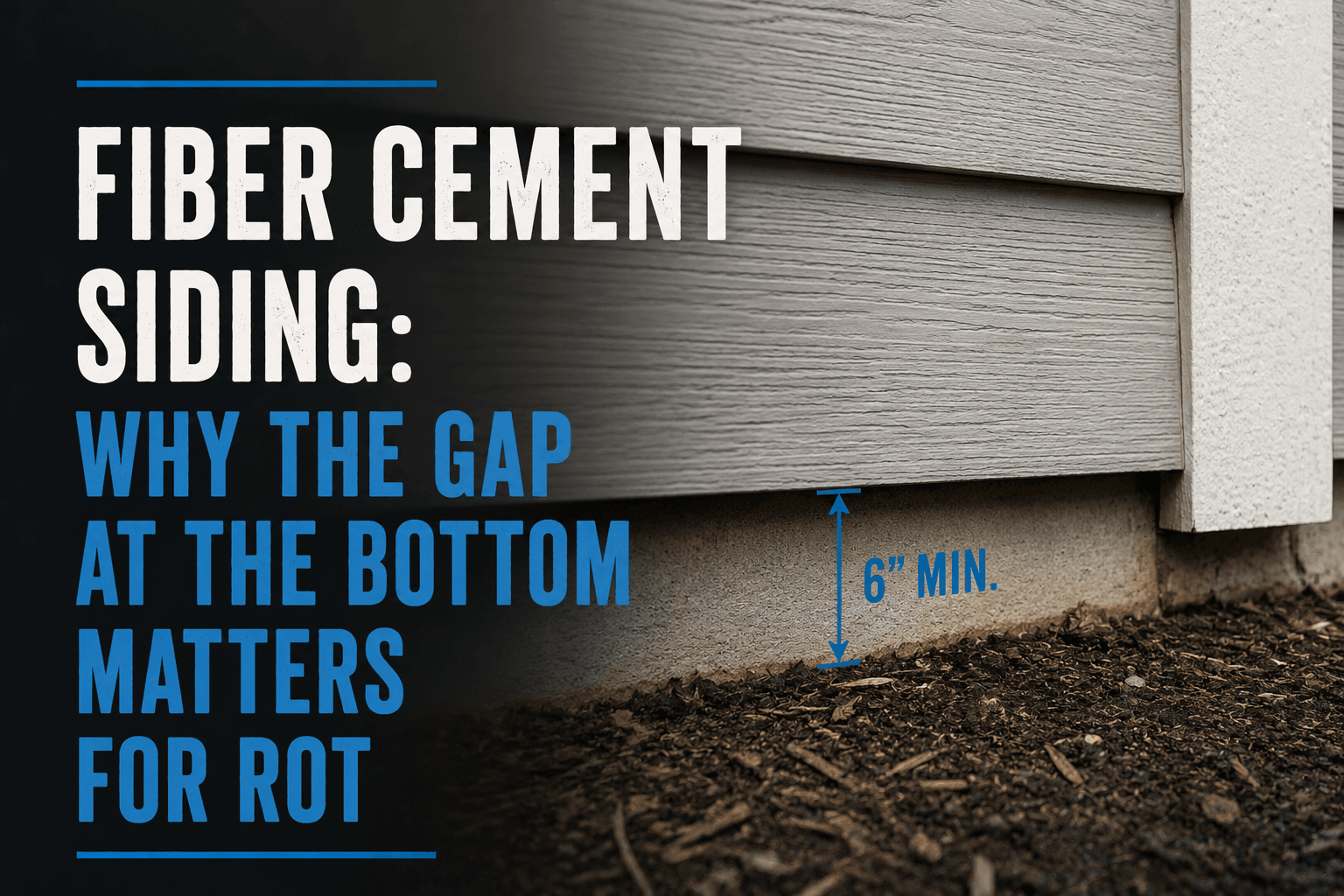
Manufacturers don’t ask for clearance at the bottom for fun.
Fiber cement typically needs:
- Clearance above soil
- Clearance above concrete
- Clearance above roofs, patios, and decks
That gap lets water drain and materials dry.
When siding is run tight to the ground or hard against concrete, it stays wet. Constantly.
A Real Inspection Where the Siding Was the Problem
I inspected a home near Henderson where the fiber cement siding looked great from five feet away. Clean. Straight. Recently painted.
Up close, the bottom edge was swelled and soft in spots.
The siding was buried in mulch. No clearance at all.
Moisture meter lit up the sheathing behind it. The siding didn’t rot — it acted like a sponge and delivered water straight to the structure.
Mulch Is Not Your Friend Here
Mulch makes this worse. Much worse.
Mulch:
- Holds moisture
- Covers the bottom edge
- Encourages insects
- Keeps siding wet long after rain
I see this constantly in newer subdivisions around Mt. Juliet and Spring Hill, where landscaping gets added after siding goes up and nobody adjusts the clearance.
It looks finished. It isn’t.
Concrete Is Just as Bad
Hard surfaces cause their own problems.
When fiber cement is tight to:
- Driveways
- Sidewalks
- Patios
- Garage slabs
Water splashes and wicks upward. There’s nowhere for it to go.
I’ve reviewed inspection reports from one of our inspectors in the Little Rock area where siding was installed directly on a patio slab. The slab stayed damp, the siding stayed wet, and the sheathing behind it paid the price.
Paint Hides This for a While
Fresh paint is a great liar.
It seals the surface temporarily and makes everything look sharp. Meanwhile, moisture is still getting in from the bottom edge where paint can’t protect it.
By the time paint starts peeling, the damage behind the siding is usually well underway.
What I Look For During an Inspection
I don’t just note “fiber cement present.”
I’m checking:
- Bottom edge clearance
- Contact with soil or concrete
- Mulch height
- Swelling or soft edges
- Fastener corrosion
- Moisture at transitions
If clearance is missing, it gets documented — even if the siding still looks good today.
Why This Matters to Buyers
This isn’t a cosmetic issue.
Improper clearance can lead to:
- Sheathing rot
- Framing damage
- Termite access
- Costly wall repairs
And because fiber cement is assumed to be low-maintenance, these problems often go unnoticed longer than they should.
The Inspector’s Bottom Line
Fiber cement works best when it can dry.
If it’s trapped against the ground or concrete, it stays wet — and wet walls don’t age gracefully.
That little gap at the bottom isn’t a suggestion. It’s the difference between a long-lasting exterior and a slow, expensive surprise hiding behind it.