TL;DR:
- A warehouse inspection is a detailed process that assesses structural safety, operational risks, and regulatory compliance. It differs from an audit, which evaluates overall management effectiveness and safety policies, both serving distinct purposes. Proper inspection management involves systematic planning, documentation, and re-inspection to mitigate liabilities and enhance property value.
A warehouse inspection is not a quick walk-through with a clipboard. For real estate professionals and investors operating in the Mid-South, it is one of the most consequential steps in the due diligence process. A thorough inspection reveals the actual condition of a property, exposes deferred maintenance, confirms regulatory compliance, and flags operational risks that directly affect both acquisition pricing and long-term asset value. This guide breaks down what a complete warehouse inspection involves, which standards govern it, and how to use findings to protect your investment before closing.
Table of Contents
- Understanding warehouse inspections vs. audits
- Core components of a comprehensive warehouse inspection
- Compliance standards and regulations shaping warehouse inspections
- Best practices for conducting and managing warehouse inspections
- Reevaluating warehouse inspections: What real estate investors often miss
- Trusted warehouse inspection services for Mid-South commercial real estate
- Frequently asked questions
Key Takeaways
| Point | Details |
|---|---|
| Inspections vs audits | Warehouse inspections identify immediate hazards on the floor, while audits evaluate policy effectiveness and operational efficiency. |
| Critical inspection areas | Effective inspections assess safety surfaces, racking integrity, equipment, fire safety, emergency readiness, PPE, and accurate inventory. |
| Compliance essentials | Adhere to OSHA General Duty Clause and ANSI/RMI MH16.1 for racks, plus NFPA 10 for fire extinguisher maintenance. |
| Inspection process | Follow a repeatable cycle including document review, onsite walkthrough, reporting, corrective action, and re-inspection. |
| Inspection value | Translate inspection findings into action plans to reduce risk and improve warehouse safety and operational efficiency. |
Understanding warehouse inspections vs. audits
Many investors use the terms inspection and audit interchangeably. They are not the same thing, and conflating them can leave serious gaps in your due diligence.
A warehouse safety inspection is a structured walkthrough focused on unsafe conditions, equipment issues, and worker behaviors visible on the floor at that moment. It is real-time and reactive. An audit, by contrast, is a broader evaluation that examines inventory accuracy, equipment status, layout efficiency, and whether safety policies are actually functioning as designed. Think of an inspection as catching a fire while it is starting, while an audit confirms whether your fire prevention system is working.
Inspections control live risk, identifying active hazards during daily operations, while audits confirm whether safety policies and procedures are working as designed. Neither replaces the other.
For investors acquiring industrial or commercial warehouse properties in Tennessee, Arkansas, Mississippi, or Southeast Missouri, both serve a distinct purpose:
- Inspection: Identifies immediate hazards, damaged equipment, blocked exits, missing safety markings, and visible structural concerns
- Audit: Evaluates whether inventory records match physical stock, whether racking load capacities are labeled, and whether corrective action from prior findings has actually been implemented
- Combined approach: Delivers a full picture of the property’s condition and operational risk profile, which is essential for accurate underwriting
Experienced investors know that a warehouse passing a basic visual check can still carry six figures in deferred remediation costs. The inspection uncovers the hazard; the audit tells you whether management has been addressing hazards at all.
Our commercial inspection services are built around this combined approach, and our industrial warehouse inspections are designed to deliver both layers in a single, coordinated engagement.
Now that you know the distinction between inspections and audits, let’s explore the key areas covered in a thorough warehouse inspection.
Core components of a comprehensive warehouse inspection
A practical warehouse safety inspection checklist should cover walking and working surfaces, storage and racking systems, forklifts and material handling equipment, loading docks, fire safety, emergency preparedness, PPE compliance, hazardous materials, electrical safety, and ergonomics and manual handling. Each of these areas carries specific compliance implications and, in many cases, direct liability exposure for the property owner.

Warehouse audits cover four pillars: inventory accuracy, equipment and machinery, layout and organization, and safety and compliance. Mapping your inspection findings against these four pillars helps prioritize which issues require immediate capital and which can be addressed through operational changes.
Here is a numbered breakdown of the ten critical areas we evaluate during every warehouse condition assessment:
- Walking and working surfaces: Look for cracked concrete, missing floor markings, unmarked pedestrian lanes, and debris-cluttered aisles. A single trip hazard in a high-traffic zone can become an OSHA recordable incident overnight.
- Storage and racking systems: Inspect column bases, bracing connections, beam lock pins, and load capacity placards per ANSI/RMI MH16.1. Bent uprights or missing footplates are immediate red flags.
- Forklifts and material handling equipment: Verify daily inspection logs, operator certifications, and visible damage. Uncertified operators handling equipment in a facility you are acquiring becomes your liability at closing.
- Loading docks: Check dock leveler function, trailer restraints, dock bumpers, and traffic flow markings. Loading docks are statistically among the highest-injury zones in any warehouse.
- Fire safety systems: Confirm that extinguishers are mounted, accessible, within service dates, and documented per NFPA 10. Sprinkler head clearances of at least 18 inches must be maintained beneath storage.
- Emergency preparedness: Verify that exit routes are unobstructed, emergency lighting is functional, and first aid kits are stocked and accessible.
- PPE compliance: Confirm that required personal protective equipment is available, in good condition, and documented for the tasks performed in the facility.
- Hazardous materials: Check for proper labeling, secondary containment, SDS documentation, and segregation from incompatible materials.
- Electrical safety: Look for exposed wiring, overloaded panels, missing conduit covers, and unauthorized extension cord use, which is one of the most frequently cited violations in warehouses.
- Ergonomics and manual handling: Assess workstation heights, repetitive lift zones, and whether mechanical lifting aids are available and used consistently.
The inventory inspection process runs parallel to the physical walkthrough. Spot checks of physical stock against system records should cover multiple zones, and any discrepancy greater than 1 to 2 units or 10% in a given location warrants a recount and supervisor review before the count is accepted.
Pro Tip: During your walkthrough, take note of how operators respond to your presence. If they immediately adjust unsafe behaviors when a visitor arrives, that is a signal that the day-to-day warehouse quality control environment is different from what you see during the inspection.
With these core areas understood, the next section examines specific compliance standards and legal requirements relevant to warehouse inspections.
Compliance standards and regulations shaping warehouse inspections
Warehouse compliance review is not optional, and in the Mid-South real estate market, gaps in compliance documentation can derail a deal or significantly reduce your negotiating leverage. Two regulatory frameworks govern most of what happens in a warehouse inspection.
OSHA enforces pallet rack safety under the General Duty Clause while ANSI/RMI MH16.1 provides specific technical standards for inspection, maintenance, and damage assessment. OSHA does not publish a dedicated pallet rack standard, so citations come through the General Duty Clause, which requires employers to maintain a workplace free from recognized hazards. ANSI/RMI MH16.1 fills the technical gap, specifying requirements for anchorages, load-capacity placards, damage reporting thresholds, repair criteria, and recommended inspection frequency.
NFPA 10 sets fire extinguisher inspection schedules, including monthly visual inspections and annual certified maintenance to ensure readiness and avoid citations. The four tiers of fire extinguisher inspection are: monthly visual check by building staff, annual maintenance by a certified technician, six-year internal examination, and 12-year hydrostatic pressure testing. Missing any tier invalidates the compliance record and can constitute a violation during a warehouse compliance review.
| Inspection type | Frequency | Required qualification |
|---|---|---|
| Pallet rack visual inspection | Monthly, at minimum | Trained employee |
| Pallet rack detailed inspection | Annually, or after impact/damage | Qualified inspector per ANSI/RMI MH16.1 |
| Fire extinguisher visual check | Monthly | Building staff |
| Fire extinguisher maintenance | Annually | Certified technician |
| Fire extinguisher internal exam | Every 6 years | Certified technician |
| Fire extinguisher hydrostatic test | Every 12 years | Certified lab or technician |
Documentation is the other half of compliance. During due diligence, request inspection logs, corrective action records, and any citations or violations from the past three years. A seller who cannot produce these records is not necessarily hiding something, but the absence of documentation is itself a risk you need to price into the deal.
Pro Tip: Reviewing pallet rack compliance records before closing is one of the fastest ways to identify whether a facility has been actively managed or merely maintained enough to pass a quick visual check.
Understanding these standards is essential, but investors also need to manage the inspection process effectively, which we discuss next.
Best practices for conducting and managing warehouse inspections
Knowing what to inspect is half the equation. Knowing how to organize and manage the inspection process is what separates actionable findings from a report that gets filed and forgotten. Here is a framework we recommend for any warehouse operational assessment connected to a real estate transaction.
Warehouse inspections should operate as a repeating cycle: planning with document review, onsite walkthrough, analysis and reporting, corrective action implementation, and re-inspection to prevent issue escalation.
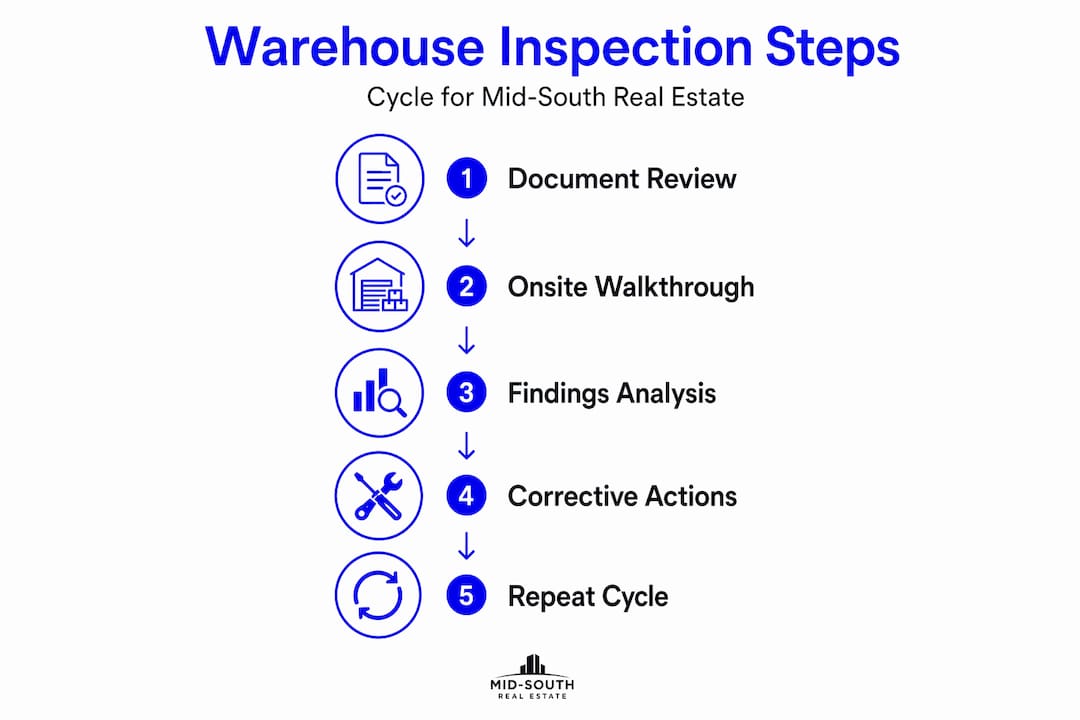
Step 1: Pre-inspection document review. Gather prior inspection reports, corrective action logs, OSHA 300 logs for recordable incidents, fire inspection certificates, and racking load placard records. This step alone often surfaces issues that would not be visible during a single walkthrough.
Step 2: Schedule the walkthrough during peak operations. A warehouse inspected at 6 a.m. before the first shift looks very different from the same facility at 10 a.m. with 20 operators, active forklifts, and receiving dock traffic. Observe live conditions to capture real operational behavior.
Step 3: Categorize findings by criticality. Use a three-tier system: immediate action required, corrective action within 30 days, and monitor and address in the next inspection cycle. Assigning ownership to each finding is essential for follow-through.
Step 4: Apply dual-verification for inventory counts. Physical counts must follow systematic zone assignments, dual verification, and prompt supervisor review when discrepancies exceed thresholds. For due diligence inspections, discrepancies greater than 10% in any zone should trigger a full recount of that zone before results are accepted.
Step 5: Build a digital or paper audit trail. Whether you use inspection software or printed logs, every cycle needs a date-stamped record that shows what was found, what was done about it, and when re-inspection confirmed resolution. This trail becomes a negotiating asset during a transaction and a liability shield afterward.
Key elements to confirm during your warehouse inspection process:
- Corrective actions from the previous inspection have documented closure dates
- No open citations from regulatory agencies remain unresolved
- Equipment maintenance logs are current and match visible equipment condition
- Loading dock incident logs show no recurring unreported near-misses
Pro Tip: Request the last two inspection cycles plus evidence of remediation for each finding. A facility that identifies the same hazard in consecutive inspection cycles without resolution is telling you something important about how the property is managed.
With inspection content and process covered, let’s share a unique perspective on the inspection priorities and common misconceptions.
Reevaluating warehouse inspections: What real estate investors often miss
Here is an uncomfortable truth we have observed working through the Mid-South market: most investors treat warehouse inspection reports as pass-fail scorecards. They scan for the big-ticket items, note the repair estimates, and move on. What they miss is that the inspection report is actually a behavioral record of the facility.
Most value comes not from a basic inventory count but from translating safety and operational findings into improvement actions that reduce risk and enhance warehouse efficiency. A report full of findings that were addressed promptly, documented thoroughly, and re-inspected to confirm closure is a sign of disciplined management. A report with clean findings but no supporting remediation records is a red flag, not a clean bill of health.
Racking inspections fail without physical identification and systematic damage workflows, leading to inspection activity without defensible coverage or proof of issue resolution. In practical terms, this means a rack labeled with damage but no follow-up work order is worse than a rack that was never labeled, because the former proves awareness of a hazard without corrective action.
We also see investors underestimate the domino effect of deferred warehouse maintenance. A loading dock leveler with a failing hydraulic seal seems minor. But that leveler forces operators to use unsafe workarounds, which leads to product damage, slip hazards, and eventually an incident that surfaces in the OSHA 300 log. By the time you see the log during due diligence, the chain has already started. Understanding how findings connect is what separates a warehouse operational assessment from a simple checklist review.
Reviewing common inspection pitfalls before your next acquisition is worth the time. The issues that cost investors the most money after closing are rarely the ones that looked obvious during the walk-through.
Pro Tip: Ask whether the inspection report you receive includes evidence of corrective action follow-through, not just a list of findings. That single distinction separates a thorough inspection from a surface-level review.
Trusted warehouse inspection services for Mid-South commercial real estate
At Upchurch Inspection, we built our industrial warehouse inspections specifically for the due diligence demands of commercial real estate transactions across Tennessee, Arkansas, Mississippi, and Southeast Missouri. Our inspectors go beyond the visual walkthrough, evaluating structural systems, fire safety compliance, racking integrity, electrical conditions, and operational risk factors that affect both property value and post-closing liability. Every report is written to be actionable, not just documentable, giving you findings you can use in negotiations, remediation planning, and compliance defense. Explore our full range of commercial inspection services or schedule your due diligence inspection today.
Pro Tip: Engage your inspection firm before you finalize your letter of intent. Early inspection findings give you the leverage to negotiate remediation credits or price adjustments before you are locked into terms.
Frequently asked questions
How often should warehouses be inspected to ensure compliance and safety?
Monthly comprehensive evaluations, weekly safety checks, and daily visual hazard scans are the baseline recommended for warehouse safety compliance. Real estate investors should confirm the facility has followed this cadence before closing.
What are the main legal standards governing pallet rack inspections in warehouses?
OSHA relies on the General Duty Clause and references ANSI/RMI MH16.1 for pallet rack safety compliance. ANSI/RMI MH16.1 sets the technical requirements for anchorage, load-capacity labeling, damage reporting, and inspection frequency.
Can building staff perform fire extinguisher inspections?
Staff can conduct monthly visual checks without certification, but annual maintenance and major examinations require a certified technician to satisfy NFPA 10 compliance requirements.
Why is it important to review past inspection reports before conducting a new warehouse inspection?
Reviewing prior reports confirms that past hazards were resolved and reveals whether the same issues keep reappearing. A strong inspection request always includes previous reports plus evidence that corrective actions were actually implemented.
What risks do inaccurate inventory records pose during warehouse due diligence?
Dirty system records are the highest-risk failure for inventory audits, resulting in misleading variance analysis and costly reconciliation work after the transaction closes. Inaccurate records can also mask shrinkage patterns or operational failures that directly affect the property’s income potential.