Commercial property buyers do not just inherit a building.
They inherit the cost of keeping that building functional.
That is the part many buyers underestimate. The property may look stable during a walkthrough. The roof may not be leaking. The HVAC systems may be running. The parking lot may still be usable. The plumbing may appear functional. The electrical service may be adequate for the current tenant. The building may even be producing income.
But that does not mean the property is financially low risk.
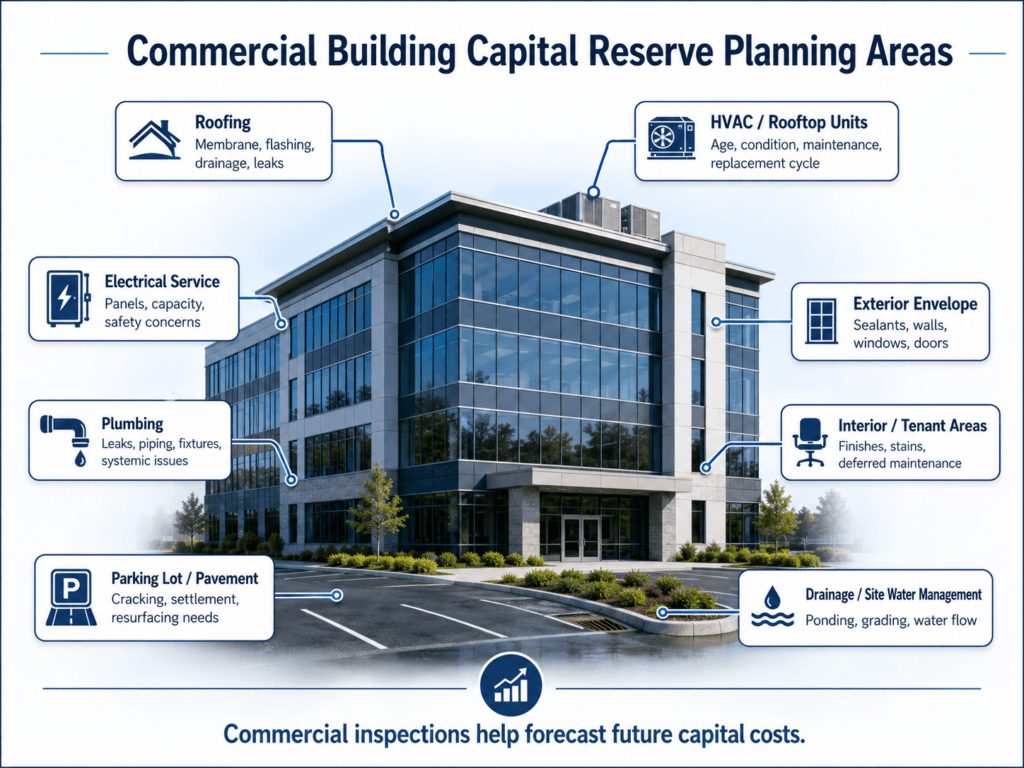
Commercial buildings age in expensive ways. Roof systems wear out. Rooftop HVAC units reach the end of their useful life. Parking lots deteriorate. Plumbing repairs begin to repeat. Electrical systems become outdated for modern use. Exterior walls, sealants, drainage systems, doors, windows, and interior finishes all require ongoing investment.
That is where capital reserve planning becomes important.
A commercial inspection or Property Condition Assessment should not only help identify what is visibly wrong today. It should help buyers, investors, trustees, lenders, and property owners understand what major expenses may be coming.
At Upchurch Inspection, we view commercial assessments as part of a larger risk management process. The purpose is not to predict the future perfectly. No inspection can do that. The purpose is to identify visible conditions, deferred maintenance, system age, performance concerns, and known limitations so the client can make better decisions about budgeting, negotiations, and ownership.
Commercial Buildings Have Two Kinds of Costs
Most commercial owners understand routine operating expenses.
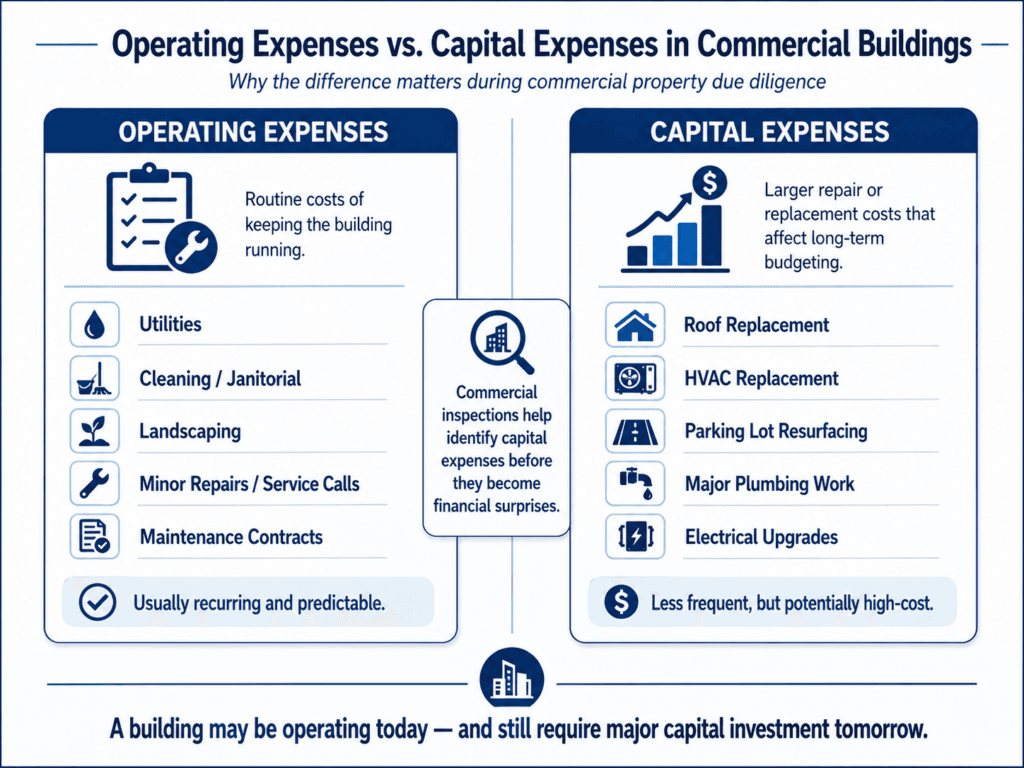
They expect to pay for utilities, insurance, cleaning, landscaping, minor repairs, pest control, maintenance contracts, and ordinary service calls. Those costs are part of owning the property.
Capital expenses are different.
Capital expenses are the larger repair or replacement items that can significantly affect the property’s financial performance. A roof replacement is not the same as changing filters. Replacing several rooftop HVAC units is not the same as paying for a service call. Resurfacing a parking lot is not the same as filling a pothole. Replacing a major plumbing line is not the same as repairing a sink trap.
These larger expenses can change the economics of the property.
A buyer may think they are buying a stable asset, but if several major systems are near the end of their practical life, the property may require substantial investment soon after closing.
That does not always mean the buyer should walk away.
It means the buyer should know.
The Inspection Helps Reveal the Future Cost Profile
A commercial inspection is a snapshot in time, but a good one can still reveal the direction a building is heading.
An aging roof with previous patching, ponding water, deteriorated flashing, and interior staining is not just a present condition. It may be a sign that the buyer needs roof reserve planning immediately.
Several older rooftop HVAC units with rust, damaged insulation, poor maintenance records, and inconsistent operation are not just mechanical observations. They may suggest a coming replacement cycle.
A parking lot with alligator cracking, settlement, failed patching, and standing water is not just an exterior defect. It may be a future resurfacing or reconstruction expense.
Repeated plumbing leaks in an older multifamily building are not just repair items. They may point to systemic piping, drainage, or water damage concerns that affect operating costs and tenant satisfaction.
That is the value of looking at the building through a capital planning lens.
The report should help the buyer understand not only what exists, but what may need money.
Capital Reserve Planning Is Not Guesswork
Some people hear “future costs” and assume it means speculation.
That is not the goal.
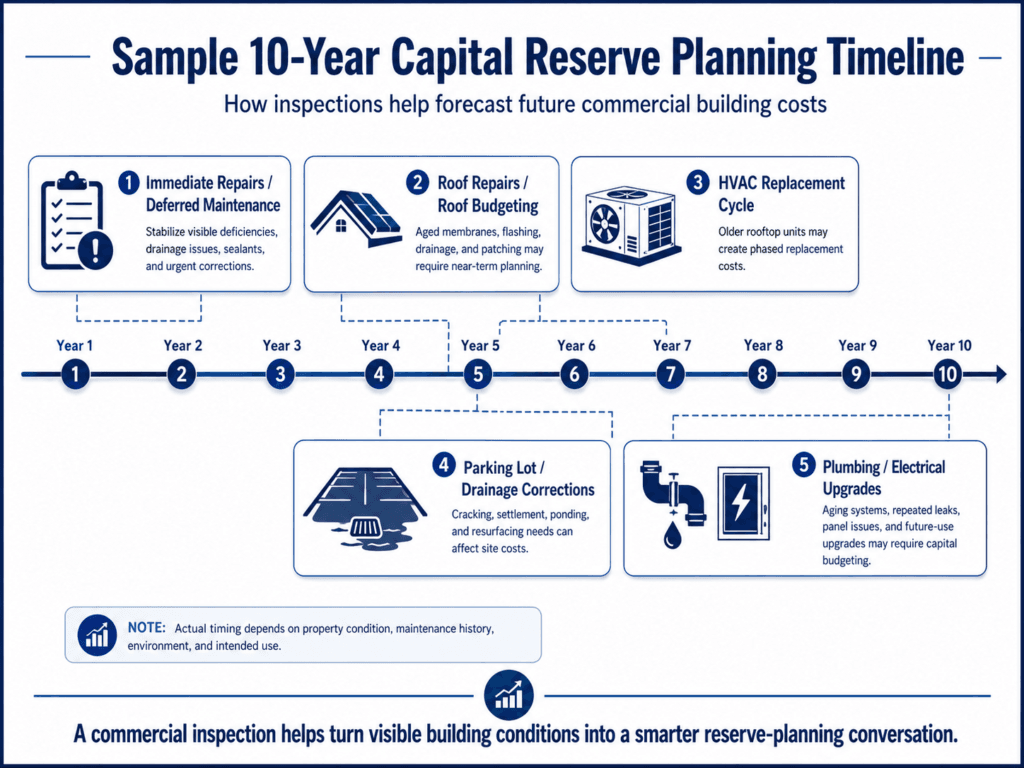
A commercial inspection does not need to pretend it can predict the exact day a roof will fail or the exact month an HVAC unit will stop operating. Buildings do not work that neatly. Weather, maintenance, installation quality, usage, tenant behavior, and prior repairs all affect service life.
But visible conditions can still inform planning.
If a roof is aged and patched, that matters. If multiple RTUs are old and poorly maintained, that matters. If the parking lot is holding water, that matters. If electrical panels show unsafe modifications or poor labeling, that matters. If plumbing defects repeat across several areas, that matters.
Capital reserve planning is not about fortune-telling.
It is about identifying reasonable risk based on the information available.
A buyer does not need perfect certainty to make a better decision. They need enough information to know where the biggest financial exposures may be.
Roof Systems Are Often the Largest Reserve Concern
Commercial roofs are one of the most important capital reserve categories because they can be expensive and disruptive.
A roof may appear acceptable from the ground. It may not be leaking during the showing. The seller may say there have not been problems. But commercial roof risk is not measured only by active leaks.
Low-slope roofs depend on drainage, membrane condition, seams, flashing, parapets, coping, penetrations, roof-mounted equipment curbs, and ongoing maintenance. When those details begin to fail, the roof may still function for a time, but the buyer may already be approaching a major expense.
A roof with ponding water, repeated patching, deteriorated flashing, soft areas, open seams, clogged drains, or interior leak evidence should be treated as a capital planning concern.
The buyer may need a commercial roofing contractor to evaluate the roof and provide pricing. That is especially important when the roof’s age is unknown, warranty information is missing, or the building size makes replacement a major financial event.
A commercial roof is not just a maintenance item.
It can be one of the largest checks an owner writes.
HVAC Systems Can Create a Replacement Cycle
Commercial HVAC equipment is another major reserve category.
Many commercial buildings rely on rooftop units, package units, split systems, boilers, chillers, or other mechanical equipment. These systems may operate during the inspection but still be nearing the end of useful service.
The concern becomes larger when multiple systems are aging together.
One older rooftop unit is a repair concern. Six older rooftop units can become a capital planning problem. If several units are from the same installation period, the buyer may face clustered replacement costs over a short ownership window.
That matters for investors, churches, schools, office buyers, retail owners, and multifamily operators.
HVAC failure is not only expensive. It can affect tenants, employees, students, patients, customers, congregation members, events, and business operations. Emergency replacement is usually more expensive and less controlled than planned replacement.
A commercial assessment should help identify visible HVAC conditions that may affect reserve planning. Age, corrosion, damaged line insulation, poor condensate management, dirty coils, missing service records, unsafe disconnects, inconsistent operation, and poor access all contribute to the risk picture.
The report does not have to provide final replacement pricing. That may require an HVAC contractor. But it should tell the buyer when the mechanical systems may deserve serious budgeting attention.
Parking Lots and Site Work Are Easy to Underestimate
Parking lots are often overlooked during commercial purchases.
That is a mistake.
A deteriorated parking lot can be a major capital expense, especially on larger properties. Asphalt cracking, settlement, potholes, failed patching, ponding water, damaged curbs, uneven walkways, and poor drainage can all affect cost, safety, appearance, and tenant satisfaction.
The site is part of the asset.
A retail building with a failing parking lot may have customer access issues. A church with deteriorated pavement may have trip hazards for elderly members and visitors. A medical office may need safe, accessible routes. A warehouse may depend on truck access, loading areas, and pavement strength. A multifamily property may face tenant complaints and liability concerns.
Parking lot problems also connect to drainage.
If water sits on pavement, drains poorly, or moves toward the building, the issue may affect more than asphalt. It may contribute to foundation movement, exterior deterioration, erosion, crawlspace moisture, or interior water intrusion.
A buyer who ignores the site may inherit a repair obligation that was visible before closing.
Plumbing Reserves Depend on Pattern and Scale
Plumbing reserve planning is especially important in multifamily, institutional, restaurant, church, medical, and older commercial buildings.
A single leaking fixture may not be a major capital concern. But repeated plumbing defects tell a different story.
If several units show staining, loose toilets, soft bathroom floors, patched drain lines, slow drainage, corroded piping, or active leaks, the buyer may be dealing with a broader system problem. In a church or school, repeated restroom issues, kitchen plumbing concerns, older water heaters, and undocumented repairs may affect operations and future budgets. In a restaurant or food-service space, drainage, grease, floor drains, and commercial fixtures can carry additional maintenance risk.
Plumbing problems are expensive because water damages other materials.
A leak is rarely just a leak. It can affect cabinets, flooring, drywall, ceilings, framing, insulation, electrical components, tenant spaces, and indoor air quality concerns. In occupied commercial properties, plumbing work can also disrupt business or tenant use.
A commercial inspection should help distinguish between isolated plumbing repairs and patterns that may require larger reserve planning.
Electrical Systems Can Affect Future Use
Electrical reserve planning is not always as simple as identifying defects.
Sometimes the larger issue is whether the existing electrical system supports the buyer’s intended use.
A building may be adequate for the current tenant but inadequate for the next use. A warehouse used for storage may have very different electrical needs than one used for light manufacturing. A retail space converted into medical use may require additional circuits and equipment capacity. A church planning media upgrades, kitchen expansion, classroom use, or daycare operations may need a more detailed electrical review.
Visible electrical concerns may include aging panels, poor labeling, missing covers, open junction boxes, abandoned wiring, amateur modifications, insufficient access, damaged exterior equipment, unsafe wiring, or questionable tenant improvements.
Some electrical issues are repair items. Others may point to larger upgrade needs.
A general commercial inspection does not replace an electrical design review or engineering analysis. But it can identify visible concerns and recommend further evaluation when the electrical system may affect cost, safety, insurance, or intended use.
For reserve planning, that is the key: identifying where electrical conditions may become more than minor corrections.
Deferred Maintenance Changes the Reserve Picture
Deferred maintenance is one of the biggest warning signs in commercial property.
It does not always look dramatic. In fact, it often appears as a collection of small things.
Sealants are failing. Gutters are clogged. Roof patches are aging. Mechanical equipment is dirty. Exterior paint is worn. Plumbing repairs are mismatched. Electrical labels are missing. Pavement cracks are spreading. Door hardware is damaged. Ceiling tiles are stained. Drainage is poor. Crawlspaces are damp. Equipment service records are missing.
Each item may seem manageable by itself.
Together, they may show that the property has been maintained reactively instead of proactively.
That matters because deferred maintenance accumulates. When owners delay routine work long enough, small repairs become capital expenses. A roof that needed maintenance becomes a roof that needs replacement. A parking lot that needed crack sealing becomes a parking lot that needs resurfacing. A drainage issue that needed correction becomes moisture damage. An HVAC system that needed routine service becomes an emergency replacement.
A commercial inspection should help the buyer see that pattern before closing.
The most expensive property is not always the one with the most obvious defect. Sometimes it is the one where everything has been neglected just long enough to become the next owner’s problem.
A Sample Capital Reserve Perspective
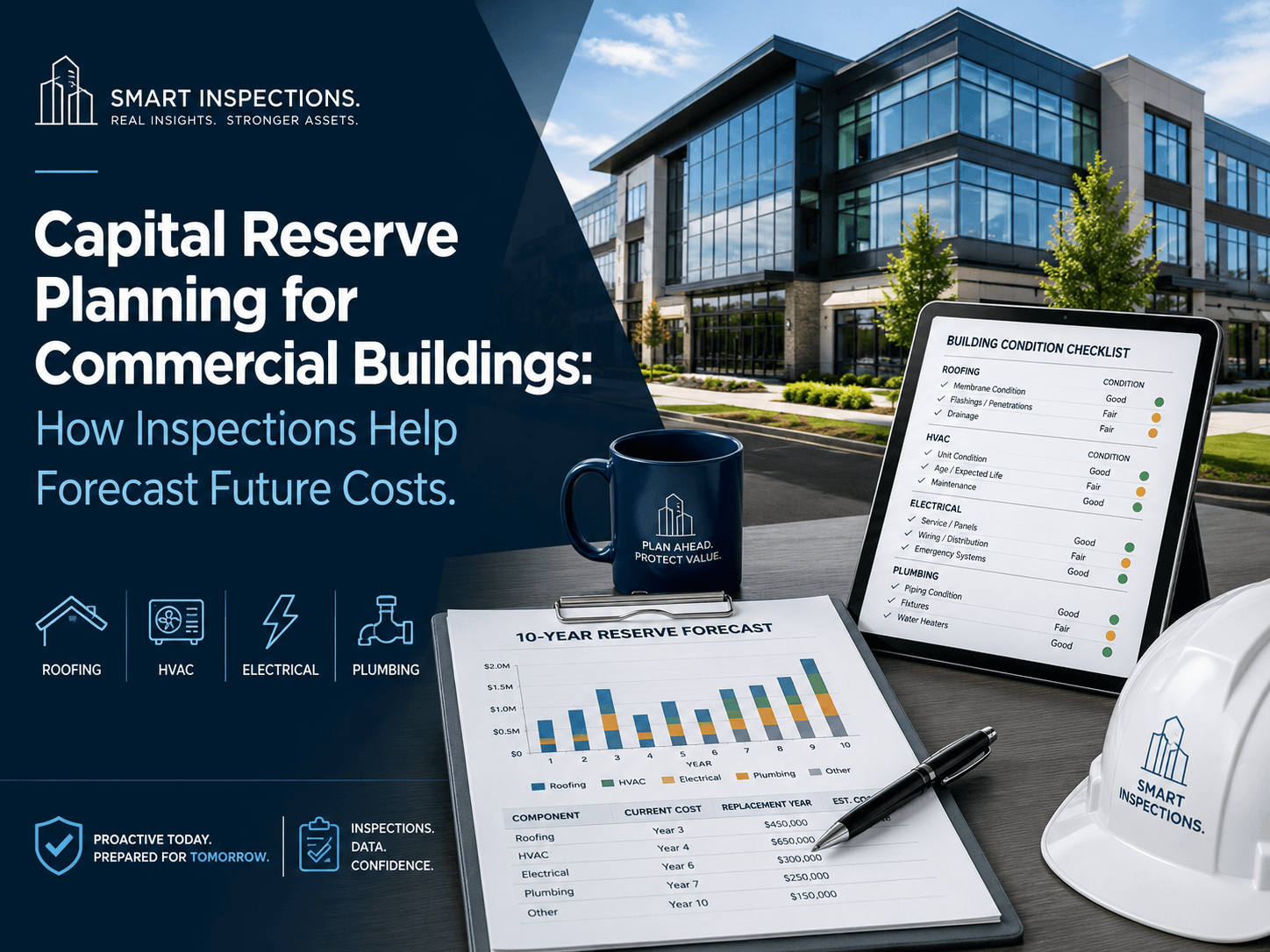
A commercial inspection or PCA may include a summary of major systems and observed concerns that help the client think about future costs. The exact format depends on the scope, property, and client needs, but the basic idea is to organize risk in a way decision-makers can understand.
For example, a simplified reserve planning summary might look like this:
| System | Observed Condition | Reserve Planning Concern | Suggested Next Step |
|---|---|---|---|
| Roof | Aged low-slope roof with ponding and prior patching | Potential near-term roof repair or replacement exposure | Commercial roofing contractor evaluation before closing |
| HVAC | Multiple older rooftop units with visible corrosion | Possible phased replacement cycle | Request service records and obtain HVAC contractor opinion |
| Parking Lot | Cracking, settlement, and ponding water | Future resurfacing/drainage correction cost | Obtain paving/drainage estimate |
| Plumbing | Repeated staining and fixture leaks in multiple areas | Possible systemic maintenance concern | Plumbing contractor review |
| Electrical | Aging panels, poor labeling, visible modifications | Safety and future-use uncertainty | Electrical contractor evaluation |
This kind of table does not replace contractor bids.
It gives the buyer a framework.
That framework can guide negotiations, specialist follow-up, lender discussions, board presentations, and post-closing budgeting.
Capital Reserve Planning Helps Buyers Negotiate
One of the most practical benefits of reserve planning is negotiation.
A buyer who understands likely future costs has a stronger basis for discussion. If a commercial roof may require major work, that may affect price. If multiple RTUs are near the end of service life, that may justify credits or further evaluation. If the parking lot is deteriorated, the buyer may request estimates before closing. If plumbing defects suggest a broader pattern, the buyer may ask for repairs, concessions, or additional access.
The point is not to exaggerate defects.
The point is to avoid pretending future costs do not exist.
Commercial buyers can negotiate more intelligently when they understand the physical condition of the asset. Sellers may not agree to every request, but a well-documented inspection gives the buyer facts instead of guesses.
That can make a significant difference before the due diligence period expires.
Boards and Trustees Need Reserve Planning Too
Capital reserve planning is not only for investors.
Churches, schools, nonprofits, and institutional owners need it just as much.
A board may be considering a campus purchase, renovation, expansion, refinance, or major repair campaign. The decision may involve donor funds, debt, grants, reserves, or long-term organizational planning. In that context, the board needs to know whether the building is likely to require major capital spending soon.
A church property with aging roofs, multiple older HVAC systems, drainage problems, and a deteriorated parking lot may still be worth buying. But the board should not be surprised by those costs after closing.
Trustees need to know what repairs may be urgent, what can be phased, what requires specialist evaluation, and what may affect the organization’s ability to use the property.
A capital reserve mindset helps boards make decisions with clear eyes.
That is stewardship, not just inspection.
Lenders and Investors Care About Physical Risk
Commercial lenders and investors care about property condition because physical risk can affect financial performance.
A building with major deferred maintenance may require additional capital after closing. That can affect debt service, tenant stability, rental income, insurance, repair obligations, and the borrower’s ability to execute the business plan.
A Property Condition Assessment can help document visible physical deficiencies and potential capital concerns. Depending on the scope, it may support lender review, investor due diligence, reserve planning, or ownership strategy.
The inspection report should be written in a way that helps decision-makers understand the risk. That means clear explanations, useful photos, system summaries, limitations, and recommendations for specialist follow-up where needed.
A report full of vague comments does not help a lender or investor understand exposure.
A report that connects physical condition to ownership risk does.
Reserve Planning Should Match the Property Type
Different commercial properties carry different reserve concerns.
A multifamily property may need close attention to repeated plumbing issues, unit HVAC systems, balconies, stairs, roofing, drainage, and tenant-related wear. A warehouse may need more focus on slab condition, loading areas, roof leaks over inventory space, electrical service, overhead doors, and site drainage. A church campus may require review of multiple roofs, multiple HVAC systems, kitchens, classrooms, fellowship halls, parking lots, and life-safety observations. A medical office may place more importance on HVAC reliability, accessibility-related issues, plumbing, electrical, and interior finish condition.
The inspection scope should reflect the property.
There is no single commercial reserve concern that applies equally to every building. The useful question is not, “What does a generic checklist say?”
The useful question is:
What major expenses could this specific property create for this specific buyer?
That is how commercial inspections become more valuable.
Local Conditions Affect Future Costs
In the Mid-South, local conditions play a major role in building performance.
Humidity, heavy rainfall, clay soils, drainage problems, long cooling seasons, storm exposure, and seasonal temperature swings all affect how buildings age. Low-slope roofs may struggle when drainage is poor. HVAC systems work hard in long cooling seasons. Pavement deteriorates when water is allowed to sit. Crawlspaces and slabs may be affected by moisture. Exterior materials can deteriorate faster when water is not controlled.
That regional context matters.
A capital reserve plan that ignores local conditions may underestimate risk. A building in Memphis, West Tennessee, North Mississippi, Arkansas, Missouri, or Kentucky should be evaluated with real local weather, soils, and maintenance patterns in mind.
Commercial buildings do not age according to a spreadsheet alone.
They age according to use, maintenance, construction quality, and environment.
A commercial inspection should not only identify what is visibly wrong today. It should help buyers understand what major expenses may be waiting after closing.
-Wes Upchurch, Upchurch Inspection
The Goal Is Not Perfect Prediction
No inspection can guarantee future costs.
A roof that appears serviceable may be damaged in a storm. An HVAC unit that appears aged may run longer than expected. A newer system may fail unexpectedly. Plumbing problems may remain hidden behind walls. Electrical needs may change when the buyer changes the use of the building.
There are always unknowns.
The goal of capital reserve planning is not perfect prediction.
The goal is better awareness.
A commercial buyer who knows the roof is aged, the HVAC systems are older, the parking lot is failing, and plumbing repairs are repeated can plan differently than a buyer who assumes everything is fine because the building was occupied and functional during the showing.
Better information does not eliminate risk.
It helps the buyer manage it.
Final Thoughts
Commercial buildings create costs long after closing.
Some costs are routine. Others are major capital events. The difference matters.
A commercial inspection or Property Condition Assessment should help buyers, investors, trustees, lenders, and property owners identify visible conditions that may affect future repair and replacement planning. Roof systems, HVAC equipment, parking lots, plumbing, electrical systems, drainage, exterior components, and deferred maintenance patterns all deserve attention because they can change the financial reality of owning the property.
The most dangerous expense is often the one the buyer did not see coming.
Capital reserve planning brings those future obligations into the conversation before the decision is final.
That is the value of a serious commercial assessment.
It does not just answer, “What is wrong with the building today?”
It helps answer the more important question:
What might this building cost me tomorrow?
Need a Commercial Property Inspection or PCA?
Upchurch Inspection provides commercial property inspections and Property Condition Assessments for buyers, investors, trustees, lenders, property owners, and real estate professionals throughout the Mid-South.
We help clients evaluate visible building conditions, deferred maintenance, major system risks, and potential capital expense concerns before closing, refinancing, budgeting, or major investment.
For commercial buildings, churches, campuses, warehouses, multifamily properties, offices, retail spaces, industrial properties, and mixed-use assets, we can help determine the right inspection scope for the decision being made.
To discuss a commercial inspection, Property Condition Assessment, or capital reserve-focused assessment, contact Upchurch Inspection.