Deferred Maintenance Is Not Just “Old Stuff”
Deferred maintenance is one of those polite phrases that sounds cleaner than what it usually means in the field. In plain language, it means the property has been asking for money for a long time, and somebody kept delaying the answer. It may not look dramatic during a showing. It may not even look urgent to a buyer walking through the living room. But deferred maintenance has a way of leaving evidence behind, and once you learn how to read that evidence, the property starts telling you how it has really been cared for.
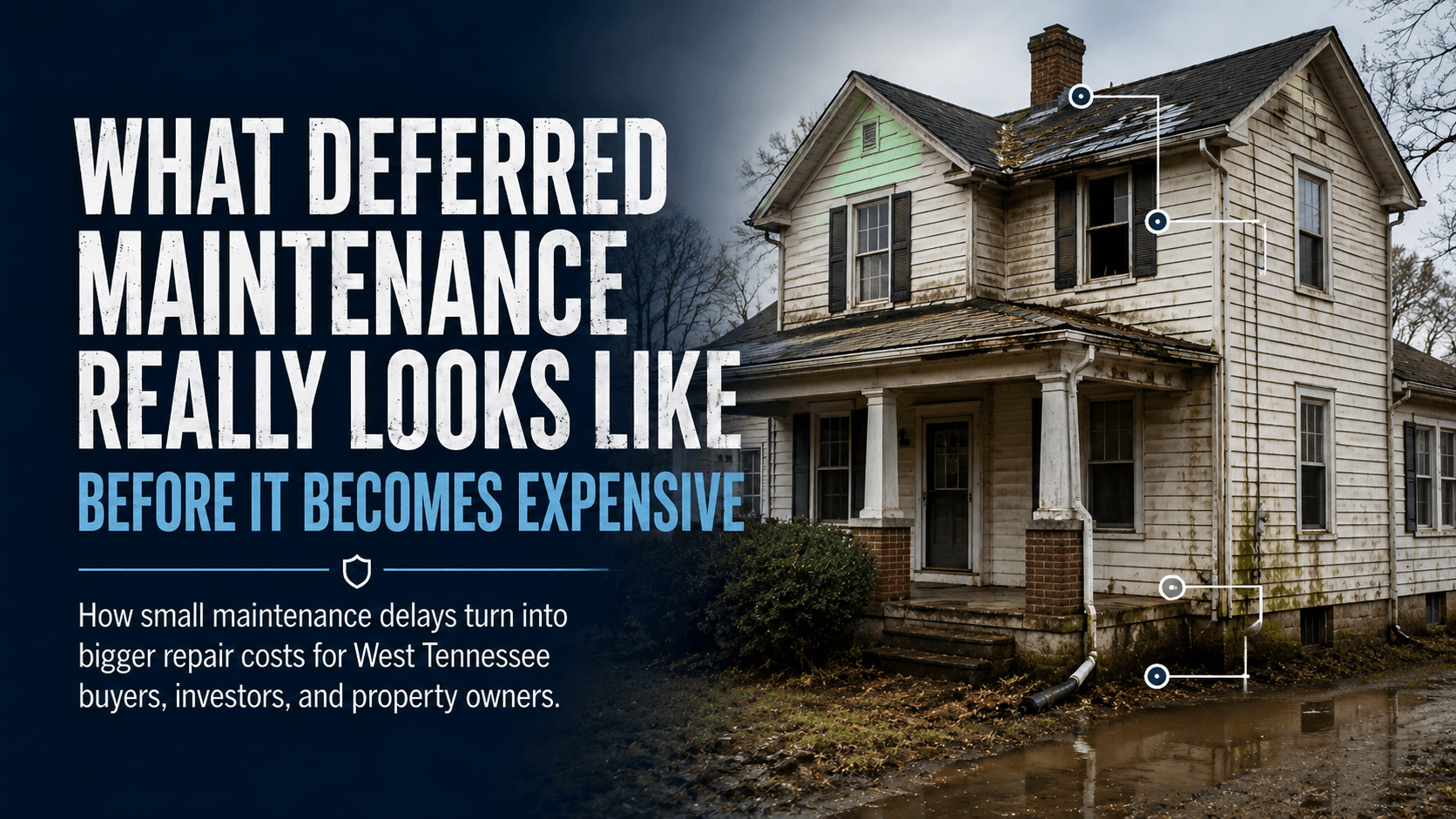
When I inspect a home or commercial building in West Tennessee, I am not only looking for what is broken at that exact moment. I am looking for what has been neglected long enough to become the next owner’s problem. A clogged gutter is a small item. A clogged gutter combined with deteriorated fascia, stained soffit material, lower brick staining, negative grading, damp crawlspace soil, rusted duct supports, and fungal-type growth on floor framing is no longer a small item. At that point, I am not looking at one defect. I am looking at a maintenance pattern.
That distinction matters because the expensive part of deferred maintenance is rarely the original defect. The expensive part is the delay. Extending a downspout before water starts collecting at the foundation is cheap. Correcting crawlspace moisture, damaged insulation, wood deterioration, pest conditions, and possible structural repairs later is not. Sealing a roof penetration correctly before it leaks into the attic is a relatively contained repair. Ignoring it until roof decking, insulation, drywall, paint, and interior finishes are involved changes the cost entirely.
A property can look presentable from the street and still be carrying years of unpaid maintenance debt. That is especially true when the visible surfaces have been cleaned up for sale. Fresh paint, new flooring, new light fixtures, and new cabinet hardware can improve the way a property photographs, but they do not erase the maintenance history in the roof, attic, crawlspace, drainage system, HVAC system, plumbing, or electrical work. Those areas usually keep better records than the listing description does.
Why West Tennessee Makes Delay More Expensive
West Tennessee is not a forgiving environment for neglected buildings. Moisture is one of the biggest reasons. NOAA’s Tennessee climate summary lists the state’s long-term average annual precipitation at 52.2 inches, and notes that annual precipitation has been above the long-term average since 2010. NOAA also reports that Tennessee has experienced above-average numbers of 3-inch extreme precipitation events since 1990, except for 2005–2009. (statesummaries.ncics.org)
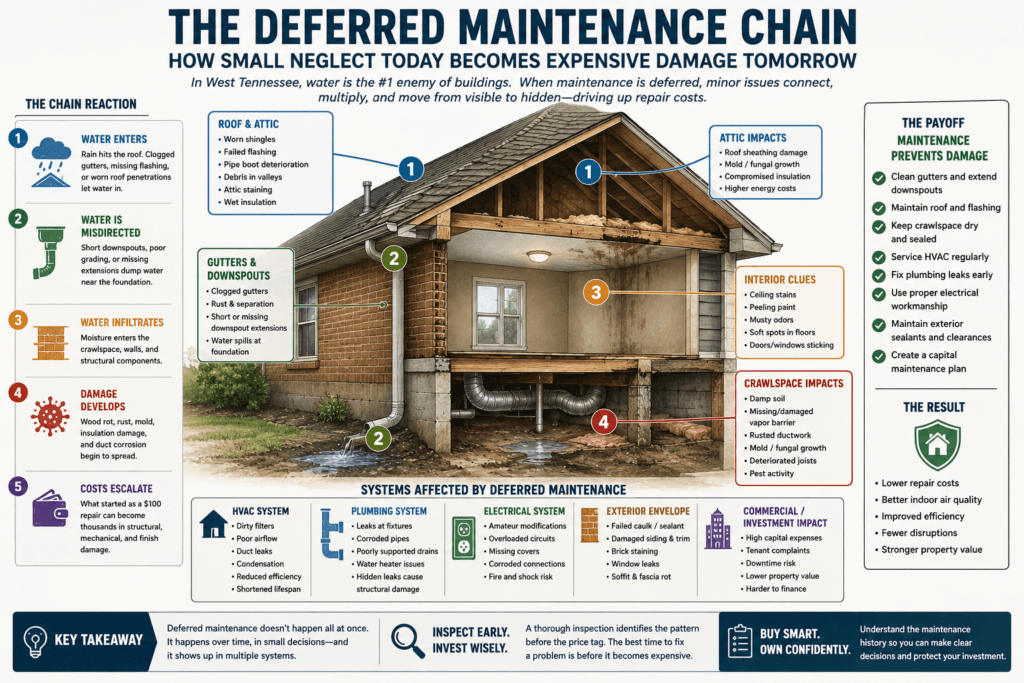
Those facts matter in the field because deferred maintenance and water work together. A neglected roof detail does not stay a roof detail forever. A failed pipe boot, an open flashing joint, or a repeatedly patched roof penetration can become attic staining, wet insulation, damaged decking, ceiling staining, and interior repairs. A short downspout does not stay a downspout problem forever. It can become saturated soil, damp crawlspace conditions, rusted metal, insulation failure, wood deterioration, and foundation-area concerns.
The soil and site conditions matter too. In parts of West Tennessee, I pay close attention to silty soils, drainage behavior, low areas, and how water appears to move after storms. A yard may look acceptable during a dry inspection window, but staining, erosion, ponding marks, settled walks, damp crawlspace soil, and lower-wall moisture indicators often tell a different story. The property does not have to be flooded to be affected. It only has to stay wet often enough and long enough.
This is where I see buyers underestimate risk. They may hear “grading issue” or “gutter issue” and think it sounds minor. Sometimes it is. But in West Tennessee, water management is not a decorative maintenance category. It is part of how the house survives. When roof drainage, site drainage, crawlspace moisture, exterior deterioration, and interior staining begin pointing in the same direction, the issue is no longer just maintenance. It is a pattern of neglect that may already be costing the property money.
The Roof Usually Keeps Score
A roof does not have to be destroyed to show deferred maintenance. Some of the most useful clues are smaller details: deteriorated pipe boots, lifted shingles, exposed fasteners, failed sealant, loose flashing, damaged drip edge details, debris in valleys, clogged gutters, stained soffits, and repeated roof cement patches. I pay close attention to those details because they often show whether the roof has been maintained properly or simply chased after every time water showed up inside.
One proper repair at the right time may prevent years of damage. Repeated temporary repairs usually tell a different story. When I see several areas smeared with roof cement, I do not automatically think, “Good, someone maintained it.” More often, I think, “Somebody has been chasing leaks.” That does not mean the roof is automatically beyond repair, but it does mean I need to look harder in the attic, at the ceilings, around exterior walls, and along the roof edges.
In this climate, water does not need many opportunities. A small roof leak can stain decking. Damp insulation can lose performance. Ceiling stains may be patched and painted. Soffit and fascia can deteriorate from roof-edge runoff. Gutters may overflow and send water down exterior walls. By the time a buyer notices a clean finished room below, the roof may already have a history written in stains, patches, rust, swelling, and soft materials.
This is why I do not evaluate roof defects as isolated surface conditions. The roof is connected to the attic, insulation, exterior envelope, gutters, grading, and sometimes the crawlspace or foundation. If the roof has been neglected, the evidence often appears in more than one place. A serious inspection should explain that relationship, not just say “repair roof as needed.”
Gutters, Downspouts, and Grading Are Not Minor Details
Buyers often underestimate gutters and grading because those items do not feel exciting. Nobody falls in love with a house because the downspouts are extended correctly. Nobody brags about proper splash blocks. But water management is one of the most important maintenance habits a property can have, especially in a region with regular heavy rain.
A missing downspout extension may be a small repair by itself. But if that same side of the house also has soil erosion, lower-wall staining, damp crawlspace conditions, wood deterioration, and uneven interior floors, the downspout is no longer just a little exterior item. It becomes part of the larger explanation. The roof collected the water. The gutter concentrated it. The downspout dumped it near the foundation. The soil held it. The crawlspace or foundation area absorbed the result.
That is deferred maintenance in plain language. It is not dramatic, and that is why it gets ignored. Water went where it should not go, and it was allowed to keep doing that. The early correction may have been simple. The later correction may involve drainage improvements, crawlspace moisture control, damaged material replacement, pest evaluation, and possible structural repair.
This is one of the reasons high-dollar buyers should care about basic exterior maintenance. Luxury finishes do not protect a property from poor drainage. Large homes, older homes, investment properties, churches, and commercial buildings can all suffer from the same water-management failures. The difference is that the repair bill is often larger because there is more building to protect.
Crawlspaces Show the Truth Faster Than the Living Room
A finished interior can lie. A crawlspace usually tells the truth. In West Tennessee homes, crawlspaces are often where deferred maintenance becomes visible first. I look for damp soil, missing or damaged vapor barrier material, rusted duct straps, sagging insulation, disconnected ducts, plumbing leaks, fungal-type growth, deteriorated joists, improper supports, debris from prior work, and signs that nobody has been under there except when something stopped working.
Building-science research supports what inspectors see in the field. U.S. Department of Energy Building America guidance states that vented crawlspaces in mixed-humid and hot-humid climates tend to increase moisture levels rather than keep the crawlspace drier. Oak Ridge National Laboratory research comparing vented and unvented crawlspaces in a mixed-humid climate found that a sealed and insulated crawlspace design performed better than a traditional vented crawlspace design. (EERE Energy)
That does not mean every crawlspace gets the same recommendation. It does mean the old assumption that vents automatically solve moisture is not reliable in our climate. In the field, I see the results of that assumption constantly. Humid air enters the crawlspace. Cool surfaces allow condensation. Ducts sweat. Insulation absorbs moisture. Wood stays damp. Metal components rust. The house slowly starts showing symptoms above and below the floor system.
A neglected crawlspace rarely stays isolated. Moisture affects wood, metal, insulation, ductwork, comfort, pest activity, and sometimes indoor air quality concerns. A buyer may walk through the main level and see new flooring, clean paint, and updated fixtures. Underneath, the crawlspace may show the actual cost of years of neglect. I do not treat that as a cosmetic issue. A damp crawlspace is part of the building’s performance history.
HVAC Systems Reveal How the Property Has Been Managed
HVAC systems are another place where deferred maintenance becomes obvious. A system does not need to be completely dead to indicate poor maintenance history. Dirty filters, poor airflow, damaged ductwork, missing insulation, rusted equipment, clogged condensate drains, poor clearance, aging components, and inconsistent service history all tell a story.
In West Tennessee, HVAC systems work hard because of long cooling seasons and humidity. When the system is neglected, the effect is not limited to comfort. Poor duct conditions can affect efficiency. Condensation problems can contribute to moisture issues. A clogged condensate line can cause damage to ceilings, floors, or cabinets. Poor crawlspace ductwork can interact with damp crawlspace conditions. A system that technically turns on may still be part of a larger maintenance problem.
For a buyer, the key question is not only whether the system operates during the inspection. The better question is whether the system appears to have been maintained, installed, distributed, and protected properly. A 15-year-old system with evidence of regular care may pose a different risk than a newer system with poor ductwork, water damage, missing service evidence, and obvious neglect.
Commercial buyers should pay even closer attention. In commercial buildings, HVAC equipment can represent a major capital expense. Aging rooftop units, deteriorated curbs, patched ductwork, poor maintenance access, damaged insulation, missing service records, and improper drainage around equipment can turn into real money quickly. The issue is not just whether conditioned air is coming out today. The issue is what the system is likely to cost the owner over the next several years.
Plumbing Neglect Usually Leaves Stains Before It Leaves Receipts
Plumbing deferred maintenance often starts quietly. A small leak under a sink. A loose toilet. A slow drain. A corroded valve. A patched line. A trap that has been bumped loose. A water heater pan that is missing, damaged, or improperly drained. None of those conditions may feel catastrophic during a showing. But water does not need permission to create damage.
When I inspect plumbing, I am looking beyond whether fixtures run. I look at staining inside cabinets, soft flooring near toilets and tubs, corrosion at supply lines, poor supports, amateur repairs, old leak marks, active drips, moisture below bathrooms, and whether the crawlspace confirms the story upstairs. A bathroom may look renovated, but the framing underneath may tell me whether the plumbing work was actually handled properly.
Deferred plumbing maintenance is especially frustrating because many plumbing problems are inexpensive when corrected early and expensive when ignored. A loose toilet can damage flooring. A slow supply leak can ruin cabinet bases. A failed tub or shower seal can affect subflooring. An improperly supported drain can leak or separate. A water heater problem can create damage quickly if leakage or discharge is not managed.
A serious buyer should not just ask whether the plumbing works. The better question is what the plumbing history looks like. In older homes and renovated properties, that question matters because the visible fixture may be new while the drain, supply, support, or surrounding structure may tell a different story.
Electrical Deferred Maintenance Is Often Hidden in Workmanship
Electrical systems reveal deferred maintenance differently. Sometimes the issue is age. Sometimes it is outdated equipment. Very often, though, the issue is workmanship history. Over the years, people add circuits, finish rooms, install lights, replace outlets, modify panels, wire appliances, and make repairs. When that work is done correctly, the system may look organized and intentional. When it is not, the defects start to cluster.
Open junction boxes, missing covers, loose receptacles, inconsistent GFCI protection, amateur splices, overloaded or poorly labeled panels, abandoned wiring, damaged conductors, questionable breaker conditions, and mismatched workmanship tell me the electrical system has not been managed with much discipline. One item may be simple. A pattern of unsafe or amateur work deserves more attention.
This is not about pretending every older electrical system is automatically unsafe. Older homes can have electrical systems that have been maintained and upgraded responsibly. The concern is when the visible evidence suggests that multiple people have modified the system over time without consistent standards. In those cases, the buyer may be seeing only the accessible portion of the problem.
For higher-value homes, flips, rentals, and commercial buildings, electrical maintenance is not a small issue. It affects safety, insurability, functionality, and future improvement costs. A property with visible electrical shortcuts may have more hidden ones, especially when finished surfaces prevent full evaluation.
Exterior Envelope Neglect Is Slow, Predictable, and Expensive
The exterior envelope is where a building fights weather every day. Siding, trim, brick veneer, sealants, flashing, windows, doors, soffits, fascia, wall penetrations, and clearances all help manage water. Deferred maintenance at the exterior rarely stays cosmetic forever.
Peeling paint on trim may look minor until the wood is soft. Failed caulk around windows may look simple until water has entered the wall. Brick veneer staining may seem cosmetic until it lines up with drainage, weep holes, flashing concerns, or high moisture at the base of the wall. Damaged fascia may look like a carpentry repair until the roof edge and gutter system explain why it failed.
West Tennessee humidity and rain make these details matter. Exterior materials do not need to be perfect, but they do need to be maintained. Paint, sealants, flashing, drainage, and clearances are not just appearance items. They are part of how the building sheds water.
When I see deteriorated trim, low siding clearance, staining, open penetrations, failed sealant, and poor drainage in the same area, I do not treat each as a separate cosmetic issue. I treat them as part of the same exterior maintenance story. The buyer needs to know whether the property needs minor exterior repair or whether the exterior has been allowing water to work on the building over time.
Renovation Can Hide Deferred Maintenance Instead of Correcting It
One of the biggest mistakes buyers make is assuming that a renovated property has also been repaired. Renovation and repair are not the same thing. A property can have new flooring, fresh paint, modern fixtures, updated cabinets, and trendy finishes while still carrying old moisture damage, aging systems, poor drainage, questionable wiring, and substandard plumbing.
This is why flipped homes need careful inspection. A cosmetic renovation can interrupt the evidence trail. Old stains get painted. Uneven floors get covered. Cabinets hide plumbing. New trim hides swelling. New fixtures distract from old electrical work. Flooring makes the house feel new even when the crawlspace underneath still shows years of neglect.
A good renovation corrects the cause of damage. A weak renovation improves the appearance while leaving the underlying condition alone. The difference matters because a buyer may pay a premium for the finished look while inheriting the old problems.
In Memphis and West Tennessee, this is especially relevant because much of the housing stock is older. HUD’s 2024 Comprehensive Housing Market Analysis for the Memphis HMA reported that in 2023, the city of Memphis had an estimated 294,400 housing units, with 48 percent built before 1970 and only 4 percent built since 2010. (HUD User) Older homes are not bad by default. But when older homes are renovated quickly or cheaply, the inspection needs to determine whether the work respected the building or just dressed it up.
Deferred Maintenance in Commercial Buildings Is a Capital Planning Problem
In commercial property, deferred maintenance is not just a repair issue. It is a capital planning issue. A commercial buyer, board, church, investor, or property manager should not only ask what is broken today. They should ask what the building is likely to demand over the next several years.
Commercial buildings often carry maintenance backlogs in the roof, HVAC equipment, electrical distribution, plumbing, parking areas, drainage systems, exterior envelope, and interior finishes. A roof may be near the end of its useful life. Rooftop units may be aging. Sealants may be failing. Parking areas may be deteriorating. Drainage may be affecting the building perimeter. Interior stains may suggest roof or plumbing issues. Each item matters, but the larger question is how those items affect ownership cost.
This is where commercial inspections and property condition work differ from ordinary buyer anxiety. The question is not just whether something is defective. The question is whether the defect affects operation, tenant experience, insurance concerns, immediate safety, maintenance budgeting, capital reserves, or negotiation leverage. A small commercial building with aging rooftop units, roof drainage concerns, interior staining, electrical modifications, and poor site drainage may still be a viable purchase. It should not be evaluated as though those are unrelated repair notes.
A serious commercial client is not buying a perfect building. They are buying a risk profile. Deferred maintenance is one of the clearest ways that risk profile shows itself.
Churches and Nonprofits Often Carry a Different Maintenance Pattern
Churches, nonprofits, and older institutional buildings often have a unique maintenance pattern. The building may have been loved, but not fully funded. Volunteers may have handled small repairs. Committees may have postponed major work. Budgets may have prioritized ministry, staffing, outreach, education, or operations over building systems. None of that is surprising, and it is not a criticism. It is simply how many large nonprofit properties age.
The result can be a building with a lot of history and a lot of deferred capital need. Roofs get patched. HVAC systems are nursed along. Plumbing issues are handled as emergencies. Electrical upgrades happen in phases. Exterior maintenance waits. Drainage is ignored because it does not feel urgent until interior damage appears.
For a church board or nonprofit leadership team, the inspection should not be framed as “what is wrong with the building” in a shallow way. The better framing is: what maintenance debt has accumulated, what conditions are immediate, what conditions are likely to become expensive, and what should be planned over time? That is where a serious inspection becomes a decision-making tool instead of just a defect list.
This matters because boards do not usually need drama. They need clarity. They need to know whether the building is safe to keep using, whether systems are near the end of useful life, what needs specialist evaluation, what can be phased, and what should not be deferred anymore.
Rental and Investor Properties Show Deferred Maintenance in Layers
Rental and investor properties often show deferred maintenance differently from owner-occupied homes. The property may have been kept functional enough to rent, but not necessarily maintained in a way that protects long-term value. That distinction matters. A tenant may report what stops working, but they may not notice roof drainage, crawlspace moisture, exterior wood deterioration, attic staining, unsafe electrical modifications, or slow plumbing damage until the problem becomes obvious.
In rental houses, I often pay attention to layers of repair. A patched door. A replaced section of flooring. A repaired cabinet base. A newer water heater beside older corroded valves. A panel with several generations of electrical work. A crawlspace containing debris from prior repairs. A bathroom that looks updated above but questionable below. Each item may be explainable. Together, they may show a property operated by reaction rather than maintenance planning.
Investors should care about this because deferred maintenance affects more than immediate repair cost. It affects tenant complaints, vacancy risk, insurance exposure, future capital needs, resale value, and whether the property can be improved profitably. A cheap property with years of hidden maintenance debt may not be cheap at all. It may simply be asking for money after closing instead of before.
Deferred Maintenance Can Affect Negotiation More Than a Single Defect
Deferred maintenance changes negotiation because it changes the conversation. A buyer may not need every item repaired before closing. But they do need to understand whether the property has a normal repair list or a larger maintenance backlog.
A missing handrail is a repair item. A roof showing repeated leak attempts, attic staining, damaged fascia, and interior ceiling repairs is a pattern. A dirty HVAC filter is a maintenance item. An aging system with poor duct conditions, condensation issues, and no evidence of service is a larger concern. A minor plumbing leak is one thing. Plumbing leakage combined with soft flooring, stained framing, and questionable repairs is another.
When the inspection identifies a pattern, negotiation becomes more defensible. The buyer is not simply asking for random repairs. The buyer can explain that multiple visible conditions point toward a larger issue requiring further evaluation, correction, or budgeting. That matters because serious sellers, agents, investors, attorneys, and commercial decision-makers usually respond better to organized risk than emotional reaction.
The point is not to turn every inspection into a fight. The point is to make sure the buyer understands what kind of financial responsibility they may be assuming. Sometimes that means repairs. Sometimes it means credits. Sometimes it means further evaluation. Sometimes it means walking away. The inspection should give the buyer enough clarity to decide without pretending the property is better maintained than it is.
Why Cheap Inspections Often Miss Deferred Maintenance Patterns
A cheap inspection can be expensive if it misses the pattern. Deferred maintenance is not always obvious from the living room. It often requires time in the attic, crawlspace, exterior, roof area, mechanical spaces, and around the site. It requires looking at how one defect relates to another. It requires asking whether the condition is isolated or connected.
A fast checklist inspection may identify visible defects but fail to interpret the maintenance history. The report may say the downspout needs an extension, the crawlspace has moisture, the insulation is damaged, and fungal-type growth is present. Those are useful observations, but the more valuable conclusion is that the property may have a chronic moisture-management issue affecting multiple components.
That is the difference between documenting symptoms and understanding the property. High-dollar clients are not paying for someone to notice the obvious. They are paying for judgment. They want to know what the defects mean, what they connect to, and what the property may cost them after closing.
This is also why report language matters. A report that simply lists defects may be technically correct but still fail to help the client understand priority and risk. A better report should explain when defects appear connected, when further evaluation is warranted, and when a condition may represent deferred maintenance rather than a one-time repair need.
What Buyers Should Ask When They See Deferred Maintenance
Buyers often ask, “How much will it cost to fix?” That is a fair question, but with deferred maintenance, it is not always the best first question. The better first question is, “What caused this, and how long has it been happening?” A repair estimate without understanding the cause can be misleading.
Replacing damaged wood does not solve the drainage problem that damaged it. Cleaning fungal growth does not solve the moisture source. Painting stained drywall does not solve the roof leak. Replacing flooring does not solve subfloor movement. Servicing the HVAC system does not correct bad duct design or chronic crawlspace humidity.
The buyer should also ask whether the condition appears isolated or systemic. Is this one old leak, or does the house show a broader moisture pattern? Is this one electrical defect, or does the property show a history of unsafe modifications? Is this one aging component, or are several major systems near the end of service life at the same time? Is this a cosmetic renovation, or did the work actually correct the underlying causes?
Those questions move the inspection from a repair list to a risk discussion. That is where the value is.
What Deferred Maintenance Looks Like Before It Becomes Expensive
Before deferred maintenance becomes expensive, it often looks boring. That is the problem. It looks like a gutter that should be cleaned, a downspout that should be extended, a filter that should be replaced, a pipe boot that should be repaired, a small stain that should be investigated, a crawlspace vapor barrier that should be corrected, a small plumbing leak that should be fixed, or a panel cover that should be secured.
Then time passes.
The gutter overflow damages fascia. The downspout saturates the foundation area. The filter neglect stresses the HVAC system. The failed pipe boot stains the attic. The small leak damages the subfloor. The missing vapor barrier allows crawlspace moisture to continue. The small electrical issue becomes part of a larger unsafe-workmanship pattern. The property does not fail all at once. It sends signals, gets ignored, and then sends a bill.
That is why I take deferred maintenance seriously. It is not because every small defect is terrifying. It is because small defects are often the first visible evidence of a property owner’s maintenance habits. Some houses are cared for. Some houses are patched. Some houses are dressed up for sale. Some houses are operated until the next owner inherits the backlog.
How I Read Deferred Maintenance During an Inspection
When I suspect deferred maintenance, I do not stop at the first defect. I look for confirmation. On the exterior, I look at gutters, downspouts, roof edges, grading, splashback, soil erosion, siding and trim clearance, wall penetrations, window sealants, vegetation, and whether water appears to be moving away from the structure or toward it. In the crawlspace, I look for damp soil, vapor barrier condition, rust, staining, duct condensation, damaged insulation, plumbing leaks, fungal-type growth, improper supports, and whether old repairs appear competent.
In the attic, I look for roof leak evidence, old stains, active moisture indicators, ventilation issues, insulation disturbance, duct problems, exhaust termination, and whether roof repairs appear to have solved the cause or just covered the symptom. In the electrical system, I look for patterns of amateur workmanship, missing covers, open splices, improper connections, inconsistent upgrades, and whether the panel appears organized or chaotic. In the plumbing system, I look for stains, corrosion, leaks, poor supports, loose fixtures, damaged cabinet bases, and whether wet areas show repeated repair history.
The goal is not to make the house sound worse than it is. The goal is to understand whether the property is showing ordinary age, normal repair needs, or a deeper pattern of neglect. Those are different conclusions, and buyers deserve to know the difference.
What This Means for West Tennessee Buyers
West Tennessee buyers should expect moisture, drainage, crawlspaces, roofs, HVAC systems, exterior maintenance, electrical workmanship, plumbing history, and renovation quality to be inspected with real attention. Those are not random categories. They are where deferred maintenance repeatedly becomes expensive in this region.
A property may look clean. It may be updated. It may have a beautiful kitchen, new floors, and fresh paint. It may even have a short list of obvious defects. But if the visible clues point toward long-term water mismanagement, poor repair habits, aging systems, or neglected hidden areas, the buyer needs to understand that before closing.
Deferred maintenance is not just old stuff. It is the cost of delay. In West Tennessee, delay often shows up through moisture, movement, rust, stains, rot, failed insulation, aging equipment, and repairs that never addressed the cause. The earlier a buyer recognizes that pattern, the better chance they have of making a clear decision instead of inheriting someone else’s maintenance debt.