Multifamily properties can look better on paper than they do in real life.
The rent roll may look solid. The occupancy rate may look acceptable. The exterior may present well enough from the parking lot. A few renovated units may photograph nicely for the listing. On the surface, the deal may appear to make sense.
But multifamily buildings have a way of hiding problems in patterns.
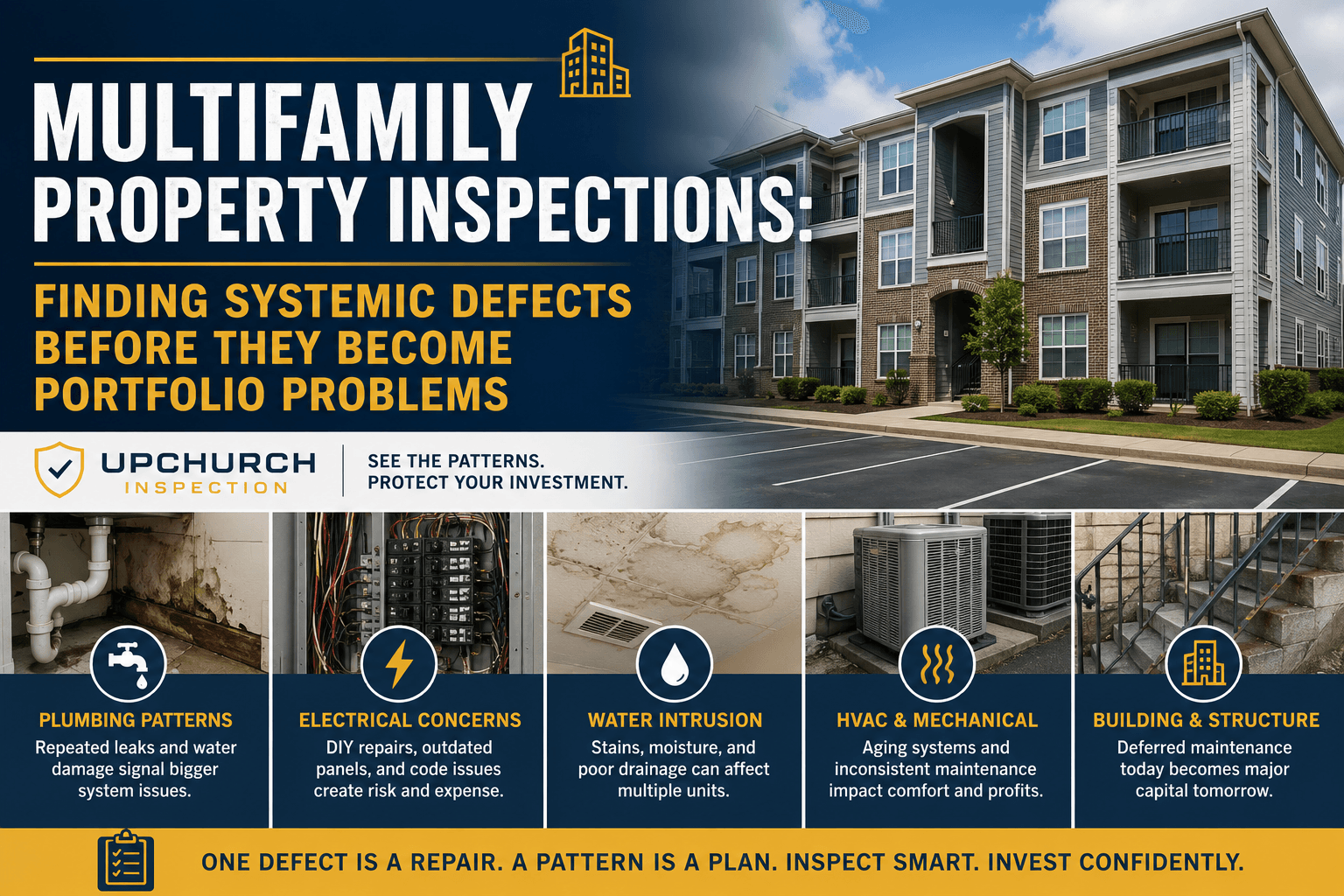
One plumbing leak may be a maintenance item. Repeated plumbing leaks across several units may be a system problem. One soft bathroom floor may be a repair. Several soft bathroom floors may suggest long-term moisture management issues. One bad electrical repair may be isolated. Multiple amateur electrical repairs across several units may indicate a history of low-quality maintenance.
That is why multifamily inspections need to be approached differently than a standard residential inspection.
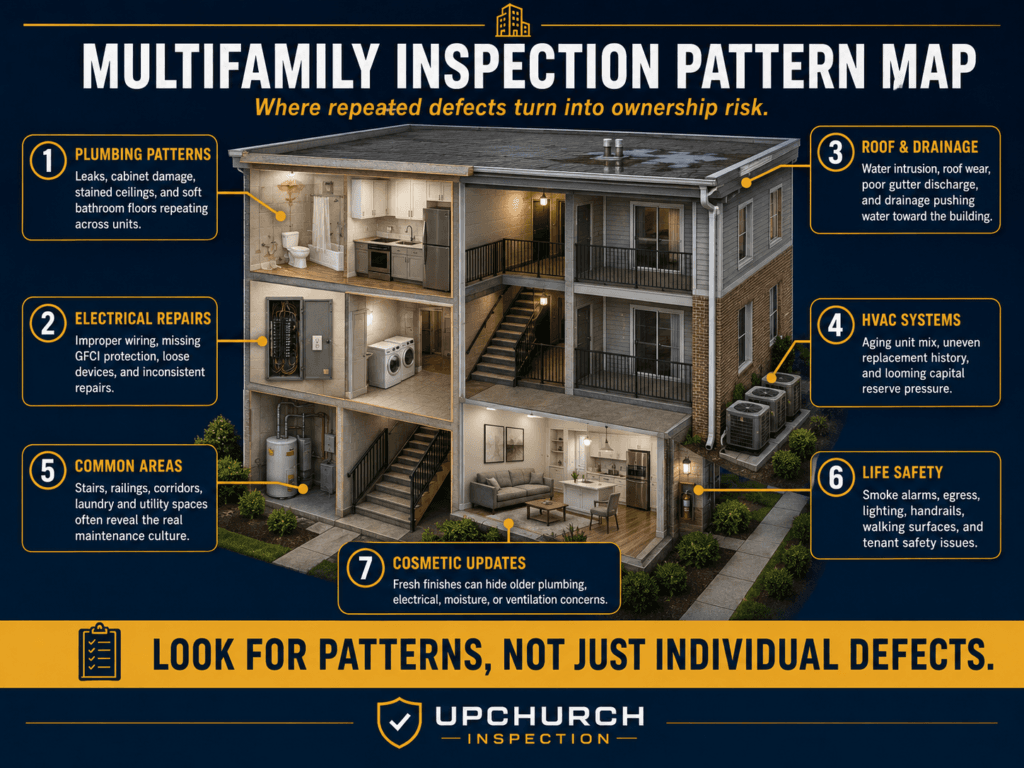
A multifamily property is not just one building. It is a collection of repeated systems, repeated layouts, repeated maintenance decisions, and repeated risks. The real value of the inspection is not only finding individual defects. The value is recognizing when the same kind of defect shows up again and again.
At Upchurch Inspection, that is one of the biggest things we look for in multifamily due diligence: patterns. Patterns tell you whether the buyer is dealing with normal wear and tear or whether the property has deeper deferred maintenance concerns that could affect cash flow, capital reserves, tenant satisfaction, and long-term ownership.
The Difference Between a Defect and a Pattern
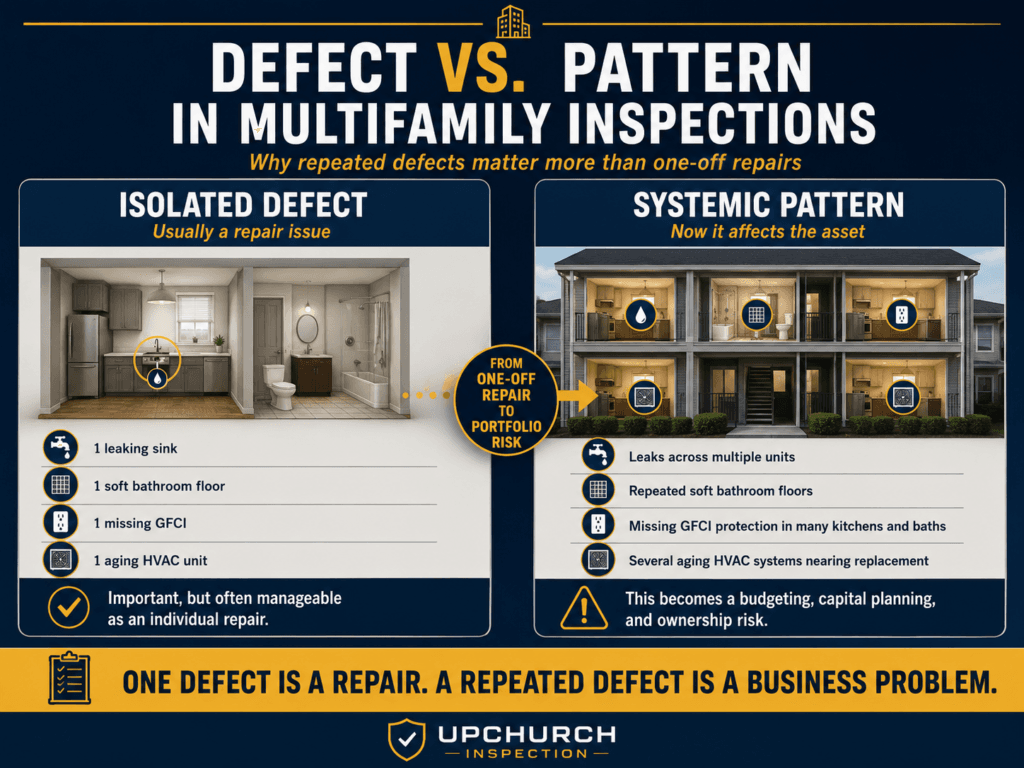
In a single-family home inspection, one defect may carry a lot of weight because there is only one home to evaluate. In a multifamily building, an individual defect still matters, but the bigger question is often whether that defect is part of a larger trend.
A leaking sink in one unit is not unusual. A leaking sink in five units is different. A missing GFCI outlet in one kitchen may be a simple correction. Missing protection across many kitchens or bathrooms may suggest outdated electrical standards or inconsistent maintenance. A stained ceiling in one apartment may come from an old leak. Similar staining in several units may suggest recurring plumbing, roofing, or HVAC condensate problems.
This is where multifamily inspections become more like asset evaluation than simple defect reporting.
The buyer needs to know what kind of property they are inheriting. Has the building been maintained proactively, or has it been patched together one tenant complaint at a time? Are the issues isolated, or do they repeat across the property? Are the repairs consistent with professional work, or do they suggest years of cheap fixes?
Those questions matter because a multifamily buyer is not only buying walls, floors, fixtures, and roofs. They are buying a maintenance history.
And sometimes that maintenance history is written all over the building.
Older Multifamily Properties Carry Their Own Kind of Risk
Many older apartment buildings across the Mid-South were built during periods when construction methods, materials, and expectations were different. Some have been renovated carefully. Others have been modified repeatedly over decades by different owners, tenants, handymen, and maintenance crews.
That layered history can create uncertainty.
A 1970s apartment building, for example, may have original plumbing in some areas, newer repairs in others, and partial renovations in selected units. One unit may have updated fixtures while the unit next door still has aging supply lines, old shutoff valves, and deteriorated cabinet floors from prior leaks. The listing may advertise “updated units,” but the inspection may reveal that the updates were cosmetic while the underlying systems remained largely unchanged.
This is common in multifamily acquisitions. The visible finishes can distract from the expensive systems behind them.
Paint, flooring, countertops, and appliances are easy to see. Drain lines, electrical modifications, roof drainage, water intrusion history, crawlspace conditions, and mechanical age are where the financial risk often lives.
A buyer who only looks at the renovated surfaces may miss the condition of the asset underneath.
Plumbing Problems Are Often the First Pattern to Watch
Plumbing is one of the most important areas in a multifamily inspection because plumbing defects can repeat across the entire property.
In older multifamily buildings, we often pay close attention to staining, cabinet damage, active leaks, patched drain lines, slow drains, corroded supply lines, loose toilets, deteriorated tub surrounds, damaged flooring around wet areas, and evidence that leaks have occurred before.
The problem is not always the one leak visible on inspection day. The larger concern is whether the property has a history of water-related issues that have been repaired only enough to keep tenants in place.
A buyer may walk one unit and see a stained vanity base. In another unit, the bathroom floor may feel soft. In another, the ceiling may show old staining below an upstairs bathroom. In another, the tub surround may be poorly sealed. None of those observations alone tells the whole story. Together, they begin to show how the property has been maintained.
Water is expensive in multifamily buildings because it travels. A leak in one unit can damage another unit. A plumbing problem can create tenant complaints, interior repairs, flooring damage, drywall repairs, mold concerns, and repeated service calls. In occupied properties, repairs are also harder to schedule and more disruptive.
That is why plumbing patterns matter. They can turn into operating expenses, capital planning issues, and tenant retention problems.
Electrical Repairs Can Reveal the Quality of Past Maintenance
Electrical conditions in multifamily properties often tell you a lot about the history of the building.
A clean, consistent electrical system suggests one kind of ownership history. A property with mismatched panels, missing covers, open junction boxes, loose receptacles, amateur wiring, poor labeling, and inconsistent GFCI protection suggests something else.
In multifamily buildings, electrical concerns can be especially important because the same mistakes may exist in many units. If one kitchen was modified improperly, others may have been handled the same way. If one panel shows poor workmanship, the buyer should be alert to the possibility that other panels may show similar problems.
This is not about being alarmist. It is about recognizing that multifamily maintenance is often repetitive. The same person, crew, or contractor may have worked on many units over time. Good work can repeat. Bad work can repeat too.
For a buyer, the issue is not only the cost of correcting one visible defect. The issue is whether the property has a broader electrical maintenance problem that should be evaluated further before closing.
Roof and Drainage Problems Can Affect Multiple Units at Once
Roof concerns in multifamily buildings can create wider consequences than roof concerns in a single-family home.
A roof leak over one apartment may affect that unit. But roof drainage problems, deteriorated flashing, ponding water, worn shingles, failing low-slope roof sections, or poor gutter discharge can affect multiple units, common areas, exterior walls, framing, insulation, and tenant spaces.
In the Mid-South, water management is a serious issue. Heavy rain, humidity, poor grading, clogged gutters, and inadequate downspout discharge can all work together against a building. Multifamily properties are often large enough that water management problems can repeat across several building elevations.
A buyer should be especially cautious when roof concerns appear alongside interior staining, exterior wood deterioration, crawlspace moisture, foundation movement, or poor site drainage. These conditions may not be separate problems. They may be connected parts of the same maintenance story.
The same applies to site drainage. If water is moving toward the building, pooling near foundations, washing out soil, or collecting around walkways and parking areas, the risk is not limited to appearance. Poor drainage can contribute to structural movement, moisture intrusion, tenant complaints, pavement deterioration, and long-term repair costs.
A multifamily property does not need to be perfect. Few are. But the buyer needs to know whether water is being controlled or whether the building has been left to fight water year after year.
HVAC Issues Become More Serious at Scale
HVAC risk in multifamily properties depends on the type of systems installed, but the larger principle is simple: scale changes the financial impact.
One aging system is a repair concern. A property full of aging systems is a capital reserve concern.
Some multifamily buildings use individual systems for each unit. Others may have shared equipment, package units, wall units, boilers, or a mix of old and new installations. Whatever the configuration, the buyer needs to understand whether the mechanical systems have been replaced thoughtfully over time or whether the property is approaching a wave of equipment failures.
This is where service records, installation dates, and observed condition matter. A building with a clear replacement history and documented maintenance is very different from a building where nobody can explain which systems are old, which were recently replaced, and which are barely holding on.
In occupied multifamily properties, HVAC failures can also create tenant pressure quickly. Comfort complaints become management problems. Emergency repairs become operating expenses. Repeated failures can affect tenant satisfaction and lease renewals.
The inspection cannot predict the exact failure date of each system. But it can help the buyer understand whether the mechanical condition appears orderly, neglected, mixed, or concerning enough to warrant specialist review.
Cosmetic Renovations Can Hide Deferred Maintenance
One of the most common traps in multifamily acquisitions is mistaking cosmetic improvement for building condition.
A unit can have new vinyl plank flooring, fresh paint, updated light fixtures, and a newer appliance package while still having old plumbing, marginal electrical work, moisture damage below the surface, poor ventilation, or an aging HVAC system.
Cosmetic updates matter for rentability. They do not necessarily solve physical risk.
This matters because many investment properties are prepared for sale by improving what shows well. The units may look cleaner. The photos may look better. The rent projections may look stronger. But the inspection may reveal that the underlying maintenance problems were not corrected.
A buyer should not assume that a renovated unit is a fully improved unit.
The inspection should help separate appearance from condition.
Common Areas Tell the Truth
Common areas are often overlooked, but they can reveal how the property is managed.
Hallways, stairwells, laundry rooms, mechanical rooms, crawlspaces, attics, exterior walkways, utility areas, and storage spaces usually receive less cosmetic attention than occupied units. That makes them useful during due diligence.
If common areas show damaged finishes, poor lighting, unsafe stairs, moisture staining, open electrical conditions, deteriorated handrails, loose guards, pest activity, or neglected mechanical spaces, that may reflect the broader maintenance culture of the property.
In multifamily buildings, the common areas are not just shared spaces. They are evidence.
They can show whether ownership has been proactive, reactive, or absent.
Life Safety Concerns Should Not Be Treated as Minor Details
Life safety observations are especially important in multifamily properties because multiple people live in the building.
Smoke alarms, carbon monoxide alarms where applicable, emergency lighting, stairs, handrails, guards, electrical safety, fire separation concerns, egress issues, trip hazards, and unsafe exterior walking surfaces can all carry more significance in a multifamily setting.
A missing smoke alarm in one apartment is a defect. Missing or inconsistent alarms across several units suggest a broader safety management issue.
Loose handrails or damaged stairs may be simple repairs, but they should not be ignored. Multifamily properties have repeated tenant and visitor traffic. Small hazards can become larger liability concerns.
A commercial inspection is not a municipal code inspection or a full fire marshal review. But visible life safety concerns should be documented clearly, and further evaluation should be recommended when appropriate.
Occupied Units Create Inspection Limitations
Multifamily inspections often involve limitations because units may be occupied, inaccessible, partially blocked by tenant belongings, or unavailable during the inspection window.
That is not unusual, but it needs to be understood.
If only a sample of units is inspected, the buyer should understand that the findings may not represent every condition in every unit. The sample still has value, especially when repeated patterns appear. But the scope should be clear.
In some cases, the sample tells enough of the story. If similar plumbing, electrical, HVAC, or moisture concerns appear across the units that are inspected, it is reasonable to question whether similar issues may exist elsewhere.
That does not mean guessing. It means recognizing risk based on observed patterns.
For larger properties, a buyer may need a sampling strategy, specialist evaluations, sewer scoping, roof review, environmental review, or additional access before closing. The inspection scope should match the size and risk of the deal.
In multifamily properties, one defect may be a repair. Repeated defects are where the real risk begins.
-Wes Upchurch, Upchurch Inspection
The Report Should Help the Buyer Think Like an Owner
A multifamily inspection report should not just list defects unit by unit without context. That can bury the real issue.
The buyer needs to understand what the findings mean as an owner.
A useful report should help answer questions like:
Are the plumbing defects isolated, or do they appear across several units? Are the electrical concerns minor corrections, or do they suggest poor maintenance practices? Is the roof condition creating active risk to multiple spaces? Is the site drainage affecting the building? Are the HVAC systems approaching a costly replacement cycle? Are life safety concerns repeated? Are cosmetic renovations masking older systems?
Those questions are what turn an inspection report into a due diligence tool.
For multifamily buyers, the most important findings are often not the individual defects. They are the repeated conditions that affect budgeting, negotiation, and post-closing management.
Multifamily Defects Can Affect the Numbers
Every investor understands the spreadsheet.
But the spreadsheet is only as good as the assumptions behind it.
If the buyer assumes normal maintenance but inherits systemic plumbing problems, the numbers change. If the buyer assumes HVAC replacement can be spread over several years but discovers multiple systems are already at the edge of failure, the numbers change. If the buyer assumes the parking lot has several years left but drainage and pavement conditions require near-term repair, the numbers change.
A multifamily inspection helps test the physical assumptions behind the deal.
It can affect repair requests, price negotiations, lender discussions, reserve planning, and the buyer’s decision about whether the property still makes sense.
This is not about killing deals. It is about understanding them.
A good inspection gives the buyer leverage, clarity, and a more realistic picture of the asset.
Final Thoughts
Multifamily properties are different because defects repeat.
One issue may be a repair. A repeated issue may be a business problem.
That is why multifamily inspections should focus not only on individual defects, but on systemic conditions, deferred maintenance patterns, and the way those issues may affect ownership after closing.
The buyer needs to know whether they are purchasing a well-maintained asset with normal wear, or a property that has been held together by years of patchwork repairs.
The difference matters.
It affects capital reserves. It affects tenant satisfaction. It affects negotiations. It affects operating expenses. It affects whether the property performs the way the buyer expects it to perform.
A multifamily inspection should help bring those risks into the open before closing.
Because once the deal closes, the maintenance history becomes the buyer’s problem.
Need a Multifamily Property Inspection?
Upchurch Inspection provides multifamily property inspections and commercial Property Condition Assessments for investors, buyers, lenders, property owners, and real estate professionals throughout the Mid-South.
We evaluate multifamily properties with attention to visible system condition, deferred maintenance, repeated defects, moisture concerns, life safety observations, and practical ownership risk.
For apartment buildings, small multifamily properties, mixed-use buildings, and investor-owned residential portfolios, we help clients understand what they are inheriting before closing.
To discuss the right inspection scope for your multifamily property, contact Upchurch Inspection.