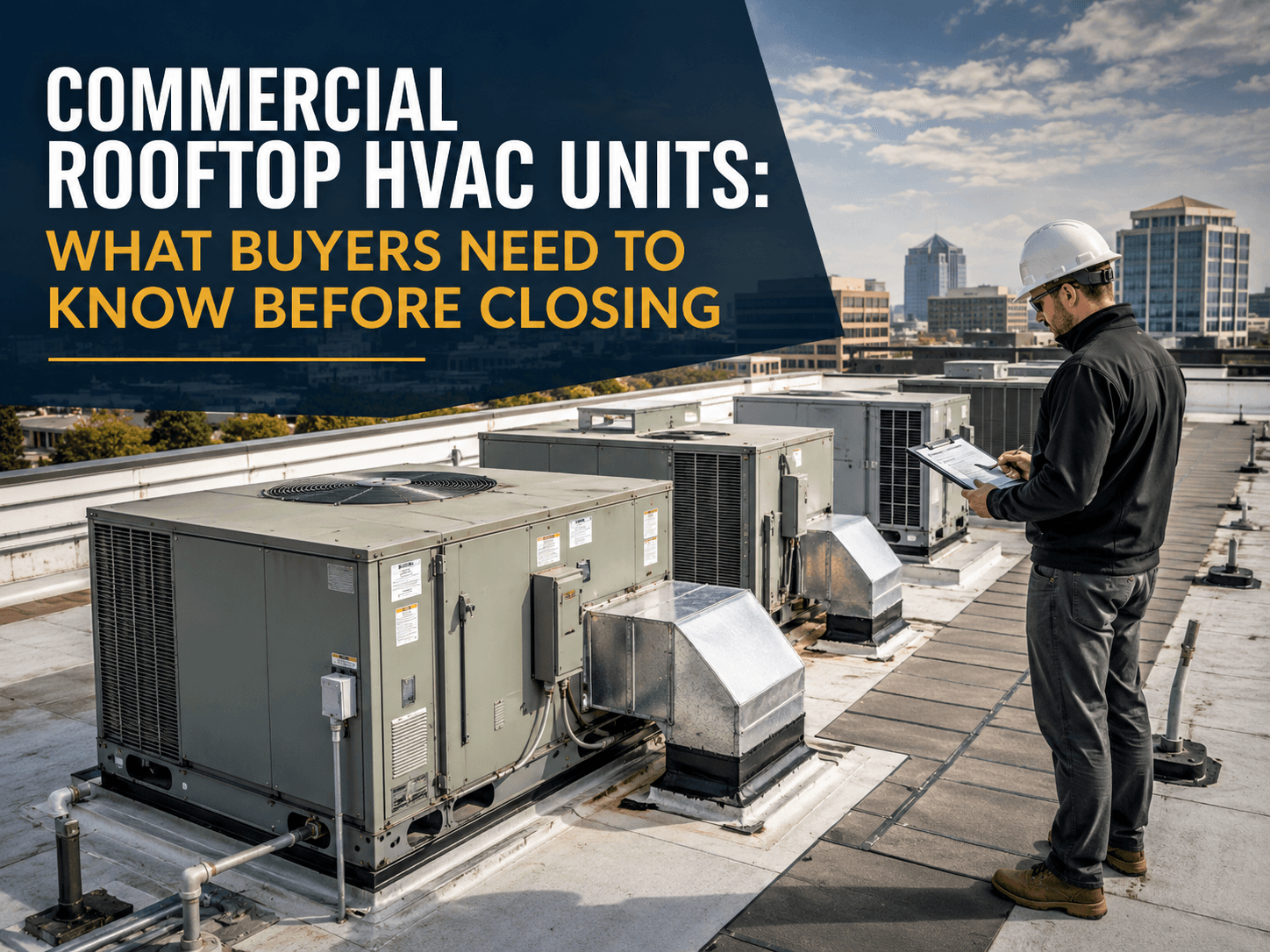
Commercial buyers often underestimate HVAC risk.
That is understandable. During a showing, the building may feel comfortable. Air may be moving through the registers. The broker may say the units are working. The seller may say there have not been any major issues.
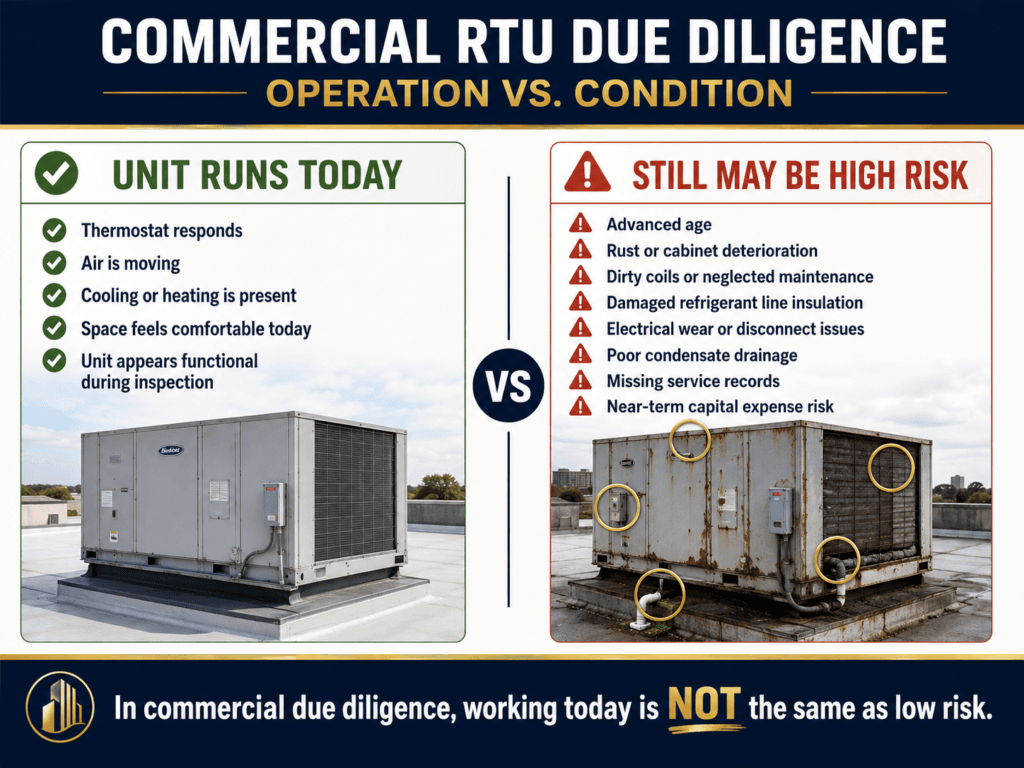
But in commercial real estate, “working today” is not the same thing as “low risk.”
A rooftop HVAC unit can operate during the inspection and still be near the end of its practical service life. It can cool the building on a mild day and still struggle during peak summer heat. It can appear functional while showing signs of rust, poor maintenance, electrical wear, refrigerant concerns, condensate issues, or previous patchwork repairs.
For commercial buyers, that matters because HVAC systems are not just comfort equipment. They are capital assets.
If one rooftop unit fails after closing, the buyer may be looking at a meaningful repair or replacement cost. If several units are aged, poorly maintained, or clustered near the end of their service life, the buyer may be inheriting a major capital expense problem.
That is why rooftop HVAC systems deserve serious attention during commercial due diligence.
At Upchurch Inspection, we look at commercial HVAC systems through the lens of risk management, deferred maintenance, and capital planning. The goal is not simply to say whether a unit turned on during the inspection. The goal is to help the buyer understand what the visible condition of those systems may mean for ownership after closing.
Why Rooftop Units Matter in Commercial Real Estate
Many commercial buildings use rooftop HVAC units, commonly called RTUs.
These units are common on:
- Retail centers
- Office buildings
- Churches
- Daycare facilities
- Medical office buildings
- Restaurants
- Warehouses with office areas
- Light industrial properties
- Mixed-use commercial buildings
- Institutional buildings
- Shopping centers
- Standalone commercial structures
RTUs are popular because they place heating and cooling equipment outside the occupied space, free up interior square footage, and allow multiple areas or tenant spaces to be served separately.
But that convenience comes with a tradeoff.
Rooftop units live in harsh conditions.
They sit on the roof through summer heat, humidity, heavy rain, storms, wind, temperature swings, and year-round exposure. They are often out of sight and out of mind. Because they are on the roof, owners may not notice deterioration until performance drops, tenants complain, leaks develop, or a unit fails.
That makes RTUs one of the most important systems to evaluate during a commercial property inspection or Property Condition Assessment.
The Mistake Buyers Make: Confusing Operation With Condition
One of the most common mistakes in commercial due diligence is assuming that if HVAC equipment turns on, the risk is low.
That is not a safe assumption.
A commercial rooftop unit can be operational while still having:
- Advanced age
- Rusted cabinet panels
- Deteriorated refrigerant line insulation
- Dirty coils
- Damaged access panels
- Poor condensate drainage
- Electrical wear
- Improper disconnect conditions
- Evidence of repeated repairs
- Missing service documentation
- Damaged duct connections
- Poor roof curb flashing
- Unsafe or difficult service access
- Corrosion at gas piping or electrical components
- Inconsistent temperature output
- No clear maintenance history
The system may be functional in the moment, but a buyer needs more than a momentary functional check.
They need to understand the ownership risk.
A better due diligence question is:
Are these systems likely to create significant expense during the buyer’s ownership period?
That is a different question than:
Did the unit run today?
Why HVAC Risk Is Really Capital Expense Risk
In a residential inspection, a worn HVAC system may be an important repair concern.
In a commercial acquisition, HVAC can become a capital planning issue.
That is especially true when a property has multiple rooftop units.
A small office building may have two or three units. A retail strip center may have several. A church or institutional campus may have multiple buildings with multiple systems. A medical office building may rely heavily on consistent temperature control. A daycare may have comfort, safety, and operational concerns tied directly to mechanical performance.
When HVAC equipment begins failing, the cost is not always limited to the equipment itself.
HVAC problems can affect:
- Tenant comfort
- Lease obligations
- Business operations
- Emergency repair costs
- Interior humidity
- Indoor air quality concerns
- Electrical loads
- Roof penetrations
- Energy efficiency
- Maintenance budgets
- Replacement planning
- Negotiation strategy
- Capital reserve requirements
For an investor, the question becomes:
How much of the building’s future income is already spoken for by aging mechanical systems?
That is the real issue.
The Mid-South Climate Is Hard on Rooftop Units
Commercial HVAC equipment in the Mid-South works hard.
In Memphis, West Tennessee, North Mississippi, Arkansas, Missouri, Kentucky, and surrounding regions, rooftop units are exposed to a challenging combination of conditions:
- Long cooling seasons
- High humidity
- Heavy rainfall
- Strong sun exposure
- Seasonal temperature swings
- Storm activity
- Condensate production
- Dust, pollen, and airborne debris
- Periods of high demand followed by milder seasons
Humidity is especially important.
High humidity can increase the workload on cooling equipment, contribute to condensate management issues, accelerate corrosion, and make comfort problems more noticeable inside the building.
Temperature swings also matter. Equipment expands, contracts, cycles, and ages. Seals, insulation, electrical connections, panels, and components all experience wear over time.
A rooftop unit in this region does not live an easy life.
That does not mean every older unit is automatically defective. But it does mean buyers should not treat RTUs as an afterthought.
What We Look for During a Rooftop HVAC Assessment
A commercial inspection or Property Condition Assessment is not the same as a full mechanical contractor service evaluation.
An inspector is generally not dismantling equipment, checking refrigerant charge, performing combustion analysis, calculating load design, or guaranteeing future service life.
But a visual and functional assessment can still reveal a lot.
During a commercial assessment, we may look at visible and accessible conditions such as:
1. Approximate Age of Equipment
Age is one of the first indicators of HVAC risk.
The age of a unit may be determined from the data plate, serial number, manufacturer information, records provided by the owner, or other available documentation.
Age alone does not determine condition. A newer unit can be neglected. An older unit can be well maintained.
But age matters because commercial HVAC equipment has a finite service life. As equipment gets older, the likelihood of repairs, performance issues, and replacement planning increases.
For commercial buyers, a building with several older units should immediately raise capital reserve questions.
2. General Exterior Condition
The exterior cabinet can reveal a lot about how the unit has aged.
Concerns may include:
- Rusted cabinet panels
- Missing screws
- Damaged access panels
- Open seams
- Loose covers
- Corroded fasteners
- Deteriorated labels
- Physical impact damage
- Evidence of prior repairs
- Poorly sealed openings
A rooftop unit is not judged only by appearance, but visible deterioration can suggest age, exposure, poor maintenance, or potential future service issues.
3. Coil Condition
Dirty or damaged coils can affect efficiency and performance.
Visible concerns may include:
- Dirt buildup
- Debris accumulation
- Damaged fins
- Blocked airflow
- Poor access for maintenance
- Evidence that routine service has been neglected
Dirty coils do not always mean the unit is failing, but they can suggest poor maintenance and reduced performance.
In a commercial setting, poor maintenance across several units can tell an important story about the property.
4. Refrigerant Line Insulation
Damaged or missing insulation at refrigerant lines is common.
It may appear minor, but it can indicate age, sun exposure, lack of maintenance, and potential efficiency concerns.
During a roof-level assessment, we often look for:
- Cracked insulation
- Missing insulation
- UV deterioration
- Loose or poorly secured line sets
- Physical damage
- Improper support
This is not usually the largest defect on a commercial building, but it contributes to the overall picture of system maintenance.
5. Electrical Disconnects and Wiring
Electrical conditions at rooftop units matter.
Visible concerns may include:
- Damaged disconnects
- Loose covers
- Improper wiring
- Corrosion
- Unsupported conduit
- Open electrical components
- Unsafe access conditions
- Missing labels
- Evidence of amateur repairs
Commercial HVAC units combine mechanical, electrical, and sometimes gas-fired components. Poor electrical conditions at RTUs should not be ignored.
6. Gas Piping and Combustion-Related Observations
Some rooftop units provide gas heat.
Visible concerns may include:
- Corroded gas piping
- Poor support
- Missing sediment traps where expected
- Damaged connectors
- Improper clearances
- Evidence of previous modification
- Concerns requiring HVAC contractor review
A general commercial inspection does not replace a full HVAC combustion safety analysis, but visible gas piping concerns should be documented and evaluated further where appropriate.
7. Condensate Management
Commercial cooling systems produce condensate.
Poor condensate management can contribute to roof staining, drainage issues, microbial growth concerns, interior leaks, and equipment damage.
During an assessment, visible concerns may include:
- Poorly routed condensate lines
- Discharge onto roof surfaces
- Clogged or damaged drains
- Improper slope
- Staining around units
- Evidence of leakage
- Water pooling near equipment
In humid climates, condensate management is not a small issue. It can be a recurring maintenance concern.
8. Roof Curbs and Flashing Around Units
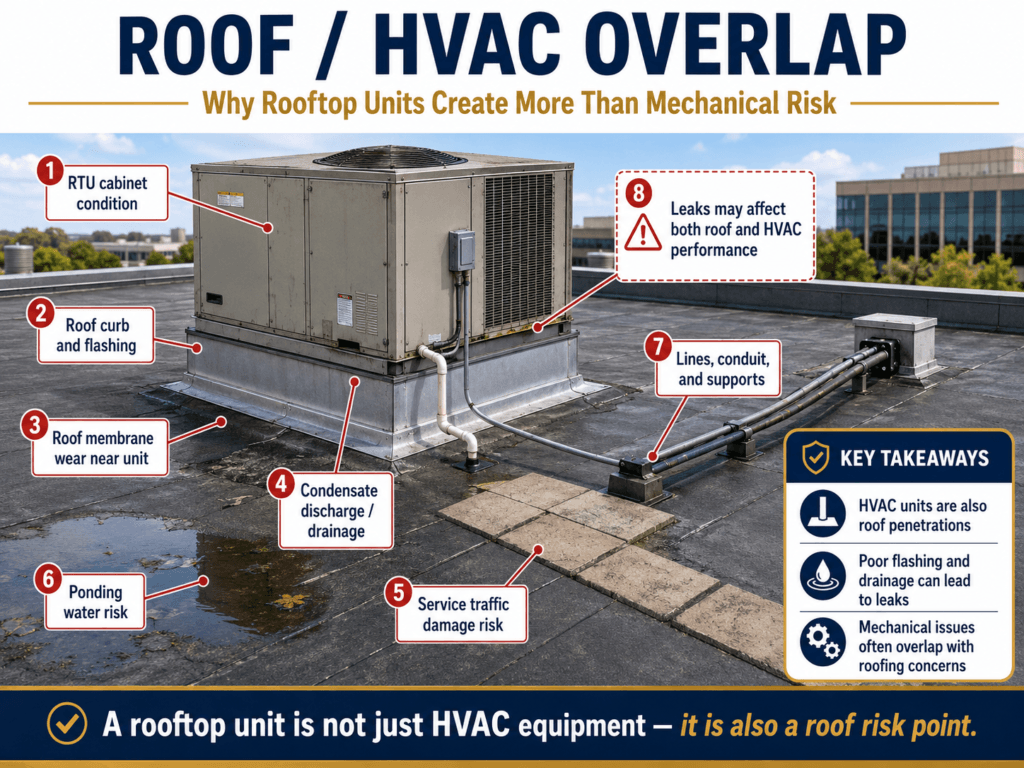
RTUs are roof-mounted. That means every unit is also a roof penetration.
The connection between the unit, curb, flashing, and roof membrane matters.
Concerns may include:
- Deteriorated sealant
- Poor flashing details
- Evidence of roof leaks near units
- Soft areas around curbs
- Rusted curbs
- Improper patching
- Ponding water near units
- Membrane deterioration around equipment
This is where HVAC and roofing risk overlap.
A rooftop unit can create mechanical concerns and roof concerns at the same time.
9. Service Access and Safety
Commercial HVAC units need routine service.
If the roof access is unsafe, limited, poorly located, or difficult, that can affect maintenance over time.
Concerns may include:
- Unsafe roof access
- Missing ladders
- Damaged access hatches
- Lack of safe walking surfaces
- Units located near roof edges
- Poor clearance around equipment
- Obstructed access panels
If technicians cannot easily and safely maintain equipment, maintenance is more likely to be neglected.
That can shorten system life and increase repair risk.
10. Evidence of Maintenance History
Service records can be extremely valuable.
A building with older but well-maintained units may be a very different risk than a building with newer equipment and no maintenance documentation.
Buyers should ask for:
- Preventive maintenance records
- Recent repair invoices
- Replacement history
- Warranty information
- Contractor service reports
- Tenant comfort complaint records
- Records of major component replacements
If no records are available, that does not prove the equipment was neglected. But it does create uncertainty.
And in commercial due diligence, uncertainty has value.
Usually, that value is expressed as risk.
Multiple RTUs: The Problem Is Often the Pattern
The biggest HVAC risk is not always one bad unit.
Sometimes the real issue is the pattern across the property.
For example:
- All units are approximately the same age
- Several units show rust or cabinet deterioration
- Multiple units have damaged line insulation
- Service records are missing for all equipment
- Several units appear poorly maintained
- Units are mismatched from years of piecemeal replacement
- Tenant spaces have inconsistent comfort
- Roof areas around units show repeated patching
- HVAC electrical disconnects show similar deficiencies
This pattern may suggest deferred maintenance across the mechanical systems.
That matters because a buyer may not be facing one repair.
They may be facing a replacement cycle.
A property with six RTUs that are all 15 to 20 years old may require a very different capital reserve strategy than a property with one older unit and five newer, well-documented units.
This is the kind of distinction commercial buyers need before closing.
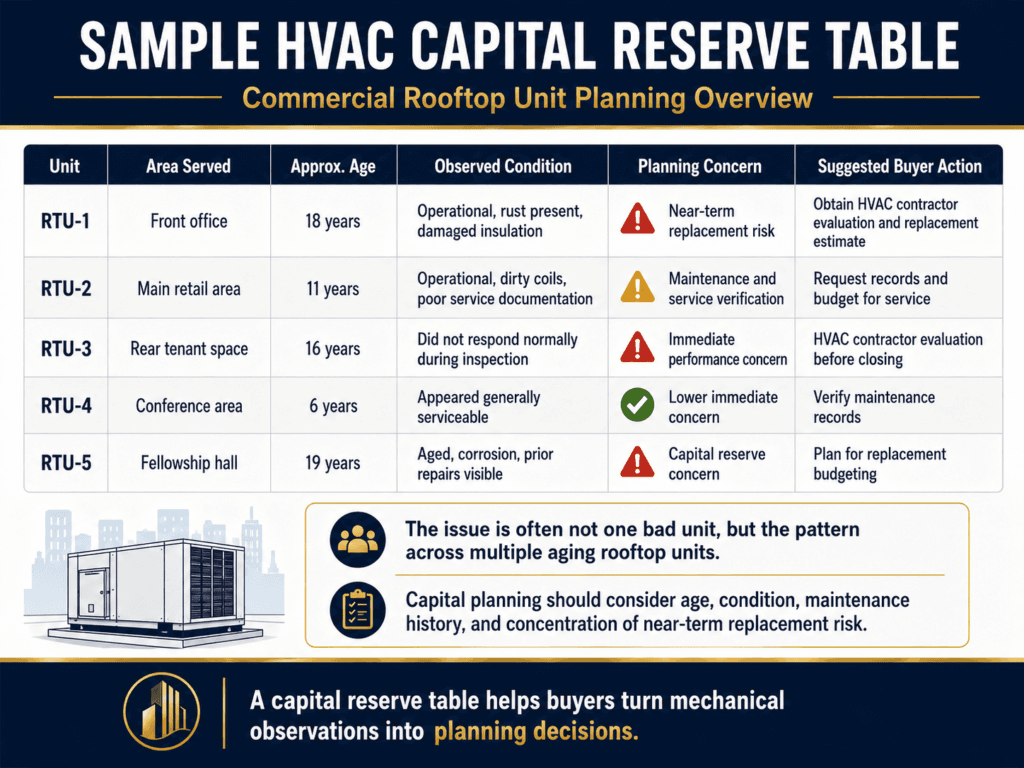
Sample HVAC Capital Reserve Table
A Property Condition Assessment may include a capital reserve table or similar summary to help the buyer understand likely near-term and long-term concerns.
Here is a simplified example of how rooftop units might be organized for planning purposes:
| Unit | Area Served | Approx. Age | Observed Condition | Planning Concern | Suggested Buyer Action |
|---|---|---|---|---|---|
| RTU-1 | Front office | 18 years | Operational, rust present, damaged insulation | Near-term replacement risk | Obtain HVAC contractor evaluation and replacement estimate |
| RTU-2 | Main retail area | 11 years | Operational, dirty coils, poor service documentation | Maintenance and service verification | Request records and budget for service |
| RTU-3 | Rear tenant space | 16 years | Did not respond normally during inspection | Immediate performance concern | HVAC contractor evaluation before closing |
| RTU-4 | Conference area | 6 years | Appeared generally serviceable | Lower immediate concern | Verify maintenance records |
| RTU-5 | Fellowship hall | 19 years | Aged, corrosion, prior repairs visible | Capital reserve concern | Plan for replacement budgeting |
This table does not replace contractor pricing.
But it gives the buyer something useful: a clearer picture of HVAC risk.
That is often what commercial clients need most.
How HVAC Findings Can Affect Negotiation
HVAC findings can affect a commercial transaction in several ways.
A buyer may use the information to:
- Request seller repairs
- Request a price reduction
- Request repair credits
- Extend the due diligence period
- Bring in an HVAC contractor
- Obtain replacement estimates
- Require service records
- Adjust post-closing capital reserves
- Reconsider the purchase price
- Decide whether the property still supports the investment plan
This does not mean every old unit should kill a deal.
Commercial buildings often have aging systems. That is normal.
The issue is whether the buyer knows what they are accepting.
A $20,000 concern may be manageable. A $200,000 cluster of mechanical risk across multiple systems may change the deal.
The inspection helps the buyer separate routine ownership costs from meaningful financial exposure.
Why “Seller Says It Works” Is Not Enough
Sellers and brokers often describe HVAC systems in simple terms:
- “It works.”
- “We have not had any issues.”
- “It was serviced recently.”
- “The tenants have not complained.”
- “The roof units are fine.”
- “We replaced one a few years ago.”
Those statements may be true.
They may also be incomplete.
A unit can work and still be old. A unit can have no recent complaints because the space has been vacant. A unit can have been serviced recently because it was already having problems. One replaced unit does not eliminate concern about the others.
Commercial buyers need documentation, not just reassurance.
Helpful documentation may include:
- Model and serial numbers
- Installation dates
- Preventive maintenance history
- Repair invoices
- Warranty information
- Tenant complaint history
- Utility cost history
- Records of recent major component replacement
- Confirmation of areas served by each unit
The more complex the property, the more important documentation becomes.
HVAC and Tenant Risk
For income-producing properties, HVAC risk is also tenant risk.
If the HVAC system fails, the owner may face:
- Tenant complaints
- Rent disputes
- Emergency repair costs
- Business interruption claims
- Lease compliance issues
- Vacancy risk
- Reputation issues
- After-hours service calls
- Temporary cooling or heating costs
This is especially important in:
- Medical office buildings
- Daycare facilities
- Restaurants
- Retail centers
- Office buildings
- Churches and event facilities
- Multifamily properties
- Senior living or care-related facilities
- Buildings with temperature-sensitive operations
For some tenants, comfort is not just comfort. It affects business operations.
A medical office with poor cooling in summer may have a different risk profile than a vacant warehouse storage area. A daycare with inconsistent heating or cooling may face operational pressures. A restaurant with poor HVAC may affect customer experience and staff working conditions.
The intended use of the building matters.
HVAC and Roof Risk Are Connected
Rooftop HVAC units should not be evaluated in isolation.
They are installed on the roof, which means they can affect the roofing system.
Common crossover issues include:
- Poor flashing around roof curbs
- Ponding water near units
- Roof membrane damage from service traffic
- Condensate discharge onto roof surfaces
- Improperly supported lines or conduit
- Rust staining
- Patch repairs around equipment
- Leaks near curbs
- Roof damage from repeated HVAC service work
This is one reason commercial assessments need to look at the building as a system.
A mechanical issue may also be a roof issue.
A roof leak may be related to flashing around equipment.
A condensate problem may be contributing to roof deterioration.
A service access problem may be causing roof membrane damage.
Commercial buildings do not fail in neat categories. Systems overlap.
When to Bring in an HVAC Contractor
A commercial inspector can identify visible concerns, functional limitations, age-related risk, and conditions that warrant further evaluation.
But there are times when an HVAC contractor should be brought in before closing.
Further HVAC evaluation may be appropriate when:
- Equipment is older or near the end of expected service life
- Multiple units show deterioration
- Units do not operate properly during the inspection
- There are no maintenance records
- The building use depends heavily on mechanical performance
- The buyer needs replacement cost estimates
- The property has complex mechanical systems
- There are tenant complaints
- The systems appear modified or poorly maintained
- There are safety concerns
- The buyer needs confirmation of capacity for intended use
This is not overkill.
It is good commercial due diligence.
A buyer should not wait until after closing to discover that the building’s mechanical systems do not support the intended use or require major replacement.
HVAC Scope Should Match the Property
Not every commercial property needs the same HVAC assessment.
A small office condo with one split system does not carry the same mechanical risk as a church campus with multiple buildings and a dozen units.
The inspection scope should consider:
- Number of units
- Equipment type
- Building size
- Building use
- Occupancy status
- Tenant sensitivity
- System age
- Maintenance history
- Access limitations
- Whether cost opinions are needed
- Whether specialists should be involved
- Whether the buyer is planning a change in use
A property buyer planning to keep the existing use may have one level of concern.
A buyer planning to convert the space may have another.
For example, a warehouse used for storage may not need the same HVAC performance as a medical office conversion. A church campus with classrooms, sanctuary space, offices, kitchens, and fellowship areas may have multiple comfort zones and demand patterns.
The scope should match the decision being made.
Red Flags Commercial Buyers Should Watch For
Commercial buyers do not need to be HVAC experts, but they should know when to slow down and ask more questions.
Red flags may include:
- Several units appearing old
- No maintenance records
- Multiple units from the same installation era
- Rust or corrosion on cabinets
- Units not responding properly
- Staining or water around units
- Repeated roof patching near RTUs
- Damaged disconnects or wiring
- Inconsistent comfort inside the building
- Tenant complaints about temperature
- Vacant spaces where systems have not been tested under real use
- Evidence of repeated service calls
- Seller unable to identify which unit serves which area
- Missing data plates
- Poor service access
- Units located on deteriorated roof areas
One red flag may not be a deal-breaker.
A pattern of red flags may be a capital planning issue.
Example Scenario: The “Profitable” Building With Tired RTUs
Consider a buyer evaluating a small commercial building with several tenant spaces.
The rent roll looks good. The location is strong. The building appears occupied and functional.
During the assessment, the roof is accessible and five rooftop units are observed.
The findings look something like this:
- Three units are older and show visible corrosion
- Two units have deteriorated refrigerant line insulation
- One unit does not appear to respond normally
- Service records are not available
- Roof membrane around multiple units shows patching
- One tenant reports uneven cooling in summer
- The electrical disconnects show age and weathering
None of those findings alone may prove immediate failure.
But together, they create a different picture.
The buyer may now have to consider:
- HVAC contractor evaluation before closing
- Replacement estimates for older units
- Whether the seller should provide service documentation
- Whether the purchase price reflects near-term mechanical risk
- Whether reserves should be increased after closing
- Whether tenant comfort issues may affect renewals
That is the purpose of commercial due diligence.
It changes the conversation from:
“The building seems fine.”
To:
“Here are the mechanical risks that may affect the deal.”
HVAC Findings Should Be Written for Decision-Makers
A commercial report should not bury HVAC concerns in vague language.
The report should help decision-makers understand what was observed and why it matters.
That is especially important when the report is being reviewed by:
- Buyers
- Investors
- Lenders
- Trustees
- Facility managers
- Attorneys
- Brokers
- Boards
- Partners
- Property managers
A useful report does not just say:
“HVAC unit is old.”
It should provide practical context:
“Several rooftop HVAC units appeared aged and showed visible deterioration. Maintenance records were not provided. Due to the number of units and observed condition, further evaluation by a qualified HVAC contractor is recommended before the end of the due diligence period. The buyer should consider near-term repair or replacement budgeting.”
That type of language supports business decisions.
It is not alarmist. It is clear.
Commercial Buyers Should Ask These HVAC Questions Before Closing
Before closing on a commercial property, buyers should ask:
- How many HVAC units serve the building?
- What areas does each unit serve?
- How old is each unit?
- Are service records available?
- Have any units been replaced recently?
- Are there active tenant complaints?
- Are any units under warranty?
- Are there known refrigerant, compressor, heat exchanger, or control issues?
- Has the building use changed since the systems were installed?
- Are the systems adequate for the buyer’s intended use?
- Are there roof leaks or patching near the units?
- Are replacement costs included in the buyer’s capital planning?
- Should an HVAC contractor evaluate the equipment before closing?
The answers to these questions may affect the economics of the deal.
Why This Matters for Churches, Campuses, and Institutional Buildings
Churches, schools, daycares, and institutional properties often have complicated HVAC situations.
They may include:
- Older equipment
- Multiple additions
- Systems installed at different times
- Large assembly spaces
- Classrooms
- Kitchens
- Offices
- Fellowship halls
- Gymnasiums
- Sanctuaries
- Intermittent high occupancy
- Long periods of limited use
- Deferred maintenance due to budget constraints
These properties may look functional during a showing, but HVAC costs can be substantial.
A church board or trustee group may need to understand whether the property is facing a series of upcoming mechanical expenses.
That is especially important when the building has multiple large spaces served by separate systems.
A commercial assessment can help the board understand what they are inheriting and whether additional mechanical evaluation is needed before a major purchase or renovation decision.
Why This Matters for Multifamily Properties
Multifamily properties can present a different HVAC risk.
Depending on the building, systems may be centralized, individual to each unit, or a mix of equipment types.
Concerns may include:
- Numerous aging systems
- Inconsistent replacement history
- Poor tenant maintenance
- Window units or temporary solutions
- Improper installations
- Electrical limitations
- Condensate issues
- Poor access
- Deferred maintenance across multiple units
In multifamily acquisitions, the problem is often scale.
One bad unit is a repair.
Twenty aging units are a portfolio issue.
A buyer should understand whether HVAC replacement is going to become a predictable capital expense after closing.
Why This Matters for Retail and Office Buildings
Retail and office properties often depend heavily on comfort.
If tenants, employees, customers, patients, or clients are uncomfortable, the building’s operations are affected.
Common concerns include:
- Tenant spaces served by separate RTUs
- Uneven temperatures between suites
- Poor access to thermostats or controls
- Older units above tenant spaces
- Roof leaks around HVAC curbs
- Service records controlled by tenants
- Unclear responsibility under lease terms
- Equipment replaced inconsistently over time
For leased commercial property, buyers should understand not only the physical condition of HVAC systems, but also who is responsible for maintenance, repair, and replacement under the leases.
That is a business issue, not just an inspection issue.
A rooftop unit can operate during the inspection and still represent a major capital expense risk. In commercial real estate, “working today” is not the same as “low risk.”
-Upchurch Inspection
The Bottom Line: HVAC Can Change the Deal
Rooftop HVAC units are easy to overlook because they are often out of sight.
But for commercial buyers, they can be one of the most important capital risk areas on the property.
A unit that works today may still require replacement soon. Several aging units can create a major reserve planning concern. Poor maintenance can shorten useful life. Lack of records can increase uncertainty. Roof-mounted equipment can also create roof-related concerns.
The purpose of a commercial inspection or Property Condition Assessment is not to predict the exact failure date of every unit.
The purpose is to help the buyer understand visible condition, maintenance risk, age-related concerns, and whether further evaluation is needed before closing.
Commercial buyers should not ask only:
“Does the HVAC work?”
They should ask:
“What HVAC risk am I inheriting, and how could that affect my ownership costs?”
That is the question that matters.
Need a Commercial HVAC-Focused Property Assessment?
Upchurch Inspection provides commercial property inspections and Property Condition Assessments for buyers, investors, lenders, trustees, property owners, and real estate professionals throughout the Mid-South.
We evaluate commercial buildings with attention to major system condition, deferred maintenance, visible risk, and practical decision-making before closing or major investment.
For properties with rooftop HVAC units, multiple mechanical systems, or significant capital planning concerns, we can help document visible conditions and recommend further specialist evaluation where appropriate.
To discuss the right scope for your commercial property, contact Upchurch Inspection.