
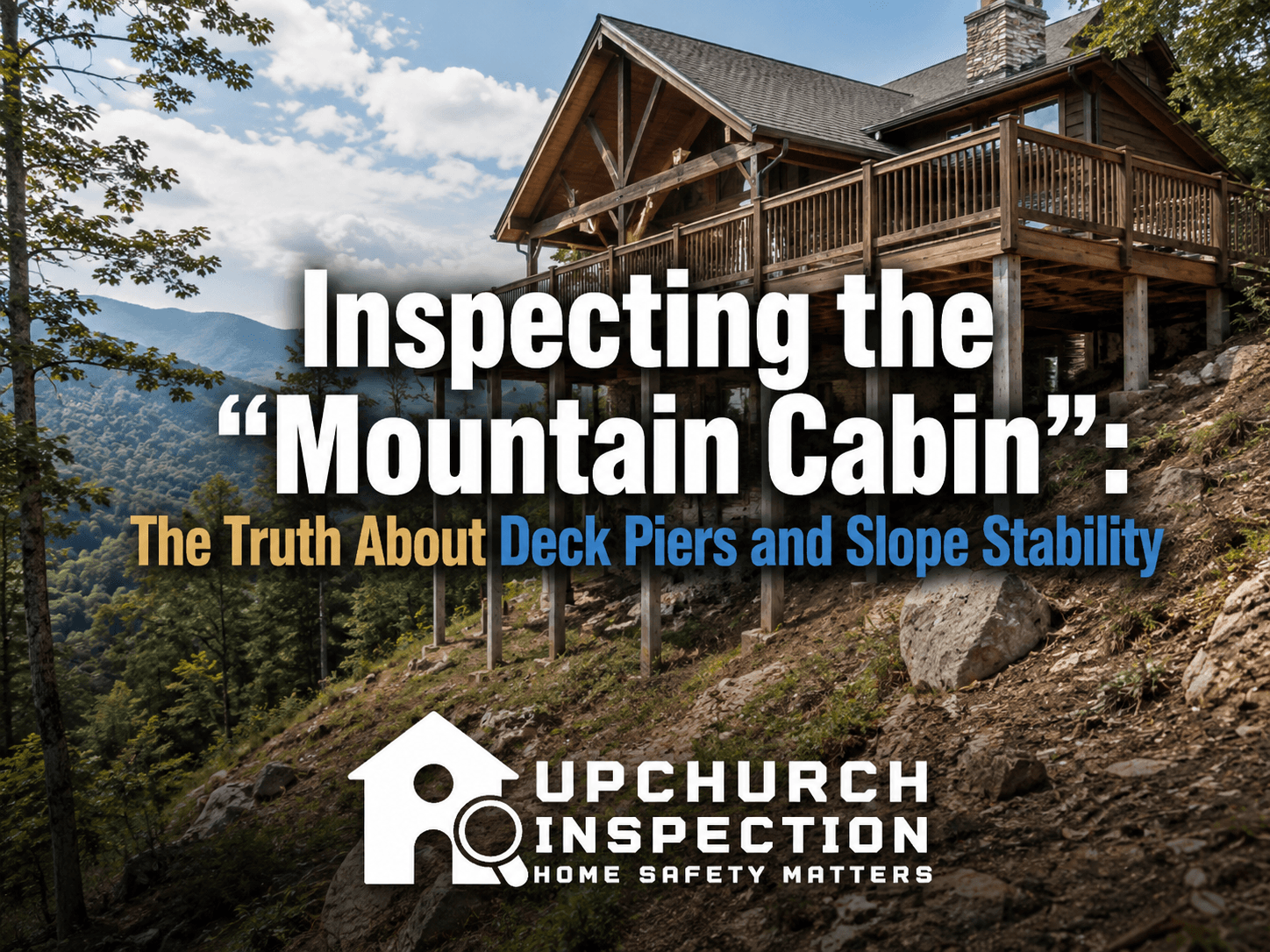
Mountain cabins in East Tennessee sell a promise. Views. Quiet. Space between neighbors. A big deck hanging out over a slope that makes you feel like you’re floating in the trees. Buyers step out onto that deck and immediately picture coffee, sunsets, maybe a hot tub if the structure looks “sturdy enough.”
That deck is also the most abused structural element on the entire property — and on mountain sites, it’s usually the first thing that tells me whether the house was built with the slope in mind or built despite it.
Mountain Lots Don’t Behave Like Flat Ones
Cabins in Sevier County and along the West Knoxville ridges aren’t sitting on uniform ground. They’re built on cut-and-fill sites, shallow soils over rock, or layered material that moves differently depending on moisture and freeze-thaw cycles.
Gravity never stops working on these lots. Soil creeps. Water travels laterally. And anything that relies on shallow support has to fight that movement year after year.
Decks feel that fight before the house does.
Decks Become Structural Extensions, Not Accessories
On flat ground, a deck is a platform. In the mountains, it’s a cantilevered structure often held up by tall posts — sometimes 10, 15, even 20 feet in the air.
At that point, the deck isn’t an accessory anymore. It’s a structural extension of the house, and it should be treated like one.
Unfortunately, many aren’t.
Post Piers: Where Things Go Wrong First
Most mountain deck failures start at the same place: the base of the posts.
I routinely find:
- Posts set shallow into soil instead of bearing on rock or proper footings
- Concrete piers poured on fill without reinforcement
- Posts sitting directly on grade with no separation
Once moisture gets involved, those supports start losing capacity. And because the deck is elevated, small movements get amplified fast.
Post-Base Uplift Is a Real Problem Here
Here’s a term that matters in the mountains: post-base uplift.
Wind loads, freeze-thaw cycles, and soil movement can lift or shift improperly anchored posts. Once that happens, the deck stops acting like a unified structure and starts moving independently.
I’ve seen decks where:
- One post lifted just enough to throw the whole deck out of plane
- Connections loosened because movement wasn’t restrained
- Ledger boards took loads they were never designed to carry
When decks move, they don’t always collapse. They loosen first. That’s more dangerous, because people keep using them.
Ledger Attachments Get Overtrusted
Buyers love hearing, “It’s bolted to the house.” That doesn’t mean much unless it was done correctly.
On mountain cabins, I pay close attention to:
- Whether the ledger is properly flashed
- Fastener spacing and type
- Evidence of rot behind the ledger
Water intrusion at the ledger is common, especially where decks intersect complex rooflines. Once rot starts there, both the deck and the house are at risk.
Tall Posts Magnify Small Errors
A one-inch shift at the base of a post doesn’t sound like much. At the top of a 16-foot post, it’s a big deal.
That’s why I look for:
- Posts that are no longer plumb
- Cross-bracing that’s missing or undersized
- Connections relying on nails instead of bolts
The taller the deck, the less forgiving the structure becomes.
Slope Drainage Undermines Supports Quietly
Water doesn’t just fall downhill. It moves through soil layers until it finds daylight. On sloped lots, that often means water traveling under deck supports.
Erosion around piers is a slow process, but it’s relentless. By the time soil loss is visible, bearing capacity is already compromised.
Fresh mulch and landscaping hide this really well.
DIY Repairs Make Things Worse
Mountain cabins attract owners who like to tinker. I respect that — until it involves structural components.
I’ve seen:
- Concrete “collars” poured around failing posts
- Shims stacked to level sagging beams
- Temporary braces that became permanent
These fixes don’t restore capacity. They redistribute stress and usually accelerate failure somewhere else.
Hot Tubs Change the Math Completely
This one deserves its own paragraph. Hot tubs are deck killers.
Water is heavy. A lot heavier than patio furniture. I routinely see hot tubs placed on decks that were never designed for that load — especially on elevated structures.
Cracking, sagging, and connection failures often start shortly after a tub is installed. By the time someone asks if the deck can handle it, the damage is already done.
Why Cabins Need Slope-Aware Inspections
Inspecting mountain cabins isn’t about checking rail height and calling it good. It’s about understanding how gravity, moisture, and structure interact on a slope.
Decks fail in the mountains because they’re built like they’re on flat ground. And slopes punish that assumption every time.
For buyers evaluating cabins and hillside homes across East Tennessee, inspections need to look past the view and into the structure holding it up.
https://upchurchinspection.com/our-service-areas/home-inspections-in-east-tennessee/
Out here, the scenery is dramatic.
So are the consequences when structural details get ignored.