
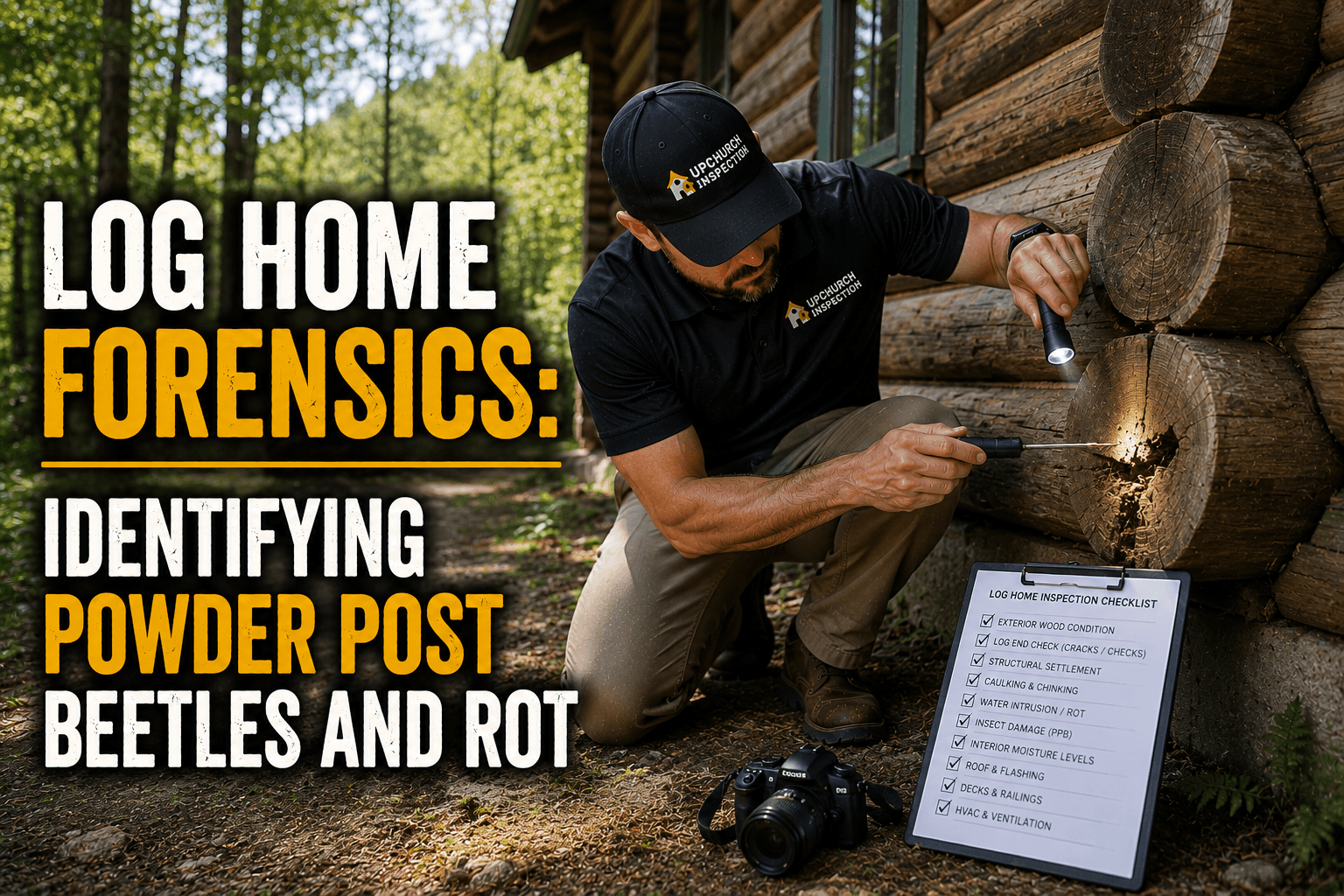
Log homes look solid. Thick walls. Heavy timbers. People assume they’re bulletproof.
They’re not.
Logs are organic, and organic materials don’t just sit there forever behaving themselves. They move, they absorb moisture, they dry out, and when conditions are right, they get eaten—slowly and quietly—by things you won’t notice until real damage is already done.
I’ve inspected log homes all over Hardeman County, and the biggest mistake owners make is thinking, “If it was a problem, we’d know by now.”
That’s almost always wrong.
Logs Are Living Material (Even After the Tree’s Dead)
A log home isn’t a concrete bunker. It’s a stacked collection of wood members that still respond to:
- Moisture
- Temperature
- Humidity
- Air movement
Logs swell when they absorb moisture and shrink when they dry. That movement opens gaps, stresses fasteners, and creates entry points for water and insects.
If you don’t manage that movement, the house starts managing itself—and it doesn’t do a good job.
Powder Post Beetles: Quiet, Patient, Destructive
Powder post beetles don’t announce themselves. They don’t chew loudly. They don’t swarm.
They just get to work.
What they leave behind:
- Fine, talcum-like powder on surfaces
- Tiny exit holes in logs and beams
- Wood that looks solid but isn’t anymore
By the time most homeowners notice them, the beetles have been there for years.
Why Hardeman County Is Prime Beetle Territory
Log homes in Hardeman County are especially vulnerable because:
- Humidity stays high
- Crawlspaces are often damp
- Logs are close to grade
- Maintenance is inconsistent
Add in shaded lots and wooded surroundings, and you’ve got ideal conditions for beetle activity.
Around rural areas, people assume bugs are just part of the deal. Some are. Structural pests aren’t.
Upward-Facing Checks: Where Rot Loves to Start
Logs naturally develop checks—cracks along the grain. That’s normal.
The problem is upward-facing checks.
When checks face up:
- They collect water
- Water sits against raw wood
- Rot begins internally
- Damage spreads from the inside out
From the outside, the log still looks fine. Inside, it’s softening.
Rot Rarely Starts Where You Expect
Rot doesn’t usually start in the middle of a wall. It starts where water hangs out:
- Bottom courses near grade
- Around windows and doors
- At roof overhang transitions
- Beneath decks and porches
- Where splashback hits repeatedly
I’ve poked logs that looked great and watched the probe sink in an inch. That’s not cosmetic. That’s structural loss.
Chinking Isn’t Structural (And It Isn’t a Fix)
Chinking gets treated like mortar. It’s not.
Chinking:
- Seals gaps
- Reduces air infiltration
- Improves comfort
It does not:
- Stop rot
- Reinforce logs
- Fix moisture problems
If chinking is failing, it’s usually because the logs underneath are moving or deteriorating. Smearing more on top doesn’t fix that.
Borate Treatments: Helpful, Not Magical
Borate treatments are one of the better tools for log homes—but they’re not permanent armor.
They work by:
- Making wood less appetizing to insects
- Slowing fungal growth
They don’t:
- Reverse existing damage
- Fix moisture issues
- Replace maintenance
I see log homes where borate was applied once and never again. That’s not a plan. That’s wishful thinking.
Crawlspaces and Grade Clearance Matter More Than Walls
Most log home failures start below the logs, not in them.
Common problems I see:
- Logs too close to soil
- Splashback soaking lower courses
- Poor drainage around the foundation
- Damp crawlspaces feeding moisture upward
If the bottom logs stay wet, everything above them eventually pays the price.
What I’m Looking For During Log Home Inspections
When I inspect log homes, I’m focused on:
- Evidence of powder post beetle activity
- Softness at log ends and joints
- Upward-facing checks holding moisture
- Condition of lower courses
- Drainage and grade clearance
- Crawlspace moisture and ventilation
I’m not just asking “Does it look rustic?”
I’m asking “Is this structure losing material?”
Why Log Homes Age Differently Than Framed Homes
Framed houses hide problems behind drywall. Log homes put everything on display—but that doesn’t make them easier to evaluate.
Damage often starts inside the log, not on the surface. By the time it shows, repair options are limited and expensive.
Replacing logs is not like replacing siding.
What Buyers Should Understand Before Falling in Love
Log homes can be great. They just require:
- Regular inspections
- Moisture management
- Pest monitoring
- Ongoing treatment
- Realistic expectations
If you want something you can ignore for ten years, a log home isn’t it.
Final Thoughts
Log homes aren’t failing because they’re poorly built. They fail because people forget they’re made of wood.
In Hardeman County, humidity, insects, and water are always working. If you’re not working against them, they’re winning—slowly, quietly, and expensively.
Protecting your West Tennessee investment starts with a forensic eye. View our West Tennessee Service Area to see a full list of towns we serve.