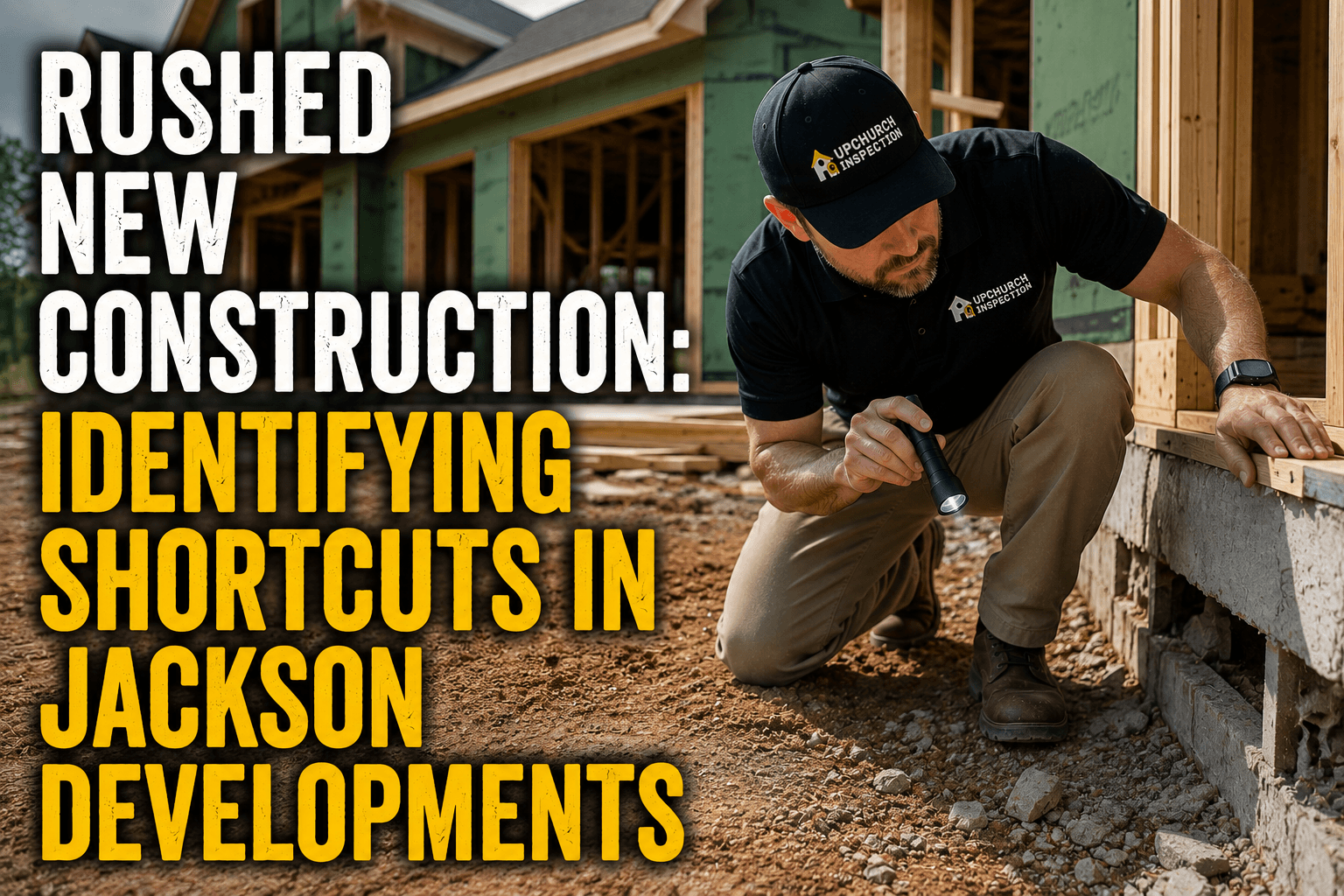
New construction is supposed to remove uncertainty. Buyers expect modern materials, current codes, and fewer surprises. In fast-growing markets, that expectation is often misplaced.
In and around Jackson—particularly for buyers commuting from Humboldt and Milan—new homes under the $400k range are going up quickly. Too quickly. Builders are racing schedules, stacking trades, and closing houses before systems have ever operated under real-world conditions.
From an inspection standpoint, the problem isn’t inexperience. It’s speed.
Why Rapid Growth Creates Construction Risk
When demand spikes, builders optimize for throughput:
- More starts
- Shorter build cycles
- Fewer delays between trades
Quality control suffers not because trades are unskilled, but because sequencing matters, and sequencing is where rushed builds break down.
Many defects in new construction aren’t dramatic failures. They’re missing components, incomplete integrations, and shortcuts that only show up after occupancy.
The Myth of “It Passed Inspection”
Municipal inspections are not forensic evaluations.
They are:
- Snapshot checks
- Limited in scope
- Performed under time constraints
Passing a code inspection means minimum standards were met at a specific moment—not that the home was built well, or that systems will perform reliably together.
Attic Systems: Where Speed Shows First
Missing or Improper Attic Baffles
One of the most common defects we find in Jackson-area new construction is missing or improperly installed attic baffles.
Without proper baffles:
- Insulation blocks soffit airflow
- Attic temperatures rise
- Moisture accumulates
- Roof sheathing ages prematurely
This defect doesn’t cause immediate damage—but it shortens roof life and increases humidity-related issues over time.
Incomplete Air Sealing
Rushed builds often skip detailed air sealing at:
- Top plates
- Attic penetrations
- Mechanical chases
The result is uncontrolled air movement that:
- Reduces HVAC efficiency
- Increases humidity
- Creates pressure imbalances
These homes aren’t drafty—they’re unstable.
Flashing Errors: Cosmetic Until They’re Not
Roof-to-Wall Transitions
Flashing defects are among the most expensive shortcuts because they hide well and fail slowly.
Common findings include:
- Missing kick-out flashing
- Improper step flashing
- Reliance on sealants instead of mechanical integration
Water intrusion here doesn’t always present as leaks. It migrates behind cladding and damages framing before interior signs appear.
Windows and Doors Installed on Schedule, Not Correctly
In rushed builds, window installation often prioritizes speed:
- Incomplete flashing sequences
- Improper pan flashing
- Over-reliance on caulk
Windows don’t fail immediately. They fail after repeated wetting cycles—long after the builder warranty period feels distant.
Crawlspaces: Clean Today, Risky Tomorrow
New crawlspaces often look pristine at closing. That doesn’t mean they were finished correctly.
Common shortcuts include:
- Inadequate vapor barriers
- Missing or incomplete sealing at penetrations
- Poor drainage at perimeter walls
- Unsealed access doors
Once occupancy begins and HVAC systems start cycling, moisture behavior changes—and crawlspaces reveal whether they were designed or just completed.
HVAC Systems Installed to Minimum, Not Performance
Sizing vs. Layout
HVAC systems in new construction are often sized correctly—but installed poorly.
We routinely see:
- Undersized return pathways
- Inadequate balancing
- Long duct runs with sharp turns
- Poorly sealed connections
These systems technically work—but they struggle under peak load and produce uneven comfort.
Short Cycling and Latent Load Issues
Improper system design leads to:
- Short cycling
- Poor humidity control
- Increased wear on components
In West Tennessee’s climate, humidity control matters as much as temperature. Rushed HVAC design ignores that reality.
Plumbing Shortcuts Hidden Behind Walls
Plumbing defects in new construction are rarely visible at walkthrough.
Common issues include:
- Improper slope on drain lines
- Loose or unsupported piping
- Minimal clearance at penetrations
- Poorly secured fixtures
These problems don’t cause immediate leaks. They cause early system fatigue and noise complaints that frustrate homeowners within the first year.
Electrical Systems: Functional But Marginal
Electrical work in rushed builds often meets code but lacks foresight.
We frequently find:
- Overloaded circuits serving modern lifestyles
- Minimal receptacle placement
- Shared circuits that complicate future upgrades
- Panels installed with no expansion capacity
The house works—but it’s already at its limit.
Structural Details Missed in the Rush
Structural shortcuts are subtle:
- Missing fasteners
- Incomplete bracing
- Improper load transfer at transitions
These don’t cause immediate failure. They reduce redundancy—making the structure less tolerant of movement, moisture, or stress over time.
Humboldt & Milan: The Commuter Pressure Zone
Buyers commuting from Humboldt and Milan often prioritize:
- Newness
- Move-in readiness
- Warranty coverage
Builders know this. Homes are marketed aggressively before systems have gone through seasonal cycles.
This is where 11-Month Warranty Inspections matter most.
Why the 11-Month Inspection Is Critical
The 11-month inspection occurs before builder warranties expire but after the home has:
- Experienced a full heating and cooling cycle
- Settled under real occupancy loads
- Revealed moisture and airflow behavior
This is when latent defects surface—and when responsibility can still be assigned.
Inspection Patterns That Reveal Rushed Construction
Experienced inspectors identify rushed builds by:
- Incomplete integration between systems
- Repeated “almost right” installations
- Reliance on sealants instead of assemblies
- Uniform shortcuts across multiple homes in the same development
These patterns don’t show up in listings. They show up in inspections.
What Buyers Should Adjust Their Expectations Around
New construction doesn’t eliminate risk. It shifts it.
Instead of aging materials, buyers face:
- Incomplete execution
- Unproven system performance
- Compressed build timelines
Understanding that tradeoff changes how inspections are used—and valued.
Final Thoughts
Rushed construction doesn’t mean bad construction. But it does mean unfinished thinking.
In Jackson-area developments serving Humboldt and Milan commuters, speed has become a design constraint. The result is homes that look complete but haven’t been tested.
An inspection isn’t about catching mistakes. It’s about identifying where speed replaced diligence—and what that means long-term.
Protecting your West Tennessee investment starts with a forensic eye. View our West Tennessee Service Area to see a full list of towns we serve.