
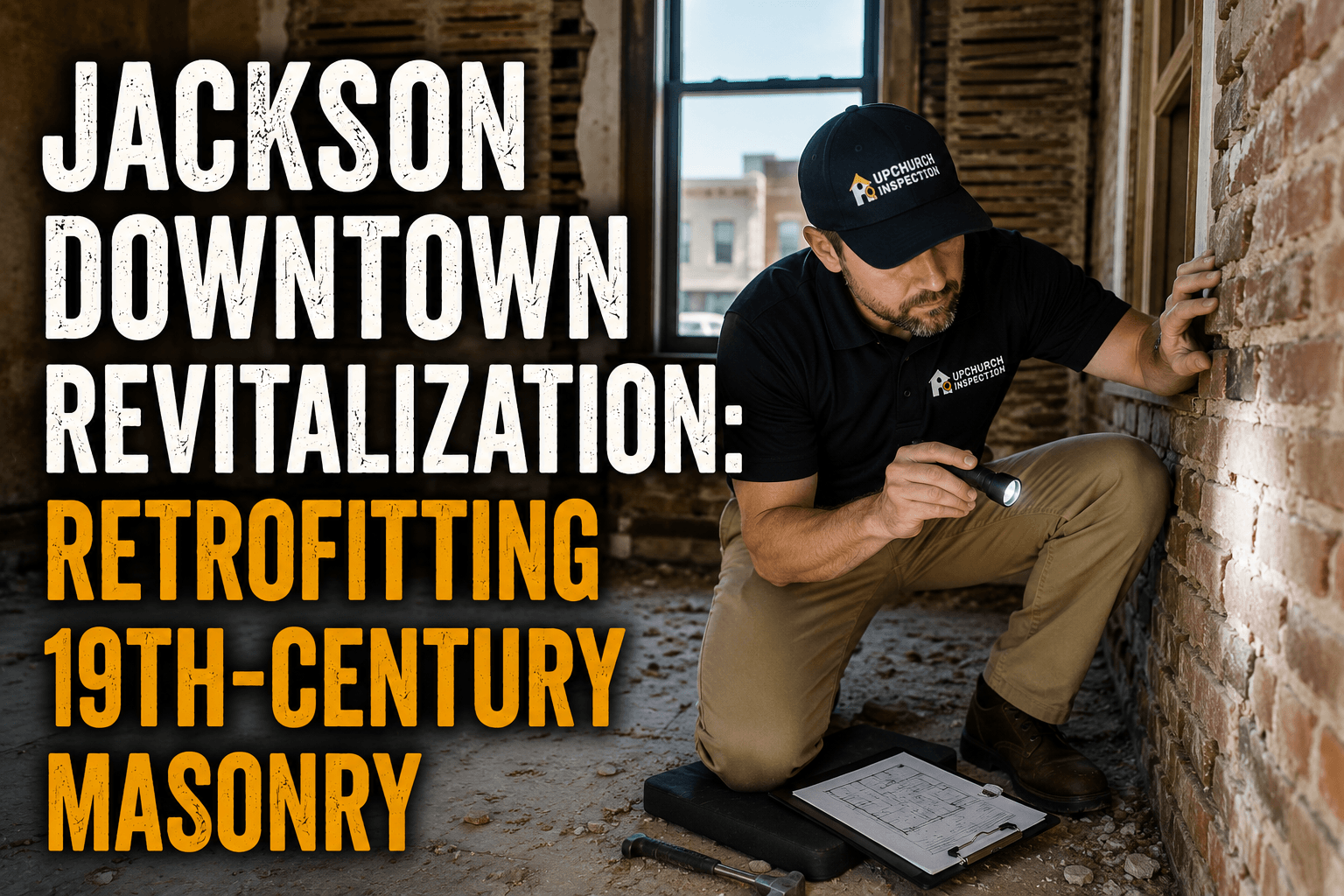
Downtown revitalization always looks good on paper. Historic storefronts get fresh signage. Upper floors get converted to offices or apartments. Brick gets cleaned, windows get replaced, and suddenly a building that sat half-vacant for decades is back in play.
What doesn’t change is the structure underneath.
In downtown Jackson, many commercial buildings date back to the late 1800s and early 1900s. They were built for a different economy, different loads, different moisture behavior, and different expectations about longevity. When modern buyers step into these properties, they’re not just purchasing square footage—they’re inheriting masonry systems that were never designed to behave the way we ask them to today.
From an inspection standpoint, the risk isn’t history. The risk is misunderstanding how historic masonry actually fails.
Why 19th-Century Masonry Behaves Differently
Historic masonry buildings in Jackson were constructed long before modern moisture control, structural reinforcement, and mechanical integration became standard.
These buildings typically feature:
- Solid brick walls (not cavity walls)
- Lime-based mortar, not Portland cement
- Wood framing pockets embedded directly into masonry
- Shallow or non-existent foundations by modern standards
They were designed to breathe, not seal.
When modern renovations ignore that reality, damage accelerates.
Unreinforced Masonry: Strength Without Flexibility
Compression vs. Lateral Forces
Brick performs exceptionally well in compression. That’s why these buildings are still standing after a century. Where they fail is lateral movement.
Unreinforced masonry does not tolerate:
- Differential settlement
- Seismic activity
- Moisture-induced expansion
- Structural load redistribution
In downtown Jackson, where buildings share walls and foundations, movement in one structure often transfers stress to another.
Rising Damp: The Moisture Problem That Never Left
What Rising Damp Actually Is
Rising damp occurs when moisture from the ground migrates upward through masonry via capillary action. In older buildings, there was often no damp-proof course to stop it.
Signs of rising damp include:
- Efflorescence on lower walls
- Deteriorating mortar near grade
- Interior plaster damage at consistent heights
- Musty odors concentrated at street level
This is not a roof issue. It’s a ground-to-wall moisture path that never stops unless interrupted.
Why Modern Renovations Make It Worse
Modern renovations often introduce:
- Interior vapor barriers
- Non-breathable paints
- Sealed flooring systems
These trap moisture inside masonry that was designed to release it, accelerating brick and mortar deterioration from within.
Floor Joist Pocket Rot: The Silent Structural Failure
Embedded Wood Is a Known Weak Point
Many 19th-century Jackson buildings rely on floor joists embedded directly into masonry walls. Over decades, moisture migrates through brick and saturates those joist ends.
The result is pocket rot.
From the interior, floors may feel solid. From the exterior, walls may look intact. Inside the masonry, joist ends slowly decay until load transfer fails.
Inspection Indicators of Pocket Rot
During inspections, we look for:
- Sagging floors near exterior walls
- Cracking or separation at joist lines
- Localized wall movement above floor levels
- Evidence of previous sistering or patch repairs
Once rot reaches a critical point, structural repair becomes invasive and expensive.
Shared Walls and Structural Interdependence
Downtown Buildings Do Not Stand Alone
In Jackson’s downtown core, most historic commercial buildings were built with party walls—shared masonry walls that serve two structures.
That means:
- One owner’s roof leak affects two buildings
- One renovation can destabilize adjacent masonry
- Structural movement transfers across property lines
Buyers often assume they control their structure. In reality, they control only part of a shared system.
Roof Systems: The Trigger for Interior Failure
Roof leaks in historic masonry buildings don’t always present as obvious ceiling stains. Instead, water travels:
- Down masonry cores
- Along embedded framing
- Behind interior finishes
By the time damage is visible, deterioration has often spread far from the entry point.
In downtown Jackson, many roofs have been patched repeatedly instead of replaced, allowing long-term moisture intrusion to persist unnoticed.
Structural Retrofits: What Works and What Fails
Compatible vs. Incompatible Materials
One of the biggest mistakes in historic retrofits is introducing incompatible materials.
Common failures occur when:
- Portland cement mortar is used on lime-based brick
- Steel reinforcements are added without moisture isolation
- Rigid materials restrict natural movement
These changes create stress concentrations that crack brick instead of stabilizing it.
Effective Retrofit Strategies
Successful retrofits respect original behavior while adding discreet reinforcement:
- Proper repointing with compatible mortar
- Moisture management at grade
- Structural reinforcement that allows movement
- Improved drainage and roof performance
The goal isn’t to modernize the building—it’s to stabilize it without breaking its original design logic.
Mechanical and Electrical Integration Challenges
Historic masonry buildings weren’t designed to house modern systems.
Common inspection findings include:
- Ductwork cutting through structural masonry
- Electrical chases carved into load-bearing walls
- Plumbing routed without regard for moisture migration
These interventions often weaken the structure while introducing new failure paths.
Fire and Life Safety Constraints
Fire protection retrofits in historic buildings are complicated by:
- Limited access for modern sprinkler piping
- Structural limitations on penetrations
- Older stair and egress configurations
Deferred upgrades here can stall occupancy approvals or require major redesign post-purchase.
What Buyers Miss During Walkthroughs
Historic downtown buildings often show well:
- Exposed brick
- High ceilings
- Open floor plans
What buyers don’t see:
- Moisture trapped behind finishes
- Compromised joist ends
- Masonry walls carrying redistributed loads
- Deferred structural maintenance masked by aesthetics
This disconnect is where costly surprises originate.
Inspection Strategy for Downtown Jackson Buyers
A proper evaluation of historic masonry buildings focuses on:
- Moisture pathways, not just active leaks
- Load transfer through walls and floors
- Condition of embedded structural members
- Evidence of incompatible repairs
- Shared-wall dependencies
This is not a checklist inspection. It’s forensic evaluation.
Long-Term Ownership Reality
Owning a 19th-century masonry building isn’t inherently risky—but it is maintenance-intensive.
Successful owners plan for:
- Ongoing moisture management
- Periodic masonry maintenance
- Careful system upgrades
- Coordination with neighboring properties
Those who don’t eventually pay for deferred understanding.
Final Thoughts
Downtown Jackson’s revitalization has unlocked real opportunity—but historic masonry buildings demand respect for how they were built.
Unreinforced brick, rising damp, and pocket rot don’t announce themselves loudly. They work slowly, quietly, and expensively.
Understanding these systems before purchase isn’t pessimism. It’s realism—and realism is what protects long-term investment.
Protecting your West Tennessee investment starts with a forensic eye. View our West Tennessee Service Area to see a full list of towns we serve.