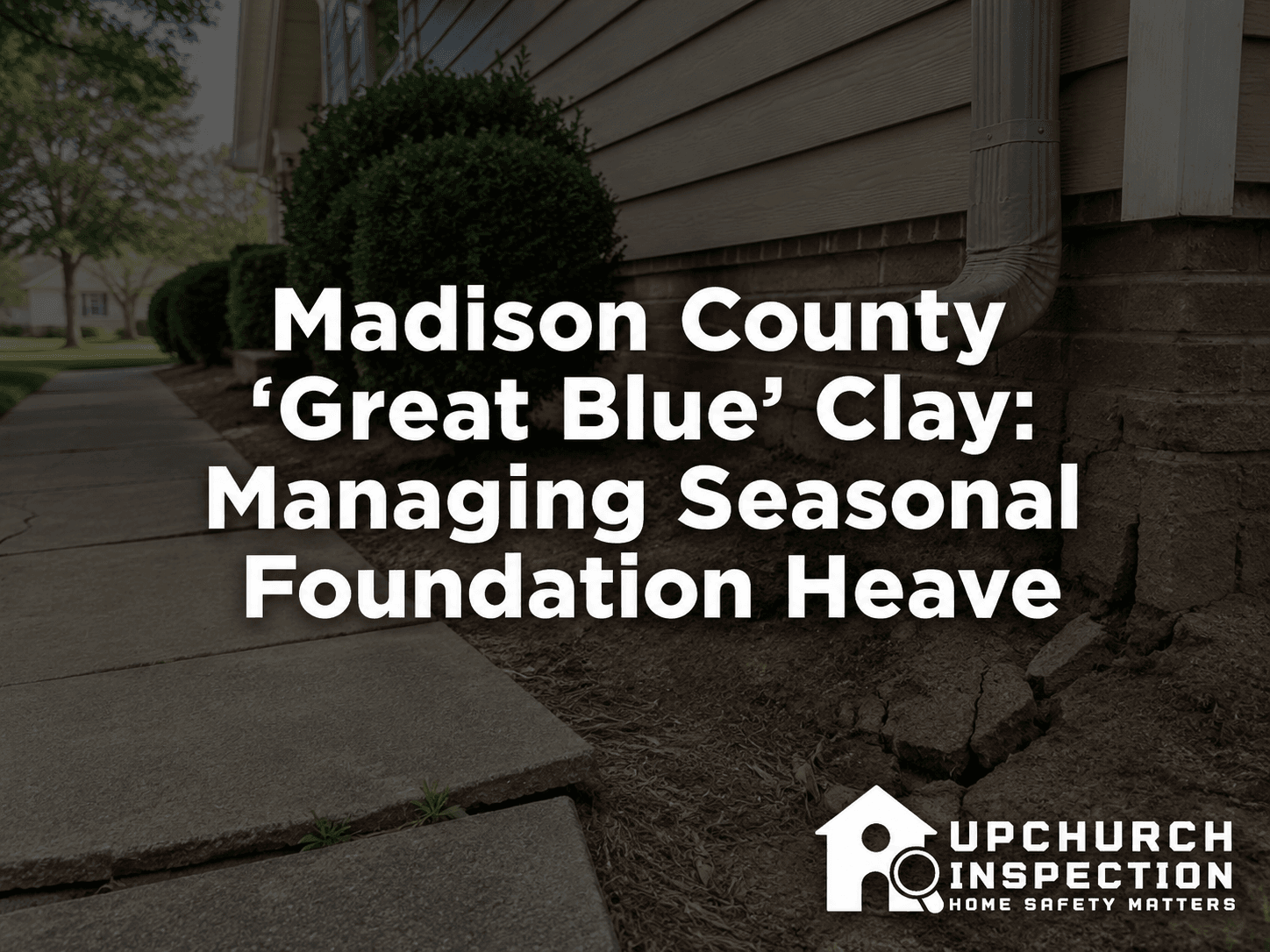
Foundation movement in Madison County doesn’t behave the way most homeowners expect. When cracks appear, the assumption is almost always settlement—soil compressing, footings sinking, structures slowly dropping under their own weight.
In large parts of Madison County, that assumption is backward.
Here, the problem isn’t that the ground gives way. It’s that it pushes back.
The culprit is a high-plasticity clay commonly referred to by inspectors, engineers, and soil professionals as “Great Blue” clay. This soil doesn’t just react to moisture—it stores it, expands with it, and releases it unevenly. That behavior creates seasonal vertical movement that can distort foundations, framing, and finishes even when the structure itself is sound.
If you’re buying or owning property in South Jackson or rural areas like Medon, understanding this soil isn’t optional. It’s foundational knowledge.
What “Great Blue” Clay Actually Is
Great Blue clay is a fine-grained, highly plastic soil with a strong ability to absorb and retain moisture. Unlike sandy soils that drain quickly or silts that lose cohesion when wet, expansive clays undergo volume change.
When moisture increases, the clay swells.
When moisture decreases, it shrinks.
That cycle happens repeatedly—season after season, year after year.
The result isn’t smooth movement. It’s differential heave, where one portion of the foundation rises while another stays put or drops slightly.
Why Heave Is More Destructive Than Settlement
Settlement tends to occur early in a structure’s life. Heave can occur indefinitely.
With expansive clay, movement is:
- Ongoing
- Directionally inconsistent
- Influenced by surface conditions, not just depth
This creates stress patterns that framing and masonry weren’t designed to accommodate.
Cracks appear, disappear, then reappear elsewhere. Floors slope one way during wet seasons and flatten during dry periods. Doors that stick in spring may function normally in late summer.
To homeowners, it feels random. It isn’t.
Active Zones: Where the Damage Begins
Understanding the “Active Zone”
The active zone is the portion of soil beneath and around a foundation that experiences moisture fluctuation. In Madison County clay soils, this zone can extend several feet below grade.
Within the active zone:
- Moisture levels change seasonally
- Soil volume expands and contracts
- Upward pressure is exerted on foundations
The deeper and wider the active zone, the more movement potential exists.
South Jackson: Urban Water, Concentrated Impact
In South Jackson, expansive clay issues are often amplified by human activity.
Common contributors include:
- Irrigation systems watering only one side of the structure
- Flower beds built against foundations
- Inconsistent gutter discharge
- Driveways and patios trapping moisture near footings
These conditions create asymmetrical moisture profiles, which cause one side of a foundation to heave more than the other.
The structure doesn’t fail because the soil is weak—it fails because the soil is unevenly strong.
Medon and Rural Madison County: Natural Moisture Cycles
In rural areas like Medon, moisture variation is driven less by infrastructure and more by natural conditions.
Here, inspectors frequently see:
- Wide seasonal moisture swings
- Limited surface drainage control
- Large roof areas dumping water near foundations
- Soil that stays saturated longer after rainfall
The result is long-duration swelling followed by extended drying periods, which increases soil fatigue and magnifies movement over time.
How Foundations React to Clay Heave
Slab-on-Grade Foundations
In slab foundations, expansive clay can cause:
- Center lift (slab doming upward)
- Perimeter restraint with interior heave
- Cracking that radiates diagonally from interior points
These slabs may appear level at rest but distort seasonally, stressing walls and finishes.
Crawlspace Foundations
Crawlspace homes often fare slightly better—but not immune.
We commonly observe:
- Pier displacement
- Beam rotation
- Uneven support contact
- Seasonal floor slope changes
Because crawlspace systems rely on multiple support points, differential heave creates uneven load transfer rather than uniform movement.
Why Cosmetic Repairs Always Fail
Crack patching, drywall repair, and repainting are common responses to clay movement. They also fail consistently.
Why?
Because the movement hasn’t stopped.
Until moisture behavior in the active zone is stabilized, repairs are temporary. The structure continues responding to soil pressure changes underneath.
That’s why the same cracks reopen—sometimes within months.
Moisture Control Is the Only Real Solution
Managing expansive clay is not about “fixing” the soil. It’s about controlling moisture variability.
Key strategies include:
- Consistent perimeter drainage
- Uniform moisture distribution
- Avoiding localized saturation
- Preventing prolonged drying near footings
The goal isn’t dryness—it’s consistency.
Clay that stays evenly moist moves less than clay that cycles between extremes.
Why Engineers Focus on Water Before Structure
When engineers evaluate homes on expansive clay, they don’t start with the foundation. They start with:
- Roof runoff patterns
- Surface grading
- Downspout termination
- Landscaping practices
Only after moisture control is addressed does structural intervention make sense.
Without moisture control, even reinforced repairs can be undermined by ongoing soil movement.
Inspection Indicators of Clay Heave
During inspections in Madison County, we look for:
- Seasonal cracking patterns
- Interior wall separation without corresponding foundation settlement
- Doors and windows that bind intermittently
- Slab cracks with vertical displacement
- Evidence of prior leveling or adjustment attempts
These indicators point toward soil-driven movement, not construction failure.
What Buyers Need to Understand Before Closing
Homes on expansive clay aren’t defective—but they are conditional.
The question isn’t:
- “Is there movement?”
It’s:
- “Is the movement managed?”
A well-maintained home with consistent drainage and moisture control can perform acceptably for decades. A neglected one will continue to move—regardless of cosmetic condition.
The Long-Term Reality of Great Blue Clay
Expansive clay doesn’t “settle out.” It doesn’t age away. It doesn’t stabilize on its own.
It requires:
- Awareness
- Management
- Maintenance discipline
Ignoring it doesn’t make it go away—it just delays the bill.
Final Thoughts
In South Jackson, Medon, and throughout Madison County, foundation movement is often misunderstood because it behaves opposite of expectation.
The ground isn’t giving way. It’s pushing up.
Understanding Great Blue clay, active zones, and seasonal moisture behavior allows buyers and homeowners to distinguish between cosmetic issues and systemic risk—and that distinction matters.
Protecting your West Tennessee investment starts with a forensic eye. View our West Tennessee Service Area to see a full list of towns we serve.