Big economic announcements don’t just change skylines. They change behavior.
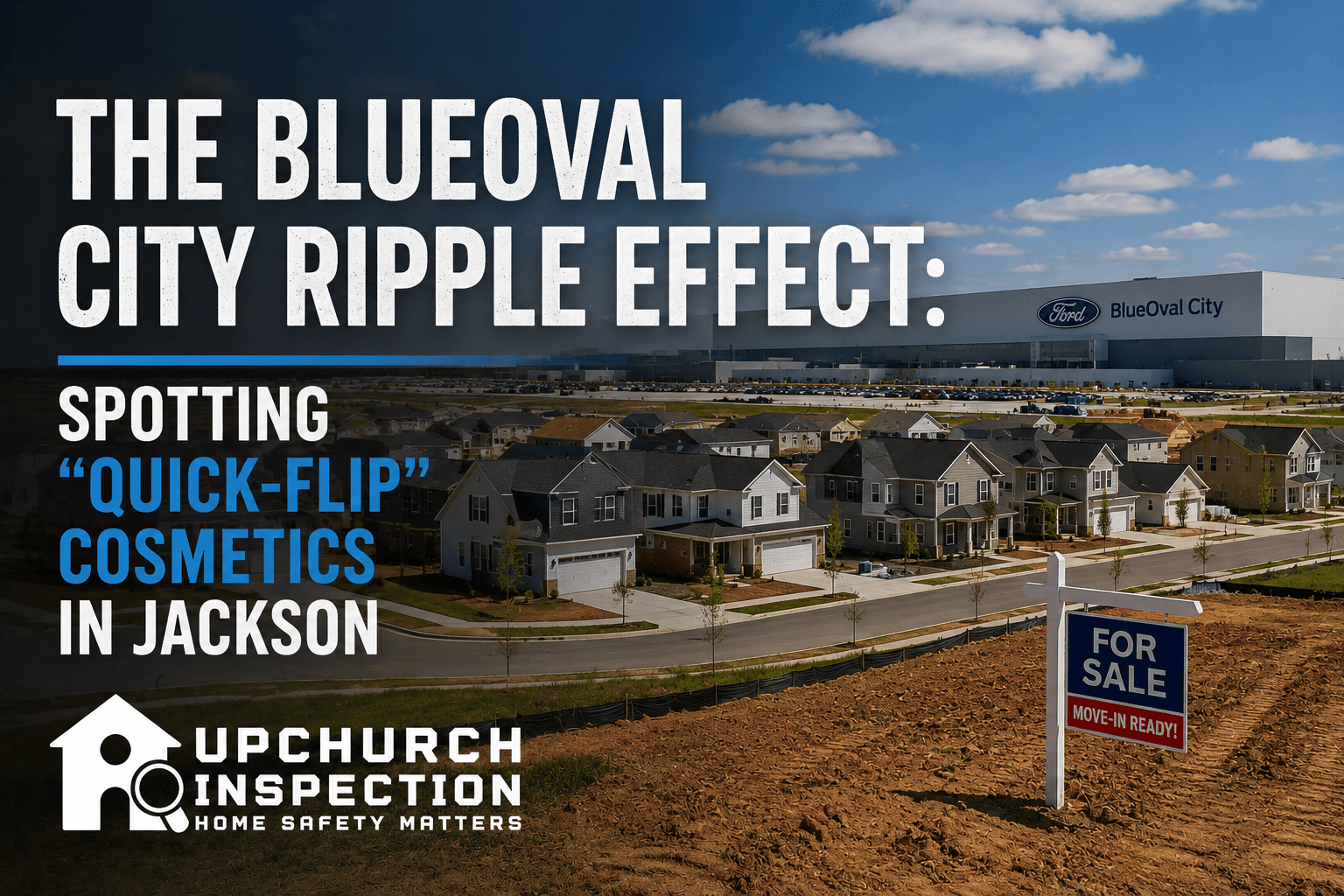
The announcement of BlueOval City triggered a predictable—but dangerous—pattern in the Jackson real estate market. Investors rushed in. Properties were bought fast, renovated faster, and pushed back onto the market with a familiar look: grey flooring, white paint, matte black fixtures, and a price jump that assumed appearance equals condition.
In Jackson, especially in North Jackson and Three Way, those assumptions are costing buyers real money.
Why Boom Markets Breed Cosmetic Fraud
When demand spikes quickly, speed becomes more valuable than quality.
Flippers in boom-adjacent markets don’t aim for longevity—they aim for:
- Appraisal thresholds
- Fast resale
- Visual impact during showings
That’s when structural, mechanical, and moisture-related defects get buried under surface-level improvements.
The “Grey LVP / White Paint” Red Flag
The flipper aesthetic isn’t inherently bad. It’s the uniformity that’s concerning.
We see the same pattern repeatedly:
- Luxury vinyl plank installed wall-to-wall
- No documentation of subfloor repairs
- Fresh paint covering staining or patchwork
- Updated fixtures without corresponding system upgrades
In many Jackson flips, the finish work is new—but everything underneath is original.
North Jackson: Older Homes, Faster Turnarounds
In North Jackson, many homes being flipped were built during periods when:
- Plumbing systems were undersized
- Electrical layouts were minimal
- Crawlspaces were never encapsulated or sealed
When these homes are flipped quickly, inspectors often find:
- LVP installed over soft or rotted subfloor
- Active moisture beneath new flooring
- Plumbing repairs hidden behind access panels
- HVAC systems pushed beyond service life
The house looks new. The infrastructure is not.
Three Way and the Commuter Effect
Three Way has become attractive to commuters priced out of surrounding areas. That makes it a prime target for quick flips.
Here, we frequently encounter:
- Garage conversions without permits
- Additions tied into existing systems improperly
- Load changes that stress original electrical panels
- Improvised HVAC distribution
These aren’t cosmetic shortcuts—they’re functional risks that don’t show up in listing photos.
Why Flooring Is the Most Common Cover-Up
Luxury vinyl plank is popular because it:
- Installs quickly
- Hides uneven surfaces
- Masks moisture staining
- Creates visual continuity
But from an inspection standpoint, LVP often conceals:
- Subfloor delamination
- Long-term leaks
- Improper crawlspace ventilation
- Structural sag masked by floating floors
When flooring goes in before underlying issues are corrected, failure is delayed—not prevented.
Paint Doesn’t Fix Moisture History
Fresh paint is one of the most deceptive finishes in flipped homes.
In Jackson flips, we often see paint applied over:
- Repaired drywall without moisture source correction
- Old plaster cracks patched cosmetically
- Wall staining from prior roof or plumbing leaks
Without understanding why damage occurred, cosmetic repair becomes temporary.
Mechanical Systems Lag Behind Aesthetics
The biggest disconnect in quick flips is between appearance and mechanical reality.
We routinely find:
- New thermostats controlling old HVAC units
- Updated registers tied to undersized duct systems
- Water heaters past expected service life
- Electrical panels never upgraded despite new load demands
These systems don’t fail on day one. They fail six months after move-in—when leverage is gone.
The Inspection Patterns That Give Flips Away
Experienced inspectors can usually identify a rushed flip within minutes.
Common indicators include:
- Inconsistent materials behind access panels
- New finishes with old shutoffs and valves
- Patchwork framing repairs in crawlspaces
- No evidence of system-wide upgrades
These patterns repeat across flipped properties because the business model rewards speed, not durability.
Why Buyers Miss the Warning Signs
Buyers caught up in a hot market tend to:
- Focus on move-in readiness
- Assume permits mean quality
- Equate new finishes with low maintenance
- Waive contingencies to compete
That’s how cosmetic flips win—and how buyers inherit deferred failures.
Jackson’s Market Isn’t the Problem—Assumptions Are
Jackson’s growth isn’t a bad thing. But rapid change exposes properties that were never built for modern expectations.
The danger isn’t renovation. It’s renovation without forensic evaluation.
Understanding what’s been improved—and what’s been ignored—is the key difference between a smart purchase and a regretful one.
Final Thoughts
The BlueOval City ripple effect has brought opportunity to Jackson—but also shortcuts.
In North Jackson and Three Way, buyers need to look past finishes and understand the systems that actually keep a home functional. Cosmetic updates don’t increase durability. Inspections do.
Protecting your West Tennessee investment starts with a forensic eye. View our West Tennessee Service Area to see a full list of towns we serve.