
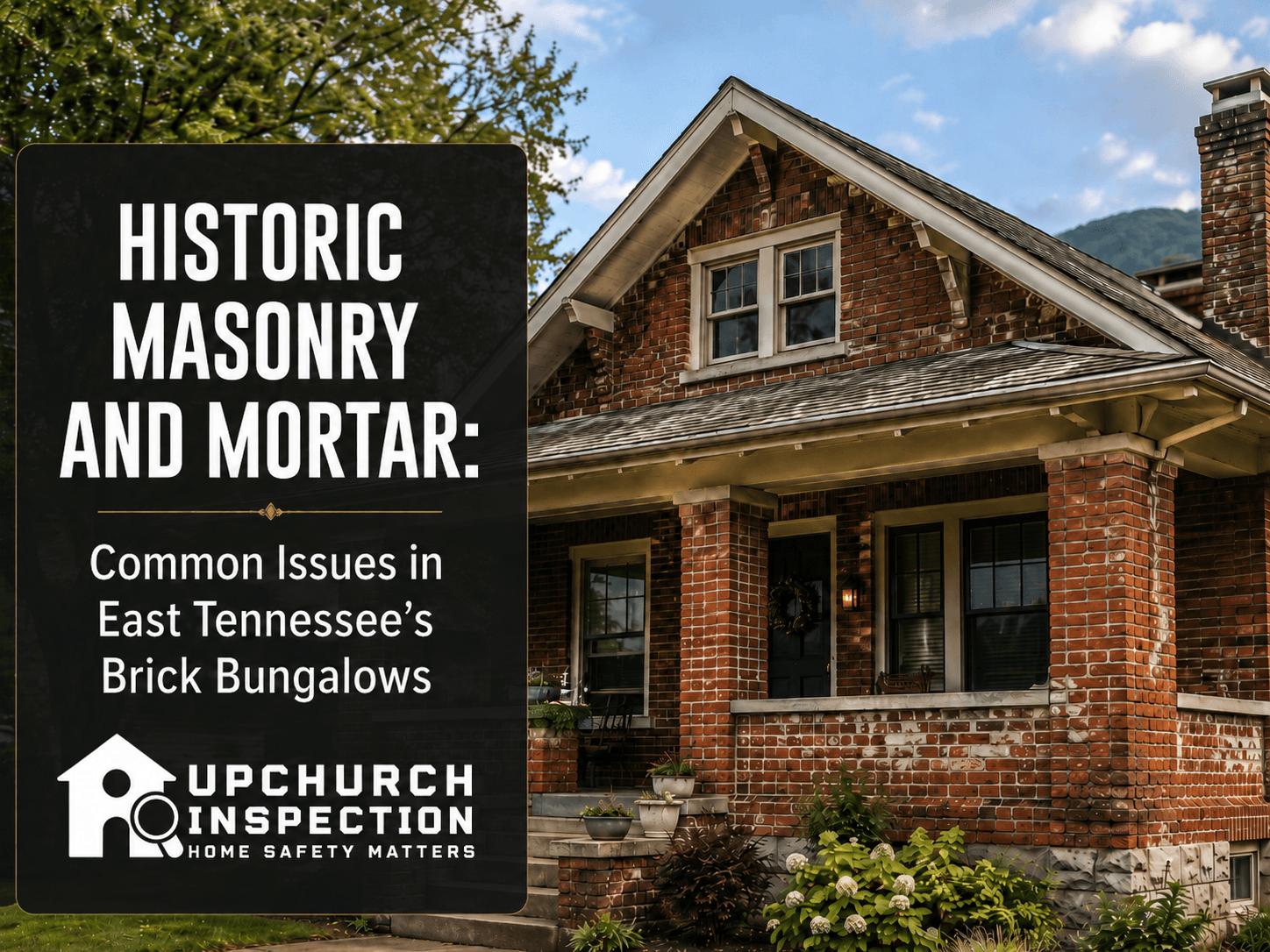
There’s a moment that happens a lot when I’m reviewing reports from our Knoxville inspector. I’ll be halfway through the photos, scrolling past brick walls that look solid, and then I’ll stop and think, Yeah… that mortar’s lying to you.
Brick bungalows all over Knoxville have that classic look—low rooflines, thick walls, deep window openings. They feel sturdy. They feel permanent. And most of the time, the brick itself really is in good shape.
The problem usually isn’t the brick.
It’s what’s holding the brick together.
If you’ve spent any time walking neighborhoods near landmarks like the Sunsphere, you’ve seen these homes everywhere. Built early- to mid-1900s. Solid craftsmanship. And masonry systems that were designed for a very different climate reality than what they’re dealing with today.
Brick Doesn’t Fail Quietly — Mortar Does
One of my go-to lines when talking through these reports is: “Brick is patient. Mortar is not.”
Historic East Tennessee brick bungalows were typically built with softer, lime-based mortars. That wasn’t a mistake—it was intentional. Soft mortar allows brick walls to expand, contract, and shed moisture without cracking the brick itself.
Fast forward 80 or 100 years, and that original mortar has taken a beating. Rain. Freeze-thaw cycles. Humidity. Ground moisture. Minor foundation movement. It all shows up first in the joints.
Our Knoxville inspector routinely documents mortar that’s:
- Powdery or sandy to the touch
- Recessed well behind the brick face
- Cracked in stair-step patterns
- Missing entirely in sheltered areas
And here’s the kicker: most homeowners don’t notice any of it because the wall still looks solid.
The East Tennessee Moisture Problem (Again)
I know I sound like a broken record on moisture, but that’s because moisture is the common thread in almost every East Tennessee inspection report I read.
Brick is porous. Mortar is porous. That’s fine—as long as the wall can dry.
In Knoxville, walls often don’t get that chance. Humidity stays high. Rainfall is frequent. And many brick bungalows sit close to grade with minimal overhangs. Water gets into the wall system and just… hangs out.
Our inspector has shown me walls where moisture readings stayed elevated days after rain, especially on shaded elevations. No leaks inside. No obvious damage. Just slow, steady saturation doing long-term work.
That’s when mortar erosion accelerates.
Repointing: Where Good Intentions Go Bad
If I had a dollar for every report where repointing made things worse, I’d have a pretty solid lunch fund.
At some point, many of these homes get “fixed” by someone who means well but doesn’t understand historic masonry. The most common mistake? Using modern Portland cement mortar.
Here’s the short version: Portland cement mortar is harder than historic brick. When moisture moves through the wall—and it always does—the brick takes the stress instead of the mortar.
Our Knoxville inspector has documented:
- Brick faces spalling and flaking
- Hairline cracking through brick units
- Mortar that looks perfect while brick deteriorates
That’s backwards. Mortar is supposed to be the sacrificial element. When it’s too hard, the brick pays the price.
One report I remember clearly involved a bungalow where only the bottom three feet of wall had been repointed—with hard mortar. Guess where the damage showed up? Right at that transition line.
Masonry doesn’t like mixed rules.
Freeze-Thaw Is Subtle, But Relentless
East Tennessee winters aren’t brutal, but they’re sneaky. Temperatures hover around freezing, bounce up, then drop again. That’s the worst possible scenario for masonry.
Water gets into the mortar joints. It freezes. It expands. It thaws. Repeat.
Our inspector often notes mortar loss and cracking on north-facing walls or areas that stay shaded and damp. Over time, joints open up just enough to allow more water in—and the cycle feeds itself.
You don’t wake up one morning with a collapsed wall. You wake up years later with bricks that don’t sit quite right anymore.
Brick Veneer vs. Structural Brick: Big Difference
Not all brick bungalows are built the same, and this matters a lot during inspection.
Some older Knoxville homes use structural brick—multiple wythes thick, carrying load. Others use brick veneer over wood framing.
The failure modes are different.
In structural brick homes, mortar deterioration can affect load distribution. In veneer systems, mortar failure often leads to moisture intrusion behind the brick, rotting framing, and hidden structural damage.
Our inspector has documented veneer walls where the brick looked fine, but the sheathing behind it showed elevated moisture and decay. The brick wasn’t failing—it was hiding the failure.
That’s why tapping bricks, checking weep paths, and reading moisture patterns matter more than surface appearance.
Weep Holes: Missing, Blocked, or Never There
Modern masonry relies on weep holes to let water escape. Historic masonry often didn’t include them—or they’ve been buried over time by landscaping, repointing, or paint.
I’ve reviewed Knoxville reports where the entire bottom course of brick was acting like a sponge because water had nowhere to go.
Our inspector pays close attention to:
- Brick-to-grade clearance
- Signs of moisture at sill plates
- Efflorescence patterns
- Interior wall staining that lines up with exterior masonry
When water can’t exit, it finds another path. Usually inward.
Paint Is Not a Waterproofing Solution
Let me say this plainly: painting brick in East Tennessee is a gamble.
Paint traps moisture. Brick wants to breathe. Those two goals don’t get along.
Our inspector has documented painted brick walls where moisture readings were consistently higher than unpainted sections of the same home. Over time, trapped moisture accelerates mortar breakdown and brick spalling.
Painted brick looks great for a few years. Then the maintenance bill shows up.
Foundation Movement Shows Up in the Mortar
Another thing I watch for in these reports is crack pattern consistency.
When mortar cracks line up with foundation movement—especially near corners or window openings—it’s usually telling a bigger story. Brick bungalows don’t flex well. When the foundation moves, the wall records it.
Our Knoxville inspector has flagged cases where mortar cracking was the first visible sign of differential settlement. The interior finishes hadn’t cracked yet. The drywall was still holding on. But the masonry had already reacted.
That’s why exterior inspection matters just as much as interior.
Chimneys: The Forgotten Masonry Element
Chimneys on these homes deserve their own paragraph—because they’re often in the worst shape.
They’re tall. Exposed. Subject to wind-driven rain. And many are no longer used but still structurally relevant.
Our inspector frequently finds:
- Missing or eroded mortar joints
- Cracked crowns
- Loose brick near the top courses
- Evidence of past patching that didn’t address water entry
A failing chimney doesn’t just risk collapse—it creates water entry points straight into the attic or wall cavity.
Why This Stuff Gets Missed
Brick bungalows age gracefully on the surface. That’s the problem.
You don’t see flashing failures. You don’t see framing rot. You don’t see moisture paths until they’ve been working a long time.
I’ve reviewed reports where buyers almost skipped the inspection because “it’s brick—it’s solid.” Those are the ones I worry about most.
The Wes Take
I like brick bungalows. I really do. They’re some of the best-built homes Knoxville has.
But they’re not maintenance-free, and they don’t forgive shortcuts—especially when it comes to mortar and moisture.
When I read reports from our Knoxville inspector, the best ones don’t just say “masonry deterioration noted.” They explain why it’s happening, what kind of mortar is involved, and how moisture is interacting with the wall.
Brick tells the truth if you know how to read it. Mortar tells it sooner.
And in East Tennessee, listening early can save you from learning the hard way later.