
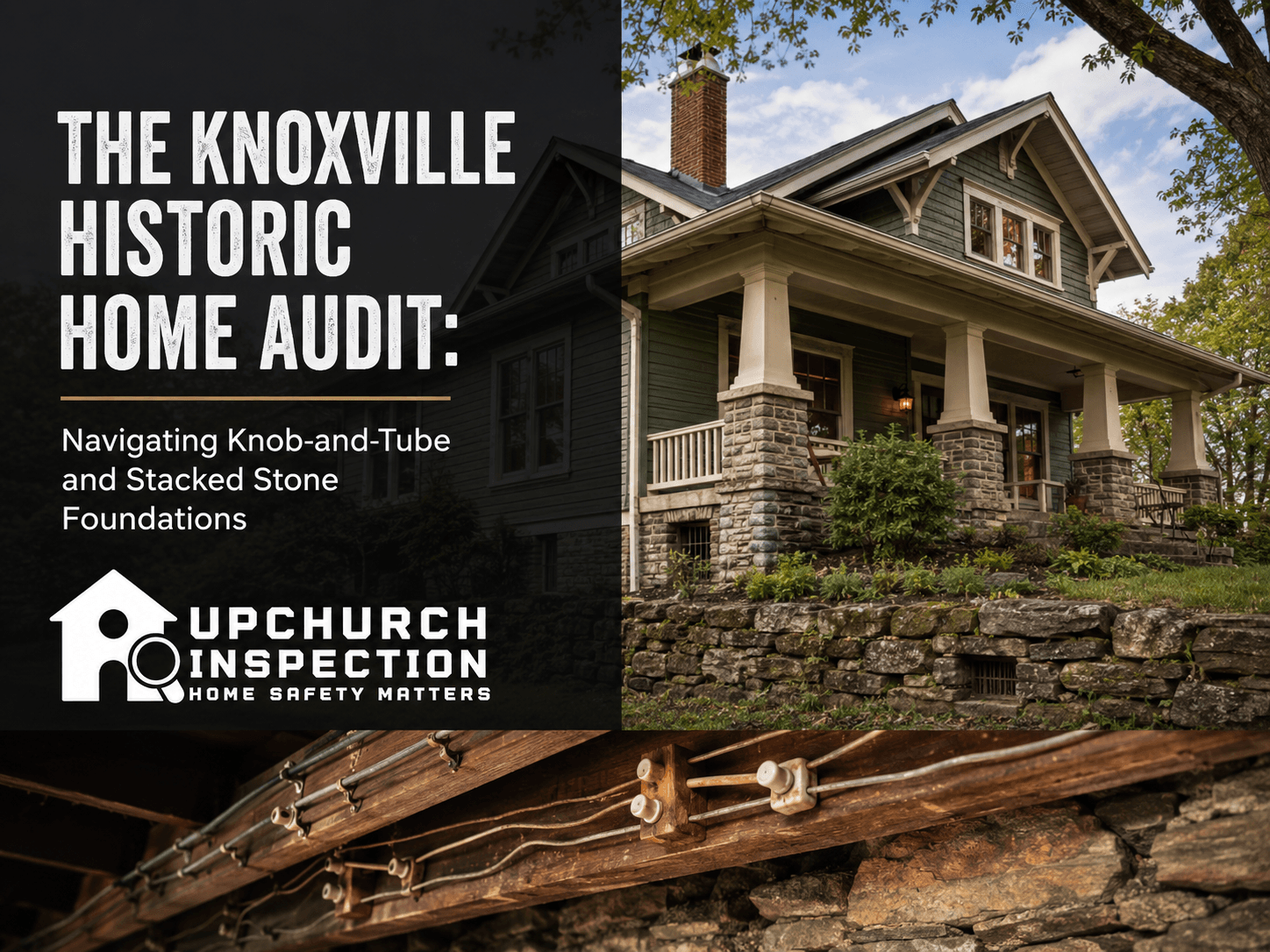
I’ll be honest—historic homes are my favorite reports to review, and they’re also the ones that make me slow down the most. Every time our Knoxville inspector sends one over from an older neighborhood, I know I’m not about to skim it. I’m about to read it.
Because old houses don’t lie. They tell you exactly what’s been done to them—sometimes carefully, sometimes recklessly—and East Tennessee historic homes are especially chatty if you know how to listen.
Knoxville has entire neighborhoods where the houses predate modern building codes, modern electrical systems, and sometimes modern common sense. Places near downtown, not far from spots like Market Square, were built when craftsmanship mattered more than speed—and when nobody imagined air fryers, EV chargers, or 200-amp electrical service.
That history is part of the charm. It’s also part of the risk.
“It’s Been Here 100 Years” Is Not a Structural Analysis
One of the most common things I hear buyers say about historic homes—especially in Knoxville—is, “Well, it’s been standing for over a century, so it must be solid.”
Sometimes that’s true. Sometimes it’s only standing because it hasn’t been asked to do anything new.
Our Knoxville inspector has walked homes with stacked stone foundations that are absolutely beautiful—tight stonework, massive footings, no obvious displacement. And right above them? Electrical systems from three different decades tied together like a science experiment.
Historic homes survive because they were built well for their time. Inspections are about figuring out how well they’re coping with our time.
Knob-and-Tube: The System Everyone Hopes Is Gone (But Often Isn’t)
Let’s talk about knob-and-tube wiring, because it comes up constantly in older Knoxville homes, especially those built before World War II.
Here’s the part people miss: knob-and-tube itself isn’t the immediate danger. The danger is everything that’s happened since it was installed.
Our inspector regularly finds:
- Knob-and-tube still energizing ceiling fixtures
- Portions abandoned but not properly disconnected
- Modern wiring spliced directly into old conductors
- Insulation packed around wiring that was designed to dissipate heat in open air
That last one matters. Knob-and-tube was never meant to be buried. When insulation gets added decades later, heat builds up where it never should.
I’ve reviewed reports where only a small portion of the home was still on knob-and-tube, but it fed critical circuits. On paper, it didn’t look dramatic. In reality, it meant the electrical system couldn’t safely support modern loads.
This is where experience matters. A checkbox that says “present” doesn’t tell the story. Context does.
Stacked Stone Foundations: Gorgeous, Strong… and Unforgiving
Knoxville’s historic homes often sit on stacked stone foundations, and I genuinely love seeing them. They’re heavy, durable, and have survived generations of freeze-thaw cycles.
But stacked stone has zero tolerance for water mismanagement.
Unlike poured concrete, stacked stone relies on gravity and friction. Mortar quality varies wildly depending on age and materials used. Once water starts migrating through the wall—and it almost always does—the mortar becomes the weak link.
Our inspector has documented:
- Mortar erosion at grade level
- Inward stone displacement near corners
- Moisture intrusion tied to missing exterior drainage
- Repairs using incompatible modern mortar that actually accelerate damage
One of my “uh-oh” indicators in these reports is when someone has repointed stone with hard Portland cement. It looks great for a few years. Then the stone starts to spall because moisture can’t escape.
Old foundations need to breathe. A lot of well-meaning repairs forget that.
Floors That Slope for a Reason
I’ve lost count of how many inspection reports include notes about sloped or uneven floors in Knoxville historic homes. Buyers panic about it. Sellers shrug it off.
The truth is usually somewhere in the middle.
Some floor slope is normal. Wood framing moves. Stone foundations settle incrementally over decades. But when our inspector documents changes—localized dips, bounce near load paths, or deflection near former chimney locations—that’s when it matters.
One report that stuck with me involved a home where a fireplace had been removed years earlier, but the framing was never properly re-supported. The house didn’t collapse. It just quietly sagged where that load used to be.
That’s the kind of thing you only catch if you understand how these houses were originally built.
Plumbing: The Silent Saboteur
If there’s one system that quietly causes the most damage in historic Knoxville homes, it’s plumbing.
Galvanized pipes are still common. Cast iron drains are everywhere. And many homes have been partially updated—new fixtures tied into old supply lines that are barely hanging on.
Our inspector routinely finds:
- Galvanized pipes reduced to pinhole flow
- Active corrosion at threaded joints
- Cast iron drains with scaling and offsets
- Evidence of prior leaks that were “fixed” cosmetically
Plumbing leaks don’t announce themselves loudly in stone-and-plaster homes. They soak. They stain. They soften framing over time.
When I review these reports, I pay close attention to moisture readings near bathrooms and kitchens—not because I expect disasters, but because historic homes forgive nothing when it comes to water.
Insulation, Airflow, and the “Why Is This Room Always Cold?” Question
Historic Knoxville homes were not designed with modern insulation strategies. Period.
Our inspector frequently notes:
- Little to no wall insulation
- Attics insulated unevenly or incorrectly
- Original windows paired with newer HVAC systems
- Drafts that don’t correlate with visible gaps
That mismatch causes comfort complaints that owners often blame on HVAC. The reality is airflow and thermal boundaries that were never designed for forced-air systems.
You can absolutely improve comfort in these homes—but only if you understand how air moves through them. Slapping insulation in random places often makes things worse.
Electrical Panels: Where Old Meets New (Badly)
One of my personal red flags is a shiny new panel feeding very old wiring.
It looks reassuring to buyers. It’s often misleading.
Our inspector has sent reports where the service panel was modern, grounded, and clean—but branch wiring included a mix of knob-and-tube, cloth-insulated copper, and modern NM cable all sharing circuits.
That’s not a system. That’s a timeline.
When I review those findings, I’m not looking for blame. I’m looking for clarity. What’s original? What’s been upgraded? What’s still doing heavy lifting that it was never meant to do?
Structural Repairs: Old Fixes vs. Good Fixes
Historic homes have almost always been repaired at some point. The question is how.
Good repairs show up as:
- Sistered joists done cleanly
- Reinforcement that matches load paths
- Masonry repairs that respect original materials
Bad repairs show up as:
- Jack posts sitting on dirt
- Shims stacked like Jenga
- Temporary supports that became “permanent”
Our inspector documents these differences carefully, because future performance depends on them.
Why I Love Reviewing These Reports
Historic Knoxville homes aren’t scary. They’re honest.
They show you what’s been ignored, what’s been respected, and what’s been misunderstood over time. A good inspection doesn’t kill the deal—it explains the house.
When I read reports from our Knoxville inspector on these properties, the best ones don’t just list defects. They tell the story of the home’s evolution. That’s what buyers actually need.
If you’re buying a historic home in Knoxville, you’re not buying perfection. You’re buying character, materials you can’t get anymore, and a structure that’s already lived a long life.
The job of the inspection is to make sure the next chapter isn’t written blindly.