
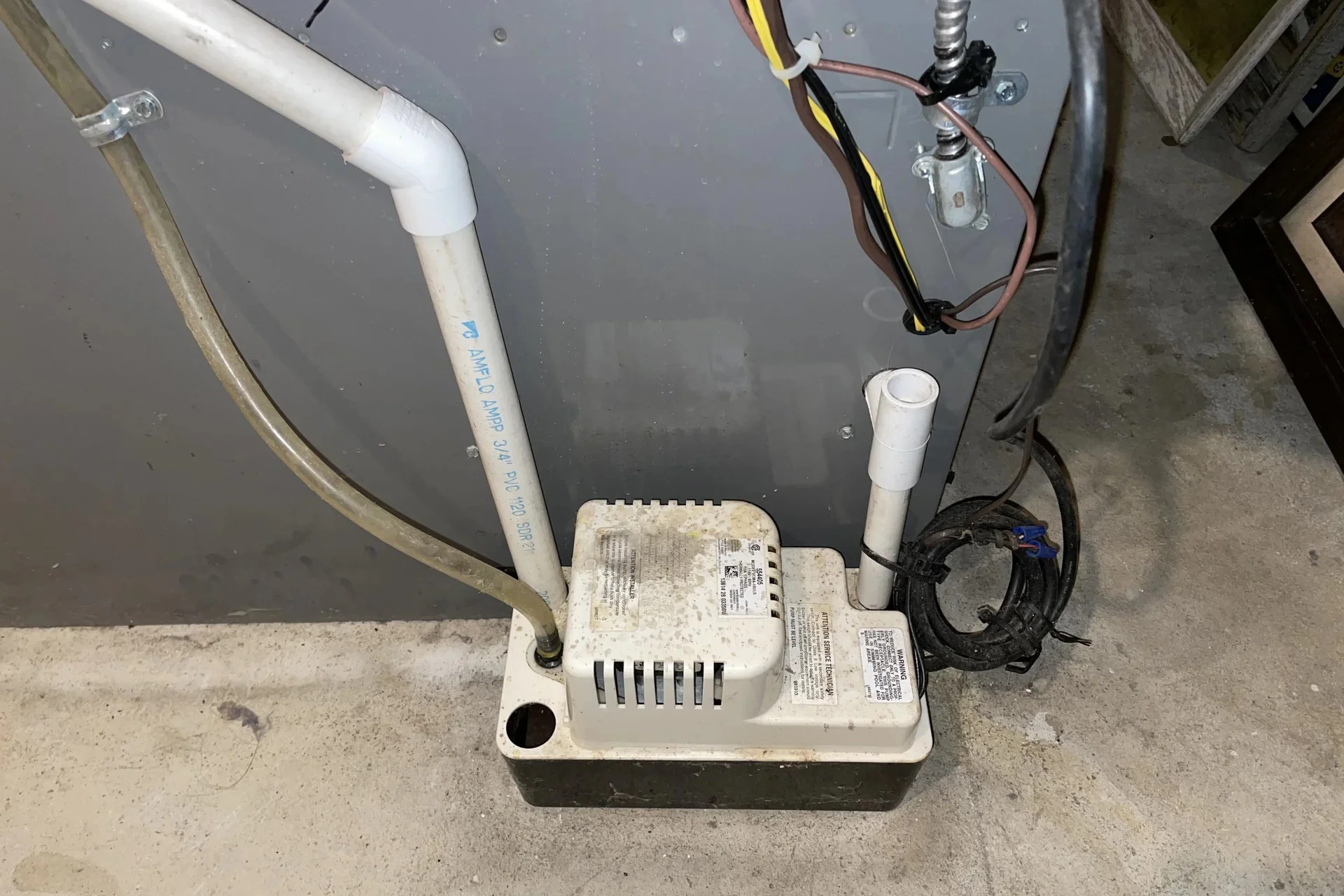
If I hear gurgling, clicking, or a faint buzzing coming from a mechanical room, I already know where I’m headed.
Condensate pumps are small, cheap, and easy to ignore — until they fail and dump water where it doesn’t belong.
What a Condensate Pump Actually Does
Anytime an air handler or high-efficiency furnace can’t drain by gravity, a condensate pump steps in.
Its job is simple:
- Collect condensate water
- Pump it up and out to a drain line
- Shut the system down if it can’t keep up
When it doesn’t do those things reliably, problems show up fast.
How I Evaluate a Noisy Condensate Pump During an Inspection
Noise is usually the first clue that a pump is failing, and I treat it as a starting point for diagnosis rather than just a nuisance to be buried. In the past decade, the market has shifted from accepting condensation pump noise as unavoidable toward quantifying it with laboratory testing. According to industry analyses on evaluating condensation systems, older technical guidance described pump decibels as starting in the mid-20s and rising to 30 dB and above, but newer models increasingly advertise 20 dB, 22 dB, 25 dB, and even 16.4 dB models as selling points [Sauermann Group]. This shift reflects growing demand in major markets such as North America and Europe for quieter equipment in apartments, offices, and mixed-use developments.
However, in practice the problem is often not just loudness, but the intermittent nature of the sound. Industry commentary notes that condensate pumps operate in cycles as the reservoir fills and then empties, which makes the sound more noticeable than a steady low hum at the same decibel level. That pattern is especially relevant in hospitality, office, and residential settings, where a pump may run for short bursts every 10 to 15 minutes rather than continuously [CSE Magazine].
In a very quiet mechanical room, even a well-maintained high-end unit can register around 25 dB(A), close to the threshold of human audibility. For context, a difference of 10 dB is commonly perceived as roughly twice as loud, so a pump at 30 dB can feel substantially more intrusive than one at 20 dB [Sauermann Group]. When I hear abnormal sounds during an inspection, I listen carefully to distinguish routine cycling from symptoms of blockage, worn bearings, or an impending failure.
The Gurgling Sound Isn’t Normal
A healthy pump runs briefly, sounds smooth, and shuts off cleanly. When it starts making noise, the type of sound usually tells you exactly what is wrong and what to check next:
- Gurgling or bubbling: This is the classic sign of trapped air, a partial clog in the discharge line, or irregular water movement inside the reservoir. The pump is trying to push water through a restriction, and air bubbles are escaping back into the bowl. Check the reservoir water level first — is it unusually high or fluctuating? Inspect the discharge tubing for kinks or sludge buildup near the connection point, and verify that the check valve is installed in the correct direction.
- Buzzing or humming: A steady buzz usually means the motor is getting power but the impeller is jammed or the pump is running dry. This often points to a debris blockage or a failing start capacitor. Before calling for service, verify that the reservoir has adequate water and that the float isn’t sticking against the wall. If the pump hums but never pushes water, the issue is likely mechanical rather than electrical.
- Grinding: A loud grinding noise typically indicates debris inside the impeller housing, worn motor bearings, or a cracked pump housing. I’ve inspected units where gravel or construction dust entered the intake and ground against the moving parts. You can often spot this by checking the inlet screen and listening closely to whether the sound changes when the water level drops.
- Rapid clicking: This is usually the sound of the float switch cycling on and off rapidly, which happens when the pump is too small for the load or the float is jammed. It can also indicate a failing relay inside the pump control board.
- Generally loud operation: Vibration against framing, loose mounting brackets, or a pump running far longer than it should can amplify noise without indicating an internal failure. Check whether the pump is securely mounted and whether the discharge line is vibrating against a stud or joist.
In Germantown, I inspected a system where the pump ran constantly but never emptied. The homeowner thought it was “just how it sounded.” It wasn’t — the discharge line was blocked about four feet from the pump, creating a gurgling backsplash that kept the float switch engaged. Once we cleared the line, the pump cycled normally and the noise stopped immediately.
Why Pumps Fail So Often
Condensate pumps fail for boring reasons, but those reasons compound quickly when maintenance is skipped:
- Algae buildup: Stagnant water in the reservoir breeds slime that coats the impeller and restricts flow. Over time, this turns a quiet pump into a gurgling, struggling unit.
- Sludge accumulation: Dust, lint, and mineral deposits mix with condensate to form a thick sludge that clogs the inlet screen and check valve.
- Failed float switches: Floats can stick open or closed, causing the pump to run nonstop or never activate at all. I’ve pulled pump covers off and found them packed with black slime, with floats that hadn’t moved freely in years.
- Burned-out motors: Running dry or against a blockage generates heat that degrades windings. A motor that hums without pumping is often one step away from burning out completely.
- Kinked or blocked discharge lines: A restricted line forces the pump to work harder, creating noise, longer run times, and repeated restart attempts. Cleaning the line via Covenant Aire Solutions is a straightforward fix that prevents most of these issues.
The typical service life of a condensate pump ranges from three to seven years, depending on water quality, usage frequency, and maintenance. Signs that cleaning is no longer enough include persistent gurgling after clearing the line, a motor that won’t start, or a float that refuses to move. When those appear, replacement is usually more sensible than repair.
Why Overflow Protection Matters
Many pumps include a safety shutoff wired into the HVAC system. When the pump fails, the system shuts down instead of flooding the house.
I’ve seen:
- Safety wires disconnected
- Pumps replaced without rewiring the shutoff
- Older pumps with no protection at all
In one Lakeland inspection, the pump had failed previously and been replaced — but the safety switch was never reconnected. The next failure would’ve meant water everywhere.
A Real Inspection Where the Noise Was the Warning
I inspected a home in Cordova where the buyer mentioned a “weird aquarium noise” near the furnace.
The pump reservoir was half full, float switch cycling constantly, and the discharge line was partially clogged. Every few minutes, the pump would struggle, click, and barely push water out.
That pump was on borrowed time — and so was the ceiling below it.
How I Inspect Condensate Pumps
I look for:
- Proper pump sizing
- Clean reservoir
- Secure discharge line
- Functional check valve
- Safety shutoff wiring
- Signs of past overflow or staining
If the pump is buried behind shelving or drywall, that gets noted. Pumps need access because they will need attention.
What Buyers Should Know
Condensate pumps aren’t expensive, until they fail.
What to monitor immediately: Listen for changes in sound pattern. New gurgling, grinding, or constant humming warrants investigation before the next inspection cycle.
What is safe to inspect: Check the reservoir water level, look for visible sludge or algae, inspect the discharge tubing for kinks, and verify the pump is securely mounted. Do not open electrical components or attempt to disassemble the pump housing.
When to call an HVAC technician: If the pump hums but doesn’t pump, if the float sticks, or if you notice overflow staining around the unit. These are signs of mechanical or electrical failure that require professional diagnosis. Moisture intrusion can also lead to serious mold growth if the issue persists.
When replacement is more sensible: If the pump is seven or more years old, if cleaning the line and reservoir hasn’t resolved persistent noise, or if the motor sounds strained. Nursing along an aging noisy pump risks sudden failure and water damage.
Nuisance noise vs. warning-sign noise: A quiet rhythmic cycle is normal. Constant running, grinding, or gurgling that persists after clearing the line is a warning. Red flags include constant running, visible overflow, no discharge despite motor sound, and HVAC shutdown tied to the safety switch. These issues can also expose latent electrical hazards in older mechanical rooms.
Frequently Asked Questions
How do you know if your condensate pump is bad?
A bad condensate pump typically shows one or more of these signs: constant running without emptying the reservoir, unusual grinding or buzzing noises, visible water pooling around the unit, or an HVAC system that shuts down due to a tripped safety switch. If the float switch sticks or the discharge line remains blocked after cleaning, the pump likely needs service or replacement.
How to make a condensate pump quieter?
Start by cleaning the reservoir and discharge line to remove sludge and algae that cause gurgling. Secure any loose mounting brackets to reduce vibration noise, and ensure the check valve is installed correctly. If the pump is older than five to seven years and still noisy after maintenance, replacing it with a modern low-decibel model is often the most effective solution.
What is the average lifespan of a condensate pump?
Most condensate pumps last between three and seven years, depending on water quality, usage frequency, and maintenance. Units in areas with hard water or heavy dust exposure may require more frequent cleaning and tend to wear out sooner. Regular inspection and line cleaning can extend service life.
What does a bad condenser sound like?
A failing condensate pump often produces grinding (indicating debris or worn bearings), persistent buzzing or humming (suggesting a jammed impeller or electrical issue), rapid clicking (from a faulty float switch), or continuous gurgling (caused by air trapped in a restricted line). Any of these sounds warrants inspection before the pump fails completely.
The Inspector’s Bottom Line
If your mechanical room is talking to you, listen.
Gurgling, clicking, and constant humming are warning signs, not background noise. Condensate pumps don’t fail dramatically — they fail slowly, then suddenly make a mess.
That’s why I pay attention to the little stuff. It’s usually what causes the biggest damage.