
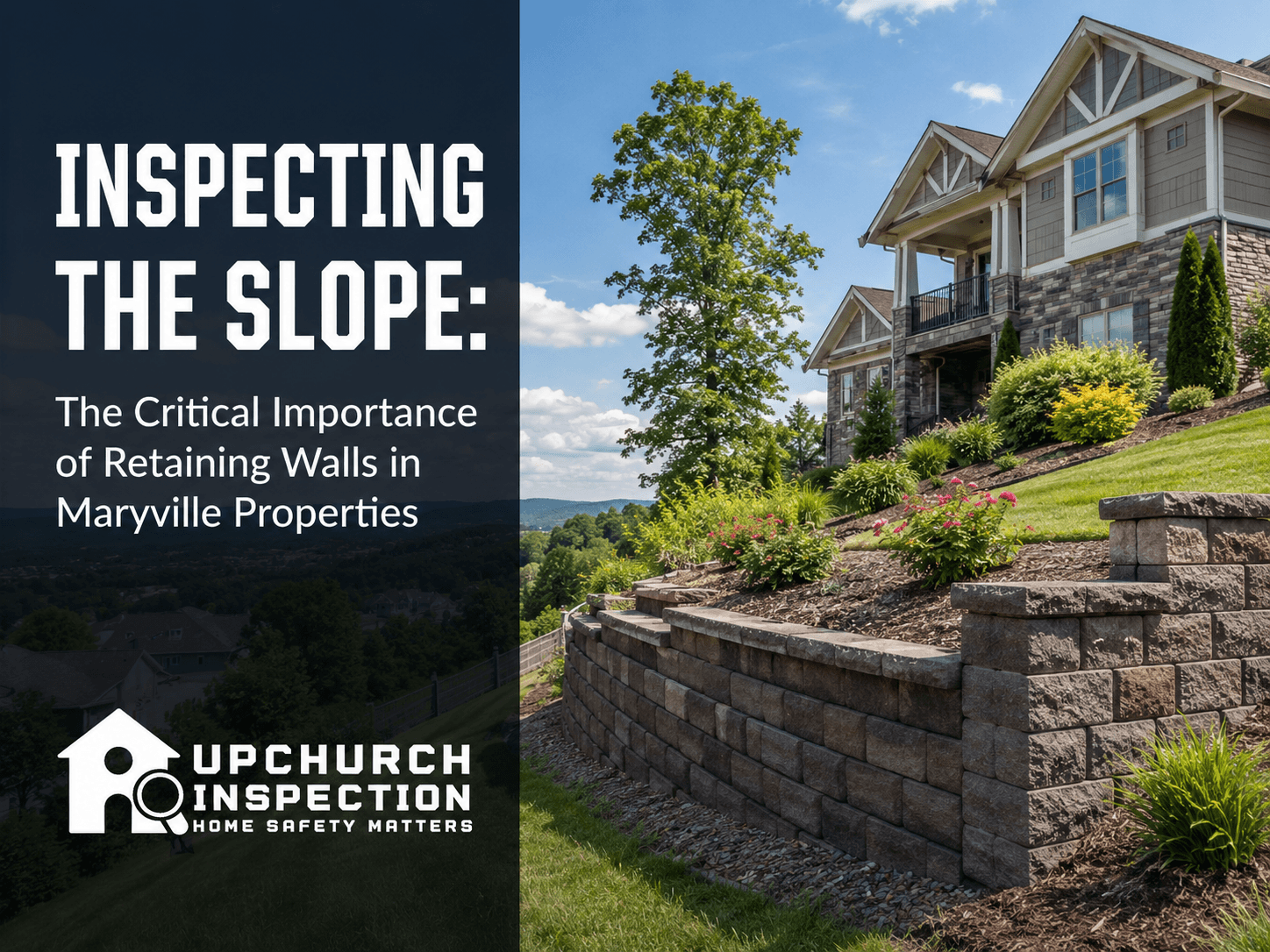
Maryville Homes Don’t Sit Flat—and That Changes Everything
When I review reports from our East Tennessee inspector, properties in Maryville consistently highlight one defining factor: elevation change. Maryville sits at the transition between the Tennessee Valley and the foothills of the Great Smoky Mountains. That geography shapes everything about how homes are built here, how they age, and where they fail.
In flatter markets, retaining walls are often decorative. In Maryville, they’re structural. They manage slope, control soil movement, redirect water, and protect foundations from forces that never stop acting on the property. When retaining walls fail—or were never designed correctly in the first place—the effects ripple outward into crawlspaces, basements, driveways, and the structure itself.
Why Retaining Walls Are So Common in Maryville
Maryville neighborhoods frequently occupy sloped lots, hillside cut-ins, and stepped terrain. Developers often carve level building pads into hillsides, using retaining walls to hold back uphill soil and stabilize downhill grades.
This is especially common in areas near transition corridors leading toward the Smokies, where elevation changes occur over short distances. Homes may have multiple retaining walls—some original to construction, others added later as landscaping evolved.
Our inspector regularly encounters properties where retaining walls were installed decades apart, by different contractors, using different materials and design assumptions. That patchwork approach often creates hidden risk.
Retaining Walls Are Drainage Systems First
One of the most misunderstood aspects of retaining walls is their relationship with water. A retaining wall is not just resisting soil—it’s resisting wet soil. And wet soil behaves very differently than dry soil.
In Maryville inspections, our inspector often finds walls that were built with little or no drainage provision behind them. Without proper gravel backfill, filter fabric, and weep holes or drain lines, water accumulates behind the wall. That trapped water increases pressure dramatically.
Over time, that pressure manifests as:
- Wall bulging or bowing
- Horizontal cracking
- Separation at wall joints
- Leaning or rotation of the wall face
These failures aren’t sudden. They develop incrementally, often unnoticed until displacement becomes visible.
Clay Soils Make Wall Performance More Complicated
Maryville’s soils often include clay-rich components that retain moisture and expand when wet. When these soils sit behind a retaining wall, pressure doesn’t just increase—it fluctuates seasonally.
During wet periods, soil swells and becomes heavier. During dry periods, it shrinks and pulls away, allowing water to penetrate deeper during the next rain cycle. This constant expansion and contraction accelerates wall fatigue.
Our inspector has documented walls that appeared stable during dry inspections but showed active movement markers after heavy rainfall events. Without drainage, clay soils turn retaining walls into long-term stress points rather than stabilizing features.
Types of Retaining Walls We See in Maryville
Maryville properties feature a wide range of retaining wall types, each with its own performance profile.
Timber walls, common in older properties, are especially vulnerable. Treated lumber degrades over time, particularly when constantly exposed to moisture. Our inspector frequently finds rotted tie-backs, deteriorated posts, and walls that are being held upright more by soil friction than structural integrity.
Concrete block walls are common in mid-aged developments. When properly engineered and drained, they perform well. When installed without reinforcement or drainage, they often fail by bowing or step cracking.
Poured concrete walls tend to be stronger but are not immune to failure. Cracking, rotation, and water pressure issues still occur, especially where drainage was omitted or compromised.
Stone and decorative landscape walls often create the greatest concern. Many were never designed to act as true retaining walls but were later relied upon to hold back significant soil loads.
Retaining Walls and Foundation Interaction
One of the most critical inspection points in Maryville is how retaining walls interact with the home’s foundation. In hillside construction, retaining walls are often located upslope from the structure. When those walls fail, soil movement doesn’t stop at the wall—it migrates downhill.
Our inspector has documented cases where failing retaining walls contributed to increased hydrostatic pressure against foundation walls, leading to basement moisture intrusion and crawlspace flooding. In some instances, foundation movement followed, triggered not by poor foundation design but by altered soil behavior upslope.
This is why retaining walls cannot be evaluated in isolation. They are part of a larger site system.
Driveways, Terraces, and Structural Load
Retaining walls in Maryville often support more than soil. They may support driveways, parking pads, patios, or entire terraces. That added load significantly increases risk.
A driveway retaining wall that lacks proper reinforcement or footing depth may perform adequately for years—until vehicle loads, water saturation, or soil movement exceed its capacity. Cracking and displacement often begin subtly at expansion joints or corners before progressing.
Our inspector pays close attention to walls supporting hardscapes, especially where cracking patterns align with traffic loads or drainage paths.
Signs of Retaining Wall Distress
Some retaining wall failures are obvious. Others are easy to miss without knowing what to look for. During Maryville inspections, our inspector looks for:
- Walls leaning forward or backward
- Separation between wall sections
- Horizontal cracking or stair-step cracking
- Soil washing out from behind the wall
- Block displacement or rotation
- Efflorescence indicating chronic moisture
- Vegetation growing through joints or seams
Even minor movement matters. Retaining walls are not forgiving structures. Once movement begins, progression is common unless corrective action is taken.
Why DIY Repairs Often Make Things Worse
Maryville’s retaining wall issues are often compounded by well-intentioned but ineffective repairs. Adding soil to level a yard, stacking additional blocks, or patching cracks without addressing drainage usually increases load without reducing pressure.
Our inspector frequently documents repairs that mask symptoms while accelerating failure. In several cases, prior owners attempted to “shore up” walls by adding weight behind them—exactly the opposite of what was needed.
Effective repairs almost always involve reducing water pressure and, in some cases, rebuilding sections with proper engineering.
The Role of Local Rainfall Patterns
Maryville’s proximity to the mountains means rainfall events can be intense and localized. Storms moving off higher elevations can dump significant rain in short periods, overwhelming poorly designed drainage systems.
Retaining walls that perform adequately during average rain often fail during these events. Our inspector notes that many wall failures occur after unusually heavy storms—not because the storm was extreme, but because the wall was already operating at its limit.
Retaining Walls in Older Neighborhoods
In older Maryville neighborhoods, retaining walls often predate modern engineering standards. Many were built as landscape features and later relied upon structurally as properties evolved.
Our inspector frequently finds walls with unknown construction details—no visible footings, no reinforcement, and no drainage. These walls may have stood for decades but are often one weather cycle away from failure.
Understanding age, construction type, and soil conditions is essential when evaluating these walls.
Why Retaining Walls Are an Inspection Priority
When I review inspection reports from Maryville, retaining wall findings often carry more long-term significance than interior cosmetic issues. A failing retaining wall can destabilize entire portions of a property and trigger cascading structural problems.
Unlike many home components, retaining walls don’t fail quietly. When they go, they go expensively.
Local Context Matters
Driving along the approach routes toward the foothills—particularly near scenic corridors like the Foothills Parkway—you can see how aggressively terrain shapes development in this region. That same terrain exerts constant pressure on residential properties.
Our inspector’s familiarity with Maryville’s topography, soil behavior, and construction patterns allows retaining wall risks to be identified before failure becomes inevitable.
The Big Picture
Retaining walls in Maryville are not optional landscape features. They are load-bearing, water-managing systems that protect homes from the realities of hillside construction.
When I review reports from our East Tennessee inspector, the most valuable insights come from understanding how retaining walls, drainage, soil, and foundations work together—or fail together.
In a region where gravity never rests, retaining walls are often the thin line between a stable property and a very expensive problem.