
East Tennessee Water Doesn’t Sit Still
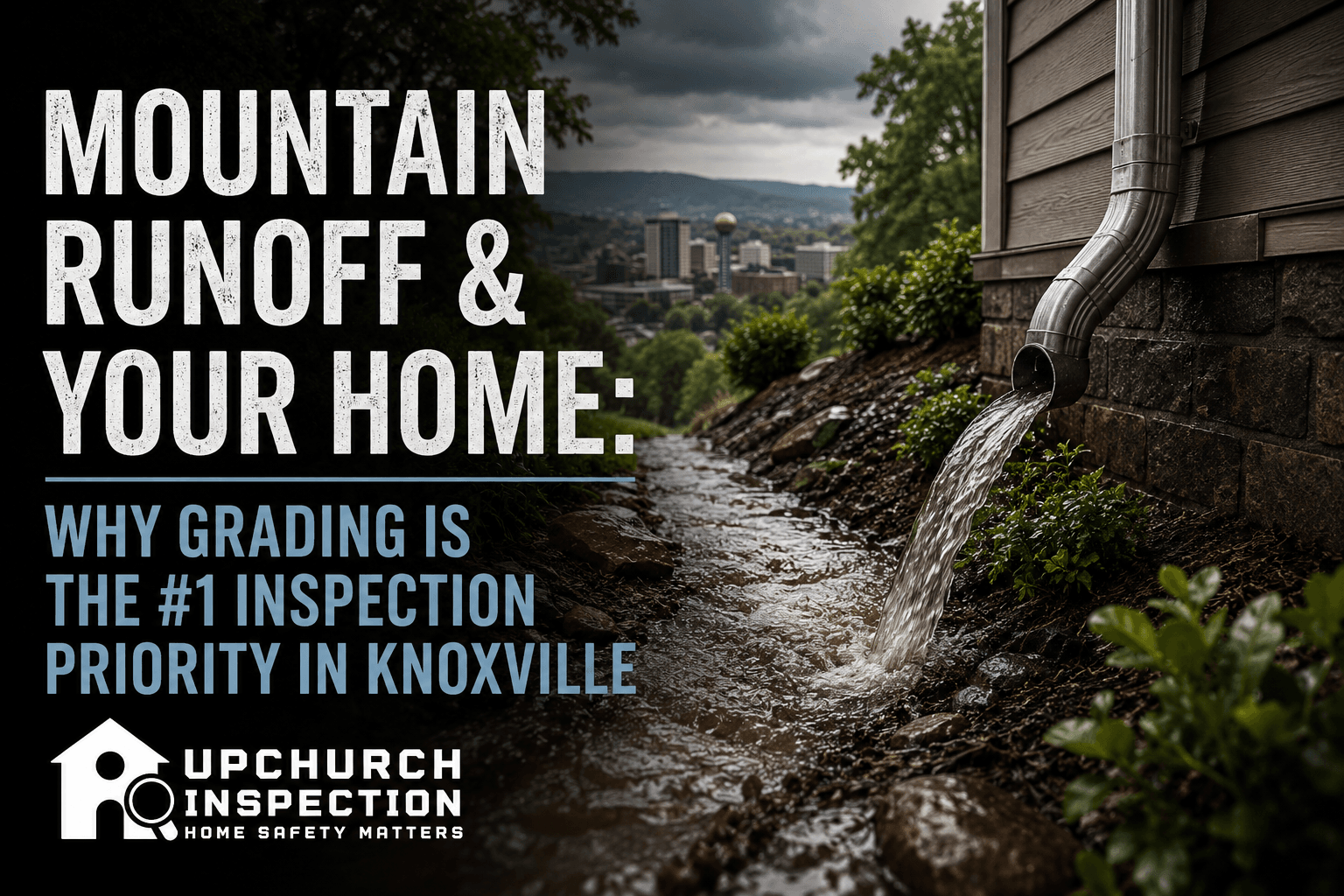
When I review reports from our inspector in Knoxville, one issue consistently stands out above the rest: uncontrolled water movement around the home. In this part of East Tennessee, gravity and rainfall do most of the talking. Water doesn’t pool quietly here—it moves, accelerates, and finds the path of least resistance.
Knoxville sits within a landscape shaped by ridges, valleys, and constant elevation changes. Add in frequent rain events and clay-influenced soils, and grading becomes more than a cosmetic concern. It becomes the single most important factor in how a home performs over time.
Why Grading Matters More Here Than Flatland Markets
In flatter regions, poor grading might lead to nuisance puddles or soggy lawns. In Knoxville, poor grading often leads to structural stress, crawlspace moisture, basement intrusion, and premature system failure.
Homes are routinely built into slopes, cut into hillsides, or perched at the transition between high and low ground. That means surface water is always trying to move downhill—and if the home is in its path, the structure becomes part of the drainage system whether it was designed to be or not.
Our Knoxville-area inspector regularly documents properties where water is being directed straight toward foundation walls due to reversed grading, settling soil, or landscaping changes made years after construction. These issues don’t show up overnight. They develop slowly, often unnoticed, until interior symptoms begin to appear.
Mountain Runoff Is a Force, Not a Nuisance
Runoff in East Tennessee behaves differently than in flatter, drier regions. Rainfall intensity combined with elevation change creates momentum. When storms move through the Tennessee Valley, water can travel quickly across yards, driveways, and retaining features.
In hillside neighborhoods, runoff often concentrates at specific points—corners of foundations, garage slabs, basement stairwells, or walkout walls. Our inspector has noted repeated moisture intrusion at these transition zones, especially where grading was never designed to manage concentrated flow.
This is why homes that look perfectly dry on a calm day can take on water during a single heavy storm. The problem isn’t the foundation itself—it’s how water reaches it.
Foundations Feel the Impact First
In Knoxville, foundations often reveal grading problems long before interior finishes do. Cracking patterns, efflorescence, and soil separation along foundation edges frequently tell the story.
Our inspector pays close attention to areas where soil has pulled away from the foundation wall. That gap isn’t just cosmetic—it allows surface water to drop directly down the wall, increasing hydrostatic pressure against basements and crawlspaces.
On slab-on-grade homes, poor grading often shows up as moisture intrusion at slab edges or through control joints. On crawlspace homes, it presents as damp soil, elevated humidity, and deteriorating framing near exterior walls.
Crawlspaces Are Especially Vulnerable
Crawlspaces are common throughout Knoxville, and they are extremely sensitive to exterior water management. When grading slopes toward the home, runoff enters the crawlspace environment either directly or through soil saturation.
In recent Knoxville inspections, our inspector documented crawlspaces with standing water days after rainfall—not because of plumbing leaks, but because exterior grading funneled water toward the foundation. Over time, this leads to wood decay, mold growth, and compromised insulation performance.
Even well-installed vapor barriers can be overwhelmed if water pressure from outside is constant.
Retaining Walls Don’t Fix Grading by Themselves
Retaining walls are everywhere in Knoxville. They’re necessary, but they’re not a cure-all. A retaining wall without proper drainage simply traps water behind it—and that water eventually finds a way out.
Our inspector frequently evaluates retaining walls that lack weep holes, gravel backfill, or proper drainage paths. When these features are missing or clogged, pressure builds behind the wall and redirects water toward nearby structures.
In some cases, failing retaining walls become secondary water sources, pushing moisture toward foundations rather than away from them.
Driveways, Sidewalks, and Hardscapes Matter
Hard surfaces play a major role in Knoxville drainage behavior. Driveways sloped toward garages, patios pitched toward foundation walls, and sidewalks that channel water inward are common contributors to moisture problems.
During inspections, our inspector looks closely at how hardscapes interact with grading. Concrete settles over time, especially on cut-and-fill lots. When that happens, water paths change—and the home often pays the price.
A driveway that drains toward a garage slab can introduce water into wall cavities or basement levels during heavy rain. These issues are easy to miss without looking at the property as a whole system.
Seasonal Effects Amplify the Problem
Knoxville’s seasonal weather patterns intensify grading-related issues. Spring rains saturate soils, reducing their ability to absorb additional water. Summer storms deliver sudden downpours that overwhelm poorly designed drainage. Fall leaf buildup clogs surface drains. Winter freeze-thaw cycles shift soil and hardscapes.
Our inspector often notes that homeowners report “intermittent” water issues—problems that only appear during certain times of year. In almost every case, grading and runoff patterns explain the timing.
Grading Changes Over Time
One of the most overlooked aspects of grading is that it’s not permanent. Soil settles. Mulch builds up. Landscaping beds rise. Erosion removes material in some areas while depositing it in others.
In older Knoxville neighborhoods, our inspector frequently finds grading that was likely adequate at the time of construction but has slowly reversed over decades. What once directed water away now funnels it back.
This is especially common near foundation corners and along exterior walls where maintenance has been deferred.
Why Inspections Focus on the Big Picture
When I review Knoxville inspection reports, the most valuable ones don’t just note “poor grading.” They explain how water moves across the entire site—where it starts, how it travels, and where it ends up.
That big-picture approach is essential in a region defined by elevation change. A problem at the top of the lot often explains damage at the bottom. Fixing the symptom without understanding the source rarely works.
Local Context Matters
Knoxville’s proximity to the Tennessee River and the surrounding ridge-and-valley terrain shapes how neighborhoods were developed. Many older areas were built before modern drainage standards were common, and even newer developments sometimes prioritize aesthetics over long-term water management.
Our inspector’s familiarity with local topography, soil behavior, and construction patterns allows grading issues to be identified early—before they turn into major repairs.
Why Grading Is the First Thing We Evaluate
Grading affects everything downstream: foundations, crawlspaces, basements, retaining walls, and even interior air quality. In Knoxville, it’s not an exaggeration to say that grading determines whether a home ages gracefully or fights water its entire life.
That’s why, when I review reports from our Knoxville inspector, grading is always near the top of the findings list. It’s not flashy. It doesn’t involve complex systems. But in a mountain-influenced environment like East Tennessee, it’s the single most important line of defense a home has.
Water will always follow gravity. The only question is whether your property is guiding it safely away—or inviting it inside.