
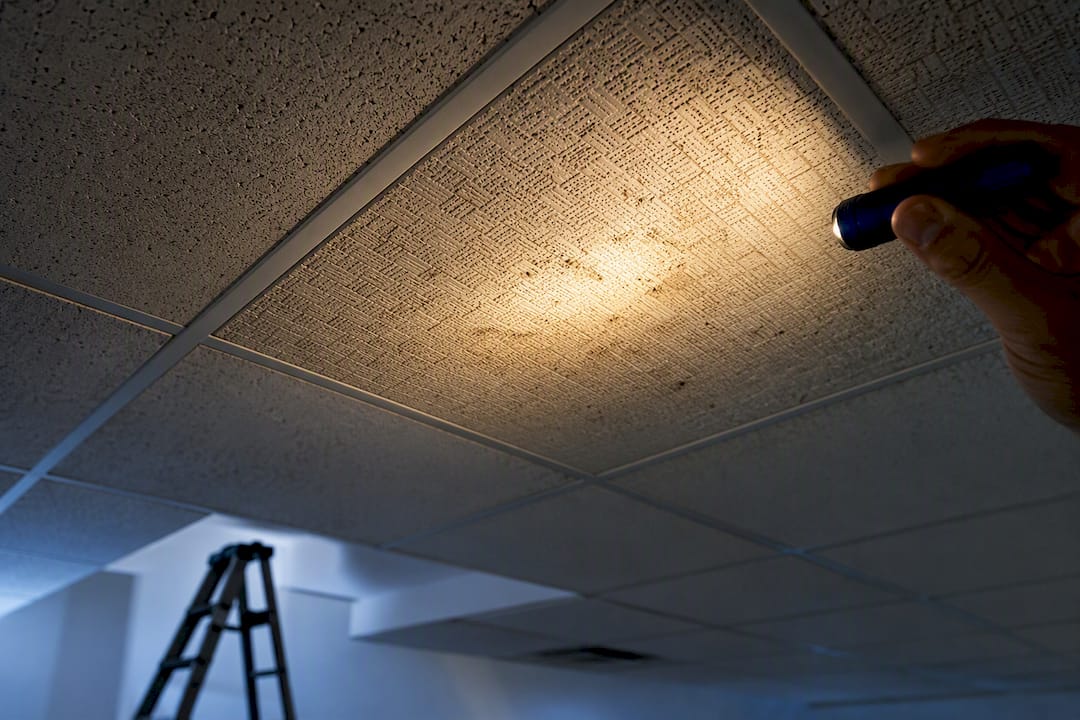
If your building has ceiling tiles installed before the 1980s, they may contain asbestos, and there is no reliable way to confirm that by looking at them. The single most important thing to do right now is stop, leave the tiles alone, and arrange accredited testing before any renovation, drilling, or demolition work touches them. Undisturbed tiles are generally not an urgent health threat, but disturbed ones are a different story.
TL;DR:
- Asbestos ceiling tiles installed before the 1980s cannot be identified definitively by sight; laboratory testing is essential for confirmation.
- Intact, undisturbed non-friable tiles generally do not pose health risks, but disturbance from damage, cutting, or removal can release dangerous fibers.
- Accredited sampling and analysis follow strict procedures to minimize fiber release, with results guiding management options such as in-place maintenance, encapsulation, or licensed removal.
- Properly licensed inspectors and abatement contractors are crucial; verify credentials and avoid DIY removal to prevent regulatory violations and health hazards.
- Managing in place with a routine inspection approach is usually safest and cheapest for stable, unaltered tiles, while damaged or disturbed tiles require professional removal.
Table of Contents
- How Do You Identify Asbestos Ceiling Tiles?
- When Do Ceiling Tiles Actually Become a Hazard?
- How Does Asbestos Testing and Sampling Work?
- Should You Manage in Place, Encapsulate, or Remove Ceiling Tiles?
- How Do You Vet Asbestos Inspectors and Abatement Contractors?
- What Health Risks Come From Asbestos Exposure?
- How Upchurch Inspection Documents Ceiling Tile Conditions
- What This Guide Gets Right That Most Advice Doesn’t
- How Upchurch Inspection Can Help You Move Forward
- Sources
- FAQ
How Do You Identify Asbestos Ceiling Tiles?
You cannot identify asbestos ceiling tiles with certainty by eye. That is the first thing I tell clients during a commercial walkthrough, and it usually surprises them. What you can do is gather clues that either raise or lower your suspicion enough to decide whether testing is worth scheduling before a renovation starts.
Start with format and texture. Many older drop-ceiling systems used 12×12 or 24×24 tiles with a stippled, pinholed, or fissured surface, sometimes with a chalky feel when you run a finger lightly across the surface without gouging it. Acoustic ceiling tile asbestos content was common in mineral fiber tiles manufactured to dampen sound in offices, schools, and retail spaces built between the 1950s and the late 1970s. Some tiles were glued directly to a substrate; others were designed to drop into a metal grid system. That distinction matters more than most owners realize, because it changes how much disturbance removal or even routine ceiling access will cause.
Here is what I have my team look for during a visual assessment, without touching or breaking anything:
- Tile dimensions and pattern (12×12 versus 24×24, stippled versus smooth)
- Edge profile and how the tile sits in the grid or against the substrate
- Any visible manufacturer stamp, product code, or leftover packaging in storage areas
- Adhesive residue color and texture around the tile perimeter
- General building age, permit history, and any past renovation records
Building age narrows the range of suspicion, but only laboratory testing can settle the question. A building constructed in 1974 could have had its ceiling replaced in 2003 with asbestos-free tile, or a 1990s building could have reused salvaged older stock during a budget renovation. Manufacturer records, when they exist, are more useful than a guess based on construction date alone. According to Inspectapedia’s review of asbestos ceiling tile identification, visual cues and age are useful for triage, not confirmation, and lab analysis remains the only way to know for certain.
Our working rule on every inspection: if the tile’s age or origin cannot be verified and a renovation is going to disturb it, treat it as presumed asbestos containing until testing says otherwise. That single habit prevents more exposure incidents than any visual checklist ever will.
When Do Ceiling Tiles Actually Become a Hazard?
The material science distinction that matters here is friable versus non-friable. Friable material crumbles or can be reduced to powder by hand pressure, which means fibers release into the air easily. Non-friable material, which describes most intact ceiling tile, holds its fibers bound in place under normal conditions.
That distinction is why the EPA is direct on this point: intact asbestos-containing materials generally do not pose a health risk if left undisturbed. The risk shows up when tiles get:
- Water damaged, which softens the material and lets fibers migrate
- Cracked, sanded, drilled, or cut for HVAC, lighting, or fire suppression work
- Removed without containment during a renovation or demolition
Glued tiles carry a different disturbance profile than drop-in tiles. Removing a glued tile often pulls up adhesive and substrate fragments along with it, while a drop-in tile can sometimes be lifted cleanly from its grid, though the plenum space above it may hold decades of settled fiber debris from HVAC vibration and past access.
Regulatory reference point: Under 40 CFR Part 763, a material is classified as asbestos-containing when laboratory analysis by polarized light microscopy finds more than 1% asbestos content. That 1% threshold, not visual judgment, is what determines management and disposal obligations.
How Does Asbestos Testing and Sampling Work?
Do not sample ceiling tiles yourself. Cutting into a tile to collect a piece for testing is itself a disturbance event, and an untrained hand can release more fiber in thirty seconds than the tile would release sitting undisturbed for another twenty years.
Here is the process an accredited inspector actually follows on a commercial or residential job:
- Map homogeneous areas. The inspector groups ceiling sections that appear to be the same material, age, and installation batch, following the sampling logic laid out under AHERA’s asbestos-in-schools rule, which governs how many samples a given area requires.
- Use wet suppression. Samples are collected wet to minimize airborne fiber release during the cut.
- Maintain chain of custody. Each sample gets logged, sealed, and tracked from ceiling to laboratory, which matters if results ever get challenged during a real estate transaction.
- Send to an accredited lab. Analysis typically uses Polarized Light Microscopy (PLM), the regulatory reference method for the 1% threshold. When results come back borderline or a client needs finer fiber discrimination, labs may follow up with Transmission Electron Microscopy (TEM), which offers higher sensitivity than PLM, according to Inspectapedia’s testing overview.
A PLM report showing less than 1% asbestos generally clears the material for normal handling under federal thresholds. A result at or above 1% triggers management decisions, and depending on condition, that means either an operations and maintenance plan or licensed abatement.
Pro Tip: Ask the lab whether it holds NVLAP accreditation before you accept results. A report from an unaccredited lab can create real problems later if a buyer’s attorney or insurer questions the data during closing.
Should You Manage in Place, Encapsulate, or Remove Ceiling Tiles?
Testing tells you what the material is. It does not automatically tell you what to do about it, and this is where I see property owners overspend or, just as often, underreact.
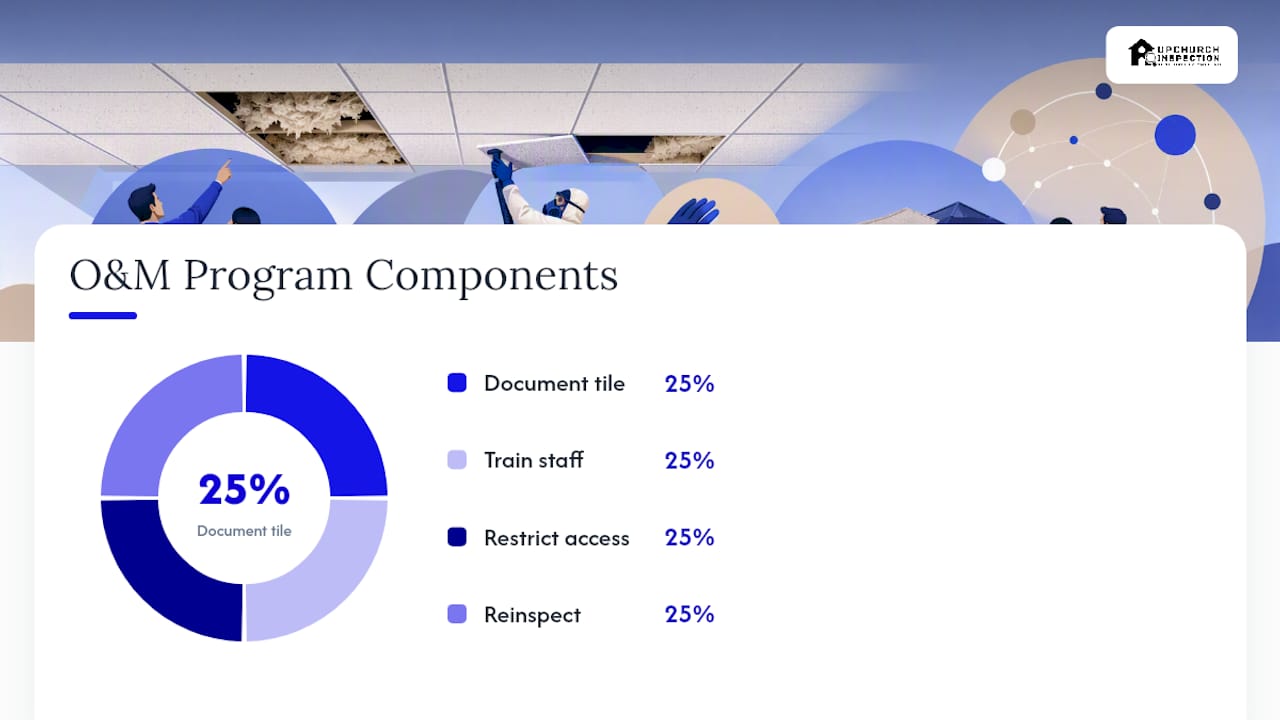
For intact, non-friable tile in stable condition, the EPA recommends an Operations & Maintenance (O&M) program as the most effective and least disruptive management strategy. That means documenting tile location and condition, training maintenance staff to recognize and avoid disturbing it, restricting unauthorized ceiling access, and reinspecting on a set schedule. It is far cheaper than removal, and for a building not undergoing renovation, it is usually the right call.
Encapsulation, sealing the tile surface with a bonding agent, works for tile in fair condition where removal isn’t planned soon, but it has limits: it cannot address hidden damage above the tile line and needs periodic reinspection to confirm the seal is holding.
Licensed removal becomes necessary when tile is extensively water damaged, crumbling, or when planned renovation or demolition will disturb it regardless of current condition. A properly run abatement project includes containment barriers, negative air pressure, air monitoring during and after the work, and licensed disposal of the waste stream.
| Approach | Best fit | Typical trigger |
|---|---|---|
| Manage in place (O&M) | Intact, non-friable tile, no renovation planned | Routine reinspection shows stable condition |
| Encapsulation | Tile in fair condition, short-term hold | Owner wants a lower-cost interim fix |
| Licensed removal | Damaged, friable, or renovation will disturb tile | Demolition, remodel, or water damage found |
For anyone underwriting a deal, the decision made here has direct CapEx consequences. A buyer who assumes O&M is sufficient but is actually planning a gut renovation is budgeting for the wrong scope of work.
How Do You Vet Asbestos Inspectors and Abatement Contractors?
These are two different jobs, and conflating them causes real procurement mistakes. An accredited inspector or surveyor identifies, samples, and documents suspect material. A licensed asbestos abatement contractor removes it. Some firms do both under separate credentials, but never assume that without checking.
Before hiring either one, do this:
- Ask for the inspector’s accreditation number and the lab’s NVLAP accreditation, then verify both independently rather than taking a business card at face value.
- Request the contractor’s state abatement license number and confirm it is current and matches the entity doing the work.
- Ask for the sampling plan, chain-of-custody procedure, and, for removal, the containment and air monitoring plan in writing.
- Confirm proof of liability insurance specific to asbestos work, not a general contractor policy.
Walk away from anyone who says testing isn’t necessary, refuses to show licensing, or pushes you toward DIY removal to save money. That advice, wherever it comes from, ignores federal disposal rules and puts occupants at unnecessary risk. If you’re weighing a broader renovation and wondering where else DIY shortcuts backfire, common pitfalls with DIY door replacement follows the same logic: some jobs cost more to undo than to hire out correctly the first time.
What Health Risks Come From Asbestos Exposure?
Asbestos exposure is linked to asbestosis, lung cancer, and mesothelioma, and the ATSDR notes that these diseases often have decades of latency between exposure and diagnosis. That long lag is part of why asbestos regulation focuses on prevention rather than treatment.
Risk scales with dose and duration. Tradespeople, maintenance staff, and abatement workers who handle these materials repeatedly face materially higher risk than someone occupying a building with intact, undisturbed tile overhead.
That is exactly why management strategy centers on preventing airborne fiber release rather than treating every asbestos-containing material as an emergency demolition project.
How Upchurch Inspection Documents Ceiling Tile Conditions
During a walkthrough, our inspectors note water staining, repeated ceiling access panels, and HVAC or plumbing penetrations through tile, all without disturbing the material itself. Those details go into the report as documented conditions, not guesses, and they give buyers and agents something concrete to negotiate around.
What we flag versus what we let ride depends on context:
- Stable, undamaged tile with no planned renovation: we note it and recommend an O&M approach or optional testing for the buyer’s records
- Water-stained or visibly deteriorating tile near a planned scope of work: we recommend accredited testing before closing, not after
That distinction has changed deal terms more than once, especially on commercial properties where a buyer assumed the ceiling was a non-issue until our report flagged staining above a leased suite.
What This Guide Gets Right That Most Advice Doesn’t
Most consumer content on this topic treats asbestos ceiling tile as either a nonissue or a crisis, with nothing in between. Neither framing serves a property owner well. The research is consistent on one point that gets buried too often: intact material left alone is not the emergency people assume it is, while the same material becomes genuinely dangerous the moment someone drills into it, sands it, or tears it out without containment.
Where I think conventional advice falls short is in treating testing as optional until a sale is imminent. Waiting until a buyer’s attorney demands answers is the expensive way to find out you have a friable tile problem. The cheaper, smarter sequence is testing before scope, not after surprise.
If you take one thing from this, prioritize documentation over assumption. Know what you have, know its condition, and let that drive whether you manage in place or bring in licensed abatement. Everything else, cost estimates, timelines, negotiation leverage, follows from that one decision.
— Holly
How Upchurch Inspection Can Help You Move Forward
Professional inspection services are a practical next step for owners who need documented answers instead of guesswork before a transaction closes. Rather than leaving ceiling tile condition as an open question in your due diligence file, an inspection team can document visible conditions, HVAC penetrations, and water staining directly in your report and coordinate sampling with accredited labs so you get PLM or TEM results tied to a clear recommendation, not just a flag with no follow-up.
Our specialized commercial inspection services cover exactly this kind of hazardous-material scenario, where a general walkthrough isn’t enough and a buyer needs a report that stands up during negotiation. If you’re weighing a purchase, a renovation, or a portfolio-wide reinspection in the Mid-South region, schedule an inspection with a qualified team and get a report built around what you actually need to decide.
This article is general information, not a substitute for advice from a qualified doctor. Consult a qualified healthcare professional about your own circumstances before acting on anything here.
Sources
- EPA — What are the health risks if I have asbestos in my home, building, apartment, or school?
- Inspectapedia — Asbestos Ceiling Tiles: Identification, Testing, and Removal
FAQ
How Can You Tell if Ceiling Tiles Have Asbestos?
You cannot confirm it visually. Format, texture, and building age can raise or lower suspicion, but only laboratory analysis by PLM or TEM confirms asbestos content.
What if I Accidentally Removed Asbestos Tiles?
Stop work immediately, leave the area, and avoid sweeping or vacuuming debris, since that spreads fibers. Contact a licensed abatement contractor to assess and clean up the area properly before resuming any work.
Are 12×12 Ceiling Tiles Asbestos?
Not necessarily. 12×12 ceiling tiles asbestos content was common in older stippled or pinholed mineral fiber tiles, but tile size alone never confirms asbestos; testing does.
What Percentage of Ceiling Tiles Have Asbestos?
There’s no reliable industry-wide percentage, since it depends heavily on building age, manufacturer, and region. What matters legally is the lab result: material qualifies as asbestos-containing at over 1% asbestos by PLM analysis under federal rules.
Do I Need to Remove Asbestos Ceiling Tiles if They’re Not Damaged?
Not usually. The EPA recommends managing intact, non-friable tile in place through an O&M program rather than removing it, reserving removal for damaged material or planned renovation that will disturb it.