TL;DR:
- A restaurant property inspection assesses critical building systems to ensure legal operation and safety. Specialty checks like hood, fire suppression, and sewer inspections are essential parts of due diligence. Proper inspections help identify maintenance, safety, and compliance issues that can significantly impact deal decisions.
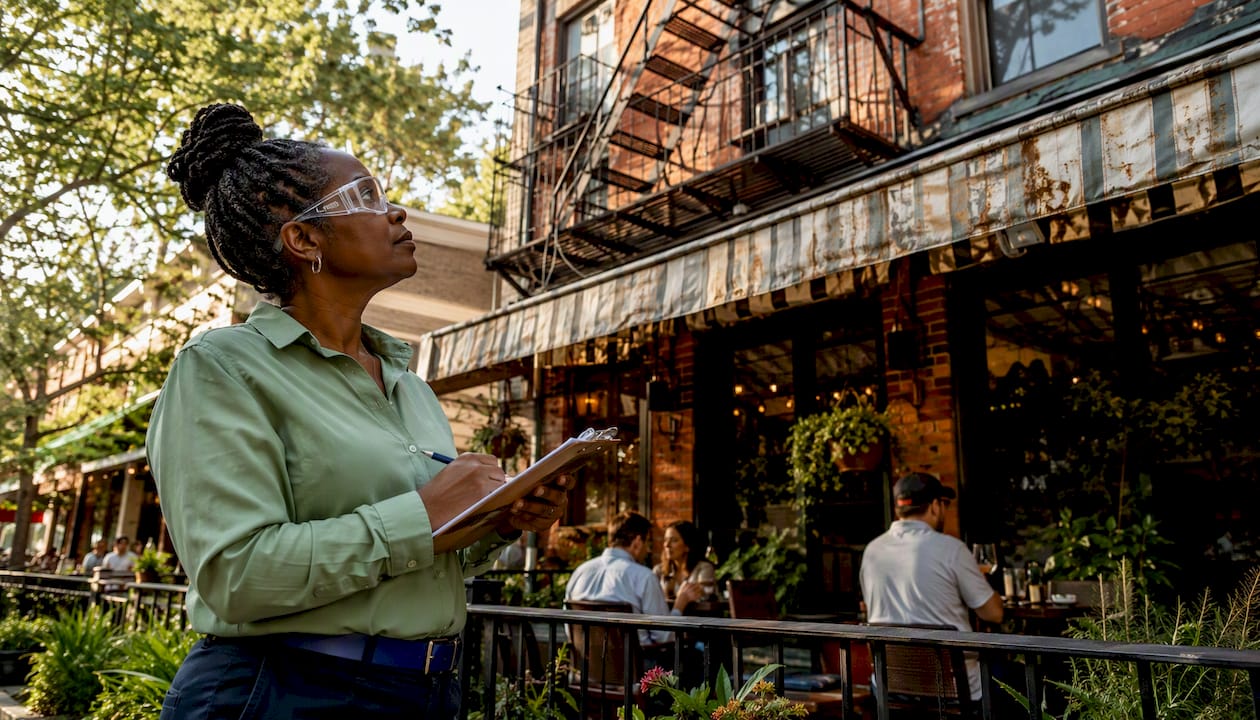
A restaurant property inspection is a systems-focused commercial assessment that goes well beyond a standard building walkthrough. It evaluates the building envelope, mechanical and HVAC capacity, plumbing and grease management, electrical service, fire suppression, and hood/exhaust systems — all the infrastructure that determines whether a food service operation can run legally and profitably from day one. If you are buying, leasing, or converting a restaurant space, the single most important next step is to hire a licensed, commercially experienced inspector and add specialty checks for hood/duct, fire suppression, grease trap, and sewer scope before you close or sign.
- A qualified inspector should carry commercial-specific credentials, such as CCPIA (Certified Commercial Property Inspectors Association) membership or an equivalent certification.
- Require a photo-backed written report that separates safety, operational, and cosmetic deficiencies.
- Specialty checks — hood/duct condition, fire suppression service tags, grease trap records, and a sewer scope — are not optional add-ons for a restaurant; they are core due diligence.
- Licensed and insured status is non-negotiable. Verify both before scheduling.
Pro Tip: Request the grease trap service invoices and hood cleaning logs before the inspection date. Their absence tells you something before the inspector sets foot on the property.
Table of Contents
- What does a restaurant property inspection actually cover?
- How does the inspection process work from scheduling to report?
- What types of inspections should you order for a restaurant space?
- What red flags should pause or reframe a deal?
- How do health inspections differ from property inspections?
- What do restaurant inspections typically cost and how long do they take?
- How do you choose the right inspector for a restaurant property?
- Key Takeaways
- What experienced inspectors know that buyers often miss
- Upchurchinspection serves restaurant buyers across the Mid-South
- Useful sources
What does a restaurant property inspection actually cover?
The CCPIA ComSOP defines a commercial inspection as a walk-through survey that produces a meaningful report on property condition based on visual observation and research. For a restaurant, that scope expands considerably because commercial kitchen systems stress building infrastructure in ways that office or retail uses simply do not.
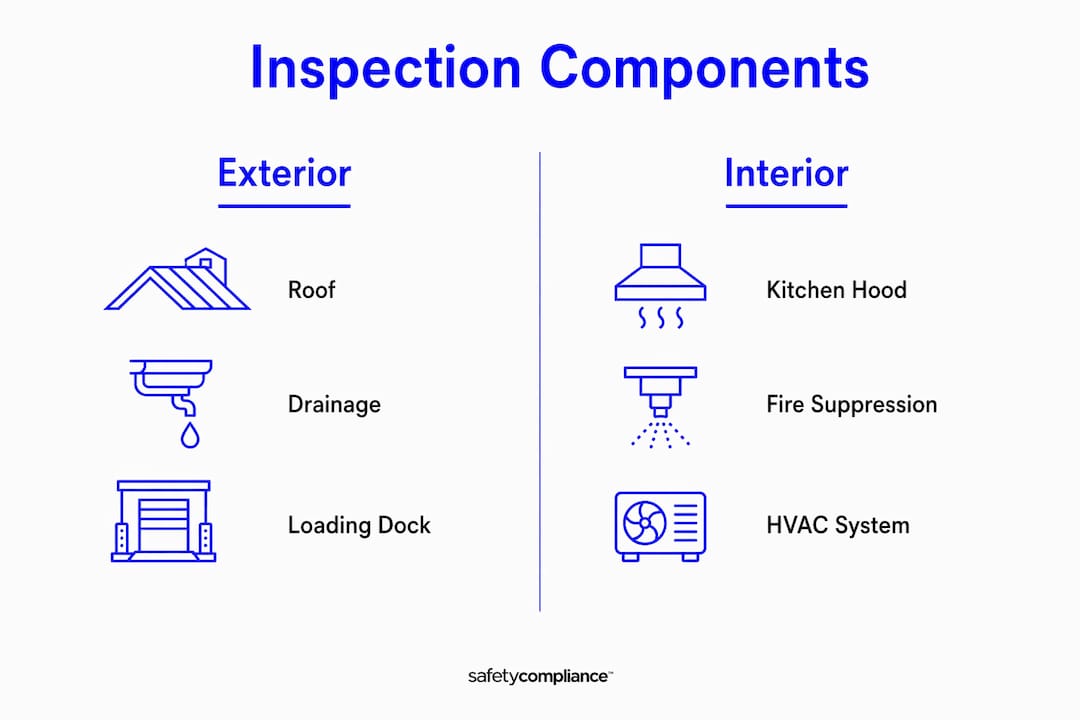
| System | What the Inspector Evaluates | Why It Matters |
|---|---|---|
| Exterior & envelope | Roof drainage, loading access, grease removal access, building penetrations | Moisture intrusion and pest entry points |
| Interior (general) | Floor drains, slope, finishes, restroom capacity, ventilation | Code compliance and operational flow |
| Hood & exhaust | Hood condition, grease filters, exhaust fan, duct access | Fire risk and ventilation adequacy |
| Fire suppression | ANSUL or equivalent system, service tags, nozzle coverage | Insurance and code requirements |
| Grease trap/separator | Condition, capacity, service records, indirect waste | Sewer backups and municipal compliance |
| Plumbing & sewer | Floor drains, trap primers, cleanout access, prior backup history | Operational continuity and repair cost |
| Electrical service | Panel size, dedicated circuits, disconnects, overheated connections | Equipment capacity and safety |
| HVAC & makeup air | CFM balance, kitchen load capacity, odor and heat control | Indoor air quality and grease accumulation |
| Roof & structure | Framing condition, rooftop equipment supports, flashing integrity | Capital repair exposure |
| Documentation | Permits, suppression tags, grease contracts, prior inspection reports | Compliance gaps and negotiation leverage |
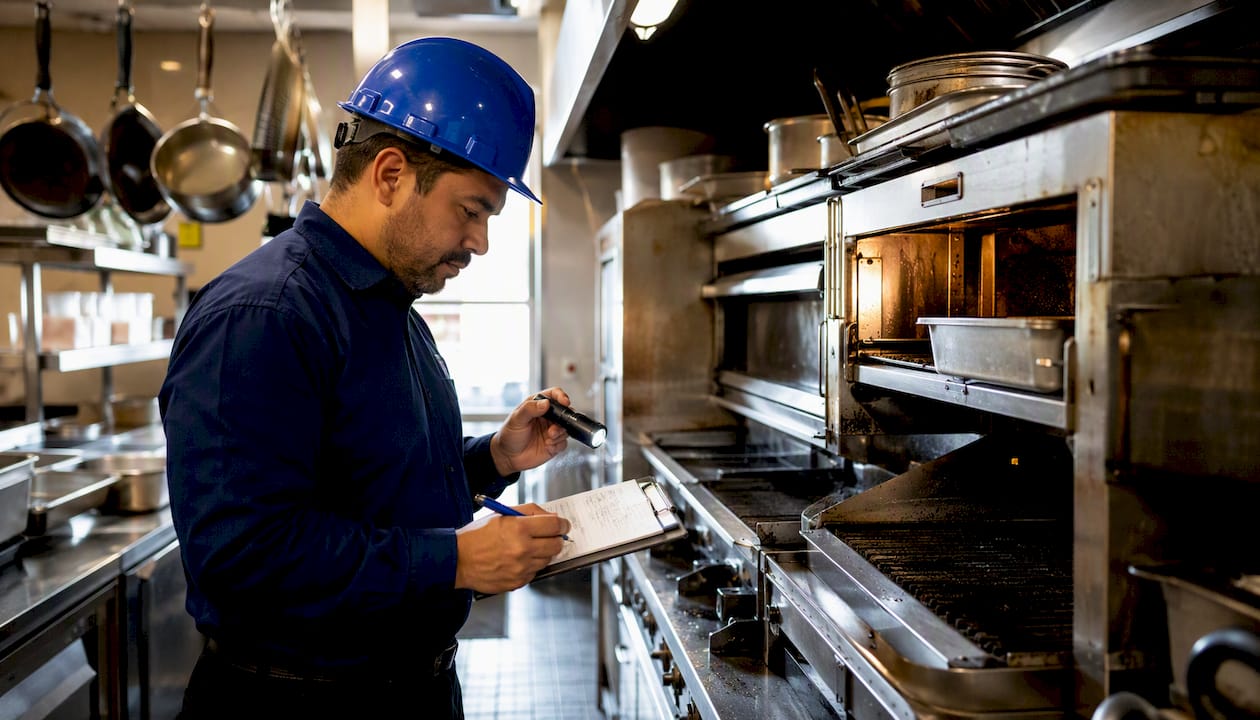
The kitchen inspection typically comes last in the walk-through sequence, after the exterior, general interior, and mechanical systems. That order is deliberate: grease and cleaning activity in an active kitchen can obscure conditions that are easier to read when the space has been assessed in context first.
How does the inspection process work from scheduling to report?
The process is straightforward, but the preparation you do beforehand directly affects the quality of findings you receive.
- Schedule with access confirmed. Coordinate with the owner or tenant to ensure all areas are accessible, including roof hatches, mechanical rooms, and grease trap access points. Active restaurants should be inspected during off-hours when possible.
- Gather documentation in advance. Provide the inspector with available building permits for hood and equipment installations, grease trap service invoices, suppression system certification tags, and any prior inspection reports or maintenance records. Gaps in this paperwork are findings in themselves.
- Exterior walk-through. The inspector starts outside: roof drainage, building envelope, grease removal access, dumpster placement, and loading areas. Evidence of chronic grease overflow near drains or staining on exterior walls is noted here.
- Interior and systems checks. General interior conditions, restroom capacity, floor drain function, and mechanical room access come next. The inspector spot-tests accessible equipment, checks service panels, and photographs deficiencies as they go.
- Kitchen and specialty systems. Hood filters, exhaust fan operation, visible duct sections, suppression nozzle placement, grease trap condition, and floor sink drainage are evaluated last. Local health department portals often publish searchable inspection histories — cross-referencing the address before your on-site visit adds useful context.
- Roof and rooftop equipment. Rooftop HVAC units, exhaust fan supports, flashing around penetrations, and any evidence of prior repairs are documented.
- Report delivery. Expect a detailed, photo-backed written report within 2–5 business days for a full commercial property assessment. Rush turnaround is available from most commercial inspectors if your contingency window is tight. The report should prioritize issues by severity, estimate remaining useful life for major systems, and identify where specialist follow-up (structural engineer, licensed HVAC contractor, hood service technician) is warranted.
What types of inspections should you order for a restaurant space?
Not every situation calls for the same scope. Here is how to match the service to the scenario.
Pre-purchase property condition assessment (PCA) is the baseline for any buyer or investor. It covers structural, mechanical, electrical, and roof systems and produces the documentation lenders and attorneys expect. A commercial property inspection for a restaurant should always include the specialty kitchen systems that a standard PCA might treat as secondary.
Specialty service checks are add-ons that become mandatory in a food service context: hood and fire suppression evaluation, grease trap or separator inspection, sewer scope (camera) for any property with a history of backups, and an electrical load review if the planned equipment list is heavy.
Operational and pre-opening audits focus on code prerequisites — ADA compliance, occupancy requirements, and the pre-operational health inspection checklist your local health department will use before issuing a food service permit.
Lease-focused inspections serve tenants evaluating a space before signing. The goal is to identify which code upgrades are the landlord’s responsibility, document existing conditions to protect the tenant’s security deposit, and flag deferred maintenance the lease may inadvertently transfer to the tenant. A property manager’s inspection framework applies directly here.
What red flags should pause or reframe a deal?
Some findings are cosmetic. Others change the economics of the deal entirely. These are the ones that warrant a hard conversation before you proceed.
- Chronic grease and sewer backups or the absence of an accessible cleanout. Recurring blockages mean recurring operational costs and potential liability. Per San Diego County health enforcement guidance, a sewage backup qualifies as an imminent health hazard that can trigger mandatory closure.
- Undersized electrical service or jury-rigged panels. Restaurants require dedicated circuits and correct disconnects for ovens, fryers, and refrigeration. An undersized service is not a maintenance item; it is a capital upgrade.
- Missing or expired hood/duct cleaning and suppression service records. Without documented service history, insurers may deny claims and authorities may require remediation before issuing permits. Require these records as a condition of due diligence.
- Roof or rooftop equipment support failures. Structural repairs to support HVAC or exhaust fans are expensive and often invisible until the roof is accessed.
- Inadequate makeup air or ventilation capacity. Poor CFM balance causes grease accumulation in walls and ceilings, accelerates equipment wear, and creates indoor air quality problems that affect staff and customers.
- A pattern of repeated health inspection violations. A single failed inspection is not necessarily alarming. A pattern of priority violations or prior closures for imminent hazards signals systemic operational problems that often reflect deferred maintenance in the building systems.
How do health inspections differ from property inspections?
These two inspection types serve different purposes, operate under different authority, and produce different outcomes. Confusing them is a common and costly mistake.
Health inspections enforce the FDA Food Code 2022 model as adopted by each state and local jurisdiction. They focus on food-safety practices: temperature control, handwashing, cross-contamination, and vermin. Property inspections evaluate building systems and long-term capital risk. Both affect operations, but through entirely different enforcement paths.
| Dimension | Health (food safety) inspection | Property condition inspection |
|---|---|---|
| Authority | Local health department | Hired by buyer/lessee (private) |
| Focus | Food-handling practices, sanitation | Building systems, capital condition |
| Timing | Routine, complaint-based, pre-operational — often unannounced | Scheduled, diagnostic, contract-driven |
| Enforcement | Correction notices, re-inspections, closure orders | Findings inform negotiation and repair cost |
| Documentation | Official inspection report, public record | Photo-backed private report to client |
Health departments classify violations as priority, priority foundation, or core. Priority items must be corrected within 5 calendar days; core violations carry a 14-day correction window. Imminent health hazards — sewage backup, lack of potable water, severe temperature abuse — can trigger immediate closure. A corrected-on-site (COS) provision allows minor fixes during the inspection itself, which do not count toward reinspection triggers.
Research from a Philadelphia study of 2013–2014 data found that nonchain restaurants inspected more frequently showed fewer violations per inspection, suggesting that inspection history and frequency are meaningful signals when evaluating a property’s operational risk.
Key point: A property inspection will not tell you whether the previous operator passed their last health inspection. Pull that record separately from your local health department’s public portal before you finalize due diligence.
What do restaurant inspections typically cost and how long do they take?
Cost and timeline vary by market, property size, and scope. Here is a realistic planning framework.
- Base commercial inspection fee depends on square footage and system complexity. A small standalone restaurant runs less than a large multi-tenant food hall. Get a written scope and fee before scheduling.
- Specialty add-ons — hood and suppression evaluation, grease trap inspection, sewer scope, and electrical load review — are priced separately. Budget for all of them on any restaurant property.
- On-site time is typically 2–4 hours for a standard restaurant footprint. Larger properties or those with multiple mechanical systems take longer.
- Report delivery is commonly 2–5 business days. If your contingency period is short, ask about rush delivery upfront.
- Specialist follow-up adds 1–2 weeks if structural or MEP (mechanical, electrical, plumbing) engineering evaluations are needed. Build that buffer into your contingency window, not after it closes.
Understanding how inspections interact with loan conditions is worth reviewing if financing is part of the transaction, since lender-required PCAs carry their own scope and timeline requirements.
How do you choose the right inspector for a restaurant property?
Pick an inspector with documented commercial restaurant experience, licensed and insured status, and the capability to perform or coordinate specialty checks. General residential inspectors are not the right choice here.

Credentials to verify: CCPIA membership or an equivalent commercial inspection certification, relevant state licenses, active general liability and E&O insurance, and references from recent restaurant or food service inspections specifically.
Questions worth asking before you book:
- Do you inspect hood/duct and suppression systems directly, or do you subcontract?
- Does your scope include a load review for electrical service sizing?
- Can you coordinate a sewer scope as part of the same engagement?
- Does your report prioritize findings by severity and estimate remaining useful life for major systems?
- Do you provide specialist referrals when findings exceed your scope?
Report qualities to require: clear photographs of every deficiency, findings separated by category (safety, operational, cosmetic), recommended specialist follow-ups named explicitly, and cost-range estimates or remaining useful life notes for major systems.
Pro Tip: Ask to see a sample report from a previous restaurant inspection before you book. A report that reads like a checklist with no photos or cost context will not help you negotiate.
Key Takeaways
A restaurant property inspection is the single most important due diligence step before buying or leasing a food service space, and specialty checks for kitchen systems are not optional.
| Point | Details |
|---|---|
| Order specialty checks | Hood/suppression, grease trap, and sewer scope are required add-ons for any restaurant property inspection. |
| Watch electrical capacity | Undersized service and jury-rigged panels are capital upgrades, not maintenance items — they change deal economics. |
| Require documentation | Hood cleaning logs, suppression service tags, and grease trap invoices must be part of due diligence before closing. |
| Separate health from property findings | Pull public health inspection records independently; a property inspector does not assess food-safety compliance. |
| Use Upchurchinspection for Mid-South deals | Upchurchinspection provides licensed, photo-backed commercial inspections with specialty system checks across Tennessee, Arkansas, Mississippi, Missouri, and Kentucky. |
What experienced inspectors know that buyers often miss
The biggest mistake buyers make is treating a restaurant inspection like a residential one with a bigger checklist. It is not. The risk profile is fundamentally different because the building systems are under far greater stress than in any comparable square footage of office or retail space.
A worn hood does not always mean imminent failure. What it usually means is that cleaning intervals have been stretched, grease has migrated into the duct, and the suppression nozzles may be partially obstructed. That is a maintenance finding, not a structural one, but it becomes a safety and insurance issue fast if it is not addressed before opening. A sticky floor drain, on the other hand, can be a sign of a trap primer that has dried out — a $50 fix — or it can indicate a grease-impacted sewer lateral that will back up into the kitchen the first time the fryers run hard. Those two conditions look similar on the surface and have very different cost implications.
In the Mid-South specifically, humidity-driven corrosion accelerates wear on exhaust fans, rooftop HVAC units, and any metal components in the grease management system. Memphis-area summers push HVAC systems harder than the equipment was sometimes sized for, and we see undersized makeup air units regularly in older restaurant conversions. When a specialist referral is warranted — a licensed electrician for panel capacity, a structural engineer for rooftop equipment supports, a licensed HVAC contractor for CFM calculations — that referral is not a hedge. It is the right call, and a good inspector will tell you exactly why.
Upchurchinspection serves restaurant buyers across the Mid-South
Buying or leasing a restaurant space without a qualified commercial inspection is one of the most expensive shortcuts in real estate. Upchurchinspection provides hospitality property inspections tailored to food service properties across Tennessee, Arkansas, Mississippi, Missouri, and Kentucky. Services include property condition assessments, hood and suppression verification, sewer scope coordination, deferred maintenance assessments, and specialist referrals when findings require licensed trade evaluation. Every report is photo-backed, prioritized by severity, and written to support negotiation, not just documentation.
If you are in due diligence on a restaurant property, schedule your inspection early in the contingency period, add the specialty checks, and ask for a prioritized repair list you can take to the negotiating table. The benefits of a thorough pre-purchase inspection go well beyond the inspection day itself. Contact Upchurchinspection to book your commercial restaurant inspection and request the full specialty add-on package.
Useful sources
- FDA Food Code 2022 — the model code that state and local health departments use to structure food-safety inspections, violation categories, and corrective timeframes.
- DC Health: Understanding food establishment inspections — plain-language explanation of inspection types, violation classifications (priority, core, COS), and closure conditions.
- San Diego County Food Facility Inspection Services — enforcement outcomes, reinspection triggers, and imminent health hazard closure procedures.
- CCPIA ComSOP — the industry standard of practice for commercial property inspections, including cooking area and grease management requirements.
- Inspection frequency and violations in Philadelphia restaurants (PMC) — research on how inspection frequency correlates with violation rates in nonchain restaurants.