TL;DR:
- A corporate office property inspection, or PCA, follows ASTM E2018 or CCPIA ComSOP standards to reveal deferred maintenance, compliance gaps, and system failures often hidden from surface-level analysis. It combines document review, physical walkthrough, and cost opinions to assess condition, remaining useful life, and financial implications, aiding negotiations and risk management. Proper preparation and understanding of inspection standards ensure companies leverage findings effectively and avoid costly surprises post-closure.
Before you sign a lease or close on a purchase, a corporate office property inspection can reveal tens of thousands of dollars in deferred maintenance, compliance gaps, or system failures that no amount of square footage analysis will surface. Many buyers assume a standard home inspection translates neatly to commercial office buildings. It does not. Office buildings operate under entirely different regulatory frameworks, carry more complex mechanical and electrical systems, and require a formal methodology most residential inspectors are not trained to deliver. This guide breaks down exactly what a thorough commercial property assessment involves, the standards that govern it, and how to put findings to work in your due diligence.
Table of Contents
- Key Takeaways
- What a corporate office property inspection actually covers
- The physical scope of an office building inspection
- Documentation review and compliance verification
- Interpreting cost opinions, RUL estimates, and risk in reports
- Steps to maximize inspection value before you commit
- My experience: what clients consistently get wrong
- How Upchurch Inspection can help you before you commit
- FAQ
Key Takeaways
| Point | Details |
|---|---|
| Use recognized standards | ASTM E2018 and CCPIA ComSOP set the benchmark for credible, defensible office building inspections. |
| Documentation gaps carry real risk | 62% of building code violations trace back to record-keeping failures, not physical defects. |
| Cost opinions guide negotiation | Remaining useful life estimates and cost-to-remedy tables translate inspection findings into capital planning tools. |
| System interdependencies matter | Inspecting isolated components misses cascading compliance failures; entire assemblies must be evaluated together. |
| Scope clarity protects all parties | Stakeholders must confirm whether missing report items are out of scope or simply omitted before acting on findings. |
What a corporate office property inspection actually covers
The industry term for a formal commercial office evaluation is a Property Condition Assessment, or PCA. You will see both terms in use. PCA is the recognized standard in commercial real estate; “corporate office property inspection” describes the same process applied specifically to office-use buildings. Knowing the difference helps when vetting inspectors and interpreting reports.
The ASTM E2018 PCA process structures the evaluation around three core deliverables: document review and stakeholder interviews, a physical walkthrough survey, and a written opinion of costs with capital expenditure forecasting. Each component feeds the others. A walkthrough without document context misses permit history. A cost opinion without a walkthrough is speculation.
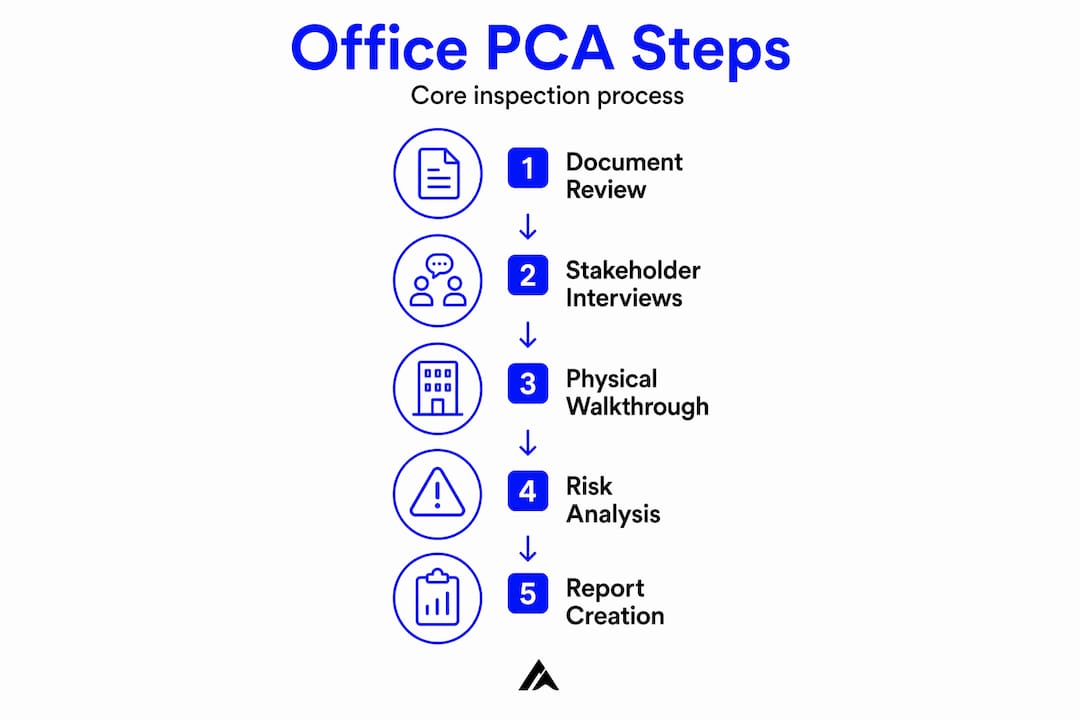
The CCPIA ComSOP standard operates as the primary certification framework for commercial inspectors and is publicly available online at no cost. While ASTM E2018 is the gold standard for lender-facing PCAs, CCPIA ComSOP governs the inspection methodology itself, specifying which systems must be observed and how findings should be reported. CCPIA was designated as the primary certification body for commercial property inspectors following changes that replaced earlier commercial inspection credentials.
Pro Tip: When commissioning a business premises inspection, ask your inspector to explicitly name the standard they are following in the written report. A report that does not state ASTM E2018 or CCPIA ComSOP may lack the credibility lenders and legal teams require.
Here is how the two frameworks compare at a glance:
| Framework | Primary Use | Who It Serves |
|---|---|---|
| ASTM E2018 | PCA for acquisitions and lending | Buyers, lenders, underwriters |
| CCPIA ComSOP | Inspector certification and methodology | Inspectors, clients, review boards |
A standard commercial inspection report differs from an ASTM E2018 PCA report in one critical way: the PCA explicitly includes cost opinions and capital expenditure timelines. A basic inspection tells you what is wrong. A PCA tells you what it will cost and when the bill is likely to arrive.
The physical scope of an office building inspection
Corporate facilities face 4 to 7 regulatory inspections per year, covering fire safety, structural integrity, mechanical systems, electrical systems, plumbing, and ADA compliance. A thorough office space compliance check during due diligence accounts for all six domains at once, so there are no surprises when the first municipal inspector shows up post-closing.
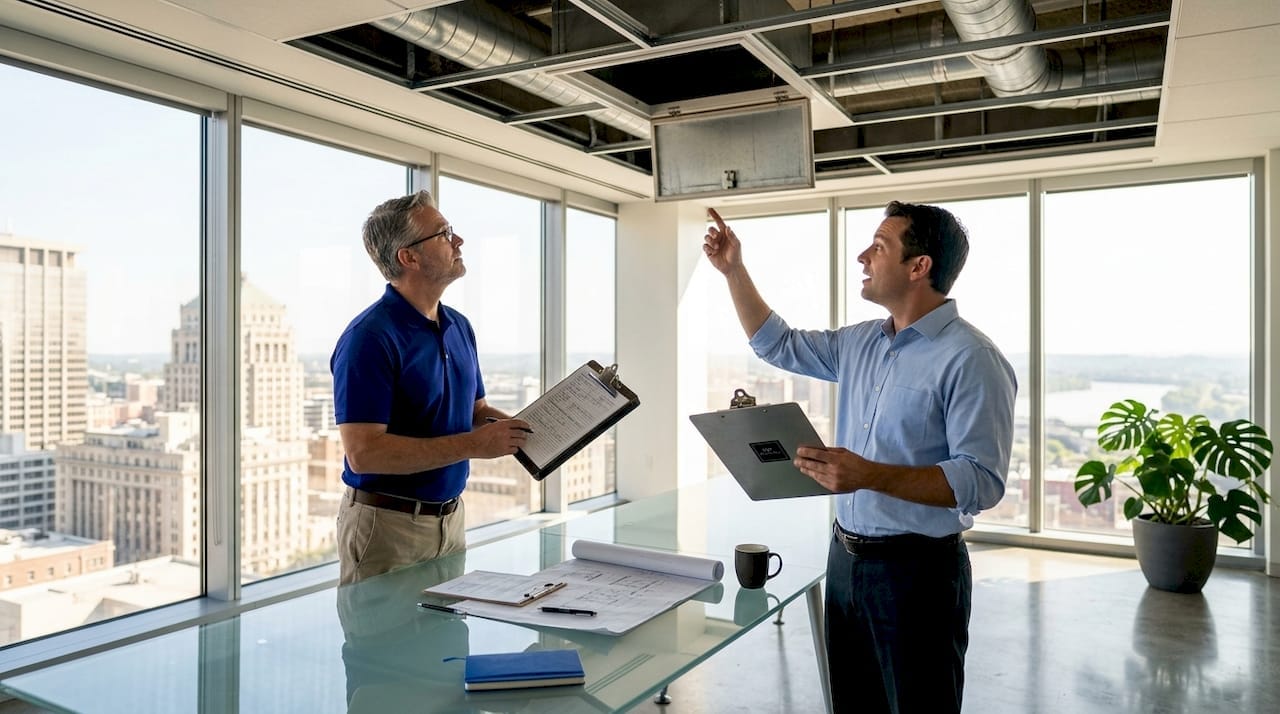
During a physical walkthrough of an office building, we inspect the following categories:
- Building envelope and exterior: Roofing membrane condition, flashing, caulking, facade cladding, windows, and drainage patterns around the foundation.
- Structural components: Visible framing, load-bearing walls, floor deflection, and concrete or masonry integrity.
- HVAC systems: Equipment age and condition, ductwork, controls, and cooling towers. HVAC failures rarely stay isolated. A failed rooftop unit in one zone can overload adjacent units, triggering a domino effect across the entire floor.
- Electrical systems: Panel capacity, branch circuit wiring, grounding, and lighting systems relative to current code.
- Plumbing: Piping material, water pressure, drainage performance, and visible corrosion, particularly in buildings constructed before 1990, when galvanized and cast iron were common.
- Fire and life safety: Sprinkler coverage, fire door ratings, alarm systems, and egress paths.
- Accessibility: ADA compliance in restrooms, entrances, parking, and common areas.
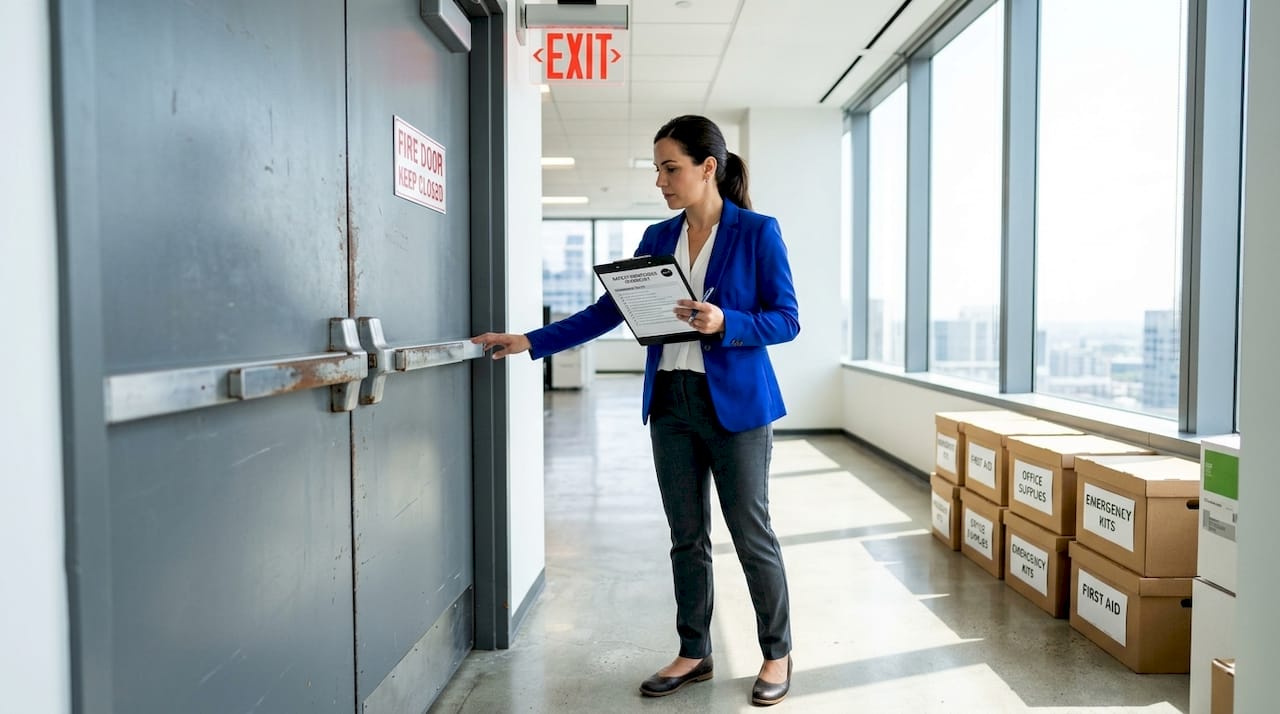
One area where office building safety audits frequently fall short is fire and life safety interdependency. A fire door can pass its rated test and still fail compliance if adjacent rated assemblies have been altered during tenant buildouts. This is exactly why a checklist approach is insufficient. We approach every system as part of an interconnected assembly, not a standalone item.
Pro Tip: Request a tenant improvement history before the walkthrough. Unpermitted modifications to rated walls, ceilings, or mechanical penetrations are among the most common compliance deficiencies we find in multi-tenant corporate office buildings.
Deferred maintenance deserves particular attention. A worn roof coating or a deteriorating parking structure might not affect occupancy today, but the cumulative cost of delay compounds quickly. The commercial property inspection guide we reference in our work consistently shows that deferred maintenance discovered post-closing is the most common source of unexpected capital expenditure for new office owners.
Documentation review and compliance verification
Physical conditions tell only part of the story. The other part lives in filing cabinets, maintenance management systems, and the facilities manager’s inbox. Commercial inspections review permits, maintenance logs, and safety certifications to detect risks that a walkthrough may not surface. A corroded pipe is visible. An expired boiler certificate is not.
Here is a structured approach to documentation review during a corporate property evaluation:
- Obtain all current certificates of occupancy. Confirm they reflect the building’s actual current use. A building converted from warehouse to office use without updated permits is a liability.
- Request maintenance logs for all major systems. HVAC, elevators, fire suppression, and generators should all have dated service records. Gaps in service history signal deferred maintenance or undisclosed equipment failures.
- Review all open or closed permits from the past ten years. Closed permits confirm that modifications were inspected and approved. Open permits indicate work that was never formally completed or signed off.
- Verify current certificates of insurance for the property. Gaps in insurance coverage for specific systems or events can shift liability to the buyer or new tenant.
- Confirm ADA compliance documentation. Many older office buildings carry known accessibility deficiencies. If the prior owner completed an ADA transition plan, it should be on file and reviewed.
- Check fire marshal inspection records and any cited violations. Repeated citations for the same deficiency indicate a pattern of non-compliance, not just a one-time oversight.
The data is sobering. Documentation gaps cause 62% of building code violations. That statistic should reframe how you think about due diligence. Most compliance failures are not the result of building systems that are physically broken. They are the result of records that were never created, updated, or retained. Poor record-keeping transfers liability to whoever holds the asset next. That could be you.
When documentation is missing, the right response is not to proceed and hope. It is to request extensions, commission targeted follow-up inspections, or factor the unknown liability into price negotiations.
Interpreting cost opinions, RUL estimates, and risk in reports
Once the walkthrough and document review are complete, the inspector produces a Property Condition Report, or PCR. Understanding what the numbers in that report mean, and what they do not mean, is where many buyers go wrong.
CCPIA’s cost-to-remedy framework converts inspection findings into dollar estimates by referencing quantities, unit costs, and remaining useful life. A PCR might show, for example, that the rooftop HVAC units have an estimated remaining useful life of 4 years and a replacement cost of $180,000. That single line item immediately informs your capital reserve modeling, your financing escrow negotiations, and your asking price adjustment.
Here is what a simplified cost-to-remedy table looks like in practice:
| System | Deficiency | Estimated Cost | Remaining Useful Life |
|---|---|---|---|
| HVAC (rooftop units) | End of service life approaching | $180,000 | 4 years |
| Roof membrane | Surface cracking and ponding | $65,000 | 3 to 5 years |
| Electrical panels | Sub-panels not labeled, one overloaded circuit | $12,000 | N/A |
| Plumbing | Cast iron drain lines, partial corrosion | $40,000 | 5 to 7 years |
PCA reports provide opinion-based RUL and cost views, accompanied by explicit disclaimers. They are not guarantees. A responsible PCR will clearly state the assumptions underlying each estimate, including local labor costs, current material prices, and the assessment date. When you receive a report without stated assumptions, treat the numbers skeptically.
ASTM E2018 helps lenders adjust underwriting assumptions, set repair escrows, and manage capital expenditure triggers over the loan term. That is not incidental. It is the entire value proposition of the process: combining physical findings, historical records, and cost opinions into a decision-support document.
Pro Tip: When reviewing cost tables, ask your inspector to separate immediate needs from projected capital expenditures over a 1 to 5-year horizon. Aligning findings to capital planning horizons gives you concrete leverage at the negotiating table.
Steps to maximize inspection value before you commit
Getting the most out of a corporate facilities inspection requires preparation before the inspector arrives and deliberate use of the report after they leave.
- Select an inspector credentialed under ASTM E2018 or CCPIA ComSOP. Credentials are not interchangeable with experience, but they confirm that the inspector operates within a recognized methodology. Ask for their certification documentation upfront.
- Define the scope in writing before the engagement starts. Specify whether the inspection covers tenant spaces, below-grade parking, roof access, and all mechanical rooms. Any deviation from the agreed scope must be documented in the final report.
- Confirm that scope deviations are explicitly disclosed. If a system was not inspected, the report must say so and explain why. An omission with no explanation is a liability for everyone.
- Request a complete cost table with quantities and unit assumptions. A list of deficiencies without cost context is a starting point. A cost table with quantities is a negotiating instrument.
- Integrate findings into your underwriting model from day one. Do not treat the PCR as a post-contract formality. Use findings to stress-test your pro forma, set capital reserves, and structure repair credits or price reductions into the deal.
- Plan for re-inspection after remediation. If the seller agrees to address deficiencies before closing, a follow-up inspection confirms the work was completed properly, not just cosmetically.
My experience: what clients consistently get wrong
Over years of completing commercial property assessments, I have watched sophisticated buyers underestimate documentation nearly every time. They walk a building, feel confident about the physical condition, and treat the records review as a compliance formality. Then the first post-closing HVAC service call surfaces a maintenance void that voids the manufacturer’s warranty. Then the fire marshal cites an unpermitted tenant improvement no one disclosed.
What I have learned is this: the physical condition of a building is visible and finite. The documentation record is where the real risk hides. Clients who pay as much attention to permits and service logs as they do to roof conditions consistently close with fewer surprises.
I have also seen cost opinions misread as contractor quotes. They are not. RUL and cost estimates must be framed as opinions with clearly stated assumptions. When a buyer treats a cost opinion as a fixed number and then discovers actual replacement costs are 30% higher due to supply chain conditions, the disappointment is real. Read the assumptions section before you read the dollar figures.
The clients who get the most value from a PCA are those who treat it as a conversation starter rather than a final verdict. They come back with follow-up questions, request clarification on scope deviations, and loop their attorneys and lenders into the findings before the inspection contingency deadline expires.
— Holly
How Upchurch Inspection can help you before you commit
At Upchurch Inspection, we deliver commercial inspection services built around ASTM E2018 and CCPIA ComSOP standards, giving buyers, lenders, and property managers reports that hold up under legal and financial scrutiny. Our inspectors exceed state qualification standards and bring documented experience with multi-tenant office buildings, mid-rise corporate campuses, and suburban office parks across the Mid-South. We do not deliver checklists. We deliver property condition assessments that include cost-to-remedy tables, remaining useful life estimates, and documented scope disclosures, so you can negotiate from a position of knowledge. If you are evaluating a corporate office property before purchase or lease, reach out to schedule a formal PCA with the details your investment requires.
FAQ
What is a Property Condition Assessment for an office building?
A Property Condition Assessment is a formal inspection of a commercial office property conducted in accordance with ASTM E2018 or CCPIA ComSOP standards. It combines a document review, physical walkthrough, and written cost opinions to support purchase, lease, and lending decisions.
How is a PCA different from a standard commercial inspection?
A PCA includes cost-to-remedy estimates and remaining useful life projections tied to specific systems, which a standard commercial inspection typically does not provide. This makes the PCA a financial planning tool, not just a condition report.
What documents should I gather before an office building inspection?
Gather current certificates of occupancy, maintenance logs for all major systems, the last ten years of permit history, fire marshal inspection records, and any ADA compliance documentation or transition plans on file.
How do inspection findings affect lease or purchase negotiations?
Cost tables and remaining useful life estimates give buyers and tenants concrete grounds to request price reductions, repair credits, or funded escrow accounts before closing. Aligned to capital planning horizons, these findings directly inform negotiating positions.
Why do compliance failures happen even in well-maintained office buildings?
Most compliance failures trace back to documentation gaps, not physical defects. Unpermitted tenant improvements, expired safety certifications, and incomplete maintenance records are the most common causes, and none of them are visible during a physical walkthrough alone.