TL;DR:
- Medical office inspections demand specialized knowledge of healthcare systems and strict ongoing compliance practices.
- The 2026 Accreditation 360 model emphasizes continuous readiness and real-time observation over last-minute preparations.
- Effective documentation, standardization across multiple sites, and proactive staff training are crucial for inspection success.
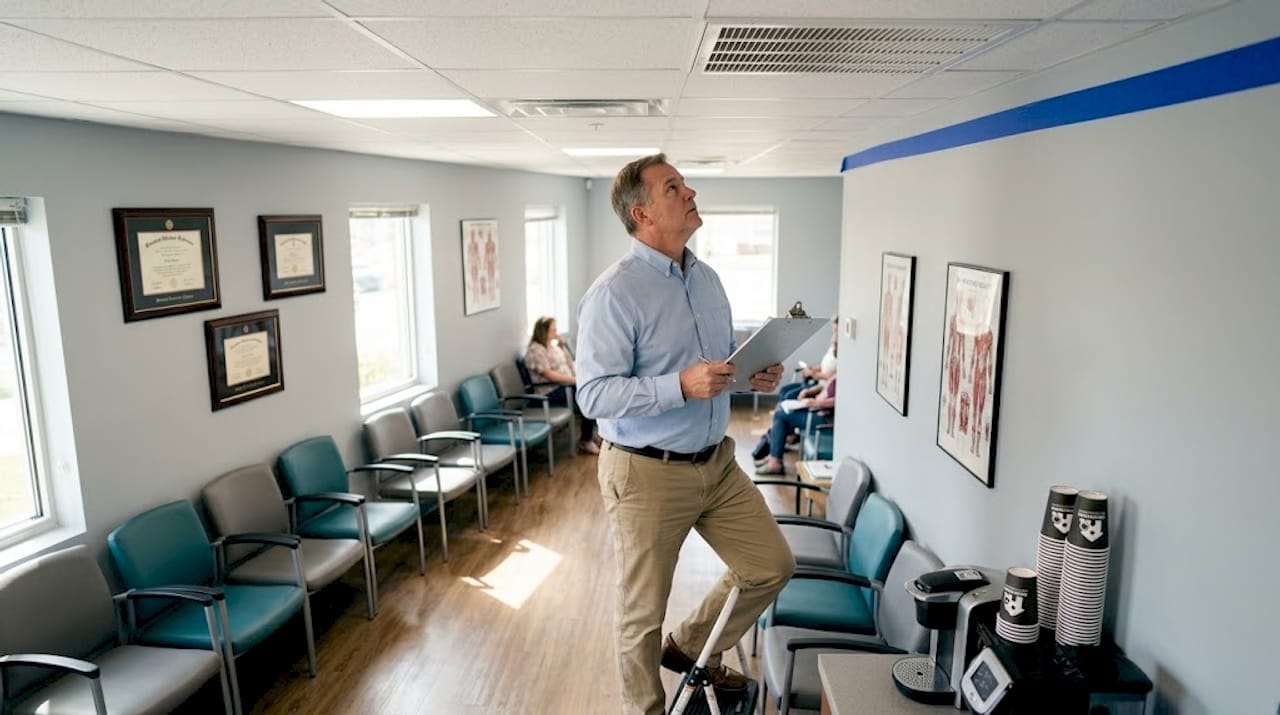
A doctor’s office property inspection is not a checkbox exercise. It is a specialized, high-stakes evaluation where regulatory compliance, patient safety, and facility infrastructure converge in ways that a standard commercial inspection simply cannot address. Most facility managers discover this the hard way, either during a survey that flags deferred issues or after inheriting a property without understanding its clinical-grade mechanical systems. This guide cuts through the confusion and gives you a clear picture of what a thorough medical office inspection actually requires, from regulatory frameworks to daily documentation habits that protect your practice year-round.
Table of Contents
- Key Takeaways
- What a doctor’s office property inspection really demands
- Regulatory demands and the Accreditation 360 model
- Specialized infrastructure unique to medical offices
- Continuous monitoring and documentation practices
- Multi-site inspection readiness challenges
- Practical preparation steps before your inspection
- My perspective on inspection culture in healthcare facilities
- Get a medical office inspection built for compliance
- FAQ
Key Takeaways
| Point | Details |
|---|---|
| Medical inspections are specialized | Doctor’s offices require compliance checks far beyond standard commercial building codes and general property evaluations. |
| Accreditation 360 changes the rules | The 2026 model merges Environment of Care and Life Safety into one Physical Environment standard with continuous monitoring requirements. |
| Documentation gaps are high risk | Inspectors prioritize evidence of routine monitoring over a clean facility on survey day. |
| Multi-site inconsistency triggers flags | Variations across office locations are treated as organizational risk, not isolated site problems. |
| Preparation is a year-round discipline | Successful inspections reflect daily operational habits, not last-minute audits before a survey. |
What a doctor’s office property inspection really demands
Most people assume a doctor’s office property inspection follows the same logic as inspecting any other commercial space. That assumption is costly. Medical office spaces require specialized infrastructure knowledge and compliance expertise that general commercial property management simply does not cover. The clinical environment introduces variables such as medical gas systems, advanced HVAC filtration, and life safety mandates that are entirely absent from a standard office walkthrough.
The regulatory layer adds another dimension entirely. A healthcare facility evaluation must satisfy requirements from multiple oversight bodies, including state health departments, the Occupational Safety and Health Administration, and accreditation organizations like The Joint Commission. Each body has distinct documentation standards, inspection cadences, and corrective action protocols. Failing one does not necessarily mean failing another, but gaps in any single area can trigger broader scrutiny across the organization.
For practice owners, this means the building inspection for clinics you commission at lease signing or purchase is only the beginning. Ongoing compliance monitoring becomes a permanent operational responsibility. The question is not whether your facility will be inspected. It is whether your team will be ready when that inspection arrives.
Regulatory demands and the Accreditation 360 model
The most significant shift facing facility managers right now is the rollout of the new Accreditation 360 framework. Effective 2026, Accreditation 360 removes over 700 redundant requirements and consolidates the Environment of Care and Life Safety chapters into a unified Physical Environment standard. This restructuring places measurable outcomes at the center of every inspection, replacing the older model where facilities would sprint to prepare paperwork in the weeks before a survey.
What does this mean operationally? Surveyors now expect year-round readiness, not a staged performance. The new Accreditation 360 emphasizes live observation over document review, requiring staff to demonstrate competency and correct procedures during actual inspection walkthroughs. Your team’s real-time behavior matters as much as your binders.
The documentation cadence under this framework is non-negotiable. Medical property compliance checks must occur at the following intervals:
- Monthly: Fire extinguisher checks, emergency lighting tests, medical gas system logs, and environmental safety rounds
- Quarterly: HVAC filter inspections, utility system reviews, and life safety equipment testing
- Annually: Comprehensive facility surveys, infrastructure assessments, and corrective action plan reviews
Pro Tip: Start building your compliance calendar now by mapping each inspection requirement to a responsible staff member with a digital timestamp requirement. This one habit eliminates the scramble before survey season.
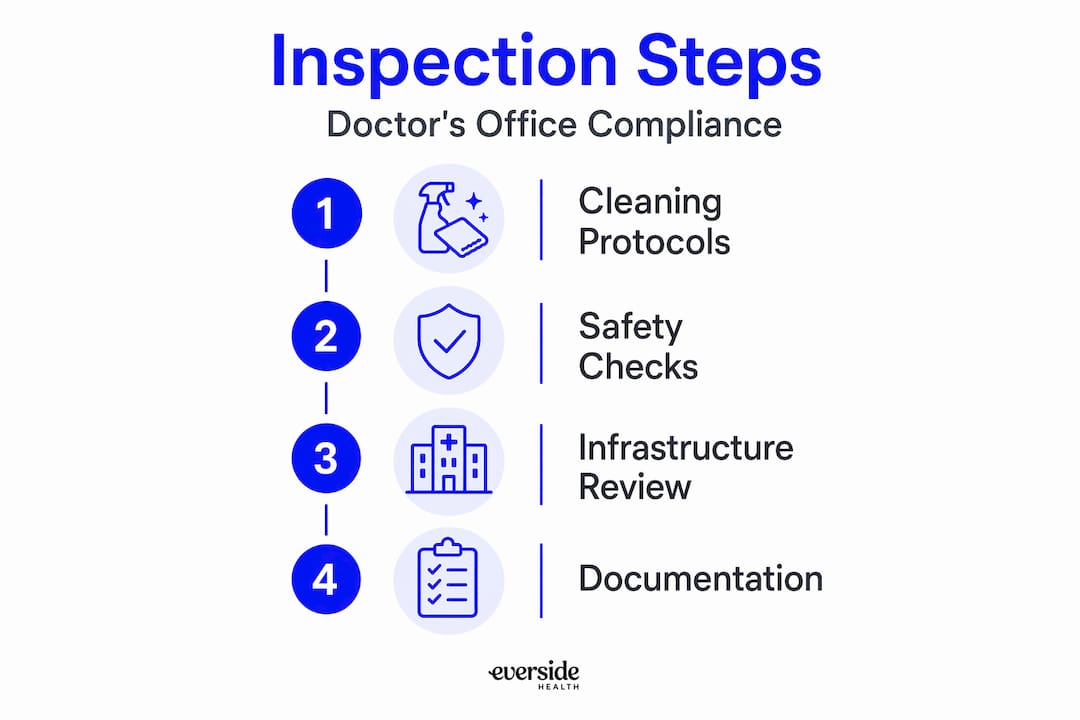
The integration of cleaning protocols, safety inspections, and infrastructure management into a single Physical Environment standard also means that fragmented records stored across different departments are a liability. Integrated Physical Environment documentation systems that unify cleaning, safety, and utility records significantly improve compliance visibility and reduce findings during surveys.
Specialized infrastructure unique to medical offices
This is where a doctor’s office inspection diverges most sharply from any other property evaluation. The mechanical and life safety systems inside a clinical environment are categorically different from what you find in a law firm or an accounting office. Medical office infrastructure includes specialized medical gas systems, advanced air filtration, and robotic-capable electrical systems, each requiring distinct inspection protocols.
Here is a breakdown of the primary systems that demand specialized attention during a healthcare facility evaluation:
| System | Key Inspection Focus | Risk if Neglected |
|---|---|---|
| Medical gas systems | Pressure integrity, storage compliance, valve condition | Patient safety incidents, code violations |
| HVAC and air filtration | Filter ratings, airflow patterns, pressure differentials | Infection control failures, regulatory citations |
| Electrical systems | Load capacity, medical-grade outlets, backup power | Equipment failure, life safety hazards |
| Fire and life safety | Sprinkler heads, exit signage, pull station access | Survey failure, occupancy permit issues |
| Plumbing | Backflow prevention, hot water temperature, sterilization lines | Health code violations, contamination risks |
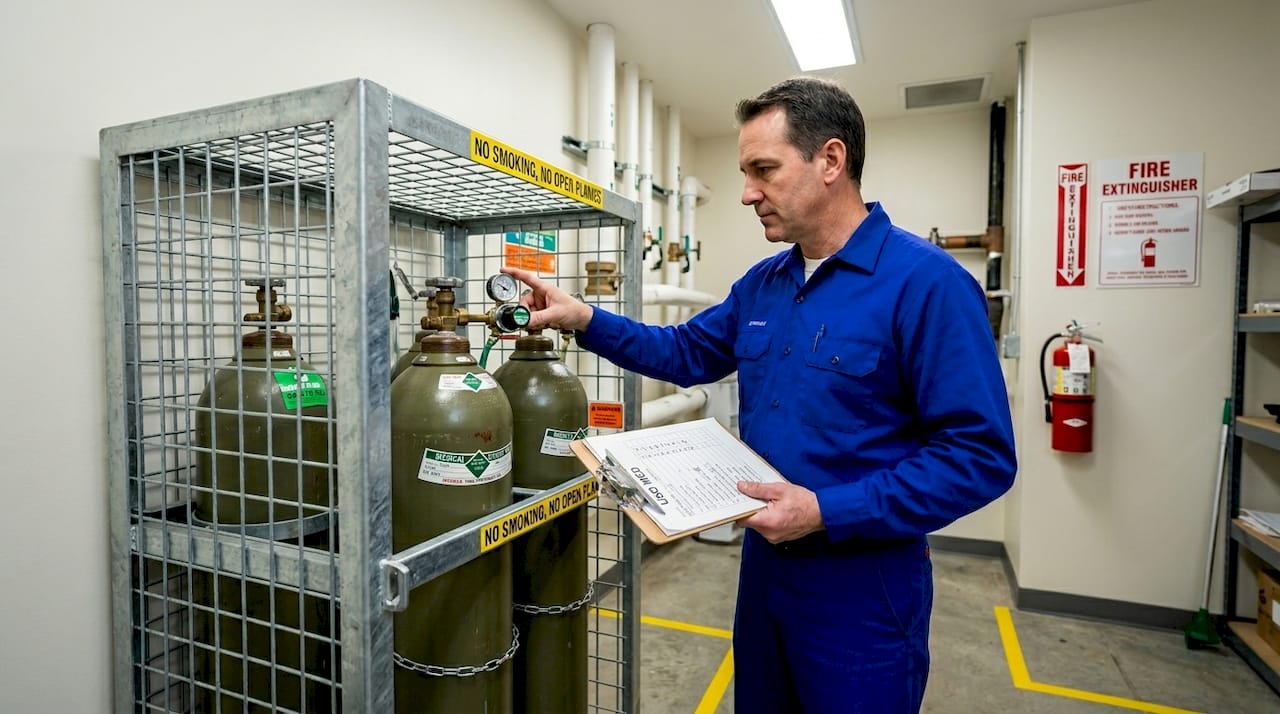
Medical gas systems deserve particular attention. Oxygen and nitrous oxide storage must comply with NFPA 99 standards, and any corrosion, improper labeling, or pressure irregularity found during inspection can result in immediate corrective action requirements. These are not systems a general commercial inspector is trained to evaluate.
Pro Tip: For HVAC systems in medical offices, verify that the system meets ASHRAE 170 ventilation standards for healthcare. Facilities serving immunocompromised patients require specific HVAC maintenance standards that go beyond typical commercial specifications.
The electrical infrastructure also demands scrutiny beyond standard load calculations. Procedure rooms may need isolated power systems, and any plans to integrate robotic surgical equipment require electrical upgrades that a building inspection for clinics must flag before occupancy or lease execution.
Continuous monitoring and documentation practices
The shift from episodic inspections to continuous operational readiness is the defining challenge of modern medical property compliance. Inspectors look for evidence of continuous monitoring rather than solely a clean facility during annual surveys. A spotless exam room means little if there are no timestamped logs proving it has been cleaned consistently for the past twelve months.
Building this habit requires systems, not willpower. Here is how facility managers can structure continuous monitoring effectively:
- Assign ownership at the task level. Every inspection item, whether a daily equipment check or a quarterly HVAC review, should have a named staff member responsible for completion and digital sign-off.
- Use software that timestamps every entry. Paper logs are still accepted, but digital platforms with automatic timestamps make it far harder for inspectors to question the integrity of your records.
- Conduct internal walkthroughs weekly. Leadership-led rounds that mirror the format of an actual survey reinforce correct behavior and catch deferred issues before they compound.
- Document corrective actions immediately. When a problem is found internally, the documentation trail for identifying, escalating, and resolving it is as important as the fix itself.
- Validate staff competency regularly. Environment of Care rounds require multidisciplinary teams tracking hazards and corrective actions, and staff must be able to demonstrate their role in that process.
The data below illustrates the documentation types most commonly flagged during inspections and their typical review frequency:
| Documentation Type | Review Frequency | Common Finding When Missing |
|---|---|---|
| Cleaning logs | Daily | Infection control citation |
| Medical gas checks | Monthly | Life safety deficiency |
| HVAC filter records | Quarterly | Environmental standard failure |
| Fire safety tests | Monthly and annually | Life safety standard citation |
| Staff competency validations | Annually at minimum | Survey finding on personnel readiness |
Pro Tip: Never treat documentation as a compliance formality. Leadership should build a culture favoring confirmatory documentation, meaning records that confirm ongoing good practice rather than records assembled to explain away problems.
Multi-site inspection readiness challenges
Managing inspection readiness across a single office is demanding. Managing it across five locations is exponentially more complex, and the stakes are higher than most practice owners realize. Inspectors evaluate the entire organization for consistency, not just the site being surveyed. If one location runs a strong compliance program while another is disorganized, that variation is recorded as an organizational risk.
The specific red flags that multi-site organizations must eliminate include:
- Policies that differ by location without documented justification
- Inconsistent competency validation records across sites
- Different cleaning and safety protocols performed under the same organizational name
- Fragmented documentation systems where records are not accessible from a central point
- Staff at one location who cannot explain procedures that staff at another location follow routinely
Systemic inconsistencies in policies and staff competencies pose greater inspection risks than isolated site issues. A single corrective action at one facility is a finding. The same corrective action at three out of five facilities is a pattern, and patterns invite deeper scrutiny.
The solution is standardization enforced from the top. Leadership must define which policies apply uniformly across all sites, audit each location against the same benchmarks, and make compliance visibility a leadership accountability metric rather than a back-office task.
Practical preparation steps before your inspection
Whether you are preparing for a formal accreditation survey or commissioning a pre-purchase doctor’s office property inspection, the preparation process follows the same logic. Use these steps to get your facility to a defensible state of readiness:
- Build a site-specific pre-inspection checklist. Generic checklists miss medical-specific items like medical gas valve access, emergency power testing, and infection control zone documentation. Customize yours to match your facility type.
- Train staff on what to expect. Surveyors will ask staff direct questions during a how-to-inspect-doctor’s-office style walkthrough. Your team should know the protocols, be able to explain them in plain language, and know where records are stored.
- Consolidate all documentation into one accessible system. Scattered binders, shared drives with inconsistent folders, and email chains are red flags. Integrated systems project operational maturity.
- Schedule a mock inspection sixty days out. A full internal walkthrough using the same format as an official survey gives you time to address findings before they become official citations.
- Communicate proactively with inspectors. Offering context for known issues before a surveyor asks about them demonstrates a culture of transparency rather than concealment. It also tends to result in better outcomes.
Reviewing your commercial property inspection preparation approach well before the survey date is one of the most practical investments a practice owner can make.
My perspective on inspection culture in healthcare facilities
I have seen what happens when a medical practice treats its inspection process as a periodic crisis instead of a daily habit. The pattern is painfully predictable. Staff scramble, documentation gets reconstructed rather than confirmed, and surveyors pick up on the anxiety immediately. Reactive preparation does not just risk a finding. It signals to inspectors that the culture itself is the problem.
What actually works is unglamorous: consistent leadership visibility in daily compliance rounds, documentation systems that make doing the right thing easier than skipping it, and a genuine understanding that patient safety outcomes and inspection outcomes are the same thing measured differently.
I also think the field underestimates how much infrastructure criticality matters. Facility managers who do not deeply understand their medical gas systems, their HVAC pressure differentials, or their electrical panel capacity are managing risk they cannot see. The doctor’s office safety inspection that exposes those gaps before a survey or a purchase is not a cost. It is protection.
Technology helps. Digital logs, automated reminders, and integrated platforms meaningfully improve documentation consistency. But technology without human accountability produces impressive records that fall apart the moment an inspector asks a staff member to explain what they actually do. Build the culture first. Let the technology confirm it.
— Holly
Get a medical office inspection built for compliance
At Upchurch Inspection, we understand that a doctor’s office requires far more than a standard commercial walkthrough. Our team specializes in medical office building inspections that cover the full scope of healthcare-specific systems, from medical gas lines and HVAC compliance to life safety infrastructure and electrical capacity for clinical equipment. We deliver detailed reports that give facility managers and practice owners a clear picture of where their property stands against current compliance standards.
If you are purchasing a medical office, renewing a lease, or preparing for an accreditation survey, explore our commercial inspection services to find the right scope for your facility. Schedule a consultation with our team and go into your next inspection prepared.
FAQ
What makes a doctor’s office inspection different from commercial?
A medical office inspection covers healthcare-specific systems like medical gas lines, clinical HVAC standards, and life safety compliance that standard commercial inspections do not evaluate. Regulatory requirements from bodies like The Joint Commission add layers that general building codes do not address.
How often should a medical office be inspected?
Under the Accreditation 360 model, medical offices require monthly, quarterly, and annual inspection cycles for different systems, plus continuous daily and weekly documentation of environmental and safety checks.
What is the Accreditation 360 model?
Accreditation 360 is the updated Joint Commission framework effective in 2026 that merges Environment of Care and Life Safety into a single Physical Environment standard, emphasizing year-round compliance over pre-survey preparation.
What happens if documentation gaps are found during inspection?
Inspectors treat missing documentation as evidence of non-compliance, often more seriously than a physical deficiency, because it suggests the issue has been ongoing rather than isolated. Gaps in routine monitoring records frequently trigger broader corrective action requirements.
Can a general property inspector evaluate a doctor’s office?
Not adequately. Medical office inspections require knowledge of NFPA 99 medical gas standards, ASHRAE 170 ventilation requirements, and healthcare electrical standards that fall outside the training and scope of most general commercial inspectors.