If you’re buying a storefront on a small-town square in Bolivar or Whiteville, you’re not buying a building.
You’re buying a relationship.
And that relationship includes your neighbors’ roofs, their plumbing, their drainage, and sometimes their bad decisions from 40 years ago.
Main Street commercial buildings don’t live in isolation. They’re stitched together. When one fails, the others feel it—whether they like it or not.
Party Walls: The Shared Problem Nobody Budgets For
Most small-town commercial buildings were built with party walls—shared masonry walls that serve two structures at once.
That means:
- One wall
- Two owners
- Infinite arguments waiting to happen
I’ve inspected buildings where one side was maintained and the other was neglected. Guess which one still suffered?
Both.
Roof Lines Lie on Main Street
On paper, everyone “has their own roof.” In reality, water doesn’t respect imaginary boundaries.
Common issues I see:
- Roofs that drain onto neighboring buildings
- Improvised flashing at shared parapetsRoof
- One owner replacing roofing while the other patches
- Water migrating sideways through masonry
If your neighbor’s roof fails, your building gets wet. Period.
Masonry Doesn’t Care Who Owns What
Brick absorbs water. Mortar fails over time. When moisture enters a shared wall, it travels.
I regularly see:
- Efflorescence bleeding through interior finishes
- Spalling brick caused by trapped moisture
- Interior damage blamed on “mystery leaks”
It’s not mysterious. It’s shared masonry doing what masonry does.
Bolivar: Older Buildings, Fewer Upgrades
In Bolivar, many Main Street buildings are older and lightly modified.
That means:
- Original brick walls
- Old roof assemblies
- Minimal insulation
- Mechanical systems added wherever they fit
When one building upgrades without coordinating, it can destabilize the shared wall system.
Whiteville: Smaller Square, Same Problems
In Whiteville, the scale is smaller but the issues are the same.
I often see:
- Party walls hidden behind finishes
- Roof drains terminating unpredictably
- Electrical and plumbing systems crossing property lines
- No clear documentation of responsibility
That last one causes the most trouble.
Fire Separation Isn’t Optional — But It’s Often Ignored
Party walls were originally intended to act as fire breaks. Over time, that intent gets compromised.
During inspections, I often find:
- Penetrations cut through shared walls
- Unsealed mechanical chases
- Missing fire stopping
- Old modifications never corrected
That’s not just a safety issue—it’s a compliance problem that can stall occupancy or insurance coverage.
Plumbing and Drainage Cross Lines Too
Older buildings didn’t always respect property lines when plumbing was installed.
I’ve found:
- Shared sewer laterals
- Drain lines running through neighboring basements
- Clean-outs located in the wrong building
Those systems work—until they don’t. Then everyone argues about who pays.
Renovations Make Things Worse If They’re Not Coordinated
One of the biggest risks on Main Street is unilateral renovation.
When one owner:
- Raises a roof
- Changes drainage
- Seals a wall
- Adds insulation improperly
they change how moisture and load move through the shared system.
That’s how one renovation creates two problems.
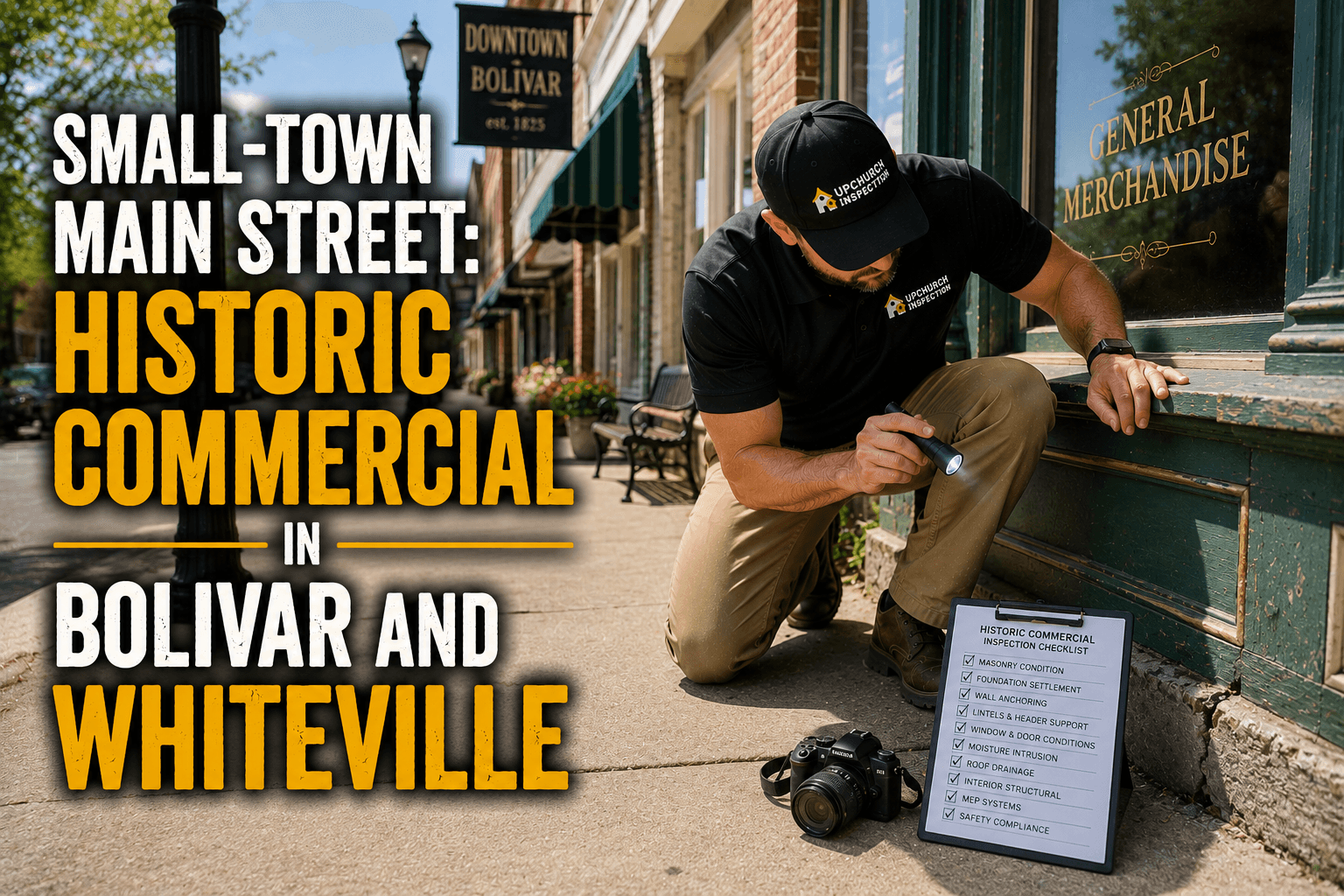
What I’m Looking For During These Inspections
When I inspect small-town commercial buildings, I’m paying attention to:
- Shared wall conditions
- Roof drainage paths
- Masonry moisture indicators
- Fire separation integrity
- Evidence of cross-building utilities
- Signs of past disputes disguised as “repairs”
I’m not just inspecting your building. I’m inspecting how it interacts with its neighbors.
Why Buyers Miss These Risks
Main Street buildings charm people. Brick, storefront windows, history—it sells the dream.
What buyers don’t see:
- Shared liability
- Deferred maintenance next door
- Unclear responsibility
- Limited control over adjacent conditions
Charm doesn’t stop water or fire.
Ownership Reality on Main Street
Successful Main Street owners understand:
- Cooperation matters
- Documentation matters
- Maintenance isn’t optional
- Your building is part of a system
Those who don’t learn fast—or pay fast.
Final Thoughts
Small-town commercial buildings in Bolivar and Whiteville can be solid investments—but only if buyers understand what they’re actually buying.
Party walls mean shared risk. Shared risk means shared consequences.
If your neighbor’s building fails, yours doesn’t get a pass.
Protecting your West Tennessee investment starts with a forensic eye. View our West Tennessee Service Area to see a full list of towns we serve.