
If you’re buying a home in Little Rock and you notice cracks in the slab, the most common assumption is bad construction or structural failure. In Central Arkansas, that assumption is often wrong.
Many slab cracks in neighborhoods like Chenal Valley and West Little Rock aren’t caused by poor workmanship at all. They’re the predictable result of expansive clay soil interacting with how modern slabs are built. Inspectors who don’t understand this dynamic tend to overreact—or defer to foundation repair companies whose incentives don’t always align with reality.
This article explains what’s actually happening under the slab, why Little Rock foundations behave differently than those in Tennessee, and how to tell the difference between seasonal movement and a true structural problem.
Little Rock Clay Is Not Tennessee Clay
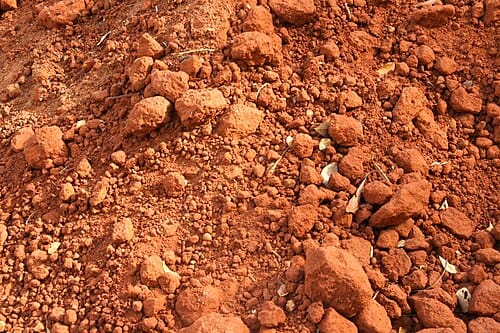
The soil beneath much of Little Rock contains a high percentage of expansive clay. This type of clay absorbs water during wet periods and expands, then shrinks significantly during dry periods.
In West Tennessee, foundation movement is more often driven by:
- Crawlspace moisture imbalance
- High water tables
- Wood framing movement
In Central Arkansas, slab movement is commonly driven by:
- Shrink–swell clay cycles
- Seasonal rainfall patterns
- Differential moisture beneath the slab
The result is a foundation that moves up and down through the year rather than remaining static.
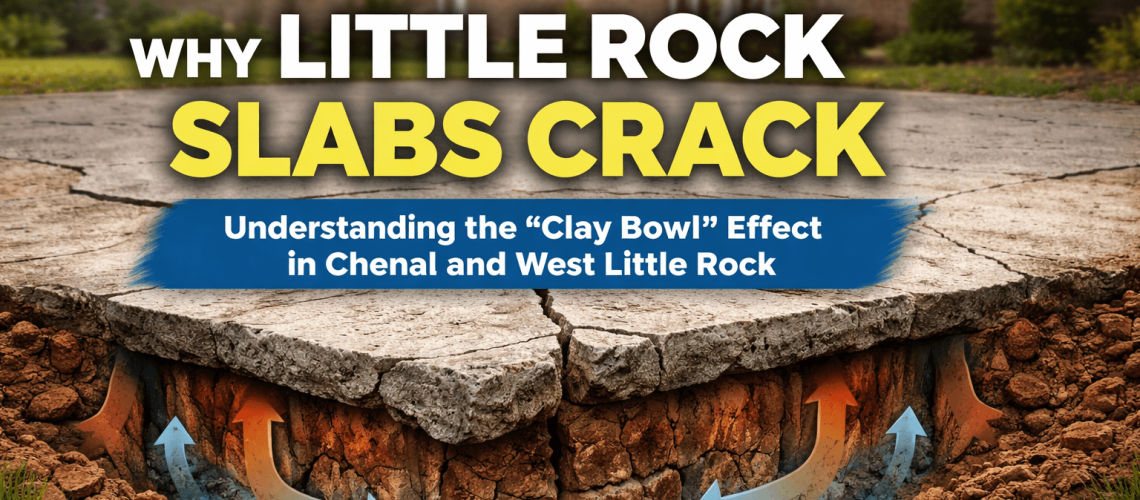
The “Clay Bowl” Effect Explained
When a slab foundation is constructed, the perimeter trench around the foundation is backfilled with disturbed soil. In areas with expansive clay, that backfill behaves differently than the undisturbed soil below the center of the slab.
Over time, this creates what engineers often refer to as a “clay bowl” effect:
- Rainwater and irrigation migrate toward the foundation edges
- Moisture becomes trapped in the expansive clay around the slab perimeter
- The clay swells, creating upward and lateral pressure
- During dry months, the same soil shrinks and pulls away
This constant expansion and contraction places stress on slab edges, interior load points, and brittle finishes like tile and drywall.
Cracks form—not because the house is failing, but because the soil is moving.
Why Slab Cracks Spike in Late Summer
One of the biggest clues that movement is soil-driven rather than structural is timing.
In Little Rock, many slab cracks:
- Appear or widen in late summer
- Become less pronounced after fall rains
- Change subtly year over year
This seasonal pattern is classic shrink–swell behavior. Unfortunately, it’s also when many homeowners are told they have a “serious foundation problem” based on a visual inspection alone.
The Problem With “Free” Foundation Inspections
Foundation repair companies in Central Arkansas are very good at talking about clay. What they are less likely to do is explain when clay-related movement does not require structural repair.
A free inspection often leads to:
- A one-size-fits-all diagnosis
- Recommendations for piers or stabilization without long-term soil analysis
- No distinction between cosmetic cracking and load-bearing failure
That doesn’t mean repairs are never needed. It means that not every crack is a failure, and not every home with expansive clay needs structural intervention.
What a Standard Inspection Can’t Tell You
A traditional home inspection can:
- Document cracks
- Note displacement or unevenness
- Recommend further evaluation
What it cannot do is determine:
- Whether movement is active or historical
- Whether cracks are load-related or soil-driven
- Whether the slab has exceeded structural tolerance
That gap is where buyers lose time, money, and leverage.
How a Licensed Engineer Changes the Outcome
When slab movement is evaluated by a licensed engineer familiar with Central Arkansas soils, the analysis goes deeper than the surface crack.
A proper evaluation looks at:
- Load paths through the structure
- Crack orientation and propagation
- Interior vs perimeter movement
- Moisture conditions and drainage patterns
- Whether movement exceeds acceptable limits
In many cases, the conclusion is not “ignore it” or “repair it immediately,” but something far more valuable: context.
That context is what separates a $0 seasonal condition from a $20,000 structural issue.
Why This Matters in Chenal and West Little Rock
Homes in Chenal Valley, Riverdale, Sherrill Heights, and surrounding West Little Rock areas are often:
- Built on steep or variable grades
- Constructed on highly active clay soils
- Marketed to buyers with low tolerance for uncertainty
In these neighborhoods, misdiagnosing soil movement can derail deals unnecessarily—or worse, lead to repairs that don’t address the real issue.
Understanding the clay bowl effect allows buyers and agents to make decisions based on engineering reality, not fear.
The Bottom Line
Cracks in a Little Rock slab don’t automatically mean failure. In many cases, they mean the soil is doing exactly what expansive clay has always done.
The real risk isn’t the crack itself—it’s relying on opinions that don’t account for local soil behavior, seasonal movement, and structural load paths.
When you understand why a slab is moving, you can decide whether it actually needs to be fixed.
That difference matters—especially in Central Arkansas.