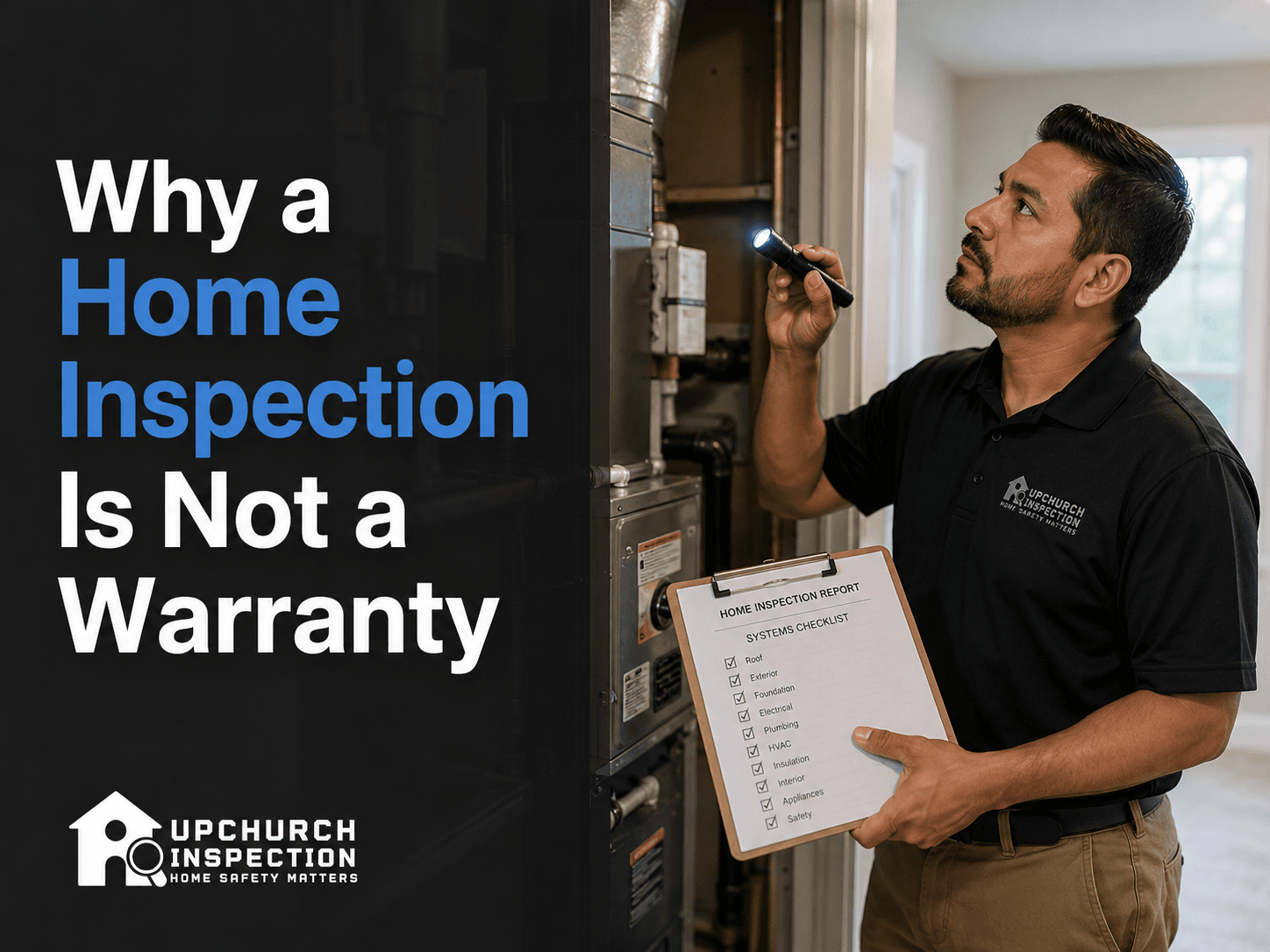
One of the most common misunderstandings inspectors encounter doesn’t come from malice or unrealistic buyers—it comes from silence. No one explicitly says a home inspection is a warranty, but many buyers subconsciously treat it like one. When something fails months after closing, the question surfaces: Why didn’t the inspection catch this?
At Upchurch Inspection, we spend a lot of time clarifying this distinction, especially across markets like Memphis, Jackson, Little Rock, Jonesboro, Cape Girardeau, and Middle Tennessee, where homes are older, environments are demanding, and systems age under real-world conditions. A home inspection provides clarity. It does not provide coverage.
Understanding that difference protects buyers from disappointment and helps them use the inspection the way it’s actually meant to work.
Inspections Document Condition — Warranties Promise Performance
A warranty is a promise about the future. It says that if something fails within a certain time frame, someone will repair or replace it.
A home inspection does the opposite.
An inspection documents observable conditions at a specific moment in time, under specific conditions, without dismantling systems or predicting outcomes. It describes how things appear and function on inspection day, not how long they’ll continue to do so.
This distinction matters most with systems that degrade gradually—HVAC, plumbing, electrical, roofing—because those systems often fail without giving a clear countdown.
Why “It Was Working Then” Isn’t a Contradiction
Buyers are often frustrated when a system that “worked during the inspection” fails later. That frustration makes sense emotionally, but it misunderstands how systems behave.
Mechanical systems don’t fail because an inspector looked at them. They fail because:
- Components wear out
- Conditions change
- Usage increases
- Environmental stress accumulates
In West Tennessee and Central Arkansas, summer heat and humidity push HVAC systems harder than mild inspection-day conditions ever will. In Southeast Missouri, freeze-thaw cycles stress plumbing long after a visual inspection is complete. In Nashville and Little Rock, rapid growth and layered renovations often leave systems operating near their limits.
An inspection captures a snapshot. Failure happens during the movie.
Why Inspectors Can’t Predict Failure Timelines
Buyers often ask, “How long will this last?”
Inspectors don’t answer that question precisely because doing so would require speculation. Two identical systems installed the same year can fail years apart depending on:
- Maintenance history
- Installation quality
- Load and usage patterns
- Environmental exposure
Predicting failure would turn an inspection into a guess—and guesses don’t protect buyers.
Instead, inspectors describe condition, age, and risk indicators so buyers can plan rather than rely on promises that can’t be kept.
The Role of “Monitor” Language
Some buyers interpret “monitor” comments as indecision or hedging. In reality, monitoring language reflects professional restraint.
When inspectors recommend monitoring, they’re acknowledging that:
- A condition isn’t currently defective
- It has the potential to change over time
- Ownership behavior matters
Monitoring is not a warranty. It’s an invitation to stay aware.
In Middle Tennessee and Northeast Arkansas, many moisture-related conditions fall into this category. They don’t demand immediate correction, but they deserve attention as seasons change.
Why Inspections Don’t Cover What Can’t Be Seen
Warranties often exclude hidden conditions. Inspections are limited by them.
Inspectors don’t open walls, excavate soil, disassemble equipment, or run systems under stress conditions beyond normal operation. That’s not a limitation of effort—it’s a boundary of safety, legality, and reasonableness.
A pipe can fail inside a wall without any prior visible indication. A heat exchanger can crack after inspection. A sewer line can collapse months later.
None of those outcomes invalidate the inspection. They confirm its scope.
Regional Conditions Increase the Gap Between Inspection and Warranty
In the regions we serve, environmental stress widens the gap between inspection findings and future performance.
High humidity, expansive soils, heavy rainfall, and temperature swings accelerate wear. Homes don’t just age—they respond continuously to their environment.
This is why experienced regional inspectors focus on patterns and margins, not promises. They know that warranties create expectations the house itself may not honor.
What an Inspection Actually Gives You
A home inspection gives buyers:
- A realistic understanding of current condition
- Insight into how the house has been maintained
- Awareness of system age and design limitations
- Context for regional behavior and risk
It gives buyers information to make decisions—not protection from future responsibility.
That distinction isn’t disappointing once it’s understood. It’s empowering.
Why Treating an Inspection Like a Warranty Backfires
When buyers expect an inspection to function as a warranty, two things happen:
- They underestimate ownership responsibility
- They overestimate what documentation can prevent
Homes are physical systems, not contractual guarantees. Ownership involves uncertainty no inspection can eliminate.
Buyers who understand this early tend to budget better, plan upgrades more intelligently, and experience less frustration when systems eventually need attention.
The Practical Reality
A home inspection isn’t there to promise that nothing will go wrong.
It’s there to make sure buyers aren’t blindsided by what’s already visible—and to help them understand what might require planning rather than reaction.
When inspections are used as tools instead of guarantees, they do exactly what they’re supposed to do.
They don’t replace responsibility.
They prepare buyers for it.
And in the markets we serve—where homes are shaped by time, weather, and real-world use—that preparation is far more valuable than any warranty ever could be.