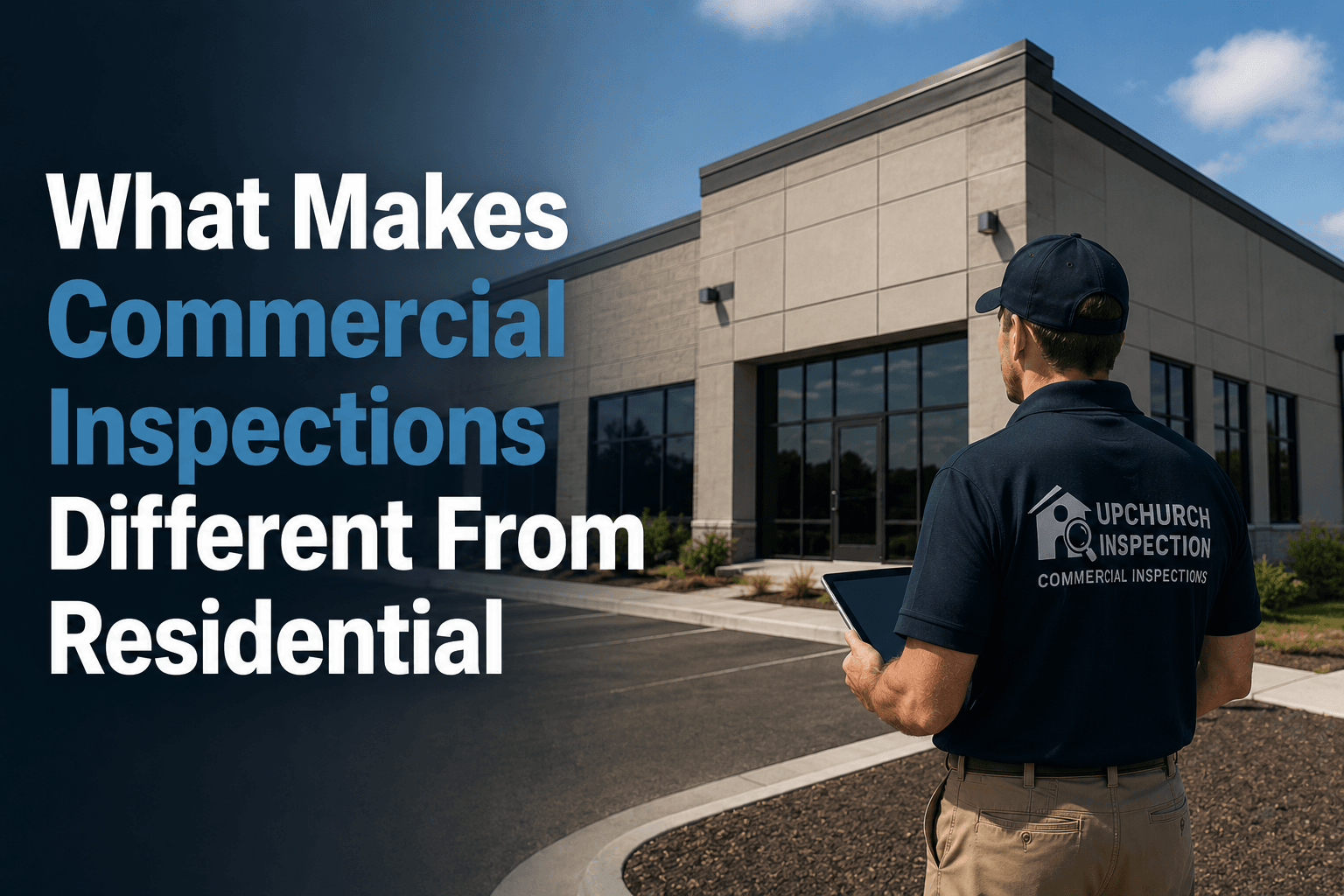
Most people assume a commercial inspection is just a larger version of a home inspection. More square footage, more systems, higher price. That assumption misses the most important difference.
Commercial inspections aren’t about checking boxes. They’re about understanding risk, liability, and long-term operational impact.
At Upchurch Inspection, we see this distinction catch buyers off guard all the time—especially those purchasing their first commercial property after years of residential investing. The shift isn’t subtle. It’s fundamental.
Commercial Properties Exist to Perform, Not Just to Shelter
A home exists primarily to be lived in. A commercial building exists to function, often continuously, often under load, and often with people, inventory, or revenue depending on it.
That changes everything about how it’s inspected.
In a commercial inspection, we’re not just asking whether something works today. We’re asking:
- How does this system behave under sustained use?
- What happens if it fails during business hours?
- How expensive is downtime?
- What liabilities does this create for ownership?
A residential inspection focuses on habitability. A commercial inspection focuses on operational continuity.
Commercial Inspections Are Risk Assessments, Not Condition Snapshots
Residential inspections document condition at a moment in time. Commercial inspections go further by evaluating exposure.
For example, an HVAC system in a home might be nearing the end of its service life. That’s important, but manageable. In a medical office, that same condition becomes a scheduling problem, a tenant issue, and potentially a compliance concern.
Commercial inspections look at:
- Redundancy (or lack of it)
- Deferred maintenance patterns
- System interdependencies
- Consequences of failure
The findings aren’t just about what’s wrong—they’re about what ownership inherits.
Scope Expands Because Responsibility Expands
In residential inspections, responsibility usually stops at the buyer. In commercial properties, responsibility extends outward.
Tenants. Employees. Customers. Congregants. Patients.
Commercial inspections account for:
- Life-safety systems and egress
- Fire separation and compartmentalization
- Accessibility considerations
- Mechanical and electrical load realities
- Roof, envelope, and drainage performance over time
Even when codes are not being enforced by the inspection itself, liability still exists, and experienced inspectors understand where owners are most exposed.
Commercial Systems Fail Differently—and Cost More When They Do
Residential systems often fail quietly. Commercial systems fail publicly.
A water heater failure in a home is disruptive. A water heater failure in a restaurant can shut the business down. A roof leak in a retail strip center doesn’t just damage drywall—it can damage inventory, lease relationships, and insurance standing.
Commercial inspections focus heavily on:
- Service history
- Maintenance accessibility
- Age relative to use, not just years
- Signs of stress rather than outright failure
These are the things that determine whether a building becomes an asset or a liability.
Reports Are Used for Decisions, Not Reassurance
Residential buyers often want reassurance. Commercial buyers want leverage and planning clarity.
Commercial inspection reports are commonly used to:
- Renegotiate purchase terms
- Establish repair escrows
- Forecast capital expenditures
- Prioritize immediate vs deferred work
- Support lender and insurer discussions
That’s why commercial reports are written differently. They’re less emotional and more analytical. The goal isn’t comfort—it’s informed decision-making.
Commercial Inspections Require Judgment More Than Checklists
You can teach someone to inspect components. You can’t shortcut judgment.
Commercial inspectors must constantly weigh:
- Severity versus probability
- Current performance versus future risk
- Code evolution versus existing conditions
- Repair feasibility versus replacement inevitability
Two buildings can have the same defect and carry wildly different implications depending on use, occupancy, and tolerance for disruption.
That judgment is what separates a true commercial inspection from a large residential one.
Why Buyers Feel the Difference Immediately
Clients often say they didn’t realize how different the process would feel until they were in it.
Commercial inspections involve more conversation, more explanation, and more scenario-based thinking. Buyers aren’t just asking “Is this a problem?” They’re asking “What does this mean for ownership?”
That shift is intentional. Commercial inspections aren’t about peace of mind. They’re about clarity before commitment.
The Practical Reality
A commercial inspection is not a bigger home inspection.
It’s a different discipline with different goals, different consequences, and different expectations. It requires experience with how buildings are used, how systems age under load, and how small issues become expensive ones when ignored.
Understanding that difference early helps buyers ask better questions, interpret reports correctly, and make smarter decisions.
And that’s exactly what commercial inspections are meant to support.
Related reading