
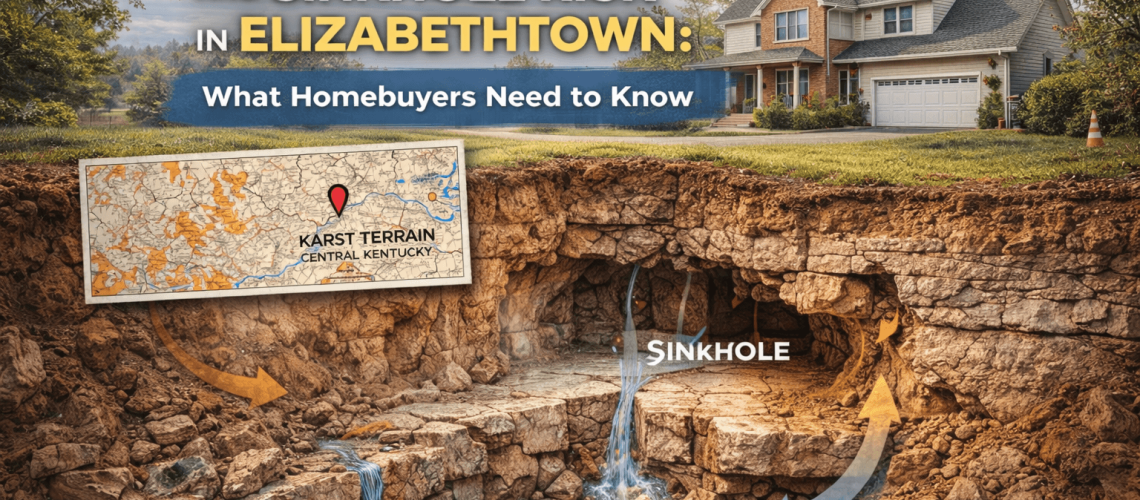
Buying a home in Central Kentucky comes with a risk most buyers from other states have never dealt with before: karst topography.
In and around Elizabethtown, the ground beneath many homes isn’t solid soil sitting on uniform rock. It’s a landscape shaped by limestone bedrock that dissolves over time, creating voids, channels, and, in some cases, sinkholes. These features don’t always announce themselves dramatically—but when they do, the consequences can be severe.
Understanding how karst terrain behaves is essential for buyers relocating to the area, especially those moving in from regions where soil-related issues are more common than geological ones.
What Karst Topography Actually Is
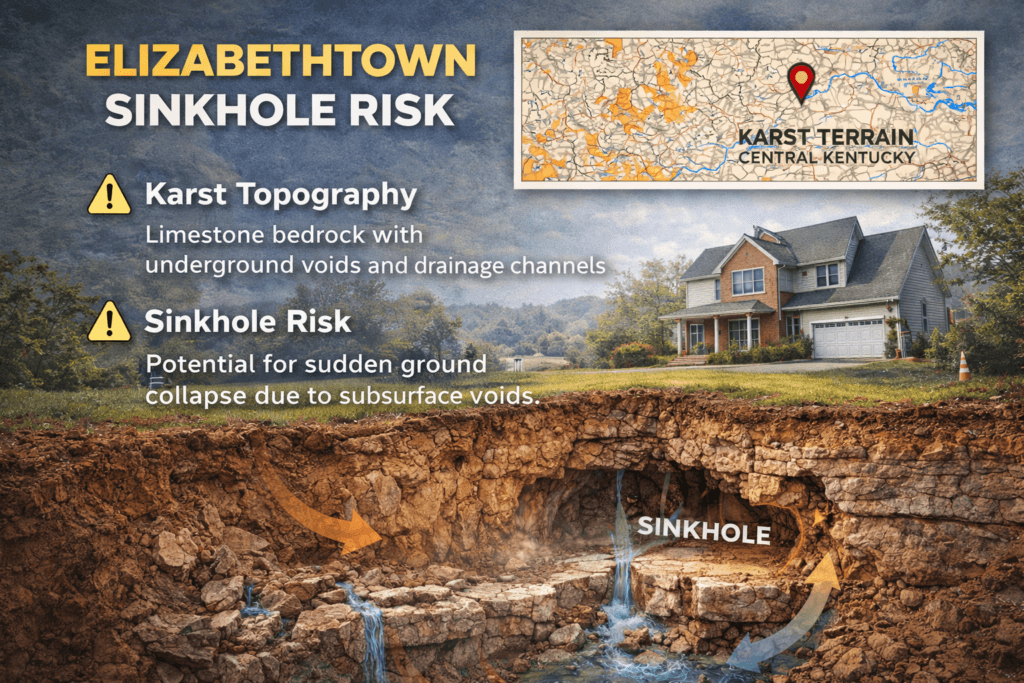
Karst topography forms when water dissolves soluble rock, most commonly limestone. Over time, this process creates:
- Underground voids
- Subsurface drainage channels
- Unstable bearing zones
- Sinkholes that may be sudden or gradual
Central Kentucky sits on extensive limestone formations, making karst conditions a regional reality, not an exception.
Unlike expansive clay or loess soil, karst issues originate below the soil layer, often far beneath what a visual inspection can reveal.
Why Sinkholes Aren’t “Random”
Sinkholes are often described as unpredictable, but in reality they usually follow patterns:
- Long-term water infiltration
- Concentrated runoff from roofs or pavement
- Broken underground utilities
- Changes in drainage or grading
- Natural subsurface erosion
Homes can appear perfectly stable for decades while voids slowly enlarge below the foundation. When surface support is finally compromised, collapse can be sudden.
How Karst Risk Shows Up in Homes
Karst-related issues don’t always look like a classic sinkhole in the yard. More often, early indicators include:
- Uneven settlement without clear soil cause
- Cracks that don’t follow typical shrink–swell patterns
- Persistent foundation movement despite dry conditions
- Doors and windows drifting out of alignment over time
Because these symptoms overlap with more common settlement issues, they’re frequently misclassified as “normal.”
Why Standard Inspections Struggle With Karst
A typical home inspection focuses on:
- Visible structure
- Surface drainage
- Interior finishes
- Observable foundation conditions
Karst problems develop out of sight, and they often require a different question altogether:
Is the ground beneath this structure stable long-term?
Without geological context, inspectors may document symptoms without recognizing the underlying risk.
Why Elizabethtown Is Different From Other Kentucky Markets
Not every Kentucky city carries the same level of karst exposure.
The Elizabethtown and Hardin County area:
- Sits directly over limestone bedrock
- Experiences active groundwater movement
- Includes areas with known sinkhole activity
- Has significant development pressure altering drainage
As development increases, so does the potential for triggering subsurface instability.
The Risk for Relocating Buyers
Buyers relocating from out of state—especially military families moving near Fort Knox—are often unfamiliar with karst terrain.
Common assumptions like:
- “The house is older, so it must be stable”
- “There are no cracks, so the foundation is fine”
Don’t always apply in karst environments.
The risk isn’t always immediate failure. It’s long-term uncertainty about what’s happening below grade.
What a Structural Perspective Adds in Karst Areas
Evaluating homes in karst terrain requires looking beyond the surface:
- Reviewing grading and runoff patterns
- Understanding how water moves through limestone
- Identifying red flags for subsurface erosion
- Assessing whether movement aligns with soil behavior or geological risk
This isn’t about alarming buyers. It’s about determining whether a home’s foundation is supported by stable bearing material or by conditions that could change without warning.
When Sinkhole Risk Becomes a Structural Concern
Not every home in karst terrain is unsafe. Many are perfectly stable.
The concern increases when:
- Drainage concentrates near the foundation
- Utility lines leak below grade
- Past fill has been placed without compaction control
- Movement continues without a clear surface cause
Those situations warrant deeper analysis—not guesswork.
The Bottom Line
Karst topography isn’t a defect. It’s a geological condition that requires informed evaluation.
In Elizabethtown and Central Kentucky, the biggest mistake buyers make is assuming that foundation movement behaves the same way it does in clay- or soil-driven markets. It doesn’t.
Understanding sinkhole risk isn’t about fear—it’s about clarity. When you know what’s happening beneath the surface, you can make decisions based on facts instead of assumptions.
In karst terrain, what you can’t see matters just as much as what you can.