
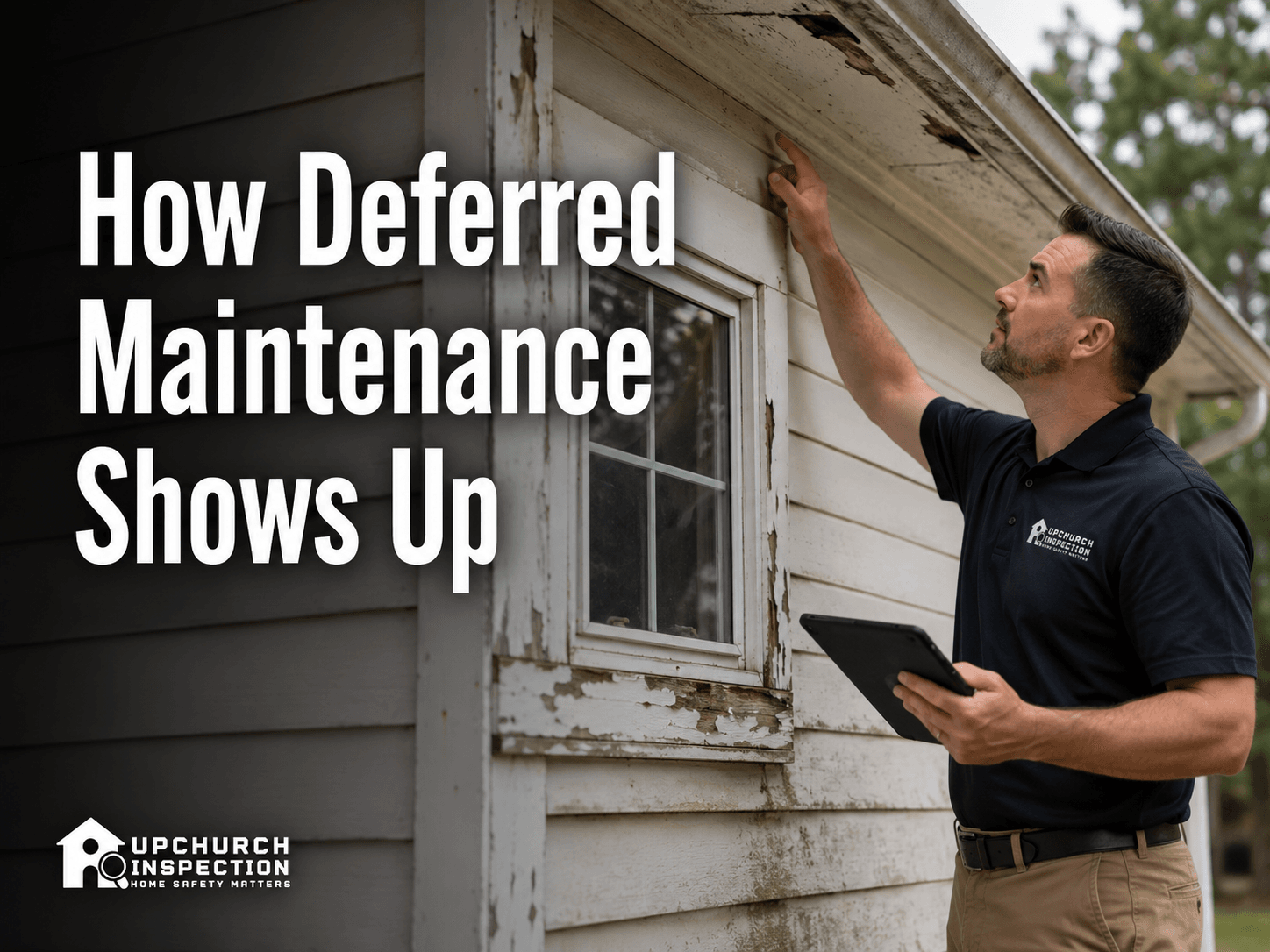
Deferred maintenance rarely announces itself as a single, dramatic failure. It shows up quietly, in patterns that develop over time, often blending into what looks like “normal aging” until ownership changes hands and those small delays start compounding.
At Upchurch Inspection, deferred maintenance is one of the most common underlying themes we see across homes in Memphis, Jackson, Little Rock, Jonesboro, Cape Girardeau, and Middle Tennessee. It doesn’t mean a homeowner didn’t care. It usually means small issues were postponed long enough that they began affecting other systems.
Deferred Maintenance Is a Pattern, Not a Punch List
Buyers often expect deferred maintenance to look like a list of obvious repairs. In reality, it shows up as relationships between conditions.
An inspector starts noticing things like:
- Multiple minor plumbing repairs instead of a single comprehensive fix
- Aging sealants and flashing paired with early moisture indicators
- Electrical components that still function but no longer reflect current demand
- Ventilation systems that were never upgraded as the home evolved
Individually, none of these items may rise to the level of a defect. Together, they tell a story of delayed attention.
Moisture Is Usually the First Messenger
Across the Mid-South, moisture is the most consistent way deferred maintenance reveals itself.
In West Tennessee and Central Arkansas, small drainage issues often go unaddressed because they don’t cause immediate damage. Over time, those same issues contribute to crawl space humidity, insulation deterioration, wood decay, or persistent odors.
In Southeast Missouri and parts of Middle Tennessee, roof drainage and grading choices made years earlier often reappear as staining, efflorescence, or localized foundation movement.
Deferred maintenance doesn’t usually cause moisture problems overnight. It allows them to develop slowly and predictably.
Systems Age Together When Maintenance Is Delayed
One of the clearest signs of deferred maintenance is system-age clustering.
Instead of staggered replacements over time, inspectors see:
- Original HVAC, water heater, and electrical components nearing the same lifecycle stage
- Roof coverings approaching replacement alongside aging flashing and penetrations
- Plumbing systems with repeated spot repairs rather than partial updates
Nothing may be failing yet, but ownership is approaching a phase where multiple systems demand attention at once.
Buyers often underestimate this because no single item appears urgent.
Cosmetic Updates Can Hide Functional Lag
Deferred maintenance doesn’t always look neglected. In fact, it often hides behind cosmetic improvements.
Fresh paint, new flooring, and updated fixtures can make a home feel “caught up,” even when underlying systems haven’t been addressed in years. Inspectors notice when finishes look modern but infrastructure reflects a much older maintenance timeline.
In growing markets like Nashville and Little Rock, this pattern shows up frequently in renovated homes where appearance advanced faster than performance.
The house looks updated. The systems tell a different story.
Small Skips Create Larger Consequences
Deferred maintenance is rarely about ignoring big problems. It’s about postponing small ones.
A missing downspout extension. A loose flashing detail. A clogged dryer vent. A minor plumbing seep. Each skipped task slightly increases stress elsewhere in the system.
Over time, inspectors start seeing secondary effects:
- Wood deterioration near moisture sources
- Electrical components exposed to humidity
- Structural members showing early movement or fatigue
- HVAC systems compensating for envelope inefficiencies
These are not failures. They’re accumulations.
Regional Conditions Accelerate the Impact
Deferred maintenance behaves differently depending on environment.
In Memphis and Jackson, expansive soils magnify drainage neglect. In Jonesboro, flat terrain limits water’s ability to move away naturally. In Cape Girardeau, freeze-thaw cycles compound small exterior maintenance gaps. In Middle Tennessee, rapid development sometimes leaves older homes competing with modern expectations they weren’t designed for.
Inspectors with regional experience recognize which deferred items are typical—and which ones are likely to accelerate into real problems if left unaddressed.
Why Deferred Maintenance Rarely Appears as One “Defect”
Inspection reports document observable conditions, not intent or history. Deferred maintenance often shows up as a collection of acceptable-but-aging observations rather than a single red flag.
That’s why buyers sometimes feel surprised later, even when the inspection was accurate. The issue wasn’t missed—it was cumulative.
Understanding that difference changes how buyers interpret the report.
What Buyers Should Pay Attention To
Instead of asking whether the home is “well maintained,” buyers are better served asking:
- Are systems aging in sequence or all at once?
- Do multiple findings point to postponed care?
- Are small issues clustered around moisture, drainage, or ventilation?
- How does this maintenance pattern compare to similar homes locally?
Those questions lead to realistic ownership expectations.
The Practical Reality
Deferred maintenance doesn’t mean a house is bad. It means the house is honest about time.
Every home carries maintenance forward. The question isn’t whether it exists—it’s whether the buyer understands how much has been postponed and how that aligns with their tolerance, budget, and plans.
A good inspection doesn’t judge deferred maintenance.
It reveals it—quietly, clearly, and in context.
And when buyers understand how deferred maintenance shows up, they stop being surprised by it later.