During inspections, there’s a moment that comes up again and again. We’re standing in a mechanical room, crawl space, or attic, and a client asks something like:
“So is this broken… or just old?”
That question matters more than most people realize, because deferred maintenance and active failure are not the same thing, and confusing the two often leads to bad decisions—either unnecessary panic or dangerous complacency.
At Upchurch Inspection, we spend a lot of time explaining this distinction because it affects how buyers negotiate, how homeowners budget, and how problems tend to snowball over time.
What Deferred Maintenance Actually Looks Like in Real Homes
Deferred maintenance isn’t dramatic. That’s part of why it’s so easy to live with.
It shows up as things like:
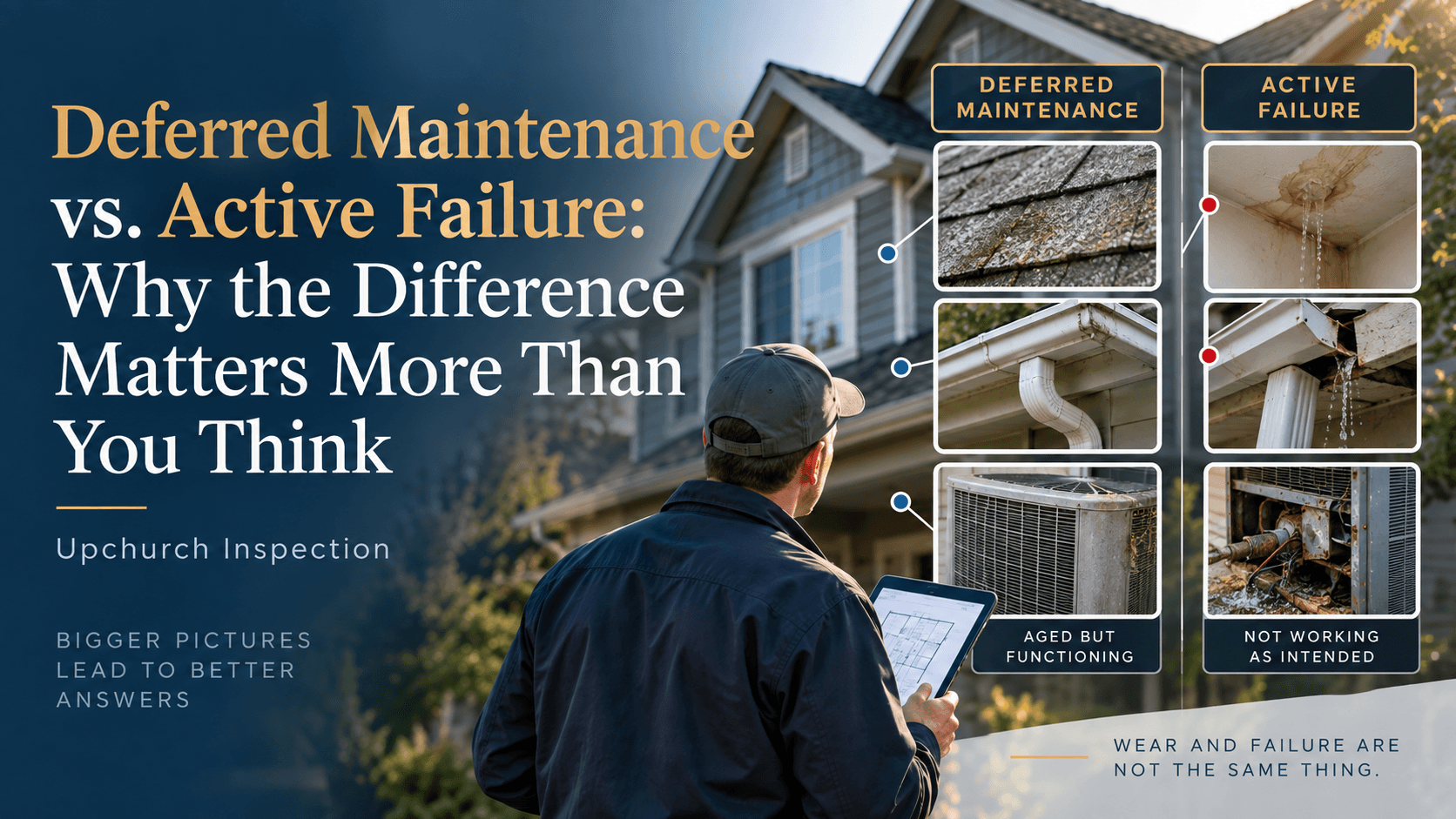
- A water heater that’s well past its expected lifespan but still heating water
- A roof with aging shingles that haven’t failed yet
- An HVAC system running longer cycles because it’s dirty or worn
- Caulking and seals that have slowly broken down over years
Nothing is “broken” in the obvious sense. The home still functions. Lights turn on. Water flows. The house feels livable.
But deferred maintenance is really just time catching up.
These systems aren’t failing yet—but they’re operating with less margin for error. When something goes wrong, it tends to go wrong quickly.
Active Failure Is Easier to Recognize
Active failure gets attention because it’s disruptive.
A pipe leaks. A breaker trips repeatedly. A furnace won’t start. A roof actively leaks during rain. These issues demand immediate action because they interrupt daily life.
Buyers usually understand active failure instinctively. Something isn’t working the way it should, and it needs to be fixed.
Where things get complicated is when buyers assume that anything not actively failing is safe to ignore.
A Real Example: Two Water Heaters, Very Different Risks
We’ve inspected homes where the water heater was visibly leaking, rusted through, and no longer producing consistent hot water. That’s active failure. Everyone agrees it’s a problem.
We’ve also inspected homes where the water heater was 18 or 20 years old, still producing hot water, and showing early signs of corrosion but no leaks.
That second scenario often gets brushed off:
“It still works.”
And that’s true—right up until it doesn’t.
The difference is predictability. Active failure has already declared itself. Deferred maintenance creates uncertain timing, which is often more stressful and expensive for homeowners.
Why Deferred Maintenance Often Costs More in the Long Run
Deferred maintenance tends to cause secondary damage.
An aging roof doesn’t fail all at once. It lets small amounts of moisture in over time. Insulation gets damp. Wood stays wet longer than it should. Fasteners corrode. By the time the leak is obvious, the repair scope has grown.
An HVAC system that’s overdue for replacement may still heat and cool, but it runs inefficiently. That increases humidity. Humidity affects framing, finishes, and indoor air quality.
Deferred maintenance quietly spreads its impact across systems.
Why Buyers Often Underestimate It
Buyers are understandably focused on the present moment. If something works during the inspection, it feels acceptable.
There’s also a psychological element. Active failure feels like a problem someone else should fix before closing. Deferred maintenance feels like something that can be handled “later.”
The issue is that “later” often arrives sooner than expected—and usually at a less convenient time.
How Inspectors Think About the Difference
When we evaluate deferred maintenance, we’re not just noting age or wear. We’re asking questions like:
- How close is this system to the end of its typical service life?
- Are there signs of strain or inefficiency?
- Has maintenance been consistent or reactive?
- What happens when this system does fail?
Active failure answers itself. Deferred maintenance requires interpretation and experience.
That’s why it often gets more explanation during the walkthrough than obvious failures do.
Negotiations Change When You Understand This
Deferred maintenance and active failure also affect negotiations differently.
Active failures are usually straightforward. Everyone agrees something needs repair.
Deferred maintenance is where deals get tricky. Sellers may feel defensive. Buyers may struggle to justify concessions. Lenders and insurers may have their own thresholds.
Understanding the difference helps buyers decide whether they want:
- Repairs
- Credits
- Price adjustments
- Or simply to proceed with eyes open
There’s no single right answer—but there is a wrong one, which is pretending deferred maintenance doesn’t matter.
Ownership Is Where the Difference Becomes Real
Once the transaction is over, the distinction becomes personal.
Active failures tend to get fixed because they have to be. Deferred maintenance becomes the homeowner’s responsibility, and the longer it’s delayed, the more disruptive it usually becomes.
Homeowners who understood deferred maintenance during the inspection are rarely surprised. They planned for it. They budgeted for it. They weren’t caught off guard.
Those who didn’t often feel blindsided—even though the signs were there.
How We Frame This at Upchurch Inspection
When we talk about deferred maintenance, we’re not trying to alarm clients. We’re trying to help them think beyond the inspection day.
We explain what’s working now, what’s aging out, and what that likely means over the next few years. Not in terms of guarantees—but in terms of realistic ownership expectations.
That context is what allows inspections to actually help people, instead of just documenting conditions.
Deferred maintenance isn’t failure yet. But it’s the stage right before it.
Understanding that difference changes how buyers interpret reports, how homeowners plan, and how houses are cared for over time.