

TL;DR:
- Effective commercial due diligence requires evaluating market conditions, operational health, legal exposure, and physical property, not just financial statements. Conducting thorough property assessments and scaling investigation scope to deal size help identify risks early, preventing costly surprises. Prioritizing red flags like customer concentration and deferred maintenance ensures better post-closing outcomes and deal security.
Most investors think commercial due diligence means reviewing a few financial statements and calling it done. That assumption has killed more deals than bad markets ever have. True commercial due diligence is a multidimensional evaluation process covering market conditions, operational health, legal exposure, and physical property condition. Whether you are acquiring a commercial building, buying a business with real estate attached, or expanding your portfolio in the Mid-South region, the depth of your pre-closing investigation directly determines your post-closing outcomes. This guide breaks down what that process actually looks like and how to do it right.
Table of Contents
- Key Takeaways
- Commercial due diligence: the core components
- Physical property assessment in due diligence
- Scaling due diligence to your deal
- Red flags and how to address them
- My perspective on getting due diligence right
- How Upchurch Inspection supports your due diligence
- FAQ
Key Takeaways
| Point | Details |
|---|---|
| Due diligence is broader than finance | Market, operational, legal, and physical assessments all belong in a thorough commercial review. |
| Property condition is a separate layer | Physical building inspections must run parallel to business analysis, not after closing. |
| Scale your scope to the deal | Smaller transactions need streamlined checks; larger deals demand deeper, multi-stream investigations. |
| Red flags demand deal-level responses | Customer concentration, deferred maintenance, and documentation gaps all require negotiated protections. |
| Early organization prevents deal drift | Well-organized documentation reduces buyer fatigue and speeds closings. |
Commercial due diligence: the core components
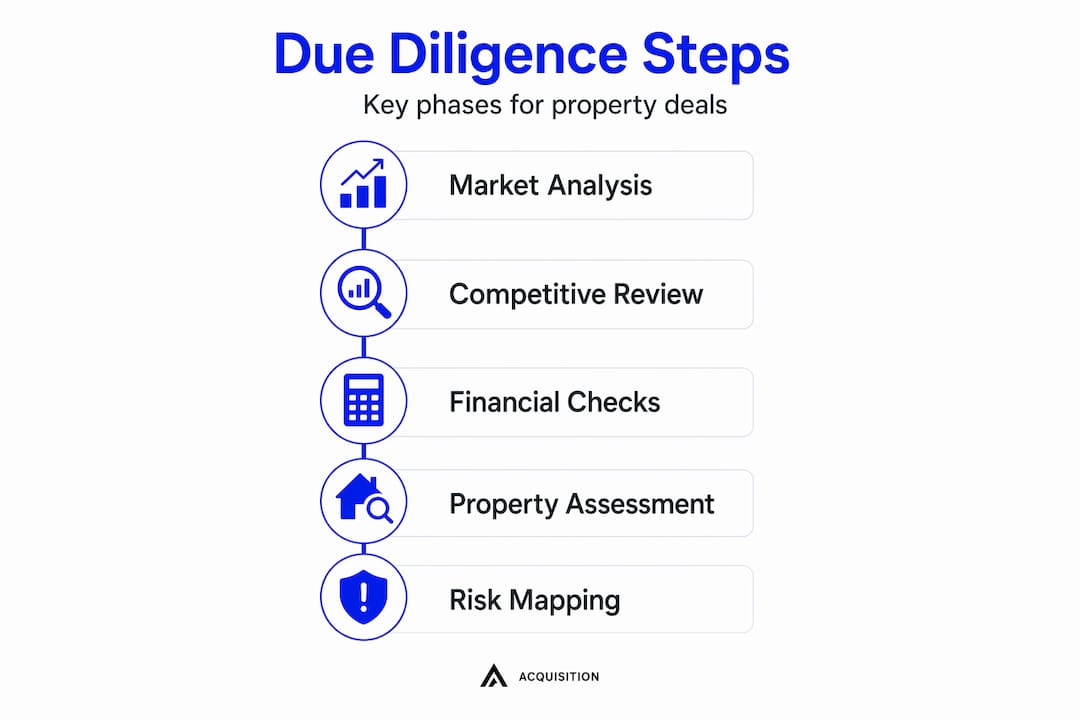
Commercial due diligence is not a single task. It is a structured investigation across several analytical layers, each designed to answer a different category of risk. When we talk about business due diligence in the context of acquisitions, four areas define the core of the work.
Market analysis and size validation is where most buyers should start. You need to verify that the market the business or property serves is large enough to support the projected revenue and that growth trends are heading in the right direction. Market analysis due diligence goes beyond reading industry reports. It means validating whether a specific location or tenant base actually reflects broader market data.
Competitive positioning requires honest assessment. What barriers exist that protect the business or asset from competition? A commercial property anchored by a single tenant in a sector facing rapid disruption carries real exposure. Understanding competitive dynamics is a core part of strategic due diligence, not an optional add-on.
The third layer covers customer and revenue quality. This is where investors prioritize recurring revenue and churn metrics over raw growth. Reviewing customer contracts, renewal terms, payment history, and concentration levels tells you whether projected income is reliable or aspirational.
The fourth layer is the operational review, which covers pricing power, sales pipeline depth, vendor dependencies, and management team stability. These factors determine whether the revenue machine keeps running after ownership changes hands.
- Validate market size claims against third-party data, not just seller projections
- Review the top 10 customer contracts for renewal risk and pricing clauses
- Assess competitor density within the trade area, not just at the regional level
- Map operational dependencies: who leaves, and does the business still function?
- Confirm that sales pipelines include weighted probability, not just gross value
Pro Tip: Request three years of customer invoicing data rather than just a revenue summary. Patterns in customer behavior, such as declining order frequency or shrinking invoice sizes, reveal churn risk that aggregate revenue numbers hide.
Physical property assessment in due diligence
Business due diligence and physical property assessment are separate disciplines. Many investors treat them sequentially, finishing the financial review before scheduling a building inspection. That sequencing creates real risk. Physical deficiencies discovered late in a transaction can derail timelines or create significant renegotiation pressure at the worst possible moment.

For commercial properties, a standard walkthrough is rarely sufficient. Property Condition Assessments (PCAs) exist precisely because complex building systems require specialized evaluation. Elevators, fire suppression systems, commercial HVAC configurations, and structural components all carry deferred maintenance risk that only a trained inspector can accurately quantify.
Here is what a physical assessment within commercial due diligence should examine:
- Structural systems: Foundation integrity, load-bearing walls, roof structure, and drainage conditions
- HVAC systems: Age, service life remaining, maintenance records, and whether units are adequately sized for the space
- Electrical and plumbing: Panel capacity, wiring age, plumbing material, and compliance with current code
- Fire and life safety: Sprinkler system condition, alarm systems, exit signage, and code compliance documentation
- Moisture and envelope conditions: Roof membrane, window seals, facade condition, and any signs of active water intrusion
A failing HVAC system in a multi-tenant commercial building is not a single repair. It can trigger a domino effect of tenant complaints, lease disputes, and capital expenditure that was never factored into your acquisition model. Identifying these conditions before closing, not after, gives you pricing leverage and time to plan.
Pro Tip: Coordinate your commercial property inspection timeline with your legal and financial diligence tracks. Discoveries from the PCA can directly inform purchase price adjustments and representations in the purchase agreement.
Successful commercial property tax appeals can save $1 to $3 per square foot depending on local tax rates. That kind of savings only becomes visible when you have a detailed, accurate picture of the property condition. A thorough assessment gives you that picture.
Scaling due diligence to your deal
Not every transaction requires the same depth of investigation. One of the biggest mistakes buyers make is applying enterprise-level due diligence processes to modest acquisitions, or worse, applying minimal scrutiny to complex deals because the timeline felt tight. Due diligence is highly scalable and should be calibrated to the size, complexity, and risk profile of the specific deal in front of you.
Here is a practical framework for scaling your approach:
- Define your risk threshold first. Before you build a due diligence scope, identify what would cause you to walk away or renegotiate. That list becomes your minimum investigation standard, regardless of deal size.
- Tier your document requests. For smaller transactions, focus on three years of financials, key contracts, title documents, and a physical inspection report. For larger deals, layer in full customer data, environmental assessments, and multi-year capital expenditure history.
- Set a parallel track structure. Legal, financial, and physical diligence should run simultaneously wherever possible. Sequential reviews extend timelines and increase the risk of buyer fatigue and deal drift.
- Build a central data room early. A shared, organized repository of documents shortens review time and reduces the back-and-forth that erodes confidence and delays closings.
- Assign clear ownership for each stream. Financial review, legal review, and physical inspection each need a designated owner with a defined deadline. Overlap without ownership creates gaps.
Standard M&A due diligence timelines run 4 to 10 weeks for most business acquisitions, though complex deals can extend significantly longer. Starting organized and running parallel tracks is the most effective way to stay within that window.
Red flags and how to address them
Every major post-closing dispute can be traced back to something missed or minimized during due diligence. Knowing which red flags carry the most weight helps you prioritize your investigation and respond strategically when issues surface.
| Red Flag | Risk Impact | Recommended Response |
|---|---|---|
| Customer concentration above 30% of revenue | High valuation risk; revenue cliff if top client exits | Negotiate earnout tied to client retention; seek written transition support |
| Deferred maintenance on core building systems | Immediate capital expenditure exposure | Adjust purchase price or require seller credits at closing |
| Revenue dependent on current owner relationships | Business may not transfer intact | Require a transition period and seller consulting agreement |
| Incomplete or missing documentation | Legal and financial exposure post-closing | Request full documentation or walk away; never assume |
| Environmental or moisture concerns in building | Remediation costs and liability exposure | Commission full environmental and moisture assessment before close |
Customer concentration above 30% of revenue is one of the most common and most underestimated deal risks. Sellers rarely volunteer this information clearly. You have to calculate it yourself from the customer data.
Twelve percent of small business acquisitions fail specifically because of dependency risks discovered too late in the process. Owner dependency and single-customer reliance are the two most common culprits. When your commercial due diligence report surfaces either condition, the deal terms need to reflect that risk directly.
Pro Tip: If a seller resists sharing customer-level revenue data, treat that resistance as a red flag in itself. Transparent sellers have nothing to hide. Friction around data access is a signal worth taking seriously.
Hidden property deficiencies follow the same logic. Deferred maintenance on a 20-year-old HVAC system or an aging roof is not just a repair cost. It is a capital planning liability that affects your financing, your operating budget, and your ability to attract or retain tenants.
My perspective on getting due diligence right
I have seen investors in the Mid-South walk into commercial acquisitions with strong financials, solid market positioning, and genuine enthusiasm. Then the deal closes, and the first winter reveals an HVAC system running on borrowed time across half the building. Nobody budgeted for it. Nobody asked.
In my experience, the investors who consistently make sound acquisitions treat due diligence as a risk mapping exercise, not a checklist. They are not trying to confirm that the deal is good. They are trying to find every reason it might go wrong. That mindset shift changes what questions you ask and which specialists you bring in.
What I have also learned is that AI tools are accelerating due diligence timelines and improving cross-disciplinary risk mapping. That is a real shift in how the process works. But technology does not replace eyes on the building. A model can flag financial anomalies, but it cannot tell you whether the roof membrane is three years from failure or whether the elevator maintenance log is missing two years of service records.
My strong belief is this: the physical inspection should be non-negotiable, even in fast-moving markets where buyers feel pressure to close quickly. The cost of a thorough property condition assessment is a fraction of one capital replacement event. Skipping it to save time is a trade you will almost certainly regret.
— Wes
How Upchurch Inspection supports your due diligence
When you are moving through a commercial acquisition or preparing for a property transaction in Tennessee, Arkansas, Mississippi, or Southeast Missouri, the physical side of due diligence needs to be handled by inspectors who understand what they are looking at and what the findings mean for your deal.
Upchurch Inspection provides commercial real estate due diligence inspections built around the timelines and priorities that investors actually face. From full Property Condition Assessments that evaluate structural systems, HVAC, electrical, plumbing, and moisture conditions, to specialized commercial building inspections for diverse property types, the reports are designed to be clear, detailed, and directly usable in deal negotiations.
If you are preparing for an upcoming acquisition or want to understand what a thorough commercial property assessment covers, reach out to Upchurch Inspection to schedule your inspection and get the documentation your deal requires.
FAQ
What is commercial due diligence?
Commercial due diligence is a structured pre-acquisition investigation covering market conditions, competitive positioning, customer and revenue quality, operational health, and physical property condition. It goes well beyond financial review to validate whether an investment performs as expected after closing.
How long does commercial due diligence take?
Standard commercial due diligence for business acquisitions takes 4 to 10 weeks, though complex deals can run significantly longer. Starting organized with parallel review tracks keeps the process within that window.
What is a Property Condition Assessment and why does it matter?
A Property Condition Assessment (PCA) is a specialized inspection that evaluates complex building systems including HVAC, elevators, structural components, and fire suppression. It identifies deferred maintenance and capital expenditure risk that general inspections typically miss.
What are the biggest red flags in commercial due diligence?
Customer concentration above 30% of revenue, deferred property maintenance, owner-dependent revenue, and incomplete documentation are the most consequential red flags. Each requires a direct response in deal terms, whether through price adjustment, contractual protections, or remediation requirements.
Can due diligence be scaled for smaller transactions?
Yes. Due diligence scales to transaction size and complexity. Smaller deals can be handled efficiently with focused financial, legal, and physical checks while still capturing the most significant risks.