
TL;DR:
- A deferred maintenance assessment reveals hidden repair costs and future financial risks by evaluating a property’s systems comprehensively. It quantifies neglected repairs, determines condition indices like FCI scores, and aids negotiation and budgeting, preventing costly future escalation. Regular updates and strategic use of assessment findings help buyers make informed decisions, safeguarding their investments from systemic neglect and secondary damages.
Most buyers walk into a property and see what it looks like today. What they miss is the financial weight of everything the current owner chose not to fix. A deferred maintenance assessment is the tool that makes that hidden weight visible. It quantifies neglected repairs, maps out cost exposure, and gives homebuyers and investors a defensible number to work with before they sign anything. Skipping this step is one of the most expensive mistakes you can make in real estate, because deferred maintenance rarely stays the same size. It grows.
Table of Contents
- Key Takeaways
- What a deferred maintenance assessment actually covers
- The compounding costs of putting repairs off
- Reading your assessment report like an investor
- Using assessment findings to make smarter purchase decisions
- Common questions about deferred maintenance assessments
- My take on where buyers go wrong
- Protect your investment before you close
- FAQ
Key Takeaways
| Point | Details |
|---|---|
| Costs compound fast | A deferred repair can escalate to 10 to 15 times its original scope within just a few years. |
| FCI score reveals true condition | A Facility Condition Index above 0.10 signals poor condition and immediate financial risk. |
| Reports support negotiations | Documented assessment findings give buyers concrete leverage to renegotiate price or request repairs. |
| Urgency tiers matter | Not every defect demands immediate action, but delaying tier-3 issues increases costs 15 to 25% per month. |
| Regular updates are necessary | Assessments should be refreshed every three to five years to reflect actual current conditions. |
What a deferred maintenance assessment actually covers
A deferred maintenance assessment is a structured evaluation of a property’s physical systems to identify repairs and replacements that have been postponed beyond their recommended schedule. This is distinct from a casual walkthrough. It’s closer to what facility professionals call a facility condition assessment, a methodical review that documents each system’s current state and remaining useful life.
Inspectors evaluate six primary areas during a thorough assessment:
- Roofing and exterior envelope: Missing flashing, failing sealants, damaged fascia, and roof systems past their service life
- Structural components: Foundation movement, framing issues, water intrusion evidence at crawlspaces and basements
- HVAC systems: Age of units, maintenance records, performance testing, and signs of deferred servicing
- Plumbing: Pipe material, water pressure, drain condition, water heater age, and visible corrosion
- Electrical: Panel condition, wiring age and type, grounding, GFCI protection, and load capacity
- Moisture and envelope performance: Evidence of leaks, mold conditions, condensation patterns, and drainage failures
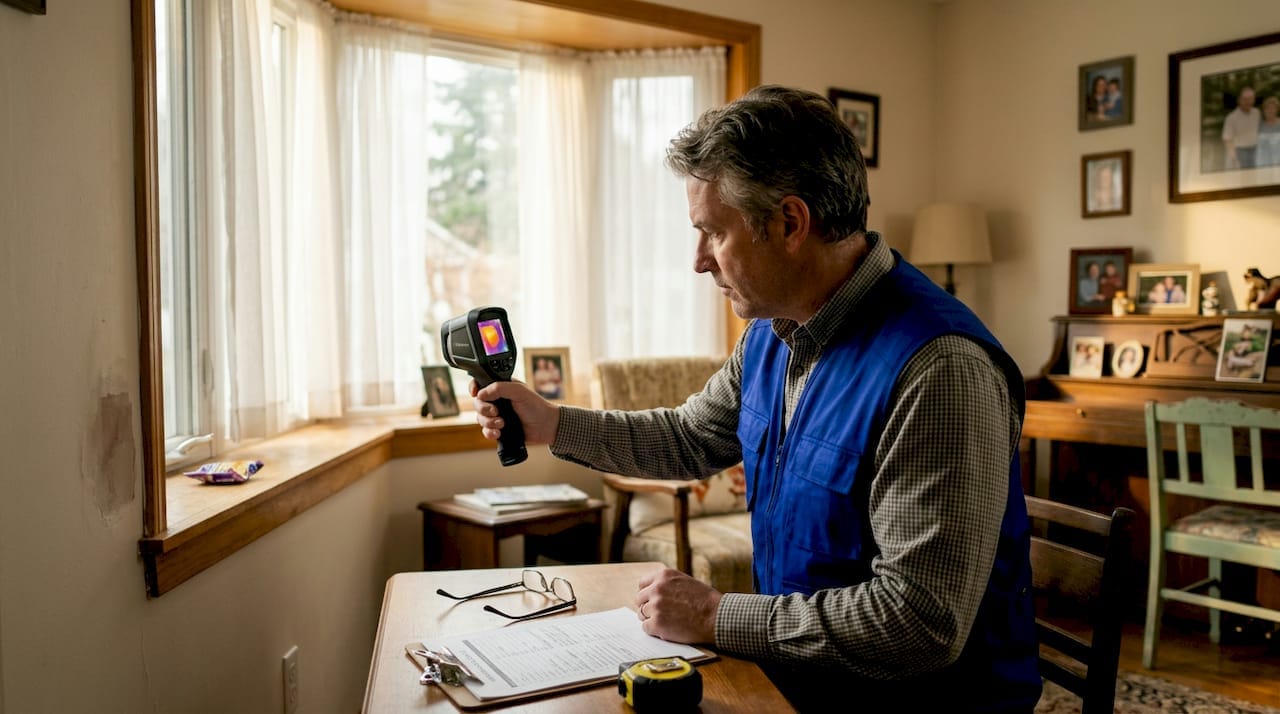
Professional inspectors use thermal imaging to detect moisture intrusion and heat loss that standard visual inspections miss entirely. At Upchurch Inspection, we’ve found significant water damage and HVAC inefficiencies through thermal imaging scans that showed no surface evidence at all.
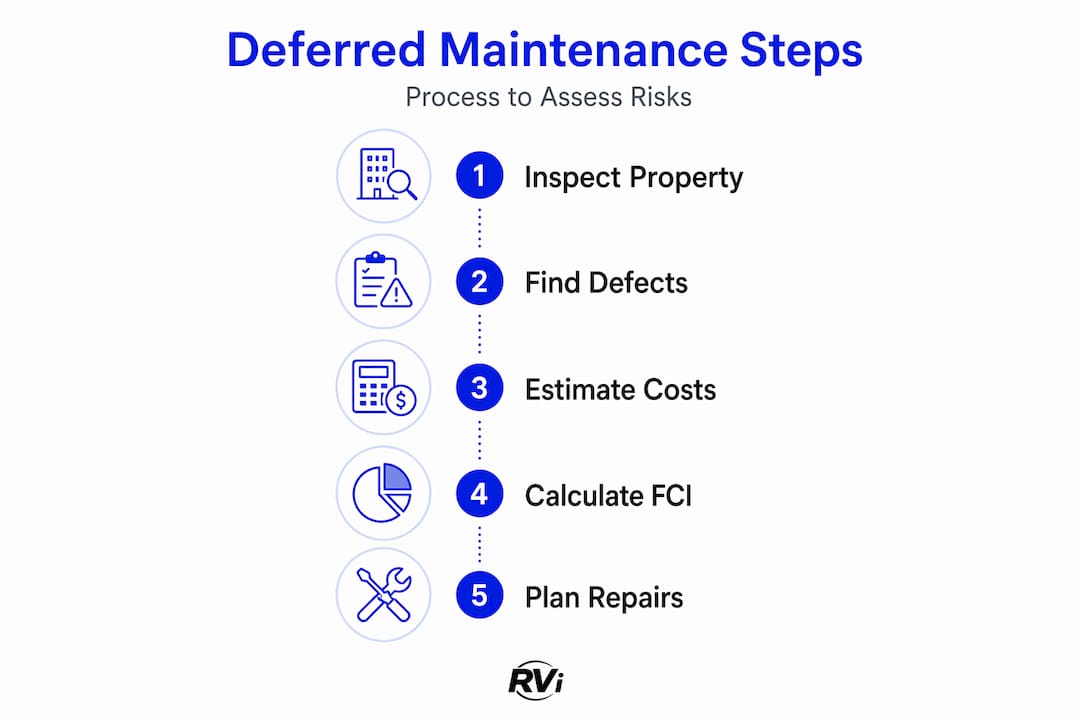
The assessment also produces a quantitative metric: the Facility Condition Index. FCI is calculated by dividing the total deferred maintenance cost by the property’s current replacement value. A score between 0 and 0.05 indicates good condition. Between 0.05 and 0.10 is fair. Anything above 0.10 signals a poor condition requiring immediate attention.
Pro Tip: Ask for the FCI score explicitly when reviewing any facility condition assessment report. If the inspector doesn’t calculate one, request a cost-to-replacement breakdown so you can calculate it yourself. A property with a 0.15 FCI sounds abstract until you convert it: on a $400,000 building, that’s $60,000 in deferred maintenance already baked in.
The compounding costs of putting repairs off
Here’s what most buyers don’t fully internalize: deferred maintenance costs can compound at approximately 7% annually and escalate total repair costs to 10 to 15 times the original scope. A $5,000 roof repair left unaddressed for five years doesn’t become a $7,000 repair. It becomes a $35,000 to $50,000 project.
The mechanism is a domino effect. A minor roof leak wets the decking. Wet decking develops rot. Rot spreads to rafters. Compromised rafters affect interior ceiling framing. What started as a flashing repair becomes a structural remediation and interior rebuild. That’s not a hypothetical. That’s what we find in the field regularly.

| Repair Type | Original Cost | 5-Year Deferred Cost | Escalation Factor |
|---|---|---|---|
| Roof flashing repair | $500 | $5,000 to $15,000 | 10 to 30x |
| HVAC servicing | $300 | $4,000 to $8,000 (replacement) | 13 to 27x |
| Foundation crack sealing | $1,200 | $12,000 to $40,000 | 10 to 33x |
| Water heater maintenance | $150 | $900 to $1,800 (replacement) | 6 to 12x |
| Exterior caulking | $400 | $3,000 to $8,000 (moisture damage) | 7 to 20x |
The financial impact extends beyond repair bills. Deferred maintenance affects insurance premiums, lender willingness to finance, and appraisal values. Some lenders won’t close on properties with flagged deferred-maintenance conditions until the repairs are documented and completed. Others will close but at reduced loan-to-value ratios, which changes your down payment calculus entirely.
“Deferring maintenance does not save money. It only pushes expense into the future where it increases due to secondary damage and inflation.” — Association Reserves
Experienced investors know that the true cost of ownership is almost never what the listing price suggests. The maintenance backlog a previous owner built up is a liability you absorb the moment you close.
Reading your assessment report like an investor
Assessment reports vary in quality, but strong ones share a consistent structure. Each deficiency is described with a condition rating, a cost estimate, and a priority tier. Understanding those three elements is what separates buyers who negotiate well from buyers who either panic or miss problems entirely.
The priority tiers typically work like this:
- Tier 1 (Immediate): Safety hazards, active water intrusion, structural failure risk. These require action before or immediately after purchase.
- Tier 2 (Short-term): Systems approaching end of service life, components with accelerating deterioration. Budget for these within 12 to 24 months.
- Tier 3 (Planned): Cosmetic issues, minor functional deficiencies, items with remaining useful life but declining condition. Schedule within six months of identification, because delaying tier-3 items increases repair cost by 15 to 25% per month.
The FCI score ties all of this together into a single number. When you see the total deferred maintenance cost in a report, divide it by the structure’s appraised replacement value. That ratio tells you, at a glance, how much financial exposure you’re absorbing.
Well-structured assessment reports also function as negotiation documents. Inspection reports serve not just as negotiation tools but as documented evidence that enhances lender and insurer confidence in a property’s condition. That documented evidence is leverage. A seller who refuses to repair a Tier 1 item is, in effect, asking you to pay full price for a property that needs immediate remediation.
Watch for two red flags in reports. First, vague language. “Roof shows wear” tells you nothing useful. A quality assessment specifies estimated remaining life and approximate replacement cost. Second, missing systems. If a report doesn’t address HVAC age, electrical panel type, and foundation condition, it’s not a deferred maintenance assessment. It’s a surface inspection wearing that label.
Pro Tip: For multi-unit investment properties, request a maintenance backlog analysis by building system rather than by unit. HVAC systems installed the same year across twelve units create a synchronized replacement wave. That’s not a maintenance item. It’s a capital event, and it needs to show up in your acquisition model.
Using assessment findings to make smarter purchase decisions
Getting the report is step one. Using it well is where most buyers fall short. Here’s how to turn assessment findings into a purchase strategy:
Calculate your true all-in cost. Add the total deferred maintenance estimate to the purchase price. That’s your real acquisition cost. If the math doesn’t work at that number, it doesn’t work at all.
Separate urgent from non-urgent repairs. Tier 1 issues need contractor quotes before you close, not after. Get at least two bids on anything flagged as immediate. The inspector’s cost estimate is a planning figure, not a final number.
Negotiate on documented evidence. Submit Tier 1 and Tier 2 deficiencies back to the seller in writing with cost estimates attached. Ask for price reductions, credits at closing, or pre-closing repairs. Sellers who have disclosed nothing and seen nothing have less standing to push back on documented findings.
Build a post-purchase repair timeline. Assessments should be updated every three to five years. Use your initial report as a baseline and schedule follow-up inspections annually for the first two years after purchase to track whether deferred conditions are progressing faster than expected.
Factor maintenance into your financing. Some buyers use assessment reports to qualify for renovation loans or negotiate seller concessions that fund an escrow for repairs. A documented repair needs assessment makes that conversation with a lender much more concrete.
Plan for systemic issues, not just individual repairs. Maintenance backlogs include active and passive layers, and obsolete or duplicate issues can represent up to 86% of the queue. For investors especially, understanding whether you’re dealing with isolated deficiencies or systemic neglect changes your post-purchase management strategy entirely.
Post-purchase, schedule an annual home maintenance inspection to catch new items before they compound. The goal is to never let the maintenance backlog rebuild. Properties that stay ahead of maintenance carry lower ownership costs, higher appraised values, and significantly better resale outcomes.
Common questions about deferred maintenance assessments
Most buyers arrive at this process with legitimate confusion about what deferred maintenance assessments cover, who needs them, and how they differ from other inspections. Here are the questions we hear most often:
What qualifies as deferred maintenance? Any repair or replacement that has been postponed beyond its recommended schedule. This includes routine items like HVAC filter changes that led to coil damage, as well as larger deferred replacements like a 22-year-old roof on a 20-year-lifespan system.
Does deferred maintenance affect appraisals? Yes, directly. Appraisers factor observable deferred maintenance into value adjustments. Significant deferred maintenance can also trigger lender conditions that require repairs before funding.
How is a deferred maintenance assessment different from a home inspection? A standard home inspection documents current conditions at a point in time. A deferred maintenance assessment adds cost quantification, remaining useful life estimates, and a priority framework. It’s a financial analysis built on inspection data.
What if the seller won’t fix anything? You have options. Negotiate a price reduction equivalent to the documented repair cost, request a closing credit, or walk away if the numbers don’t support the investment. A documented assessment gives you a defensible position regardless of the path you choose.
How often should assessments be updated? For investment properties, update assessments every three to five years or after any significant weather event or system failure.
My take on where buyers go wrong
I’ve walked through hundreds of properties across the Mid-South with buyers who were laser-focused on price and almost completely unprepared for the reality of maintenance. What I’ve seen consistently is this: the buyers who end up in financial trouble aren’t the ones who overpaid by $10,000. They’re the ones who bought a $180,000 house with $60,000 in deferred maintenance they never accounted for.
The assessment itself isn’t the failure point. The failure happens when buyers receive a report and treat it like a checklist of problems to ignore or a negotiating chip to cash out at closing. The repair needs assessment is a planning document. If you don’t build a budget around it, it doesn’t protect you.
What I’ve also learned is that the properties with the most deferred maintenance are almost never the cheapest to own. They’re just the cheapest to buy. That’s a distinction worth sitting with before you make an offer. The assessment tells you what you’re actually buying, not just what the listing price suggests.
A thorough assessment of deferred maintenance patterns often reveals not just what’s broken, but how the property has been managed over time. That story matters enormously for investors. A property with one large deferred item is very different from a property with twenty small ones. The second scenario tells you the management culture was neglectful across the board. That’s a systemic problem, not a repair problem.
— Wes
Protect your investment before you close
At Upchurch Inspection, we conduct full home inspections and commercial property inspections designed to go well beyond a surface walkthrough. Our reports document system conditions, estimated repair costs, remaining useful life, and priority classifications, giving you the same structured framework a deferred maintenance assessment provides. We serve homebuyers and investors across Tennessee, Arkansas, Mississippi, and Southeast Missouri.
If you’re evaluating a single-family home, a multi-unit rental, or a commercial building, a pre-purchase home inspection from Upchurch Inspection gives you documented, objective evidence to negotiate with confidence, plan your post-purchase budget, and avoid the compounding cost traps that catch underprepared buyers. Schedule your inspection before you finalize any purchase decision.
FAQ
What is a deferred maintenance assessment?
A deferred maintenance assessment is a structured evaluation of a property’s physical systems that identifies and quantifies repairs postponed beyond their recommended schedule. It produces cost estimates, condition ratings, and a priority framework to inform purchase and budgeting decisions.
How does FCI help buyers evaluate a property?
The Facility Condition Index divides total deferred maintenance costs by the property’s replacement value. A score above 0.10 indicates poor condition, meaning significant capital investment is required soon after purchase.
Can deferred maintenance kill a real estate deal?
Yes. Significant deferred maintenance can result in appraisal reductions, lender-required repairs before closing, or financing conditions that substantially change deal terms. Buyers who document findings early have the most options.
What systems carry the highest deferred maintenance risk?
Roofing, HVAC, plumbing, and foundations carry the highest risk because secondary damage from neglect in these systems compounds rapidly and affects multiple connected components at once.
Is a deferred maintenance assessment worth it for a newer home?
Yes. Deferred maintenance begins the moment a maintenance task is skipped, regardless of building age. New construction with missed warranty service items or builder-installed systems that were never commissioned correctly can carry measurable deferred maintenance within the first five years.