A West Tennessee Home Inspection Is Not Just a List of Broken Things
Most buyers open a home inspection report and see a list of defects. That is understandable because inspection reports are usually organized by system: roof, exterior, structure, electrical, plumbing, HVAC, attic, crawlspace, interior, and so on. That format is useful, but it can also make people think the house is just a collection of unrelated parts. In the field, houses do not fail that neatly. A roof leak can become attic staining, damaged insulation, ceiling repair, wall moisture, wood deterioration, and microbial-type growth. A plumbing leak under a bathroom can show up as a loose toilet, stained subflooring, swollen trim, crawlspace moisture, odor, fungal growth, and damaged floor framing. The report may separate those findings into different sections, but the house itself does not.
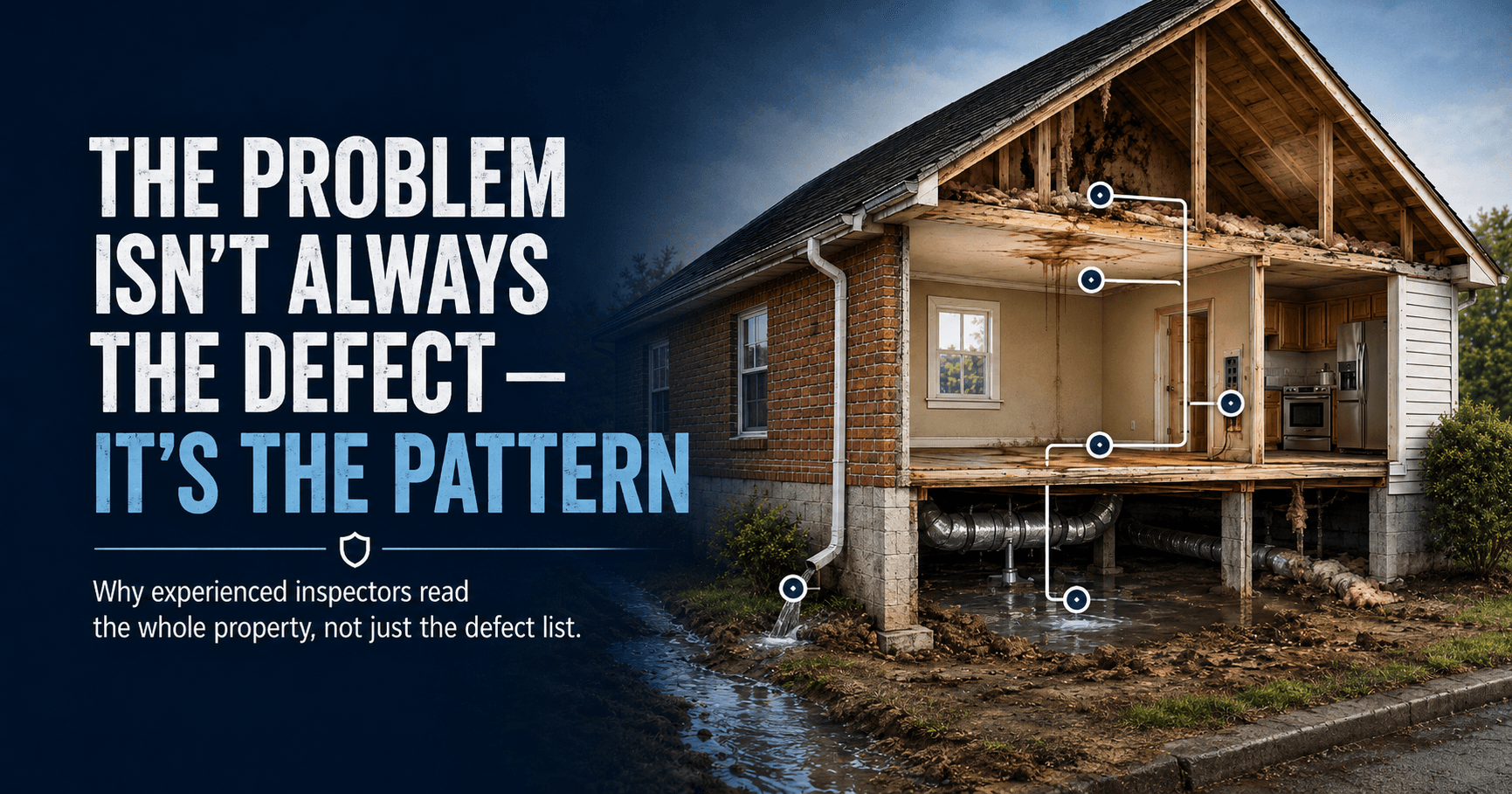
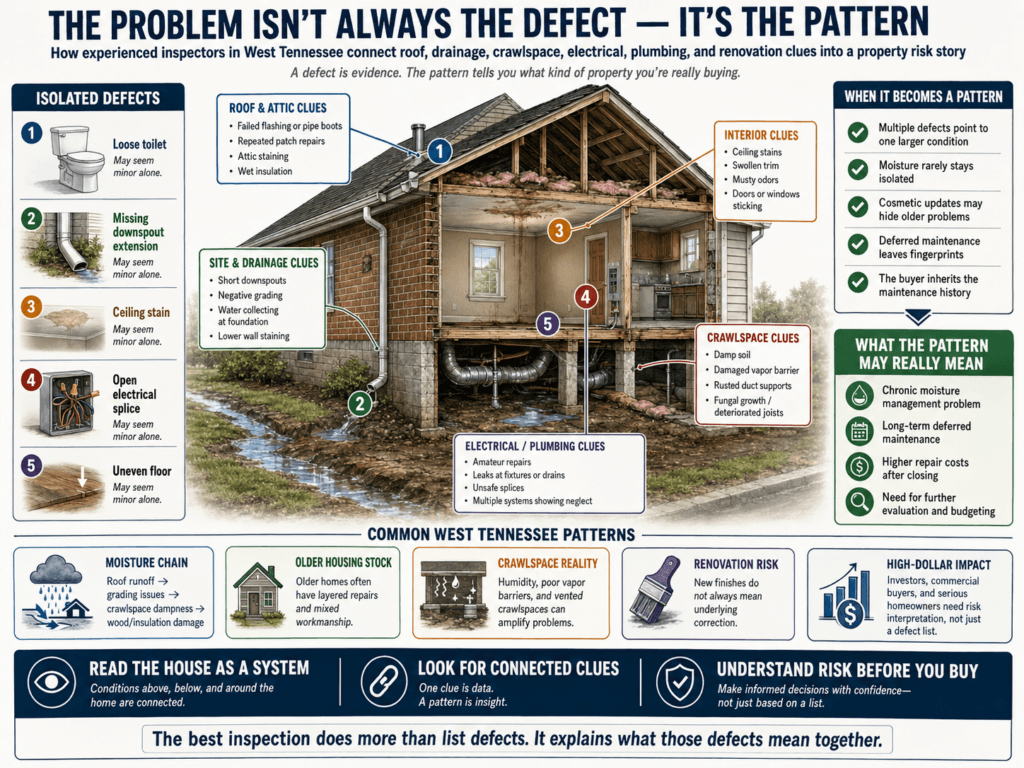
When I inspect a property in West Tennessee, I am not just looking for isolated defects. I am looking for relationships between defects. A missing downspout extension is one thing. A missing downspout extension, negative grading, damp crawlspace soil, rusted duct straps, sagging insulation, fungal-type growth on framing, and swollen trim on the same side of the house is something else entirely. At that point, I am not simply documenting repair items. I am reading the property’s behavior.
That distinction matters because the most expensive problems I find are rarely caused by one dramatic defect that suddenly appeared out of nowhere. More often, the real issue is a long-running pattern of moisture intrusion, poor drainage, deferred maintenance, amateur repair work, or cosmetic renovation that has been hiding the deeper condition of the property. A single damaged board may not tell me much. The reason that board is damaged, the surrounding conditions, the moisture pathway, the repair history, and the related symptoms throughout the house tell me far more.
West Tennessee Is a Moisture-Driven Inspection Environment
West Tennessee has its own inspection personality. This is not a dry climate where water management is an occasional concern. East Tennessee State University’s Tennessee climatology resource describes West Tennessee average precipitation as generally in the 50- to 60-inch range, and NOAA’s Tennessee climate summary lists the state’s long-term average annual precipitation at 52.2 inches. NOAA also notes that annual precipitation has mostly been above average since 1990. (EERE Energy)
That matters because a house does not need a major flood to develop moisture problems. Ordinary rainfall is enough if the property does a poor job moving water away from the structure. Gutters that dump beside the foundation, grading that slopes back toward the house, clogged underground drains, short downspouts, low crawlspace vents, dense vegetation against exterior walls, and wood or siding too close to grade can all contribute to a moisture pattern. None of those conditions may look catastrophic by itself. Together, they can keep the structure damp for years.
The soil matters too. University of Tennessee Extension describes Tennessee’s loess region as nearly flat to rolling upland with silty soils that range from poorly drained to well drained, with fragipans common in that soil area. (UT Crops) In plain inspection language, that means I pay close attention to how water behaves at the site. A yard may look fine during a dry week, but erosion, staining, settlement, crawlspace odor, rust, and moisture marks may tell me how the property behaves after hard rain.
That is why I do not get impressed by the kitchen before I understand the drainage. Kitchens sell houses. Drainage tells the truth. If the roof water is being dumped at the foundation, if the soil is pushing water toward the crawlspace, if the lower brick courses are stained, and if the crawlspace smells damp before I even get fully inside, the house is already giving me information.
What Are the Most Common Inspection Patterns I See in West Tennessee Homes?
The common problems I see in West Tennessee homes are not random. They tend to cluster around water control, roof-edge details, crawlspace moisture, aging HVAC systems, exterior envelope deterioration, older electrical work, plumbing repairs, and deferred maintenance. That does not mean every house has major issues. It means the same categories repeat often enough that I do not treat them as coincidence anymore.
On many homes, the story starts outside. I look at whether the roof drainage system actually moves water away from the structure. I look at whether gutters are present, whether they are clogged, whether downspouts discharge too close to the foundation, whether splash blocks or extensions are missing, whether grading slopes back toward the house, whether lower walls show staining, whether wood trim is too close to grade, and whether walkways or patios have settled in a way that traps water. Those exterior details often predict what I will find in the crawlspace or interior.
Inside the home, the signs may be more subtle. Swollen baseboards, musty odors, uneven floors, patched ceilings, stains under cabinets, loose toilets, condensation around supply registers, or doors that do not operate properly can all be ordinary by themselves. But when those conditions line up with exterior drainage concerns and crawlspace moisture evidence, the property starts telling a larger story. At that point, I am not counting defects. I am identifying a pattern.
Why Crawlspace Moisture Rarely Stays in the Crawlspace
Crawlspaces are one of the biggest places where West Tennessee homes reveal their real condition. A buyer may walk through the living area and see fresh paint, clean flooring, updated fixtures, and staged rooms. Then I get under the house and find damp soil, missing vapor barrier material, sagging insulation, rusted duct supports, disconnected ductwork, moisture staining, fungal-type growth, deteriorated framing, or repairs that do not match the finished appearance upstairs. That is not just a crawlspace note. In many homes, it is the beginning of the whole story.
Building-science research supports what inspectors see in the field. U.S. Department of Energy Building America guidance states that vented crawlspaces in mixed-humid and hot-humid climates can increase moisture levels rather than keep the space drier. Oak Ridge National Laboratory research comparing vented and unvented crawlspaces in a mixed-humid climate found that a sealed and insulated crawlspace design performed better than a traditional vented crawlspace design. (EERE Energy)
That does not mean every crawlspace gets the same recommendation. It does mean the old assumption that crawlspace vents automatically solve moisture problems is not reliable in our climate. In the field, I see the results of that assumption constantly. Humid air enters the crawlspace. Cool surfaces allow condensation. Ducts sweat. Insulation absorbs moisture. Wood stays damp. Metal components rust. Over time, the house starts showing symptoms above and below the floor system.
A crawlspace moisture pattern can affect comfort, insulation performance, HVAC efficiency, pest conditions, structural durability, and indoor air quality concerns. That is why I do not treat crawlspaces like optional dirty areas under the house. In West Tennessee, the crawlspace often tells the truth before the living space does.
When Is a Defect Minor, and When Is It a Warning?
Not every defect deserves the same reaction. A missing outlet cover is not the same thing as unsafe electrical modifications throughout the house. A single damaged shingle is not the same thing as a roof system showing repeated leaks, damaged flashing, attic staining, and interior ceiling patches. A minor drywall crack is not the same thing as poor drainage, sloped floors, sticking doors, masonry cracking, and evidence of foundation movement.
This is where buyers need help interpreting the report. A long report does not automatically mean a bad house. Some homes have many small defects that are ordinary, expected, and manageable for their age. Other homes may have fewer visible defects, but those defects may point toward deeper risk. The number of findings matters less than the relationship between the findings.
A loose toilet may be a simple repair. But if the toilet is loose, the flooring around it is soft, the ceiling below is stained, the crawlspace under that bathroom has moisture damage, and the drain piping has questionable repairs, the issue is no longer just a loose toilet. It becomes part of a plumbing and moisture pattern. That is the kind of distinction buyers need before closing.
Why Flipped Homes in Memphis and West Tennessee Need Careful Inspection
Renovated houses are some of the most important properties to inspect carefully because cosmetic work can interrupt the visual history of the house. A property may have new flooring, fresh paint, modern fixtures, updated lighting, and white cabinets, but the hidden systems may still carry old problems. In some cases, renovation makes the inspection more important because the evidence has been covered.
I have inspected homes where new flooring was installed over uneven or moisture-affected subflooring, bathrooms were updated while the plumbing below remained poorly supported, old roof leaks were painted over without correcting the flashing issue, and electrical fixtures were modernized while the panel still showed questionable work. That is not a design issue. That is a risk issue.
Cosmetic renovation is not the same as correction. A serious buyer should want to know whether the renovation fixed the cause of the problem or simply improved the appearance. New finishes can make a property easier to market, but they do not automatically make the roof better, the crawlspace drier, the wiring safer, the drainage corrected, or the structure sound.
This matters in Memphis because the housing stock is older than many buyers realize. A HUD market report for the Memphis housing market area noted that in 2023, about 48 percent of housing units in the city of Memphis were built before 1970, compared with 36 percent nationally, and only 4 percent were built since 2010. (ORNL Information) Older homes can be excellent homes, but they require honest evaluation. Age is not the problem. Unmanaged age is the problem.
Deferred Maintenance Leaves Fingerprints
Deferred maintenance usually does not show up as one dramatic failure. It shows up as a pattern of decisions. The gutters were not cleaned. The downspouts were never extended. The roof penetrations were patched repeatedly instead of repaired correctly. The HVAC filters were neglected. The crawlspace vapor barrier was destroyed and never replaced. Plumbing leaks were tolerated until they stained surrounding materials. Electrical additions were made by whoever was available.
A well-maintained house usually has consistency. Repairs look intentional. Materials make sense. Mechanical systems show evidence of care. The exterior manages water reasonably well. The attic and crawlspace do not look abandoned. The house may still have defects, but the defects do not all point toward neglect.
A poorly maintained house feels different. Repairs are layered. Caulk is smeared over old caulk. Roof cement appears in multiple locations. Junction boxes are missing covers. Drain lines are poorly supported. Ductwork is damaged or disconnected. Crawlspaces contain debris from old projects. The attic has staining nobody can explain. The seller says something has “always been that way.” Those are not just repair items. They are maintenance fingerprints.
That matters because buyers are not just buying the house. They are buying the consequences of how the previous owner maintained it.
Why This Matters More for High-Dollar Buyers
High-dollar clients should care about patterns more than individual defects. A luxury home, large older property, investment property, commercial building, church, multifamily property, or renovated house can carry expensive risk that is not obvious during a casual walkthrough. The inspection needs to identify visible defects, but it also needs to explain what those defects suggest about the larger condition of the property.
A buyer can budget for known repairs. What hurts buyers is inheriting a long-running pattern they did not understand. A moisture pattern may involve drainage correction, crawlspace work, damaged framing, HVAC concerns, insulation replacement, pest conditions, and further evaluation. An electrical pattern may involve panel work, unsafe splices, outdated wiring, improper additions, and hidden defects behind finished surfaces. A deferred maintenance pattern in a commercial building may affect roof systems, mechanical equipment, plumbing, electrical distribution, parking areas, drainage, and capital planning.
This is why cheap inspections can become expensive. A fast inspection may identify obvious problems but fail to connect the conditions into a meaningful risk profile. That may be enough for some properties. It is not enough for complicated buildings, older homes, commercial assets, large residential properties, or houses with extensive renovation histories.
What Commercial and Investor Clients Should Take From This
Commercial and investor inspections make pattern recognition even more important. A commercial buyer is not just asking, “What is broken?” The better question is, “What capital expenses am I inheriting?” A small commercial building may show aging rooftop HVAC equipment, roof drainage problems, sealant failures, moisture intrusion, electrical modifications, plumbing concerns, and site drainage issues. Each of those can be documented individually, but together they may reveal years of deferred maintenance.
The same is true for rental houses and multifamily properties. A property that has been patched between tenants may look serviceable during a walkthrough, but the inspection may reveal a history of short-term repairs. Repeated plumbing patches, damaged doors, older HVAC systems, poor drainage, unsafe electrical modifications, and crawlspace neglect can all point toward a property that has been operated for income without enough reinvestment.
That does not automatically make the property a bad purchase. It means the buyer should understand the maintenance backlog. In commercial and investment property, the defect is often less important than the budget consequence. A roof item is not just a roof item if it affects interior finishes, tenant disruption, insurance concerns, future capital planning, and negotiation leverage.
How Inspection Findings Should Affect Negotiation
A buyer does not need every defect to become a crisis. But the buyer does need to understand which findings may change the financial picture. A missing handrail may be a simple safety repair. A roof with repeated leak indicators, deteriorated flashing, attic staining, and interior ceiling repairs may affect negotiations differently. A damp crawlspace with damaged insulation, fungal-type growth, and poor drainage is not the same as a minor maintenance item.
Pattern-based inspection findings can help a buyer negotiate more intelligently because the discussion shifts from “fix this one thing” to “this property appears to have a larger condition that may require further evaluation and budgeting.” That is a more serious conversation. It is also more defensible because it is based on multiple visible indicators instead of one isolated observation.
This is especially important when buyers feel pressure to move quickly. A good inspection should not create unnecessary panic, but it should not soften the truth either. If the house has a pattern, the buyer needs to know that before the inspection window closes.
What Buyers Commonly Misunderstand About Inspection Reports
One common misunderstanding is that the inspection report is supposed to provide a simple pass-or-fail answer. That is not how houses work. A home inspection is a visual, limited, non-invasive evaluation of accessible systems and components. It is not a guarantee, engineering analysis, environmental assessment, code compliance inspection, or destructive investigation. But within that scope, a good inspection can still provide meaningful insight into risk.
Another misunderstanding is that the biggest photo is always the biggest problem. Sometimes the defect that looks ugly is easy to fix, while the subtle pattern behind it is more important. A stained joist, damp soil, rusted duct strap, missing vapor barrier, and musty odor may not look dramatic in a listing-photo world, but those details can tell me more about the house than a cracked tile or loose doorknob.
Buyers also sometimes assume that if a house has been renovated, it must have been improved. That is not always true. Renovation can be excellent, average, careless, or purely cosmetic. The inspection is where those differences start to show.
What I Look For When I Think a Property Has a Pattern
When I suspect a pattern, I slow down and look for confirmation. On the exterior, I look at roof drainage, gutter discharge, grading, soil erosion, vegetation, wall penetrations, siding clearance, lower brick staining, wood trim deterioration, and how water is likely to move during a heavy rain. In the crawlspace, I look for moisture staining, vapor barrier condition, duct condensation, insulation performance, fungal-type growth, damaged framing, plumbing leaks, pest evidence, and whether prior repairs appear competent.
In the attic, I look for roof staining, ventilation concerns, insulation disturbance, damaged decking, improper exhaust termination, and signs of repeated leakage. In the electrical system, I look for amateur work patterns, open splices, unsafe modifications, missing covers, improper breaker conditions, and inconsistent updates. In the interior, I look for swollen trim, uneven floors, patched ceilings, musty odors, moisture stains, sticking doors, and areas where cosmetic work may be covering old problems.
The goal is not to create a dramatic story where none exists. The goal is to determine whether multiple visible clues are pointing in the same direction. When they are, the client deserves to know.
Why the Pattern Matters More Than the Repair Estimate
Buyers often ask how much something will cost to fix. That is a fair question, but it is sometimes the wrong first question. Before repair cost, the better question is cause. What caused the damage? Is the condition active? Is it isolated? Has it affected surrounding materials? Is it likely to return if only the visible damage is repaired?
Replacing damaged wood does not solve a drainage problem. Treating fungal growth does not solve crawlspace moisture. Replacing stained drywall does not solve a roof leak. Installing new flooring does not solve subfloor movement. Fixing one electrical defect does not solve a pattern of unsafe wiring work.
This is where serious buyers usually understand the value of a more thorough inspection. They are not just trying to get a repair list. They are trying to avoid buying a problem they do not understand.
Why This Matters as a Way to Think About Property Risk
The central point is simple, but it changes how a buyer reads an inspection report. The defect is evidence. The pattern tells you what kind of property you are really buying.
That is the difference between a report that simply documents problems and an inspection that helps a buyer understand risk. A house can have defects and still be a good purchase. A commercial building can have deferred maintenance and still make financial sense. A renovated home can have some imperfect work and still be worth buying. The issue is whether the buyer understands the pattern before taking ownership.
For West Tennessee buyers, that means paying close attention to moisture, drainage, crawlspaces, roofs, exterior maintenance, HVAC condition, electrical workmanship, plumbing repairs, and the quality of prior renovations. Those categories are not random. They are the conditions that repeatedly shape property risk in this region.
A serious inspection should help the buyer understand whether the property is merely imperfect, poorly maintained, cosmetically improved, moisture-prone, structurally concerning, or carrying a larger maintenance backlog. Those are very different conclusions. They affect negotiation, budgeting, specialist evaluation, and sometimes whether the buyer moves forward at all.
The problem is not always the defect. Often, the defect is only the evidence. The pattern is what tells you what kind of property you are really buying.