Churches, schools, nonprofit campuses, and institutional properties are different from ordinary commercial buildings.
They are not just assets on a balance sheet. They are places where people gather, worship, learn, work, volunteer, serve, and build community. Decisions about these properties are rarely made by one person sitting behind a desk. They often involve pastors, trustees, elders, deacons, finance committees, school administrators, nonprofit boards, donors, lenders, and sometimes an entire congregation watching from the background.
That makes the property’s condition more than a maintenance issue.
It becomes a stewardship issue.
Before a church or organization buys, expands, refinances, renovates, or takes responsibility for a campus, the decision-makers need to understand what they are inheriting. A building may look functional during a tour. The sanctuary may be clean. The classrooms may be usable. The fellowship hall may serve its purpose. The parking lot may hold cars every Sunday. The HVAC may run well enough during a walkthrough.
But church and campus properties often carry major repair risks that are not obvious at first glance.
Large roofs, aging rooftop HVAC units, drainage problems, older electrical systems, additions from different decades, commercial kitchens, classrooms, restrooms, fellowship halls, offices, exterior walkways, parking lots, and deferred maintenance can all create expensive surprises after the decision is already made.
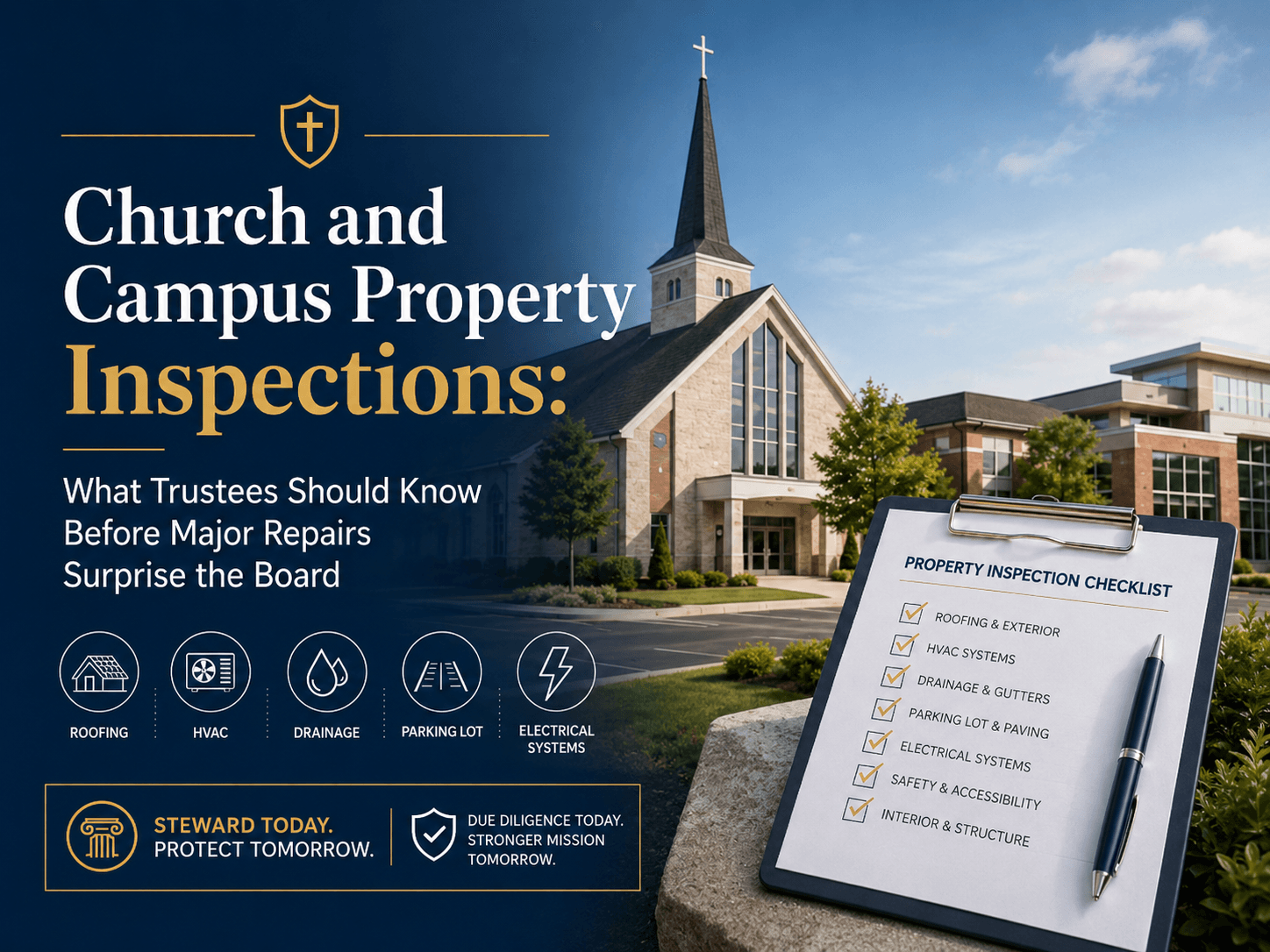
At Upchurch Inspection, we view church and campus property inspections as a form of practical risk management. The goal is not to scare a board away from a property. The goal is to help the people responsible for the decision understand the condition of the buildings, the visible risks, the limitations, and the areas where further evaluation may be needed before committing significant funds.
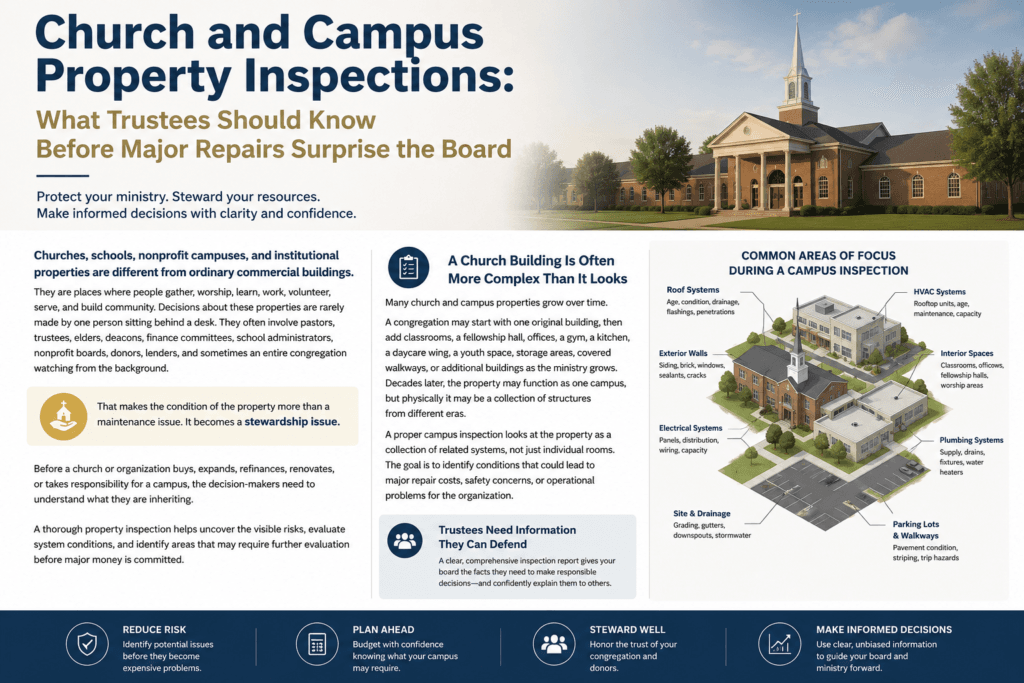
A Church Building Is Often More Complex Than It Looks
Many church and campus properties grow over time.
A congregation may start with one original building, then add classrooms, a fellowship hall, offices, a gym, a kitchen, a daycare wing, a youth space, storage areas, covered walkways, or additional buildings as the ministry grows. Decades later, the property may function as one campus, but physically it may be a collection of structures from different eras.
That matters.
Different sections may have different foundations, roof systems, electrical panels, plumbing lines, HVAC equipment, insulation levels, drainage conditions, and maintenance histories. One wing may have been renovated recently, while another area has not been meaningfully updated in years. The sanctuary may receive the most attention, while storage rooms, mechanical spaces, kitchens, crawlspaces, attics, and older classroom areas reveal a very different story.
A casual walkthrough can miss that.
A proper campus inspection should look at the property as a collection of related systems. The question is not only whether each room looks usable. The larger question is whether the campus has physical conditions that could create major repair costs, safety concerns, maintenance priorities, or operational problems for the organization.
Church leaders do not need vague reassurance.
They need clarity.
Trustees Need Information They Can Defend
A church trustee or board member has a different burden than a typical private buyer.
They often make decisions on behalf of other people. The money may come from donations, tithes, grants, financing, fundraising campaigns, or long-term reserves. When the building needs a major repair after the purchase, the board has to explain that decision to real people who trusted them to be careful.
That is why documentation matters.
A board does not just need someone to say, “The building looks okay.” It needs a report that explains what was observed, what systems may be aging, what concerns were visible, what limitations existed, and which areas should be evaluated further before the organization moves forward.
This is especially important when the property involves large expenses. Roof replacement, HVAC replacement, parking lot repair, drainage correction, electrical upgrades, plumbing work, and life-safety improvements can quickly become board-level issues.
A good inspection report gives trustees something more useful than a list of defects. It gives them a decision-making document.
It helps the board understand what the property may require after closing or after assuming responsibility for the facility. It also helps separate urgent concerns from routine maintenance, and major capital risks from smaller repair items.
That distinction matters when multiple people are trying to make a responsible decision.
The Roof Is Usually One of the Biggest Questions
Church and campus properties often have complicated roof systems.
A sanctuary may have a steep roof. An education wing may have a low-slope roof. A fellowship hall may have a different roof covering entirely. Additions may have been tied into the original building over time. There may be parapet walls, gutters, internal drains, scuppers, roof valleys, flashing transitions, skylights, mechanical penetrations, and rooftop HVAC equipment.
The roof may not be leaking during the inspection, but that does not mean it is low risk.
Church roofs are often large, expensive, and difficult to evaluate from the ground. A small leak in one area can affect ceilings, insulation, framing, electrical components, interior finishes, classrooms, offices, or worship spaces. Low-slope sections can hold water. Gutters and downspouts can become overwhelmed or poorly maintained. Flashing transitions between old and new additions can become problem areas.
For trustees, the roof question is not simply, “Is it leaking today?”
The better question is:
How much roof risk are we accepting, and what could this cost us over the next several years?
That is the kind of question a campus inspection should help answer. If visible conditions suggest the roof is aged, poorly drained, patched, deteriorated, or near the end of its useful life, the board may need a commercial roofing contractor to provide further evaluation and pricing before a major decision is made.
That is not overkill. That is responsible due diligence.
Multiple HVAC Systems Can Become a Capital Planning Problem
Churches and institutional buildings often have more HVAC equipment than people realize.
A sanctuary may have one or more large systems. Classrooms may be served by separate units. Offices may have their own equipment. A gym, fellowship hall, kitchen, daycare wing, or older addition may each have separate mechanical systems. Some campuses have a mixture of rooftop units, split systems, package units, wall units, boilers, or older equipment from different eras.
That creates a capital planning issue.
One older HVAC system may be manageable. Several aging systems across multiple buildings can become a major financial concern. If the units are all old, poorly maintained, undocumented, or visibly deteriorated, the board may be looking at years of expensive mechanical work.
The problem is that HVAC systems can still run while carrying a significant risk.
A unit may heat or cool during a walkthrough and still be near the end of its practical life. A rooftop unit may operate but show corrosion, damaged insulation, poor service access, dirty coils, condensate problems, or evidence of repeated repairs. A system may be functional under mild conditions but struggle during full occupancy or extreme weather.
For a church, HVAC problems are not just comfort issues.
They can affect worship services, classrooms, daycare operations, community events, office work, tenant use, and building humidity. A sanctuary full of people places different demands on a system than an empty room during a weekday tour. A fellowship hall used for events may perform differently under real occupancy. A daycare or school wing may require more consistent comfort than a storage area.
A board should know whether the mechanical systems appear stable, aging, neglected, or likely to require specialist evaluation before the organization commits to the property.
Kitchens, Classrooms, and Fellowship Halls Add Risk
Church and campus buildings often include spaces that are more complicated than they appear.
A commercial or semi-commercial kitchen may include plumbing, electrical, ventilation, gas piping, appliances, grease-related concerns, floor drains, and heavy-use surfaces. Even when the kitchen is not a full restaurant kitchen, it may still carry maintenance and safety concerns.
Classrooms and daycare areas bring another layer of responsibility. These spaces are used by children, teachers, volunteers, and families. Flooring, exits, electrical safety, restrooms, HVAC performance, windows, stairs, handrails, guards, and general maintenance all matter more when the building is used by the public or by children.
Fellowship halls and large assembly spaces can also create unique concerns. Large open rooms may have wide-span framing, large HVAC loads, exit considerations, ceiling systems, lighting, restrooms, storage areas, and heavy use during events.
These spaces should not be treated like ordinary rooms.
They are part of the organization’s daily function. If they fail, the problem is not only the repair cost. It may affect ministry, school operations, events, rental income, outreach programs, or public use.
Electrical Systems Often Reflect the History of the Campus
Electrical systems in church buildings can tell the story of decades of growth.
An older sanctuary may have been wired for the needs of a very different time. Later additions may have added classrooms, lighting, sound systems, offices, projectors, kitchen equipment, HVAC units, security systems, exterior lighting, and technology. Over time, panels may have been added, circuits modified, labels lost, and repairs made by different people with different skill levels.
That does not automatically mean the system is unsafe.
But it does mean the electrical system deserves careful attention.
Visible concerns may include aging panels, poor labeling, missing covers, open junction boxes, exposed wiring, amateur modifications, overloaded-looking conditions, damaged exterior outlets, unsafe extension cord use, lighting problems, improper wiring in storage or mechanical areas, and electrical concerns near HVAC equipment or kitchens.
For boards, electrical findings can matter because they affect safety, future renovations, insurance questions, and whether the building supports the intended use.
A church planning to add classrooms, expand a kitchen, install new media systems, lease space, operate a daycare, or renovate a fellowship hall should not assume the existing electrical system is adequate without further review.
A general inspection can identify visible concerns. If capacity, design, or future use is a major issue, a licensed electrical contractor or engineer may need to evaluate the system before the board proceeds.
Plumbing Problems Can Be Hidden Until the Building Is Busy
Church plumbing systems can be tricky because usage is often irregular.
A building may be lightly used during the week, then heavily used during services, events, school activities, or community programs. Restrooms, kitchens, water heaters, janitorial sinks, laundry areas, and older plumbing lines may perform differently under real demand than during a quiet walkthrough.
A restroom that seems functional during inspection may still be part of an aging system. A kitchen sink may drain slowly. A water heater may be old. A toilet may be loose. A cabinet base may show staining. A ceiling tile may show an old leak below an upstairs restroom. A crawlspace may reveal moisture conditions that are not obvious inside the building.
The concern is not always one leak.
The concern is whether the plumbing system shows signs of long-term patching, deferred maintenance, or repeated water-related issues.
For a board, plumbing concerns can become disruptive quickly. A failed water heater, restroom issue, sewer backup, or kitchen plumbing problem can affect services, events, childcare, rentals, and daily operations.
A campus inspection should help identify visible plumbing concerns and determine whether further evaluation, sewer scoping, or plumbing contractor review may be needed.
Drainage and Site Conditions Should Not Be Ignored
Church and campus properties often include large roof areas, parking lots, sidewalks, drives, lawns, playgrounds, retaining walls, exterior stairs, ramps, and multiple building entrances.
All of that site area has to manage water.
In the Mid-South, water management is a major issue. Heavy rain, clay soils, poor grading, clogged gutters, short downspouts, failed pavement, and inadequate stormwater control can create long-term problems. Water may move toward buildings, collect near foundations, wash out soil, pond in parking areas, enter crawlspaces, or contribute to exterior deterioration.
A board may not consider drainage a major concern during a tour, especially if the weather is dry. But drainage problems are often some of the most important conditions on the property.
Water affects buildings slowly. It can damage foundations, slabs, crawlspaces, framing, siding, masonry, pavement, walkways, and interior finishes. It can also create slip hazards, access issues, and recurring maintenance problems.
Parking lots deserve the same attention. Cracked asphalt, settlement, potholes, ponding water, failed patching, damaged curbs, poor striping, uneven sidewalks, and trip hazards can all affect cost and liability.
A parking lot that works today may still be approaching a major repair cycle.
For churches and schools, that matters because the site is used by families, children, elderly members, visitors, volunteers, and the public. Exterior conditions are not just cosmetic. They affect access, safety, and long-term maintenance planning.
Life Safety Observations Matter in Assembly and Institutional Buildings
Churches and campus properties are often assembly spaces.
That alone makes visible life safety concerns important.
A general commercial inspection is not a fire marshal inspection, code compliance inspection, or full life-safety audit. However, visible safety-related concerns should still be documented. Stairs, handrails, guards, emergency lighting, exit signage, electrical hazards, smoke alarms, carbon monoxide alarms where applicable, exterior walking surfaces, trip hazards, and obvious fire separation concerns can all matter.
This is especially true when the property includes classrooms, childcare areas, public gathering spaces, kitchens, or sleeping areas.
A board should not ignore these concerns just because the building has been used for years. Longstanding use does not always mean current conditions are appropriate for future use. Buildings change. Standards change. Occupancy changes. Maintenance conditions change.
When visible safety concerns are found, the right recommendation may be further evaluation by a qualified contractor, fire protection professional, design professional, or local authority having jurisdiction.
The report should be clear about the scope of the inspection. It should not claim to perform a full code or ADA compliance review unless that is specifically part of a separate service. But it should still identify visible concerns that could affect safety, operation, or future planning.
Accessibility-Related Conditions Should Be Handled Carefully
Accessibility is another area where church and campus properties need careful language and practical attention.
A commercial inspection is not automatically a formal ADA compliance audit. That type of review is a separate service and may require a specialist familiar with accessibility standards, design requirements, and local enforcement.
Still, visible accessibility-related conditions may matter to a board.
Exterior routes, ramps, parking areas, entrances, doorways, restrooms, stairs, handrails, floor level changes, and public gathering areas can affect how people use the property. If the organization serves the public, hosts events, operates a school or daycare, or invites community use, accessibility-related limitations may become part of renovation planning and risk management.
The inspection report should not overpromise. But it can note visible conditions and recommend further evaluation when accessibility concerns may be material to the organization’s intended use.
That is a practical way to handle the issue without turning a general inspection into something it is not.
Deferred Maintenance Is Common in Mission-Driven Properties
Many churches and nonprofits operate with limited budgets.
That often means maintenance gets delayed.
The roof repair waits. The HVAC unit gets one more service call instead of replacement. The parking lot is patched instead of resurfaced. The gutter issue is ignored. The old panel stays in service. The plumbing leak is fixed just enough to keep the restroom open. The exterior paint and sealant wait another year. The classroom ceiling stain is replaced, but the source is never fully addressed.
That kind of deferred maintenance is understandable.
But it still has consequences.
When an organization buys or takes over a property, it may inherit years of delayed decisions. The building may look usable, but the inspection may reveal that several systems are near the point where delay is no longer cheap.
This is where a campus inspection becomes valuable. It helps the board determine whether the property has normal maintenance needs or multiple systems have been pushed beyond a reasonable planning horizon.
A board can handle bad news if it knows it before making the decision.
What hurts organizations is the surprise repair that appears after the closing, the capital campaign, the loan, or the move.
The Inspection Should Help Prioritize
A church or campus inspection should not leave the board buried in a pile of unrelated defects.
The report should help decision-makers understand priorities.
Some items may be safety-related. Some may be immediate repair concerns. Some may require specialist evaluation. Some may be capital planning issues. Some may be routine maintenance. Some may simply need monitoring.
That distinction matters because boards often have to make phased decisions.
They may not be able to fix everything at once. They may need to decide what affects safety, occupancy, water intrusion, and mechanical reliability, and what can be planned over time.
A useful inspection report helps organize that conversation.
It does not just say, “Here are fifty problems.”
It helps the board understand which problems may matter most.
The Report Should Be Written for People Who Were Not There
This is especially important for churches and institutional properties.
The person who attends the inspection may not be the final decision-maker. The report may be reviewed by trustees, pastors, finance committees, donors, lenders, attorneys, insurance representatives, facility managers, or board members who have never walked the building.
That means the report needs to stand on its own.
It should clearly explain the findings, include photos, describe limitations, identify major concerns, and recommend further evaluation where appropriate. It should be written in a way that non-technical decision-makers can understand without watering down the seriousness of major issues.
A report that is too vague does not help the board. A report that is too alarmist can create unnecessary panic. A purely checklist-based report may miss the story of the building.
For church and campus properties, narrative matters.
The board needs context, not just defect labels.
Specialist Evaluation May Be Necessary
A good commercial inspection should identify when a specialist needs to be involved.
For church and campus properties, that may include a commercial roofing contractor, HVAC contractor, electrician, plumber, structural engineer, sewer camera provider, fire protection contractor, elevator contractor, environmental consultant, or accessibility specialist, depending on the property.
This is not a weakness in the inspection process.
It is how commercial due diligence works.
A general commercial inspection can document visible conditions and help identify risk. But some systems require specialized testing, design knowledge, licensing, or pricing. If the roof appears aged or damaged, a roofing contractor may need to provide a repair or replacement estimate. If multiple HVAC systems are near the end of their service life, an HVAC contractor may need to evaluate performance and replacement options. If structural movement is suspected, an engineer may be needed.
The purpose of the inspection is not to pretend that one person can answer every specialized question.
The purpose is to ensure the board knows which questions need to be answered before major funds are committed.
A church board does not just need to know whether the building has defects. It needs to understand what major repairs may be coming, what should be prioritized, and what risks the organization may inherit.
-Wes Upchurch, Upchurch Inspection
Church Property Decisions Should Be Made With Clear Eyes
No building is perfect.
Older churches and campuses almost always have defects. That does not mean the property is a bad choice. A building with roof concerns, aging HVAC systems, drainage problems, or deferred maintenance may still be the right property if the organization understands the cost and has a plan.
The problem is not buying a building with issues.
The problem is buying a building without understanding the issues.
A board can make responsible decisions when it has clear information. It can negotiate, budget, phase repairs, raise funds, seek grants, bring in contractors, prioritize safety, or decide that the property is not the right fit.
But it needs the information before the decision is locked in.
That is why a church or campus inspection should be treated as part of stewardship, not just due diligence.
The board is not only protecting the building. It is protecting the organization’s resources, mission, and people.
Final Thoughts
Church and campus properties deserve a thorough inspection because they carry significant responsibility.
These buildings are often large, complex, older, heavily used, and maintained under budget pressure. They may include multiple additions, roof systems, HVAC units, classrooms, kitchens, offices, assembly spaces, parking lots, drainage concerns, life safety issues, and deferred maintenance that has built up over the years.
A standard walkthrough is not enough.
Trustees and boards need clear documentation of visible conditions, major risks, limitations, and recommended next steps. They need to understand which repairs may be urgent, which systems may require specialist evaluation, and which capital expenses may be pending after the decision is made.
A church inspection is not about finding reasons to say no.
It is about helping responsible people say yes with clear eyes — or recognize when the risk is too great.
Before a church, school, nonprofit, or institutional board commits to a property, it should understand what the buildings are really saying.
Because once the decision is made, the repairs become part of the mission budget.
Need a Church or Campus Property Inspection?
Upchurch Inspection provides commercial property inspections and Property Condition Assessments for churches, campuses, schools, nonprofit facilities, institutional properties, and other commercial buildings throughout the Mid-South.
We help trustees, pastors, boards, buyers, lenders, and facility decision-makers understand visible building conditions, deferred maintenance, major system risks, and practical next steps before committing organizational resources.
For churches, schools, campuses, fellowship halls, education wings, offices, kitchens, sanctuaries, and multi-building properties, we can help determine the appropriate inspection scope for the decision at hand.
To discuss a church or campus property inspection, contact Upchurch Inspection.