
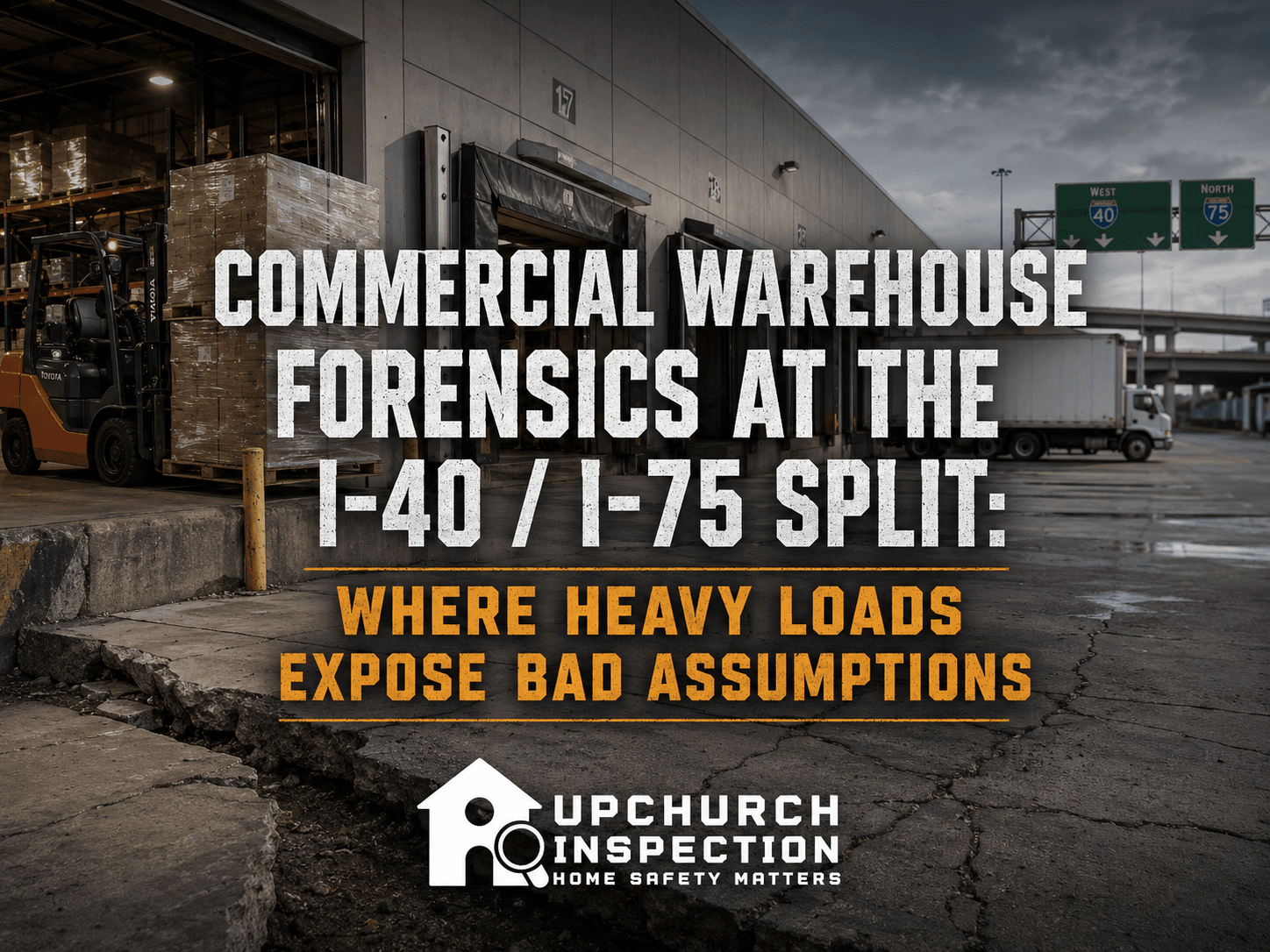
Warehouses around the I-40 / I-75 split look tough. Tilt-up panels. Big bay doors. Acres of concrete. From the outside, they project durability — the kind that makes buyers assume there’s nothing to worry about beyond roof age and lease terms.
That confidence is usually misplaced.
Warehouses don’t fail because they’re flimsy. They fail because someone assumed yesterday’s use would match tomorrow’s load. Around the Strawberry Plains corridor and the Farragut industrial areas, I see the same issues repeat: slabs that were never designed for current traffic, doors that have been abused beyond spec, and buildings quietly overstressed by what’s moving through them now.
Floor Slabs Are the Deal — Everything Else Is Noise
If I had to boil warehouse inspections down to one sentence, it would be this: the slab matters more than anything else.
Warehouses live and die by their floors. Forklifts, pallet jacks, racking systems, and loaded trailers don’t care how new the paint looks. They care whether the concrete can take the punishment.
What I’m evaluating isn’t just cracks. It’s:
- Joint condition and differential displacement
- Evidence of slab curling or edge failure
- Spalling at high-traffic paths
- Repairs that suggest chronic overload
A slab can “look fine” and still be functionally compromised for modern logistics use.
Heavy Loads Change the Rules
A warehouse built twenty years ago may have been designed for light distribution or storage. That doesn’t mean it’s ready for today’s traffic patterns.
Common red flags I see:
- Narrow aisle racking added without slab verification
- Heavier forklifts than the slab was designed for
- Concentrated loads where equipment parks repeatedly
Concrete doesn’t complain loudly. It fails incrementally. And once load paths are compromised, fixes get expensive fast.
Bay Doors Take More Abuse Than People Admit
High-traffic bay doors are another quiet failure point. At logistics hubs, doors cycle constantly. Tracks get hit. Motors get overworked. Frames loosen.
During inspections, I’m looking for:
- Bent tracks and misaligned rollers
- Impact damage at jambs
- Door seals that no longer seal
When doors don’t close cleanly, you get air loss, water intrusion, and accelerated wear on HVAC systems. It’s not glamorous — but it’s operationally expensive.
Drainage Inside the Building Matters Too
Interior trench drains, floor drains, and exterior aprons around loading docks are critical in high-throughput warehouses. When drainage is undersized or poorly maintained, water finds its way where it shouldn’t.
I see:
- Standing water near dock edges
- Efflorescence along interior walls
- Slab deterioration at drain inlets
Those are signs the building wasn’t designed — or maintained — for the volume it’s seeing now.
Roofs Feel the Equipment Weight
Warehouses attract rooftop equipment over time. Units get added. Solar arrays show up. Exhaust systems get modified. Every addition changes load and drainage behavior.
I pay close attention to:
- Ponding around new penetrations
- Structural deflection below equipment
- Flashing details that were never updated
Roofs don’t fail because they’re old. They fail because they were asked to do more than they were designed for.
Electrical Systems Age Under Load
High-throughput warehouses chew through electrical infrastructure. Motors, chargers, conveyors, and automation all draw current differently than basic lighting and office use.
What concerns me:
- Overheated conductors under load
- Panels that have grown without being re-engineered
- Grounding systems that haven’t kept up with expansion
Electrical systems rarely announce failure in advance. They show heat, imbalance, and wear — if you bother to look.
Structural Steel Doesn’t Like Moisture Either
Warehouses feel dry. They aren’t always. Condensation, roof leaks, and poor ventilation take their toll on steel over time.
I’m watching for:
- Corrosion at column bases
- Rusted connections at roof framing
- Evidence of long-term condensation
Once corrosion starts, capacity drops quietly. And repairs don’t happen during business hours.
Why Logistics Corridors Expose Weakness Faster
The I-40 / I-75 split moves volume. That volume magnifies every shortcut, every assumption, every “it’s probably fine.”
Buildings here don’t get the luxury of aging slowly. They get stress-tested daily.
The Mistake Buyers Make
Buyers focus on square footage and dock count. They assume industrial equals indestructible. It doesn’t.
Warehouses are machines. Machines wear out faster when you run them harder than intended.
Why Commercial Inspections Have to Be Blunt
This isn’t a place for optimism. If the slab can’t handle the load, the deal doesn’t work. If the doors are failing, operations suffer. If the roof or electrical systems are marginal, downtime becomes inevitable.
I don’t inspect warehouses to admire them. I inspect them to see what they’ll look like after five more years of abuse.
For buyers evaluating industrial properties across East Tennessee, understanding load history and future use is non-negotiable.
https://upchurchinspection.com/our-service-areas/home-inspections-in-east-tennessee/
Around the I-40 / I-75 split, the buildings that survive aren’t the prettiest.
They’re the ones that were built — and maintained — for the work they’re actually doing.