
I get why people hesitate on inspections in Farragut. I really do.
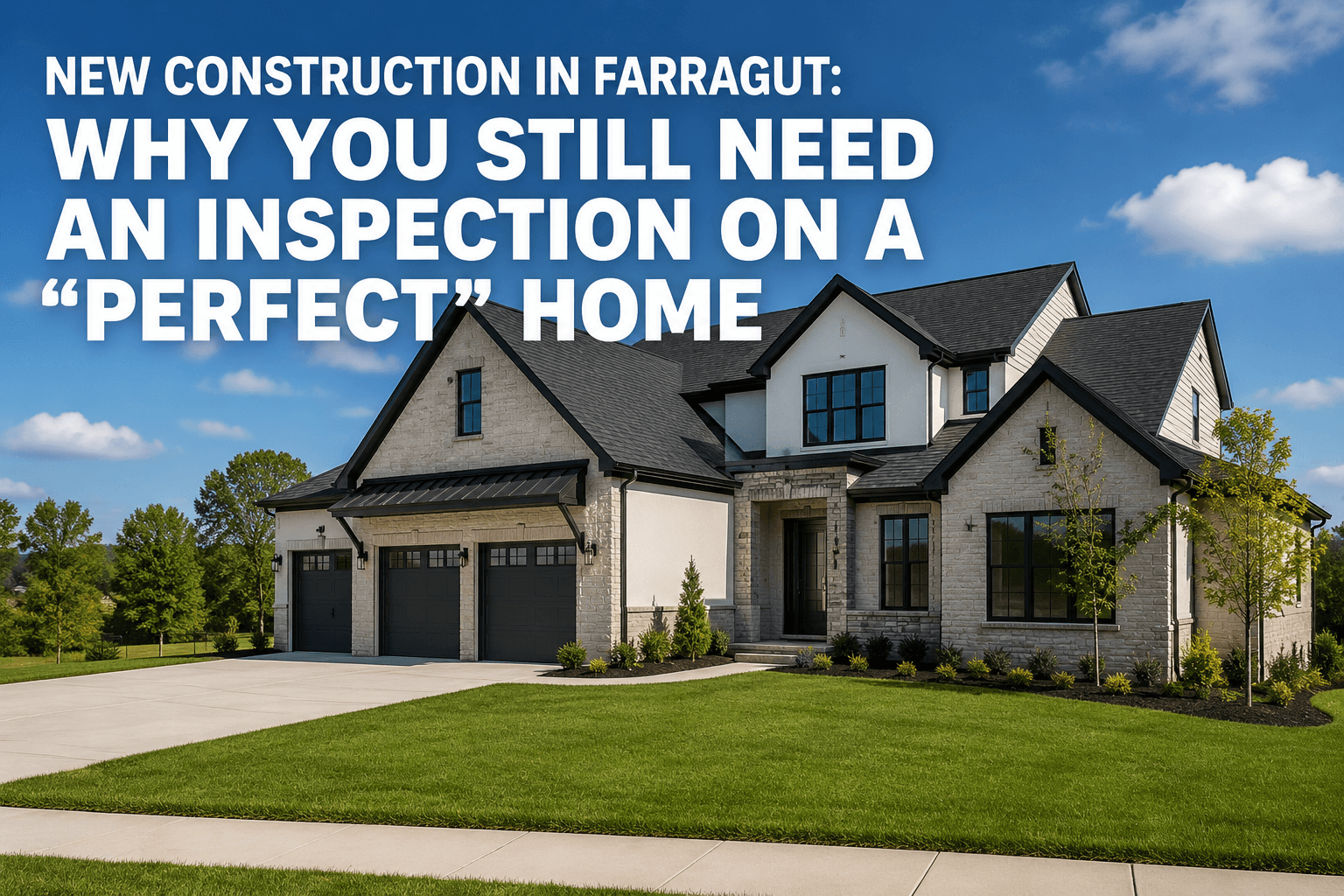
When our Knoxville inspector sends me a report from Farragut, the photos usually start the same way: clean siding, sharp brick lines, tidy landscaping, roofs that still smell new. These houses look done. They feel done. And buyers walk through thinking, What could possibly be wrong with this place?
That mindset is exactly why new construction inspections matter here.
Because the problems we find in Farragut aren’t about neglect. They’re about speed, coordination, and assumptions—and none of those show up on a glossy listing.
“It Passed All the City Inspections” — Yeah, That’s Not the Same Thing
This is where I usually stop people and reset expectations.
Municipal inspections exist to verify minimum code compliance at specific moments. They do not verify workmanship. They do not verify performance. And they definitely do not verify that every trade communicated with the next one.
Our Knoxville inspector has reviewed brand-new Farragut homes that passed every required inspection and still had:
- Improperly installed flashing
- Missing fire blocking
- HVAC ducts crushed or disconnected
- Drainage sloping toward the foundation
- Roof penetrations sealed… poorly
Nothing illegal. Nothing dramatic. Just stuff that will become your problem once the builder’s truck leaves the neighborhood.
Farragut Builds Fast — That’s the Risk
Farragut is one of the most competitive new-construction markets in East Tennessee. Builders are moving inventory quickly, and houses often go from slab to closing in a blur.
Speed isn’t evil. But speed creates pressure.
Our inspector has told me more than once, “You can feel when a house was built on a schedule.” Trades overlap. Corrections get deferred. Someone assumes the next crew will handle it.
Sometimes they don’t.
Foundations: New Doesn’t Mean Settled
One of the biggest misconceptions buyers have is that foundation issues take decades to show up. In reality, a lot of foundation-related problems are born during construction.
Farragut homes are often built on cut-and-fill lots. Soil is moved. Pads are created. Grades are shaped quickly. If compaction isn’t consistent—or drainage isn’t thought through—movement starts early.
Our inspector frequently documents:
- Hairline slab cracking that reflects soil shrinkage
- Exterior grading that looks good visually but slopes the wrong way
- Downspouts dumping water at foundation corners
- Soil separation along slab edges within the first year
None of that means the house is “bad.” It means the house is still settling into the ground it was rushed onto.
That’s when inspections matter most.
Roofs: Brand New Doesn’t Mean Properly Done
I’ve reviewed a surprising number of Farragut reports where the roof was technically new—and still wrong.
Not catastrophic. Just wrong in the ways that matter long-term.
Common findings include:
- Improper flashing at roof-to-wall transitions
- Nail pops already telegraphing through shingles
- Valley flashing installed tight, not layered
- Exhaust vents cut in after shingles were installed
These are the kinds of defects that don’t leak on day one. They leak on year three, right after the builder warranty ends.
Our inspector isn’t looking for missing shingles. He’s looking for how water will behave once gravity and time get involved.
Attics: Where New Construction Tells the Truth
If you want to know how carefully a Farragut home was built, look in the attic.
That’s where:
- Fire blocking gets skipped
- Insulation gets rushed
- Ductwork gets compromised
- Air sealing gets “value engineered”
Our inspector routinely finds attic insulation that looks thick but is installed unevenly, with voids at eaves and compression over duct runs. R-values on paper don’t mean much if air is bypassing them.
One report that stuck with me involved a brand-new home with great insulation depth—but zero air sealing at attic penetrations. The homeowner complained about humidity swings. The HVAC wasn’t the problem. The attic was acting like a chimney.
HVAC: Sized Right, Installed… Maybe
New construction HVAC issues in Farragut aren’t usually about undersized equipment. They’re about airflow and balance.
Our inspector has documented:
- Supply-heavy rooms with no returns
- Bedrooms relying on door undercuts for airflow
- Dampers left closed or never adjusted
- Ducts pinched to fit framing conflicts
On paper, the system was perfect. In practice, rooms didn’t cool evenly, humidity stayed high, and comfort complaints started immediately.
That’s not a defect you notice on a walkthrough. It shows up after the first Tennessee summer.
Plumbing: The Leaks You Don’t See Yet
New plumbing doesn’t leak because it’s old. It leaks because it was installed under pressure.
Our Knoxville inspector frequently finds:
- Loose P-traps
- Improperly supported drain lines
- Shower pans that weren’t tested long enough
- Nail plates missing at stud penetrations
I’ve reviewed reports where moisture readings were elevated behind brand-new tile. No stains. No smells. Just water doing what water does when nobody’s looking.
These are exactly the issues inspections catch early—when they’re still builder fixes instead of homeowner repairs.
Electrical: Clean Panels Hide Messy Paths
Farragut homes usually have beautiful electrical panels. Labeled. Neat. Plenty of capacity.
That’s the easy part.
Our inspector often finds:
- Crowded junction boxes
- Loose staples damaging cable sheathing
- Shared neutrals where they shouldn’t be
- Exterior circuits tied into interior runs
Again, nothing dramatic. Just shortcuts that don’t age well.
Electrical systems don’t forgive sloppiness. They tolerate it… until they don’t.
Drainage: Where “Pretty” Landscaping Lies
Fresh sod hides a lot.
I can’t tell you how many Farragut inspection reports include the phrase, “Grading appears finished but does not slope away from the foundation.”
New landscaping is designed to look good on closing day—not necessarily to move water effectively long-term.
Our inspector pays close attention to:
- Swales that dead-end
- Mulch piled against siding
- Hardscapes sloped toward the house
- Drainage paths interrupted by decorative features
In Farragut, heavy rains don’t ask permission. Water will find the low point. The question is whether the builder planned for it.
The “Builder Warranty” False Comfort
I hear this all the time:
“If anything’s wrong, the builder will fix it.”
Maybe. Sometimes.
But builder warranties usually require:
- Documentation
- Timely reporting
- Proof that the issue exists
- Proof it wasn’t homeowner-caused
An inspection gives you leverage. It gives you a baseline. It gives you a written record before the house becomes “used.”
Without that, you’re negotiating blind.
Why Pre-Drywall and Final Inspections Matter Most Here
If I could force one thing into every Farragut buyer’s process, it would be phase inspections.
Pre-drywall inspections catch:
- Framing issues
- Improper penetrations
- Missing fire blocking
- Rough-in mistakes
Final inspections catch:
- Finish defects that affect performance
- Drainage and grading issues
- HVAC balance problems
- Water management failures
Our Knoxville inspector has caught things at pre-drywall that would’ve been impossible to fix cleanly later.
Once drywall goes up, mistakes get expensive—or permanent.
Farragut Is Built for Growth, Not Forgiveness
Driving through areas near Turkey Creek, you can feel how fast this area is moving. New homes. New roads. New infrastructure.
That growth creates opportunity—but it also creates pressure on trades, schedules, and oversight.
A house can be new and still be wrong. Not dangerously wrong. Just wrong enough to cost you time, comfort, and money later.
The Wes Take
I like Farragut homes. They’re attractive, functional, and built for modern living.
But “new” is not a quality guarantee. It’s a starting point.
When I review Farragut inspection reports from our Knoxville inspector, the best ones don’t nitpick cosmetic issues. They focus on how the house was assembled, not how it photographs.
An inspection on a new home isn’t about distrust. It’s about verification.
Because once you move in, the builder moves on—and the house becomes yours in every sense of the word.
That’s when you want to already know what you’re living with.