

A wind mitigation inspection report is your home's report card for hurricane readiness. It’s a specialized assessment that details the specific features your home has to resist wind damage.
This isn't just about safety—it's a powerful financial tool. A licensed inspector performs the assessment and provides the official proof insurance companies need to give you significant discounts on your premium, especially in storm-prone areas.
Unlocking Insurance Savings with a Wind Mitigation Report
Think of a standard home inspection as a general health checkup for your house, covering everything from plumbing to the electrical system. A wind mitigation inspection report, on the other hand, is like a visit to a specialist. It focuses intensely on one critical area: how well your home can stand up to the immense force of high winds from a hurricane or severe storm.
This isn't just for peace of mind; it's a direct path to saving money. The report documents key structural and protective features that insurance companies value because they reduce the risk of catastrophic damage. When your home has these elements, your insurer sees you as a lower risk and rewards you with credits that can dramatically lower your annual premium.
The process is simple. A certified inspector examines specific parts of your home's construction and records their findings on a standardized form. That official report becomes the key that unlocks those potential discounts.
Why This Report Matters to Your Wallet
For most homeowners, the biggest motivator is the chance for a substantial drop in insurance costs. The report serves as verifiable proof of your home's wind-resistant features, which insurers are often required by state law to reward with discounts. The core components evaluated include:
- Roof Geometry: The shape of your roof plays a huge part in how it handles wind. Hip roofs, for example, tend to perform better than gable roofs.
- Roof-to-Wall Connections: This looks at how securely your roof is attached to the walls. Are there just toenails, or are there stronger hurricane clips or straps?
- Opening Protection: This is all about your windows, doors, and garage doors. Are they rated to withstand impacts from windborne debris?
- Secondary Water Resistance: Think of this as a backup plan. It's an extra layer of protection under your roof covering that can prevent major water intrusion if shingles get blown off.
Each of these elements adds to your home's overall resilience. It makes sense, right? A home with a hip roof, strong hurricane clips, and impact-rated windows will fare much better in a storm than one without them.
Before we dive deeper, it's helpful to see the big picture. The benefits of a wind mitigation inspection go beyond just a single discount.
Key Benefits of a Wind Mitigation Inspection
| Benefit Category | Description | Potential Impact |
|---|---|---|
| Insurance Premium Reduction | Provides documented proof of wind-resistant features, qualifying you for state-mandated insurance credits. | Can result in hundreds or even thousands of dollars in annual savings on your homeowner's insurance policy. |
| Enhanced Home Safety | Identifies potential weak points in your home's construction that could fail during a high-wind event. | Allows you to make targeted improvements that better protect your property and family during a hurricane. |
| Increased Property Value | A home with documented storm-resistant features is more attractive to buyers in coastal or storm-prone regions. | Can be a strong selling point, potentially increasing your home's market value and appeal. |
| Informed Decision-Making | The report gives you a clear, objective assessment of your home's ability to withstand storms. | Empowers you to prioritize repairs and upgrades, ensuring you invest in the most effective protective measures. |
As you can see, this inspection is a strategic move that pays off in multiple ways—protecting your wallet, your property, and your peace of mind.
A Powerful Tool for Homeowners
Ultimately, the wind mitigation inspection report empowers you as a homeowner. It's not just a piece of paper; it's a strategic asset. The financial impact is well-documented. Insurance risk models have shown that nearly 99% of homes can qualify for some level of mitigation credit, which shows just how many people can benefit.
Since it isn't practical for insurers to inspect every single property themselves, these homeowner-initiated inspections are the primary way to access these valuable credits. You can learn more about the data behind these discounts by reviewing the full study on Florida windstorm mitigation credits.
By obtaining a wind mitigation report, you are taking a proactive step to not only protect your property but also to actively manage and reduce one of your most significant homeownership costs.
This report puts you in control. It provides the necessary documentation to ensure you get the discounts you deserve, turning your home's sturdy construction into tangible, year-after-year savings.
Decoding Each Section of Your Report
At first glance, a wind mitigation report can look pretty technical. But it’s best to think of it as a story about your home's strength, told in seven distinct chapters. Each chapter details a specific feature that adds to its hurricane readiness. Once you understand what the inspector is looking for, you can read your own report with confidence and see exactly where your home shines.
The whole process is standardized on an official form, known in Florida as the OIR-B1-1802. This consistency is key—it ensures every insurance company gets the same clear information. Each checkbox and photo serves as hard evidence of your home's wind-resistant features, which can translate directly into real savings for you.
This diagram gives a simple overview of the who, what, and why of the whole process.
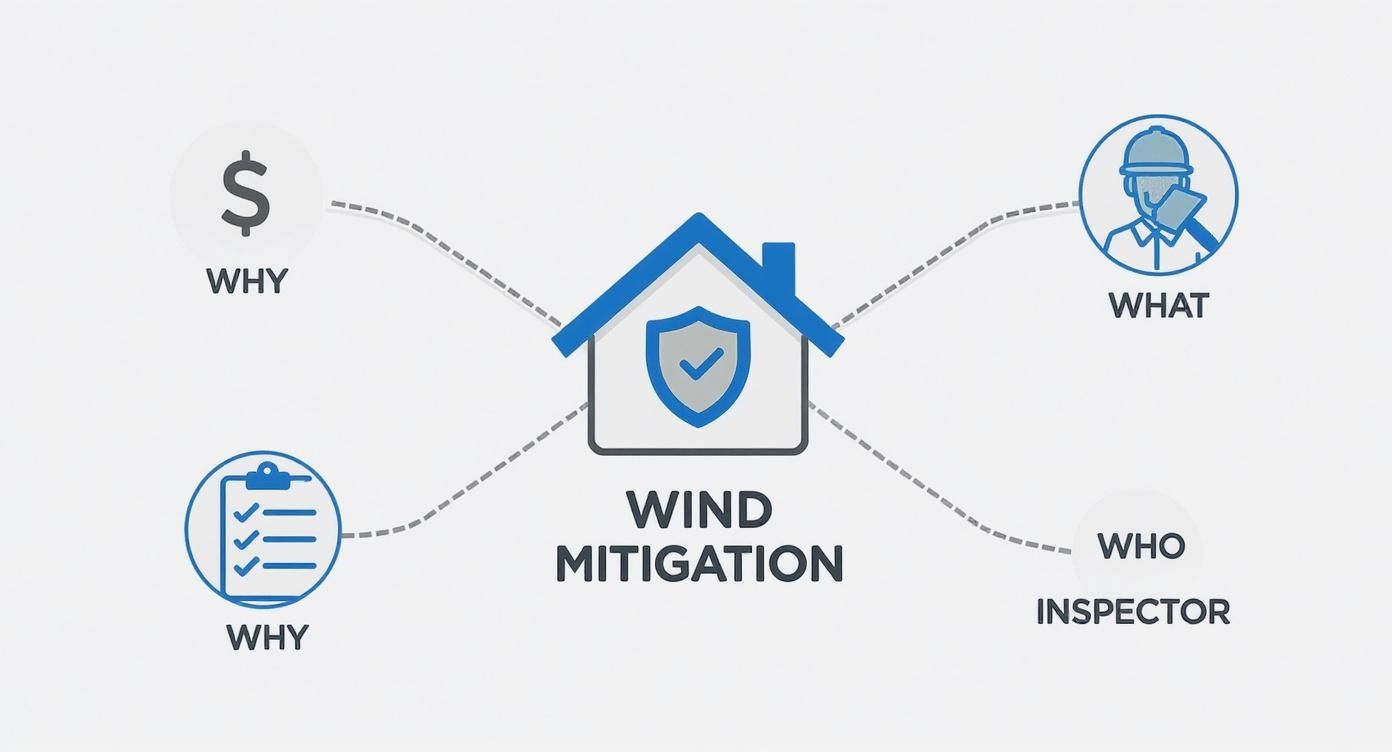
As you can see, it's a straightforward cycle: a certified pro assesses specific parts of your home to help you qualify for some well-deserved financial benefits.
Roof Covering and Installation Date
The first chapter of your report zooms in on the outermost layer of defense: your roof covering. This section documents the material—shingles, tiles, metal, you name it—and, crucially, its installation date. Insurers are very interested in the age of your roof because newer materials installed to modern building codes perform significantly better in a storm.
For instance, modern shingles with a high-wind rating are built to handle uplift forces that would easily rip older, standard shingles away. The inspector will be on the lookout for permits and other documents to verify the roof’s age, since a roof replaced after key building code updates often earns a substantial credit.
Roof Deck Attachment
Next, we go a layer deeper to see how the roof deck is attached to the trusses. The roof deck is the plywood or OSB sheeting that forms the base of your roof, and how it’s fastened down is a critical detail for structural stability. Think of it like the stitching on a heavy-duty jacket; the quality of that connection is everything.
The report will note two things here:
- Nail Type: The size and type of nails used to secure the decking.
- Nailing Pattern: How far apart the nails are spaced. Closer spacing, like every 6 inches, creates a much stronger bond than wider patterns.
A securely attached roof deck is far less likely to get peeled back by intense winds, which prevents catastrophic failure and the massive water intrusion that always follows.
Roof to Wall Attachment
This section is one of the heavy hitters when it comes to securing insurance discounts. It’s all about how your roof structure is physically anchored to the walls of your home. If you were trying to hold down a tent in a storm, you’d want strong stakes, not flimsy pegs. It’s the exact same principle.
Up in the attic, the inspector is looking for specific hardware:
- Toe Nails: The weakest link. This is where nails are just driven at an angle through the truss and into the top of the wall.
- Clips: These are small metal connectors that create a much stronger connection than toe nails alone.
- Single Wraps: Metal straps that go over the top of the truss and are secured to the wall on one side.
- Double Wraps: The gold standard. These straps wrap completely over the truss and are fastened to the wall on both sides, providing the strongest connection.
The presence of hurricane clips or wraps is one of the most impactful features on a wind mitigation inspection report. It demonstrates a fundamental level of structural integrity that insurers heavily reward.
Roof Geometry
Believe it or not, the very shape of your roof plays a huge role in how it handles wind. This part of the report identifies your roof’s design, usually classifying it as a gable or hip roof. A gable roof has two sloping sides that meet at a ridge, creating that classic triangle shape on the ends.
A hip roof, however, slopes down on all four sides. This aerodynamic shape lets high-velocity winds flow over and around the house more easily, putting significantly less pressure on the structure. Because of this superior performance, homes with a hip roof almost always qualify for a nice insurance credit. To see what these reports look like in practice, you can view a sample report from Upchurch Inspection.
Secondary Water Resistance (SWR)
Think of Secondary Water Resistance (SWR) as a waterproof backup plan for your roof. It’s a special self-adhering membrane applied directly to the roof deck, right under the shingles or tiles. If a hurricane manages to blow off part of your primary roof covering, this sealed barrier is what stops water from pouring into your attic and home.
This feature is a relatively new requirement in building codes for many storm-prone areas. If your home has it, the report will document it, giving your insurer proof of an extra, powerful layer of protection against costly water damage.
Opening Protection
Finally, the report addresses the most vulnerable points on your home: the openings. This means your windows, doors, garage doors, and skylights. Wind doesn't need to knock down a wall to cause chaos; a blown-out window or garage door is all it takes for dangerous pressure changes to build up inside, which can lead to the roof being lifted off entirely.
The inspector will check if these openings are protected and rated for impact. They’ll be looking for things like:
- Impact-rated windows and doors that can withstand flying debris.
- Documented and approved hurricane shutters.
To get the highest level of credit, every single opening needs to be protected to a certain standard. The report provides photographic evidence of these protections, leaving no doubt in the underwriter's mind about your home's readiness.
What to Expect During the Inspection
It’s completely normal to feel a bit of anxiety about any kind of home inspection. But a wind mitigation inspection is a whole different ballgame. It's straightforward, non-invasive, and we're usually in and out in less than an hour. Think of it less like a disruptive event and more like a quick, professional walkthrough focused only on the features that keep your home standing strong in high winds.
When a certified inspector from Upchurch Inspection arrives, their goal is to document the key structural elements that protect your home. We aren't there to nitpick cosmetic flaws or general maintenance issues. Our job is a highly specialized data-gathering mission for your insurance provider.
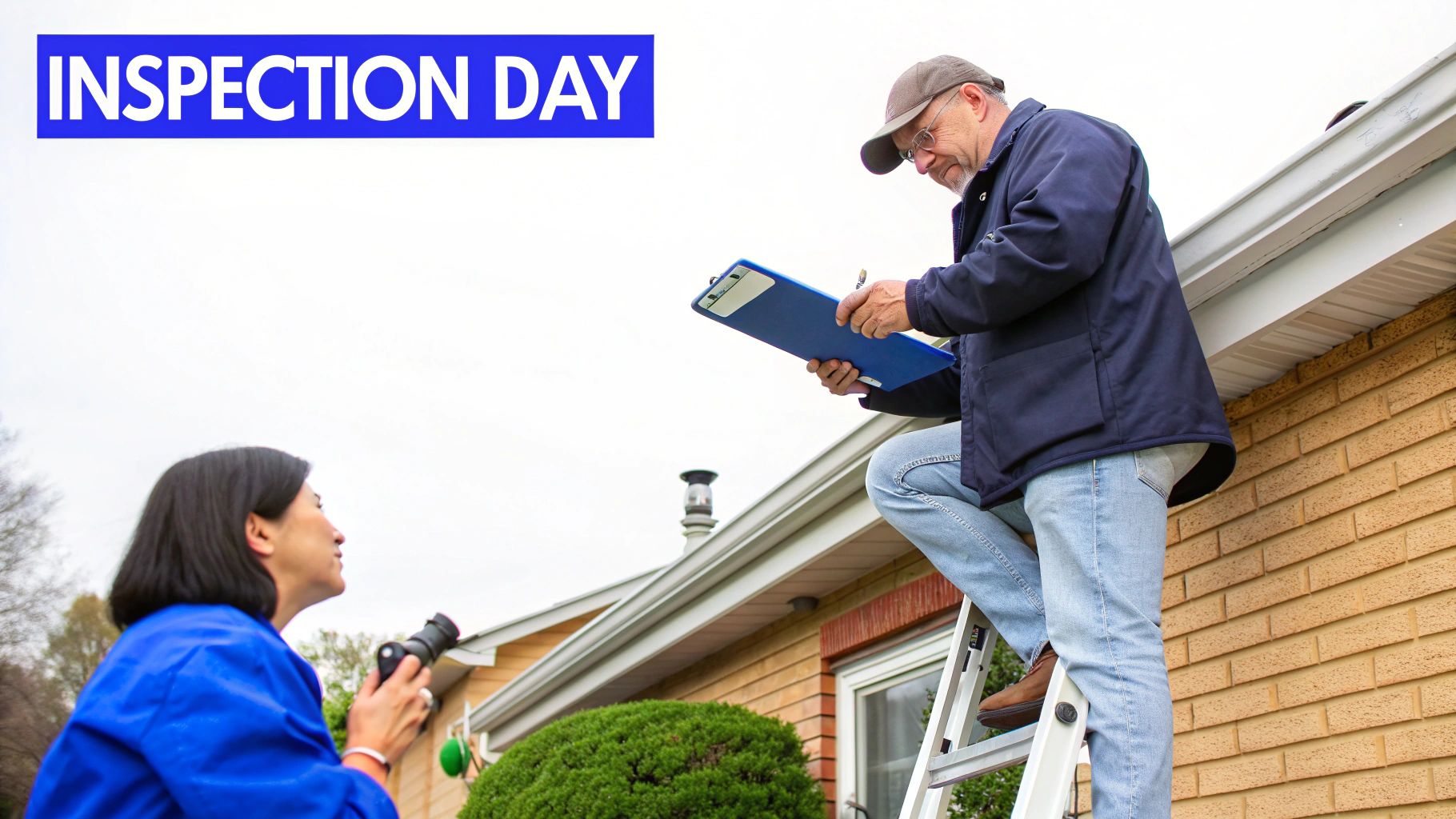
The inspector will methodically move through a checklist, examining specific areas and taking photographs that serve as visual proof for your insurer. This documentation is the key that unlocks your eligibility for those valuable discounts.
Key Areas of Examination
Our inspector's attention is laser-focused on a few critical zones of your property. We'll start by assessing the home’s exterior to document your roof's shape and look for any protective coverings on windows and doors, like hurricane shutters.
Next comes the most important part of the inspection, which usually takes place in the attic. This is where we can see the "bones" of your roof structure. It’s the behind-the-scenes stuff that really matters.
Specifically, we're looking for:
- Roof-to-Wall Connections: We need to see exactly how your roof trusses are anchored to the walls. We’ll be identifying the presence of hurricane clips or straps, which are engineered to be far stronger than simple toenails.
- Roof Deck Attachment: We'll measure the size of the nails used to secure the plywood roof deck and document how far apart they are. Closer nail spacing means a stronger roof that’s less likely to peel off in a storm.
This part of the process is absolutely crucial. Strong connections in the attic are one of the biggest factors in qualifying for insurance credits.
A wind mitigation inspection is a focused assessment, not a top-to-bottom home evaluation. Its purpose is to verify and document the specific features that reduce windstorm risk, which is why it’s much quicker and more targeted than a pre-purchase home inspection.
How You Can Prepare for the Visit
Getting ready for our visit is simple. Your main task is just to provide clear access so we can do our job efficiently.
- Clear Attic Access: Please make sure the path to your attic hatch is clear of boxes or other stored items. Our inspector needs to get in and out safely to take the necessary photos.
- Gather Documentation: If you have paperwork for a new roof, windows, or hurricane shutters, have it ready. Things like permits or product approvals can help us verify installation dates and confirm compliance with modern building codes.
That’s pretty much it. There’s no need to deep clean your house or worry about minor repairs. While the process is different from a buyer's inspection, you can get a better sense of an inspector’s comprehensive approach by learning more about what to expect during your home inspection.
After completing the assessment and taking all the photos, the inspector will compile everything into the official wind mitigation inspection report. We'll send this document directly to you, ready for you to forward to your insurance agent and start saving.
How Your Report Translates into Insurance Savings
Your wind mitigation report is much more than a piece of paper—it's the key to unlocking real, tangible savings on your homeowner's insurance. Insurance companies don't just hand out discounts on a whim. They need hard proof, and this standardized report gives them the evidence they need to apply valuable "credits" to your policy, rewarding you for owning a home that’s built to withstand a storm.
Think of it like a report card for your home's hurricane readiness. Every wind-resistant feature documented by your inspector—from the shape of your roof right down to the nails holding it all together—earns you points. The more points you rack up, the bigger the discount. It’s a simple system that turns an inspector’s findings into a powerful financial tool.
There’s a good reason insurers take this so seriously. The whole system is rooted in lessons learned from past disasters. After Hurricane Andrew tore through Florida back in 1992, the analysis was sobering: shoddy construction and weak building codes were to blame for roughly 25% of all insured losses. Simple things, like not using enough nails on shingles, made the damage exponentially worse. That storm changed everything and is why insurers are so laser-focused on verifying these specific construction details today.
The Good, Better, Best Framework for Savings
Not all homes are built the same, and your insurance credits will reflect that. The great thing is, the discounts are cumulative—the more protective features your home has, the more you’ll save. Let's break it down using a "Good, Better, Best" approach to see how different features stack up.
Good Savings Potential
A home in this category has some basic, foundational mitigation features. It might not be a fortress, but these elements still prove it’s a lower risk than a home with nothing to show.
- Key Feature: A hip-shaped roof. Its sloped, aerodynamic design is naturally better at deflecting high winds than a flat-sided gable roof, earning it a solid discount all on its own.
- Example Scenario: Your house has a hip roof, but it’s an older home without modern upgrades like impact windows or strong roof-to-wall connections (it might just have older "toe-nails"). Even so, the report confirms the roof shape, unlocking that first tier of savings.
Better Savings Potential
This is where you start seeing a more robust system of protection. The homeowner has gone beyond the basics, and the insurance savings reflect that extra effort.
- Key Features: A hip roof plus strong roof-to-wall connections, like metal hurricane clips or single wraps.
- Example Scenario: Your inspector’s report documents the hip roof and includes clear photos of hurricane clips physically fastening your roof trusses to the walls. This combination proves your roof isn't just shaped to handle wind but is also securely anchored down, earning you a much bigger discount than the roof shape could alone.
Best Savings Potential
This is the gold standard for wind mitigation. A home in this category has a complete, interlocking system of protections that work together to create maximum wind resistance. This is where you see the most significant premium reductions, often saving homeowners well over a thousand dollars a year.
- Key Features: A hip roof, strong roof-to-wall connections (like double wraps), a secondary water resistance (SWR) barrier, and complete opening protection (meaning impact-rated windows and doors or approved hurricane shutters on every single opening).
- Example Scenario: Your wind mitigation report is basically a perfect score. It confirms every major protective feature is in place, properly installed. The insurance company sees a home like this as a fortress—the lowest possible risk—and rewards you with the maximum credits they offer.
Your wind mitigation report is a powerful tool for negotiating lower homeowner's insurance rates. To discover broader ways to lower your insurance costs, check out other strategies to reduce insurance premiums and save money.
At the end of the day, this report gives you the official leverage you need to claim the discounts you've earned, turning your home's strong bones into recurring annual savings.
Using Your Report to Plan Home Upgrades
Think of your wind mitigation report as more than just a piece of paper for your insurance company—it’s a personalized roadmap to a stronger, safer home. Once you have the findings in hand, you've got a powerful tool. It not only helps secure insurance discounts but also empowers you to make smart decisions about future improvements. The report clearly lays out your home's strengths and, just as importantly, pinpoints its vulnerabilities.
The first step is simple: give the report a once-over for accuracy and then get it to your insurance agent right away. That action alone can start the process of applying valuable credits to your policy. After that, it’s time to shift from paperwork to planning, using the inspector's insights to map out effective home upgrades.

Prioritizing Upgrades for Maximum Impact
If your report came back with missing or subpar features, don't get overwhelmed. Look at it as an opportunity. The trick is to prioritize the upgrades that give you the biggest bang for your buck, both in terms of storm safety and long-term insurance savings. Not all improvements are created equal, and your report shows you exactly which ones will move the needle.
Your home's wind resistance is like a chain, and the report just showed you its weakest links. It’s far more effective to strengthen those specific areas than to make random improvements.
Here’s a practical way to prioritize based on common findings:
- High Priority (Major Structural Gaps): If the inspector noted weak roof-to-wall connections—like finding old-school toe-nails instead of modern hurricane clips—this is your top priority. These foundational weaknesses, once fixed, can lead to some of the biggest insurance discounts and a massive boost in safety.
- Medium Priority (Vulnerable Openings): A lack of protection for windows and doors is a huge vulnerability. Upgrading to impact-rated windows or installing approved hurricane shutters creates a substantial defense against high winds and flying debris, often resulting in noticeable premium reductions.
- Lower Priority (Enhancements): Already have strong core features? You might consider adding a Secondary Water Resistance (SWR) barrier during your next re-roofing project. While it's a great feature, it’s often a less urgent fix compared to securing the roof structure or protecting openings.
Analyzing the Cost Versus Benefit
Once you have a priority list, it's time for a cost-benefit analysis. You're looking for that sweet spot where an upgrade's cost is justified by the combined value of better safety and future insurance savings. Some improvements can actually pay for themselves over time through lower premiums.
For instance, retrofitting your entire roof with hurricane clips might seem like a big expense upfront. But what if that one project could save you $800 annually on your insurance premium? The upgrade could pay for itself within a few years, all while making your home fundamentally safer.
Your wind mitigation report empowers you to have informed conversations with contractors. You can show them exactly what the inspector flagged and ask for quotes on specific, targeted repairs that will directly improve your home's rating.
If your report suggests a roof replacement would significantly improve your home's wind resistance, understanding the potential cost of a new roof is a critical first step in your planning. Similarly, if the inspector pointed out existing damage, you can learn more about common roofing issues unveiled by home inspectors to get a better handle on the necessary fixes. By using your report as a strategic guide, you transform it from a simple form into an actionable plan for a more resilient and affordable home.
Common Questions About Wind Mitigation Reports
As a homeowner, it's natural to have a few questions when you're looking at a wind mitigation report. Getting clear, straightforward answers helps you move forward with confidence, making sure you understand the whole process and can get the most out of it. Let's tackle some of the most common things people ask.
The good news is that these reports have a pretty long shelf life. A single wind mitigation inspection report is typically considered valid by insurance companies for up to five years from the day it was done.
This five-year window means you don’t have to get a new inspection every single year to keep your discounts. But—and this is important—if you make any big structural changes to your home, like putting on a new roof or installing impact windows, you’ll definitely want a new inspection. That's the only way to get those upgrades on paper and lock in even bigger savings.
Can I Perform the Inspection Myself?
While the DIY spirit is great for a lot of home projects, this isn't one of them. A wind mitigation inspection is a job strictly for licensed professionals. Insurance carriers require the official report to be filled out and signed by a certified inspector, contractor, or engineer. This ensures the findings are accurate, unbiased, and meet their standards.
Trying to fill out the form yourself will only lead to an invalid report that your insurer will flat-out reject. The inspector's credentials and signature are what give the document its authority and unlock those valuable discounts.
Which Mitigation Feature Offers the Biggest Discount?
This is a question we get all the time. While every home and policy is a little different, some features almost always deliver the biggest bang for your buck. The "big three" for securing serious insurance credits are:
- Roof-to-Wall Connection: This is a huge one. Upgrading from basic toenails to much stronger hurricane clips or straps usually results in one of the most significant discounts available.
- Roof Geometry: The shape of your roof matters. A hip roof is a major plus, as its sloped, aerodynamic design handles high winds far better than a standard gable roof.
- Opening Protection: Having a complete system of impact-rated windows, doors, and garage doors (or approved hurricane shutters) is a high-value feature that insurers love to see.
The real magic happens when you have a combination of these top-tier features. A home with a hip roof, strong roof-to-wall connections, and full opening protection will almost always see the most dramatic drop in its insurance premium. Each feature builds on the last, creating a multiplier effect on your savings.
Ready to see how much you could save and make your home safer? The team at Upchurch Inspection provides thorough, professional wind mitigation inspections across Greater Memphis and West Tennessee. Schedule your inspection today and get the official report you need to lower your insurance costs.