
Ceiling stains are liars.
They tell you something happened — but not when, not where, and definitely not whether it’s still happening. That’s why I never stop at “old water stain” and move on.
Water doesn’t show up on ceilings by accident. And it rarely shows up only once.
Why Ceiling Stains Get Misread
Most people see a stain and immediately ask one of two questions:
- “Is that active?”
- “Was that fixed?”
The honest answer, without testing, is: maybe.
Water can travel. It can wick along framing. It can drip from somewhere that’s several feet — or several rooms — away from where it finally shows itself.
The stain is the receipt, not the source.
A Real Inspection Where the Ceiling Wasn’t the Problem
I inspected a home near Beech Bluff where the living room ceiling had a faint yellow ring. Seller said it was from “an old roof leak that was repaired years ago.”
Roof above looked fine.
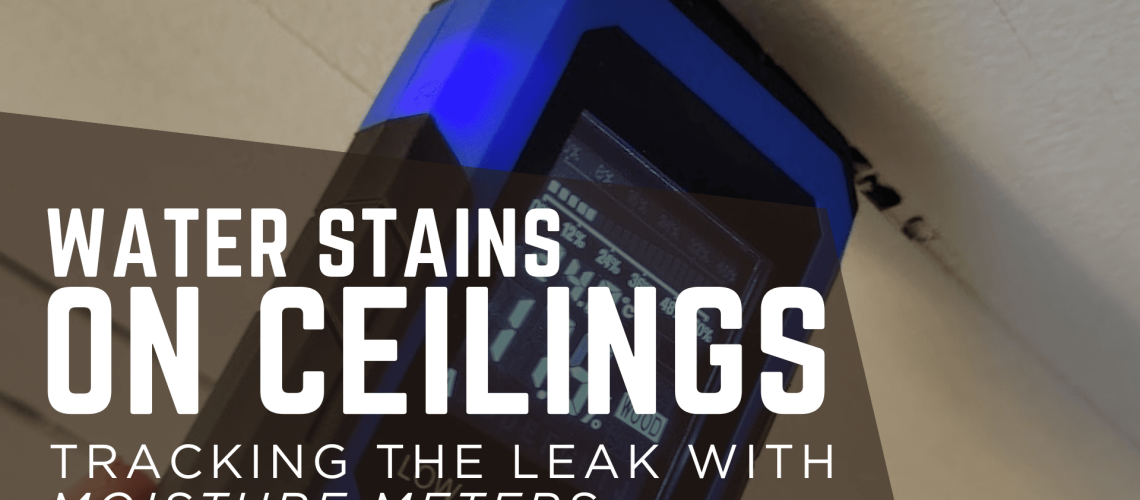
Moisture meter told a different story.
Elevated readings near an HVAC register led us into the attic, where a poorly insulated duct had been sweating for years. Not a roof leak at all. Condensation. Slow. Persistent. Still happening.
Same stain. Very different cause.
Why Dry Doesn’t Mean Done
This is where people get tripped up.
A ceiling can be dry today and still point to a problem that comes back:
- Only during heavy rain
- Only during HVAC season
- Only when a bathroom is used
- Only when the temperature swings
If you don’t know the source, you don’t know the risk.
What Moisture Meters Actually Tell Me
I’m not just poking drywall for fun.
Moisture meters help me:
- Identify active vs. inactive moisture
- Compare stained areas to control areas
- Track moisture paths
- Decide whether further evaluation is needed
They don’t tell me why water is there — but they tell me whether it’s still present.
That matters.
Common Sources I See (That Aren’t Roof Leaks)
Everyone blames the roof first. Often incorrectly.
I regularly trace ceiling stains back to:
- Bathroom exhaust fans venting into the attic
- Condensate drain line issues
- HVAC duct condensation
- Plumbing leaks above
- Overflowing tubs or showers
- Poor attic ventilation
I reviewed an inspection from one of our inspectors near Middleton where a “roof stain” turned out to be a leaking toilet seal two rooms away. Water followed the framing and showed up where no one expected it.
Why the Shape of the Stain Matters
Stains tell stories if you look closely.
- Circular stains often mean dripping
- Long streaks suggest movement
- Diffuse discoloration can mean condensation
- Sharp edges usually indicate a one-time event
- Darkening over time suggests recurrence
Painted-over stains are their own category — and they get extra attention.
Fresh Paint Is a Clue, Not a Fix
If the ceiling’s freshly painted in one spot, I slow down.
Paint doesn’t stop moisture. It just hides evidence until the next cycle. I’ve seen stains bleed back through new paint in less than a month.
Covering a stain without understanding it is like resetting a smoke alarm without checking for fire.
What Buyers Should Understand
Not every ceiling stain is a deal-breaker.
But every ceiling stain deserves:
- Context
- Moisture testing
- Correlation with other systems
- Honest documentation
Sometimes the answer really is “old and resolved.”
Sometimes it’s “inactive but worth monitoring.”
Sometimes it’s “this isn’t done yet.”
The inspection is where you sort that out.
The Inspector’s Bottom Line
Ceilings don’t stain themselves.
If there’s evidence of water, my job isn’t to guess — it’s to trace, test, and explain what’s likely happening and what still might.
Because water is patient. And if it found its way in once, it’ll try again unless something changed.