
Handrails and guardrails look simple. Almost boring.
That’s usually why they’re wrong.
I can’t tell you how many times someone waves a hand and says, “Those are fine.” And then I put a tape measure on them and everything changes.
Why Rails Matter More Than People Think
Rails exist for one reason: to stop falls.
Not to decorate staircases.
Not to give your hand something to brush against.
To keep people — especially kids — from going where gravity takes over.
When they fail, the consequences are immediate and ugly.
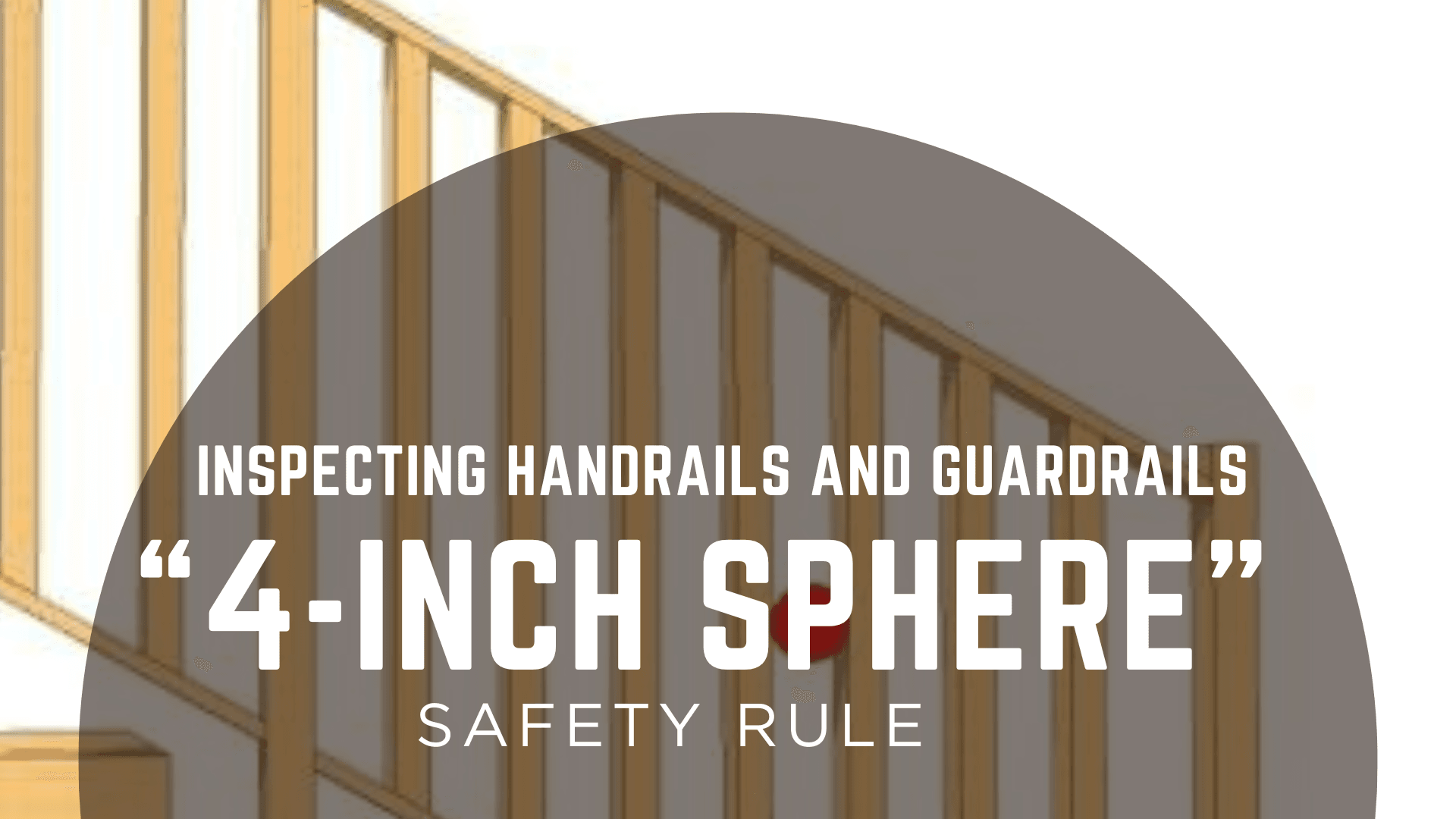
The “4-Inch Sphere” Rule (In Plain Language)

Here’s the basic idea:
If a 4-inch sphere can pass through an opening in a guardrail, it’s considered unsafe.
Why four inches? Because that’s roughly the size of a small child’s head.
If a head can fit, the body can follow. And once that happens, railings don’t get a second chance.
Where This Goes Wrong in Real Homes
Most failures aren’t dramatic. They’re subtle.
I regularly see:
- Balusters spaced just a little too far apart
- Horizontal rails that act like ladders
- DIY deck rails built by eye, not measurement
- Stair rails mounted too low or too high
- Guardrails that wiggle when you lean on them
They look sturdy. They just don’t meet basic safety standards.
A Real Inspection Where Inches Mattered
I inspected a home near Three Way where the upstairs overlook had custom wood railings. Beautiful craftsmanship. Solid feel.
Measured the spacing — just over four inches in multiple spots.
That wasn’t a design preference issue. That was a fall hazard, especially for visiting kids.
Pretty doesn’t cancel physics.
Handrails vs. Guardrails (People Mix These Up)
They do different jobs.

Handrails are for grip.
They need to be:
- Graspable
- Continuous
- Mounted at the correct height
- Securely fastened

Guardrails are for containment.
They need to:
- Be tall enough
- Be strong enough
- Have safe spacing
- Resist outward force
I often see one done right and the other done wrong — on the same staircase.
The Deck Rail Problem
Decks are where creativity goes to fight gravity.
I’ve reviewed inspection notes from one of our inspectors near Henderson where a deck rail had horizontal cables spaced too far apart. Looked modern. Failed the sphere test everywhere.
Modern designs still have to respect basic safety.
Why “It’s Been Like That for Years” Doesn’t Matter
I hear this constantly:
“No one’s ever fallen.”
That’s luck, not validation.
Rails don’t exist because something already happened. They exist to prevent the thing you never want to happen.
What I Actually Do During the Inspection
I don’t eyeball rails.
I:
- Measure spacing
- Check height
- Push and pull for stability
- Test handrail grip
- Look for loose fasteners
- Check transitions and terminations
If a rail moves when it shouldn’t, that’s a problem — even if it hasn’t failed yet.
What Buyers Should Take Away
Rail issues are usually fixable. Often inexpensive. Sometimes straightforward.
But they’re also one of the most common injury-related defects I find.
Ignoring them because they “seem fine” isn’t worth it.
The Inspector’s Bottom Line
Handrails and guardrails aren’t decorative. They’re safety systems.
The four-inch rule isn’t arbitrary — it’s written in blood and broken bones from decades of falls.
If a railing doesn’t pass basic measurements, it doesn’t pass real-world safety. And that’s why I always measure — not guess.