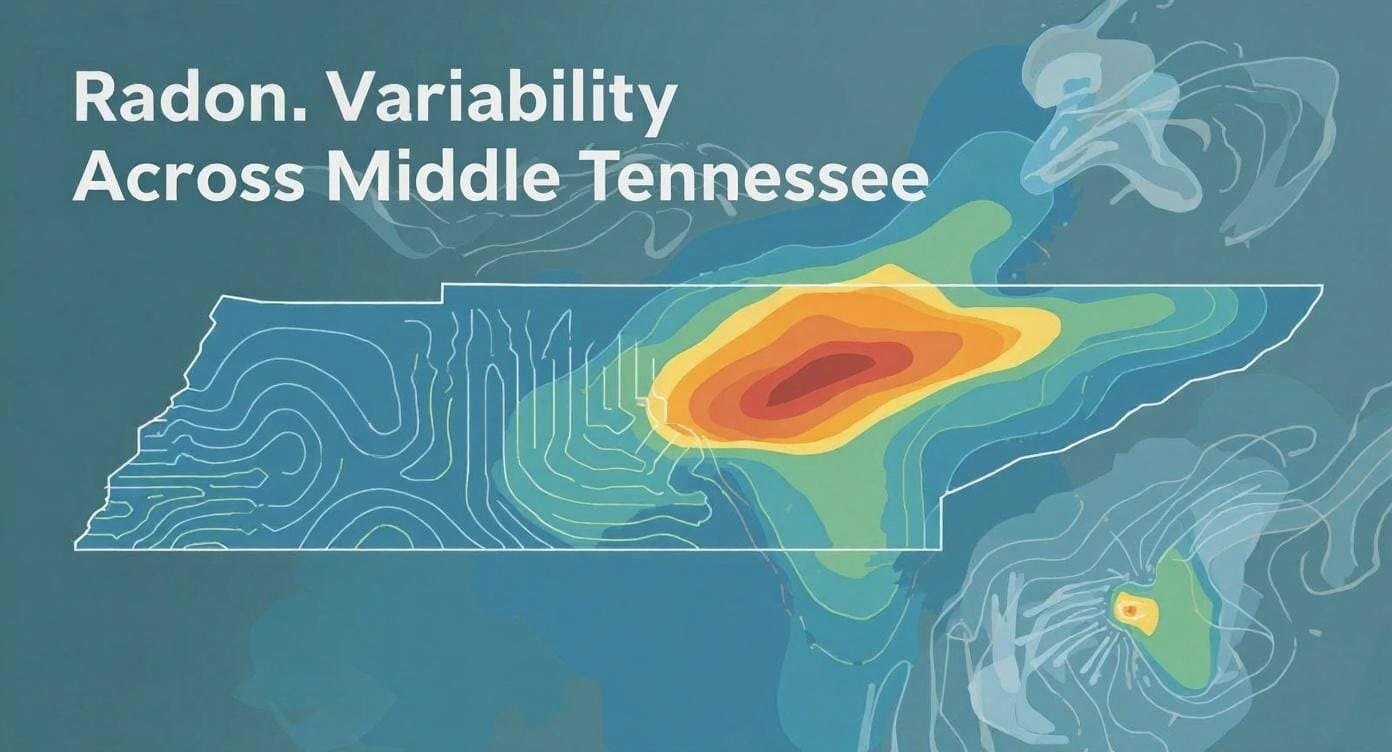
Radon testing results in Middle Tennessee often surprise buyers because there is no single pattern that applies to every home or neighborhood. Homes in Nashville, Mount Juliet, Hendersonville, Franklin, Murfreesboro, and nearby communities can show dramatically different radon levels even when they were built at the same time or sit only a few streets apart.
This variability is why inspectors rely on testing rather than assumptions when evaluating radon risk in the region.
Why Radon Levels Change From House to House
Radon is produced by the natural breakdown of uranium in soil and rock, and Middle Tennessee’s geology is far from uniform. Limestone, shale, and mixed soil conditions create pathways that allow radon to move differently beneath each structure.
Inspectors often see:
- One home testing low while the neighboring home tests elevated
- Similar floor plans with very different results
- Radon levels that change after renovations or air sealing
- Homes that tested low in the past testing higher years later
Because of these variables, location alone is not a reliable predictor.
Construction Type Influences Radon Entry
How a home is built plays a major role in how radon enters and accumulates.
In Middle Tennessee, elevated readings are commonly found in:
- Homes with basements or partial basements
- Slab-on-grade homes with expansion joints or penetrations
- Newer, tighter homes with limited natural air exchange
- Houses with sumps or foundation drainage systems
That said, inspectors also encounter elevated radon in homes that don’t fit these categories, reinforcing the need for testing rather than assumptions.
New Construction Does Not Eliminate Radon Risk
Many buyers assume that newer homes are less likely to have radon issues. In practice, inspectors regularly find elevated radon levels in recently built homes around Nashville and surrounding areas.
Tighter construction can reduce natural ventilation, allowing radon to accumulate more readily if entry points exist. Without testing, these homes may go years without detection.
Seasonal and Weather-Related Variation
Radon levels can fluctuate based on weather conditions, temperature differences, and how a home is occupied.
Inspectors frequently note changes related to:
- Cold weather increasing stack effect
- Heavy rainfall altering soil gas movement
- HVAC operation affecting pressure differences
- Windows and doors being opened or closed
This variability is why radon testing is conducted under controlled conditions during inspections.
Short-Term Testing During Real Estate Transactions
Most real estate transactions rely on short-term radon testing because it fits within purchase timelines. These tests provide a snapshot of radon levels during the test period rather than a lifetime average.
Inspectors focus on:
- Proper placement in the lowest livable area
- Maintaining closed-house conditions
- Accurate test duration and retrieval
- Clear documentation of results
Short-term results help buyers decide whether further evaluation or mitigation should be considered.
What Elevated Results Typically Mean
When elevated radon levels are identified, the next step is usually evaluation by a qualified radon mitigation professional. Mitigation systems are well-established and commonly installed in Middle Tennessee.
Buyers are often relieved to learn that:
- Radon mitigation is effective
- Systems are typically unobtrusive
- Long-term testing can confirm results after installation
Testing early allows these conversations to happen before closing rather than after move-in.
Why Testing Is Recommended Despite Variability
The unpredictable nature of radon in Middle Tennessee is exactly why testing is recommended. Visual inspections cannot detect radon, and maps cannot account for individual home conditions.
Testing provides data that replaces uncertainty, allowing buyers to make informed decisions based on measured conditions rather than assumptions.
The Role of Local Inspection Experience
Inspectors who regularly test homes across Middle Tennessee recognize how widely radon results can vary. That experience helps ensure tests are placed correctly, conducted properly, and interpreted within local context.
This approach keeps radon discussions practical, factual, and focused on clarity rather than fear.