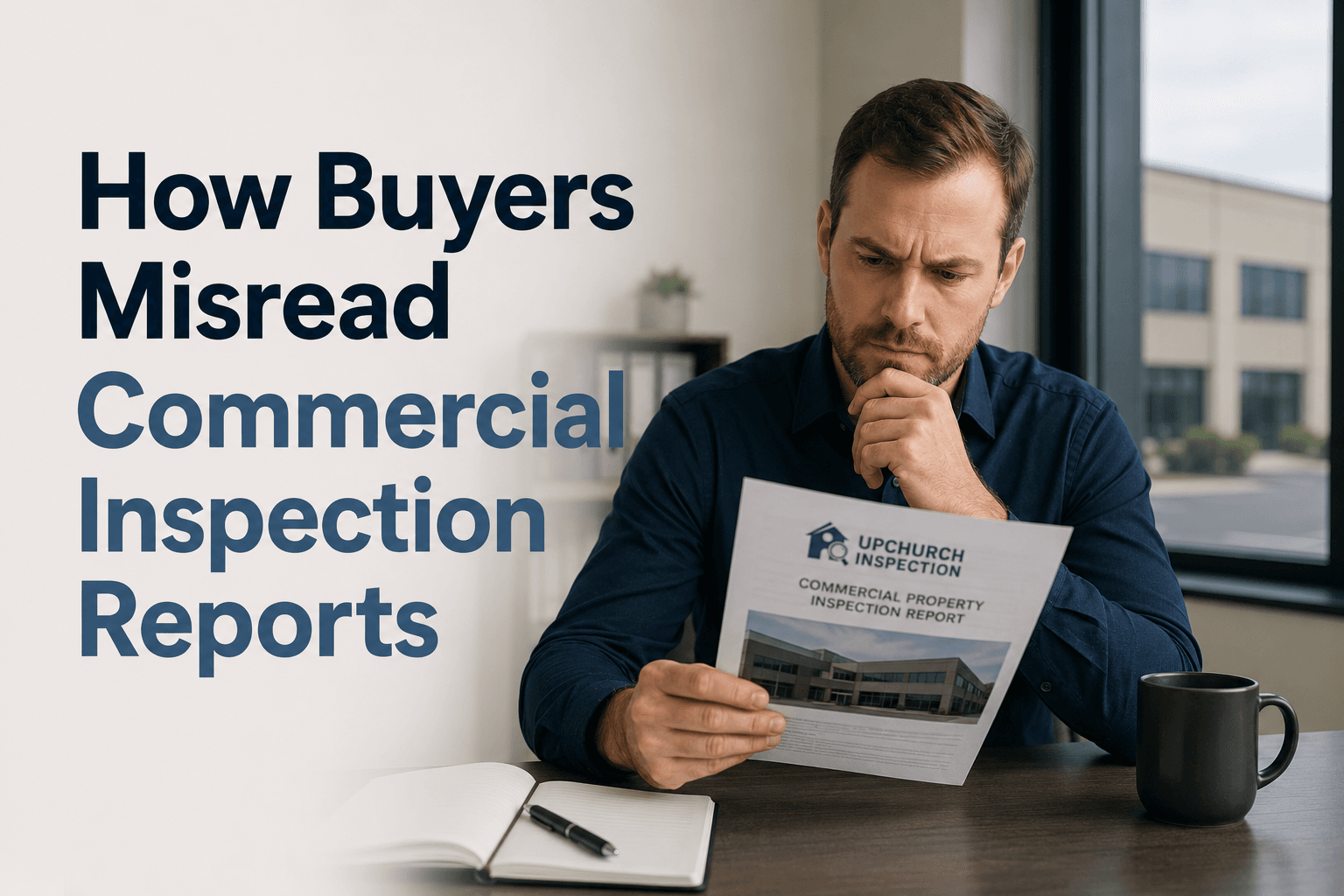
Commercial inspection reports are often blamed for killing deals, creating tension, or “finding too much.” In practice, most of the friction doesn’t come from what’s in the report. It comes from how the report is read.
At Upchurch Inspection, we see the same pattern repeatedly: buyers approach a commercial inspection report with a residential mindset. They look for pass–fail answers, clean conclusions, or reassurance. Commercial reports aren’t written for that purpose, and when they’re read that way, confusion is almost guaranteed.
Commercial Reports Are Not Executive Summaries
One of the first mistakes buyers make is treating a commercial inspection report like a verdict.
Residential reports often feel narrative and guided. Commercial reports are intentionally dense. They document conditions, risks, and observations without telling the buyer what decision to make. That’s not a flaw. It’s by design.
A commercial inspection report is closer to a technical risk document than a consumer checklist. Its job is to surface information that supports financial, operational, and legal decisions—not to simplify those decisions into yes-or-no answers.
When buyers expect conclusions instead of context, they misread what the report is offering.
Buyers Often Confuse Documentation With Urgency
Commercial reports list a lot of issues. That volume alone can feel alarming.
The mistake buyers make is assuming that everything listed carries the same weight. It doesn’t.
Commercial inspections document:
- Current deficiencies
- Deferred maintenance
- Design limitations
- End-of-life systems
- Operational vulnerabilities
Some of these require immediate attention. Many do not. The report doesn’t rank them emotionally—it records them factually.
Experienced buyers read commercial reports by asking, “What changes my risk profile?” not “What looks bad on paper?”
“Needs Repair” Does Not Mean “Deal Breaker”
Another common misread is assuming that repair recommendations signal failure.
In commercial properties, repairs are expected. Buildings are acquired with the understanding that work will be done. A report that identifies needed repairs is not exposing a bad property—it’s describing ownership reality.
Buyers who treat every repair recommendation as a red flag often miss the bigger picture: whether the building’s issues are predictable, manageable, and budgetable.
A property with known, quantified repairs is often less risky than one that appears “clean” but lacks documentation or history.
Buyers Focus on Symptoms Instead of Systems
Commercial reports often describe symptoms: corrosion, staining, wear, cracking, inefficiency. Buyers sometimes fixate on these without stepping back to understand system behavior.
For example:
- A roof issue isn’t just a roof issue—it’s a drainage, maintenance, and access issue.
- An electrical concern may be about load growth, not just components.
- HVAC comments often relate to redundancy and downtime risk, not immediate failure.
Misreading symptoms as isolated problems leads buyers to misunderstand the real exposure.
Commercial inspections are written system-first, not component-first. That distinction matters.
Missing the Difference Between Condition and Liability
Some buyers read commercial inspection reports as if they’re code enforcement documents. They’re not.
Commercial inspections do not certify code compliance. They identify conditions that may carry liability depending on use, occupancy, and jurisdiction.
A condition that isn’t illegal may still be expensive, disruptive, or risky. Conversely, a technically non-compliant condition may pose minimal practical risk depending on how the building is used.
Buyers who confuse condition with compliance often overreact—or underreact—because they’re reading the report through the wrong lens.
Inexperienced Buyers Look for “Clean” Sections
Commercial buyers new to inspections often scan reports looking for sections that appear problem-free. When they don’t find them, they assume the property is unusually troubled.
In reality, commercial buildings rarely have “clean” systems across the board. Age, usage, and maintenance decisions always leave fingerprints.
A report that shows findings in every system isn’t alarming. It’s normal.
The question isn’t “Does this building have issues?”
It’s “Are these issues consistent with the building’s type, age, and use?”
Experienced Buyers Read Reports Backward
Seasoned commercial buyers often start with the sections that affect:
- Business interruption
- Safety exposure
- Capital planning
- Tenant impact
They’re less concerned with how long the report is and more concerned with where risk clusters.
They don’t ask, “Is this a good building?”
They ask, “What does this building demand from ownership?”
That shift in perspective changes everything.
Why Conversations Matter More Than Conclusions
Commercial inspection reports are not meant to stand alone. They’re meant to be discussed.
Inspectors expect buyers to ask questions, test assumptions, and explore scenarios. The most productive commercial inspections involve dialogue—before, during, and after the report is delivered.
When buyers treat the report as a final word instead of a starting point, they miss much of its value.
The Practical Reality
Commercial inspection reports aren’t misaligned with buyer needs. Buyer expectations are often misaligned with what commercial inspections actually provide.
These reports don’t tell buyers what to do. They show buyers what they’re stepping into.
When read with the right mindset, commercial inspection reports don’t create uncertainty. They replace false confidence with informed decision-making—and that’s exactly what they’re meant to do.
Related reading