
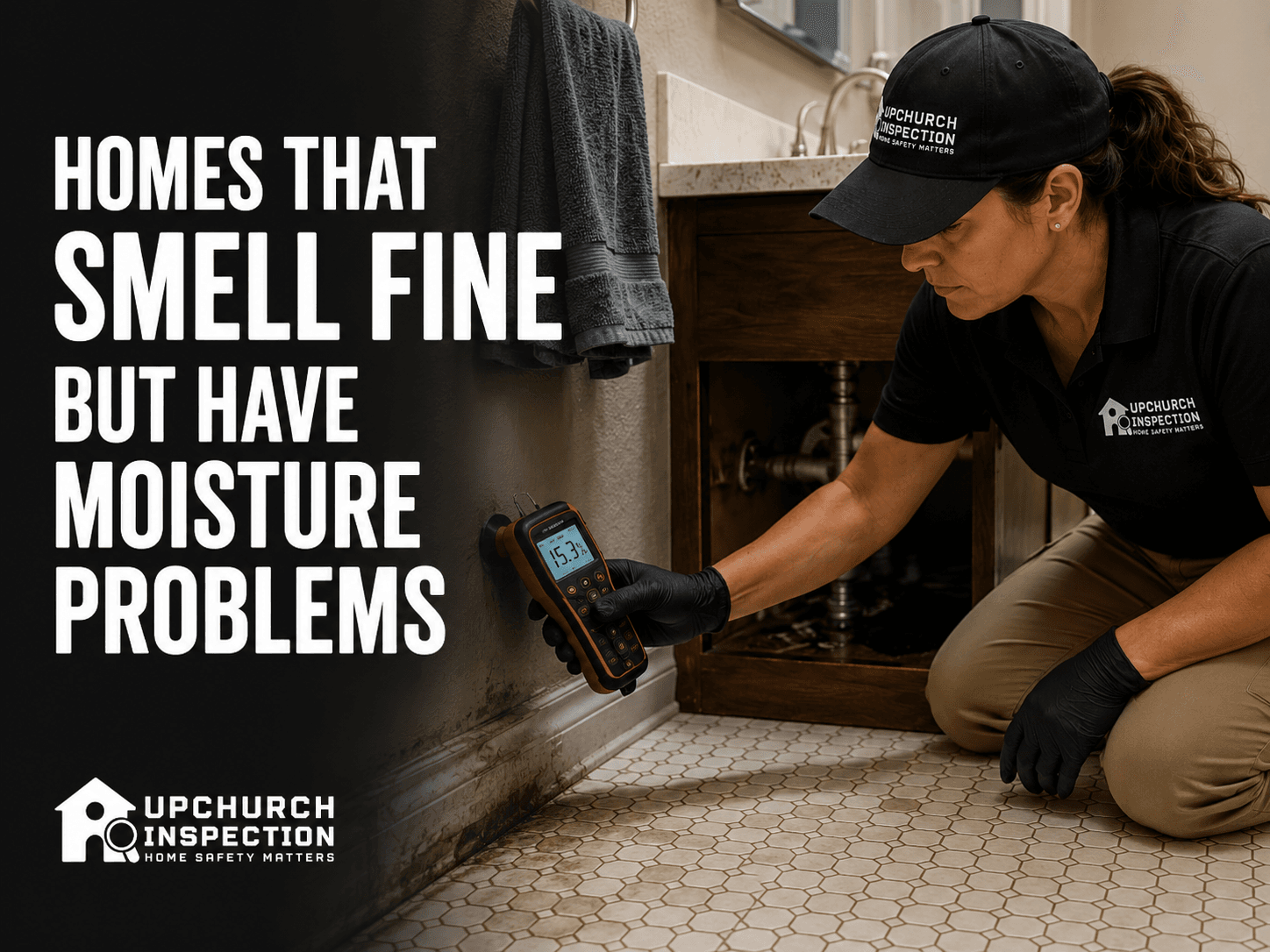
One of the most misleading assumptions buyers make is that moisture problems announce themselves through smell. If a house doesn’t smell musty, sour, or damp, it’s easy to believe moisture isn’t an issue. In practice, that assumption fails often—especially in the regions we serve.
At Upchurch Inspection, we routinely inspect homes across Memphis, Jackson, Little Rock, Jonesboro, Cape Girardeau, and Middle Tennessee that smell perfectly normal and still show clear signs of moisture stress. Not because something was hidden deliberately, but because moisture doesn’t always behave the way people expect.
Odor Is a Late-Stage Symptom, Not an Early Indicator
Smell usually shows up after moisture has been present long enough to support biological activity or material breakdown. By the time a house smells musty, conditions have often existed for months or years.
Many moisture problems exist well before that point.
Elevated humidity, slow evaporation, seasonal saturation, or intermittent wetting can stress materials without producing a noticeable odor. The house feels fine. The air smells neutral. The moisture is still there.
Inspectors don’t rely on smell to assess moisture because they’ve learned how unreliable it is as an early signal.
Modern Homes Mask Moisture Better Than Older Ones
Newer or renovated homes often hide moisture problems more effectively than older homes.
Tighter construction, improved finishes, and frequent repainting reduce airflow and absorb fewer odors. Vinyl flooring, sealed drywall, and synthetic materials don’t hold smells the way older wood or plaster did.
In places like Nashville and Little Rock, where many homes have been renovated or rebuilt, inspectors often find moisture conditions that haven’t yet produced sensory clues. The house feels clean. The materials are just beginning to show stress.
The absence of smell doesn’t mean the absence of moisture—it often means the house is earlier in the cycle.
Crawl Spaces Are the Most Common Source
Across West Tennessee, Central Arkansas, and Northeast Arkansas, crawl spaces are the most frequent origin of odor-free moisture problems.
A crawl space can be damp, humid, or seasonally wet without producing a strong smell upstairs. Air movement patterns often keep odors contained while allowing moisture to influence framing, insulation, and subfloor materials.
Inspectors commonly find:
- Elevated crawl space humidity
- Condensation on mechanical components
- Insulation deterioration
- Rusting hardware
- Soil moisture with no standing water
None of these conditions require a smell to be active.
Seasonal Conditions Matter More Than Inspection Day
Many moisture problems are seasonal.
In Memphis and Jackson, extended summer humidity creates conditions where moisture accumulates slowly rather than dramatically. In Cape Girardeau, freeze-thaw cycles can trap moisture in materials without immediate odor. In Jonesboro, flat terrain allows water to linger after rain events long after surfaces appear dry.
An inspection performed during dry weather can still reveal moisture stress if the inspector knows what to look for. Smell is rarely part of that evaluation.
HVAC Can Mask Moisture While Making It Worse
Air conditioning often hides moisture problems by keeping interiors comfortable.
A system may remove enough moisture from the air to prevent odors while still allowing condensation or humidity buildup in crawl spaces, wall cavities, or ductwork. The house feels cool and dry. The moisture remains where air movement is limited.
Inspectors often notice this disconnect in homes where comfort is good but materials show early moisture-related wear.
The HVAC didn’t fix the moisture problem—it just delayed its sensory impact.
Paint and Finishes Can Delay Detection
Fresh paint is excellent at resetting smell.
In renovated homes across Memphis, Nashville, and Little Rock, inspectors regularly see surfaces that look pristine but show subtle moisture indicators beneath. Staining patterns, peeling at edges, soft materials, or repeated repainting in the same areas often tell a story smell never did.
Paint covers odor far more effectively than it stops moisture.
Why Buyers Miss These Conditions
Buyers are conditioned to trust their senses. If the house looks clean and smells normal, it feels safe.
Moisture problems break that rule.
They often require:
- Visual pattern recognition
- Understanding of regional behavior
- Awareness of seasonal cycles
- Attention to materials, not air
Inspectors learn to look for these signals because they see the outcomes repeatedly—not because buyers missed something obvious.
What Inspectors Pay Attention To Instead of Smell
Rather than relying on odor, inspectors focus on:
- Material condition and deterioration patterns
- Relative humidity and condensation indicators
- Corrosion and organic growth locations
- Drainage and water movement behavior
- Consistency between interior and substructure conditions
These indicators matter whether the house smells fine or not.
What Buyers Should Ask
Instead of asking, “Does it smell musty?” buyers are better served asking:
- Where does moisture tend to accumulate in homes like this locally?
- How does this house handle humidity seasonally?
- Are there subtle indicators of long-term moisture exposure?
- Does the inspection note moisture-related observations in multiple areas?
Those questions lead to understanding rather than false reassurance.
The Practical Reality
A house doesn’t need to smell bad to have moisture problems. It just needs time.
Moisture works quietly, gradually affecting materials long before it affects air quality. By the time smell shows up, the issue is often well-established.
A good inspection doesn’t wait for odor to appear.
It reads the signals that come first—especially in the regions we serve, where moisture behavior shapes how homes age whether you can smell it or not.