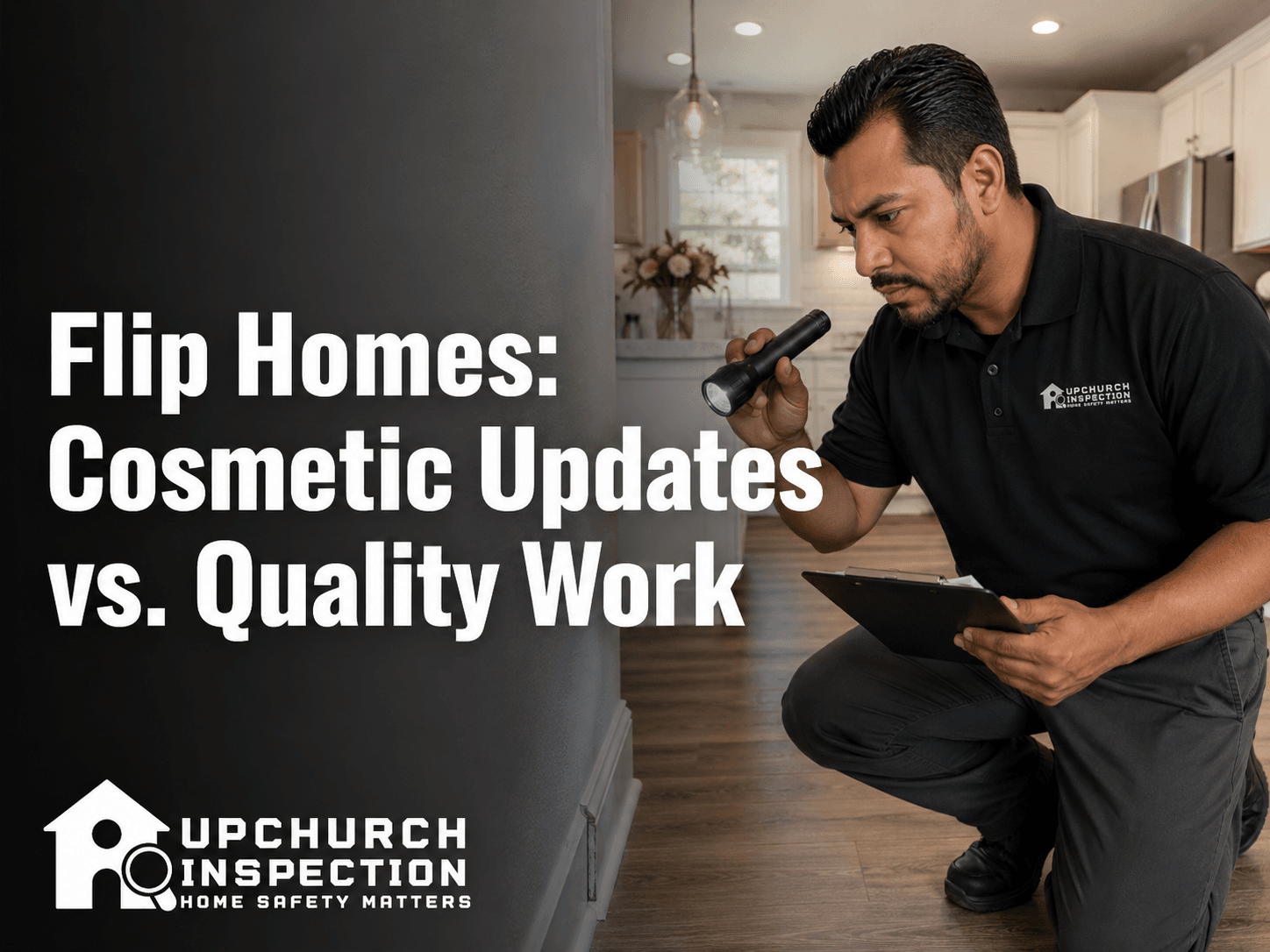
Flipped homes are everywhere in the markets we serve. From older neighborhoods in Memphis and Jackson to fast-moving areas around Nashville and Little Rock, buyers routinely walk into houses that look new, clean, and move-in ready—often after sitting vacant only months earlier.
A fresh flip can feel like relief. New paint, new floors, new fixtures. The house looks finished. The inspection, however, is where the difference between cosmetic improvement and quality work becomes clear.
At Upchurch Inspection, flip homes don’t raise concern because they were renovated. They earn attention because renovations can either reveal care—or hide shortcuts.
Cosmetic Work Changes How a House Looks
Quality Work Changes How a House Behaves
Cosmetic updates are surface-level by nature. Flooring, paint, cabinets, lighting, and fixtures dramatically change first impressions. They sell houses.
Quality work shows up differently. It affects how systems perform, how moisture moves, how loads transfer, and how the house handles stress over time.
Inspectors are less interested in what was updated than what wasn’t.
A home can look completely transformed while still relying on:
- Original plumbing runs
- Aging electrical infrastructure
- Marginal drainage patterns
- Poor ventilation decisions
- Uncorrected structural movement
None of those are visible from the entryway.
Fresh Finishes Often Quiet Warning Signals
One of the challenges with flipped homes is that visual cues inspectors normally rely on have been softened or removed.
Paint hides staining history. New drywall erases crack patterns. Vinyl flooring masks floor movement. Trim conceals alignment issues. These updates don’t create problems—but they reduce the visible trail inspectors use to understand how the house has behaved over time.
In Memphis and Jackson, where soil movement and moisture are long-term realities, this matters. A house that looks calm may simply have had its history cosmetically reset.
Inspectors compensate by paying closer attention to alignment, consistency, and transitions—places where behavior tends to resurface despite finishes.
The Systems That Get Skipped Most Often
In flipped homes across Little Rock, Jonesboro, and Cape Girardeau, inspectors consistently see the same systems lag behind the finishes.
Plumbing often receives spot repairs rather than full updates, especially when original materials are still technically serviceable. Electrical systems may be left functionally intact but undersized for modern demand. HVAC may be replaced without correcting duct design or airflow problems.
These decisions aren’t always negligent. They’re often budget-driven.
But buyers should understand that “new” doesn’t always mean “complete.”
Layout Changes Tell You a Lot About Priorities
Flip homes frequently involve layout changes—opened walls, reworked kitchens, added bathrooms. These changes are where quality work really distinguishes itself.
Inspectors look closely at:
- How framing modifications were handled
- Whether load paths appear logical
- How plumbing and electrical were rerouted
- Whether ventilation was reconsidered or ignored
In Middle Tennessee and Central Arkansas, flipped homes sometimes show signs of walls being removed for aesthetics without adequate attention to structure or mechanical rerouting. These aren’t always failures—but they often require closer evaluation.
Speed Leaves a Signature
Most flips operate on a timeline. The faster a project turns, the better the margins.
Inspectors can often tell when work was rushed—not because it looks bad, but because details were deferred. Incomplete sealing, mismatched materials, inconsistent workmanship, or systems that were “made to work” rather than designed properly tend to show up.
These aren’t catastrophic issues. They’re indicators of how decisions were made.
A flip done slowly usually ages better than a flip done fast.
Regional Conditions Expose Shortcuts Over Time
Flip homes behave differently depending on environment.
In West Tennessee and Northeast Arkansas, drainage shortcuts show up quickly in crawl spaces. In Nashville, rapid redevelopment sometimes layers modern interiors over older infrastructure without reconciling the two. In Southeast Missouri, exterior shortcuts often surface through moisture and freeze-thaw exposure.
Inspectors with regional experience recognize which cosmetic improvements tend to hold up locally—and which ones commonly unravel within a few seasons.
Why Flip Homes Aren’t Automatically a Problem
A flipped home isn’t inherently risky. Some renovators do excellent work and address systems comprehensively. Others focus primarily on visual impact.
The inspection isn’t about labeling the flip as “good” or “bad.” It’s about understanding what kind of flip it is.
A quality flip usually shows:
- Logical system upgrades alongside finishes
- Consistent workmanship across areas
- Evidence of addressing causes, not just symptoms
- Design choices that respect the home’s structure
A cosmetic flip often looks impressive but leaves ownership responsibility front-loaded.
What Buyers Should Pay Attention To
Instead of asking, “Was this flipped?” buyers are better served asking:
- What systems were actually updated?
- Do finishes align with infrastructure?
- Are repairs isolated or systemic?
- How does this renovation fit regional realities?
Those questions lead to informed decisions rather than surface-level comfort.
The Practical Reality
Flip homes are designed to look finished. Inspections are designed to see past that finish.
Cosmetic work sells a house. Quality work determines how it lives afterward.
A good inspection doesn’t criticize renovation—it translates it. It helps buyers understand whether what they’re seeing is a new chapter built on a solid foundation, or a fresh coat of paint on an unfinished story.
That distinction matters long after the showing ends—especially in the regions where we inspect every day.