TL;DR:
- Not all commercial property inspections provide the same value, and assuming they do is costly for Mid-South investors.
- Understanding standards like ASTM E2018 and ComSOP helps ensure inspections accurately assess materials and identify risks.
Not all commercial property inspections deliver the same value, and assuming otherwise is one of the most expensive mistakes Mid-South investors make. A missed deficiency in a flat roof, an uninspected HVAC unit serving 8,000 square feet, or an undocumented drainage issue can quietly reshape your return on investment before the ink dries on closing documents. This guide cuts through the confusion about inspection scope, standards, and process so you can walk into your next acquisition with a clear picture of what you’re buying, what it will cost to maintain, and where your real risks lie.
Table of Contents
- Why inspection standards matter: ASTM E2018 and ComSOP explained
- Preparation essentials: Documents, access, and coordination
- What inspectors evaluate: Major building systems and their impact
- From walk-through to reporting: Inspection methodology and what to expect
- Our take: The hard truths about reliable property inspections
- Connect with certified inspectors for your next smart investment
- Frequently asked questions
Key Takeaways
| Point | Details |
|---|---|
| Know your standards | ASTM E2018 and ComSOP are key frameworks that define scope and confidence for commercial property inspections. |
| Prepare for success | Advance document review, access planning, and team coordination ensure thorough inspections and fewer surprises. |
| Focus on major systems | Site, structure, envelope, MEP, and life-safety systems are where inspections deliver maximum investor value. |
| Clarify limitations | Always have inspectors document what was inaccessible or out of scope so you can manage risk and negotiations. |
| Trust transparency | A truly useful inspection provides clear, documented findings—not just a checklist—so you can make confident investment decisions. |
Why inspection standards matter: ASTM E2018 and ComSOP explained
With the importance of inspections established, understanding the underlying standards is your first step toward making sense of any proposal or report you receive.
Two frameworks dominate commercial property inspections in the United States. The first is ASTM E2018, which governs Property Condition Assessments (PCAs). A PCA under ASTM E2018 is benchmarked to a framework for evaluating commercial improvements and identifying material deficiencies for transactional due diligence and planning. In plain terms, this standard is built for transactions. Lenders, equity partners, and institutional buyers often require a PCA before a deal closes because it documents the physical condition of the asset and flags deferred maintenance that could affect value.
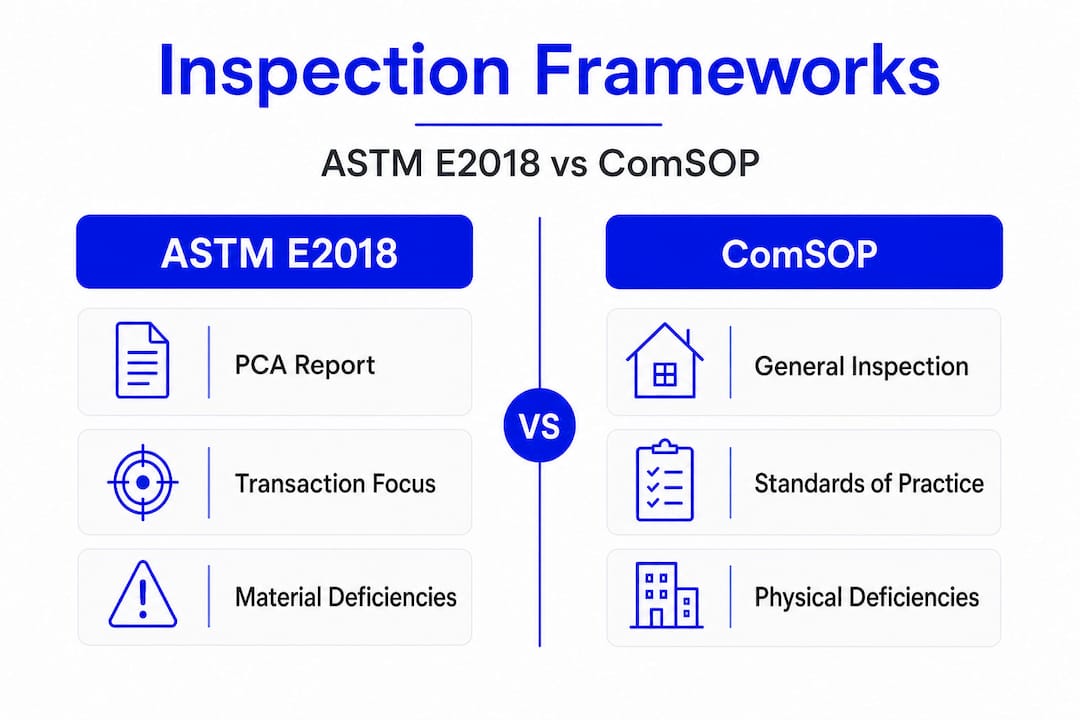
The second framework is the CCPIA ComSOP, formally known as the International Standards of Practice for inspecting commercial properties. ComSOP defines best practices for performing commercial property inspections, including a visual walk-through plus research and reporting. Where ASTM E2018 is a transaction-driven benchmark, ComSOP is the practical on-site guide that tells inspectors how to perform, document, and report their findings. Think of ASTM as the rulebook for what the assessment must accomplish, and ComSOP as the playbook for how an inspector actually conducts the work.
For investors doing due diligence in commercial real estate, understanding which standard applies to your inspection matters. A report labeled “ASTM-based” does not automatically mean every system was inspected in depth. Scope can be limited by agreement, access, or budget.
| Feature | ASTM E2018 (PCA) | CCPIA ComSOP |
|---|---|---|
| Primary use | Transaction due diligence | On-site inspection practice |
| Driven by | Lenders, institutional buyers | Inspectors, commercial clients |
| Scope | Material deficiencies, cost estimates | Visual walk-through plus research |
| Code compliance | Not required | Out of scope |
| Reporting focus | PCR (Property Condition Report) | Findings documentation |
“A PCA does not guarantee that every system was fully evaluated. Confirm the agreed scope in writing before you sign the engagement letter.”
Pro Tip: When you receive an inspection proposal, ask specifically which standard governs the work and request a written scope of services. “ASTM-based” language in a proposal does not always mean the full ASTM E2018 protocol was followed. Confirm it.
Preparation essentials: Documents, access, and coordination
With standards outlined, let’s move to the practical steps you must take to get an inspection started on solid ground.
Preparation is where most investors lose time and money. A poorly coordinated inspection leaves gaps in the report that can haunt you during negotiations or after closing. Commercial inspection workflows typically include pre-inspection document review and coordination for access to key areas such as mechanical rooms, electrical rooms, tenant spaces, and rooftop access. Skipping this step means your inspector may arrive on-site without the documents or access needed to do the job right.
Here is a practical preparation sequence to follow before every commercial inspection:
- Gather key documents. Collect current leases, maintenance logs, prior inspection reports, as-built drawings, and any environmental studies. These give the inspector context for what they are looking at and flag areas that have had prior problems.
- Confirm physical access. Arrange keys, access codes, and escort contacts for mechanical rooms, electrical panels, rooftops, and tenant-occupied spaces. Inspectors cannot evaluate what they cannot reach.
- Coordinate with property management. Give property managers advance notice so they can prepare tenants and unlock restricted areas. Surprises on inspection day waste time and create gaps in coverage.
- Identify lender requirements. Some inspections are performed for lender or servicer requirements where minimum notice rules and escorted versus unescorted access policies can affect what can be inspected and documented. Know these rules before scheduling.
- Review the inspection agreement. Confirm scope, exclusions, and deliverables in writing. This protects you if disputes arise about what was or was not covered.
Using a thorough inspection checklist before the inspection day helps you track every document and access point. If you are evaluating commercial properties for the first time, this preparation phase is where experienced investors separate themselves from those who get caught off guard.
One often-overlooked preparation step is reviewing any prior insurance claims on the property. A hail damage inspection checklist can reveal whether the roof has sustained unreported storm damage, which is especially relevant in the Mid-South where severe weather is common.
Pro Tip: Always document areas that were inaccessible on inspection day and communicate these gaps to all stakeholders before closing. An inaccessible mechanical room is not a minor footnote. It is a known unknown that should factor into your negotiation or capital reserve planning.
What inspectors evaluate: Major building systems and their impact
With every area accessible and documentation ready, here is how inspectors dig into the building’s vital systems.

A thorough commercial inspection covers far more than walls and windows. Commercial inspection scope should cover the major property systems investors care about: site and drainage, structure, building envelope and roofing, core MEP (mechanical, electrical, plumbing), plus life safety and egress and accessibility considerations. Each system carries its own risk profile and cost implications.
Here is a breakdown of the major systems and why each matters to your investment:
- Site and drainage: Poor grading and drainage cause water intrusion at foundations, leading to structural damage and mold. This is one of the highest-frequency issues in Mid-South commercial properties due to regional rainfall patterns.
- Structure and foundation: Cracks, settlement, and bearing capacity issues are expensive to repair and can affect insurability. Foundation problems in older commercial buildings across Tennessee and Arkansas often trace back to clay soil movement.
- Building envelope and roofing: The roof is typically the single most expensive system to replace. Flat and low-slope roofs common in commercial buildings require detailed evaluation of membrane condition, flashing, and drainage.
- MEP systems: Mechanical, electrical, and plumbing systems drive operational costs. Aging HVAC units, undersized electrical panels, and corroded plumbing can represent six-figure capital expenditures.
- Life safety and egress: Fire suppression systems, emergency lighting, exit signage, and accessibility compliance issues can trigger mandatory remediation and liability exposure.
Review key inspection areas to understand how each system connects to your overall risk assessment. For roofing specifically, a dedicated roof inspection checklist helps you track condition, age, and repair history.
| System | Typical concerns | Potential cost impact |
|---|---|---|
| Site/drainage | Erosion, ponding, grading failures | $5,000 to $50,000+ |
| Structure/foundation | Settlement, cracking, bearing issues | $20,000 to $200,000+ |
| Envelope/roofing | Membrane failure, flashing leaks | $15,000 to $150,000+ |
| MEP systems | HVAC age, panel capacity, pipe corrosion | $10,000 to $100,000+ |
| Life safety/egress | Sprinkler gaps, lighting failures | $5,000 to $75,000+ |
Understanding HVAC considerations for real estate is especially relevant when evaluating older commercial buildings where equipment may be well past its useful life. Similarly, if prior storm or fire damage is suspected, reviewing insurance claim guidance can clarify what repairs may have already been completed and what documentation should exist.
Pro Tip: Do not automatically order additional testing for every system. Invest in specialized testing such as thermal imaging, air quality sampling, or sewer scoping only when the visual inspection reveals evidence of a deeper problem. Unnecessary testing adds cost without adding clarity.
From walk-through to reporting: Inspection methodology and what to expect
Now, let’s walk through what happens step-by-step, from the on-site inspection process to how the findings arrive on your desk.
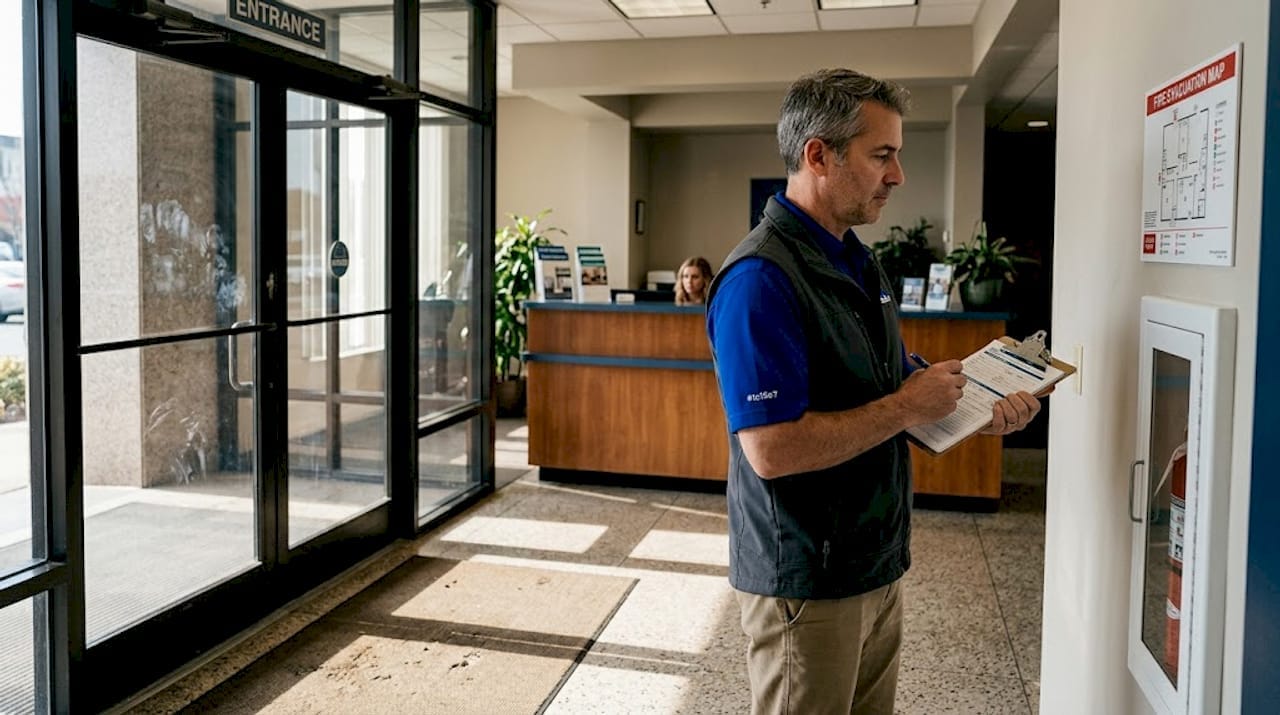
The actual inspection follows a structured sequence. The inspector begins with a visual walk-through of all accessible areas, documenting conditions with photographs and field notes. Selecting appropriate tools is part of the methodology, but the ComSOP approach emphasizes that inspections are fundamentally visual in practice unless you expand scope with qualified testing or special equipment. This is an important boundary to understand.
Here is how the process typically unfolds:
- Pre-inspection review. The inspector reviews documents you provided and confirms the agreed scope before arriving on-site.
- Systematic visual walk-through. Starting at the exterior, the inspector works through each major system in a logical sequence, taking photographs and notes at every finding.
- Supplemental research. The inspector may review permit histories, prior reports, or utility records to provide context for visual findings.
- Report preparation. Findings are organized by system, with photographs, condition ratings, and recommended actions. Inaccessible areas are documented explicitly.
- Report delivery and review. You receive the report and should review it with your inspector or advisor before finalizing negotiations or capital planning.
“A commercial inspection is a visual assessment of observable conditions at a point in time. It is not a code compliance audit, a warranty, or a guarantee of future performance.”
ComSOP-based inspections focus on identifying physical deficiencies and documenting findings rather than performing technically exhaustive code-compliance walkthroughs. Code compliance verification is treated as out of scope for the inspection standards themselves. This distinction matters because investors sometimes assume an inspection clears a property for code compliance. It does not.
Understanding why certified inspectors matter comes into sharp focus here. A certified inspector knows how to document limitations clearly, which protects both the inspector and the client. If a fire or smoke event has occurred at the property, knowing how to handle fire or smoke damage documentation can inform what additional investigation is warranted beyond the standard visual scope.
Pro Tip: Insist on explicit language in your report about what was and was not inspected. A report that lists inaccessible areas is more valuable than one that stays silent on them, because those gaps are exactly where your negotiation leverage lives.
Our take: The hard truths about reliable property inspections
After understanding the technical process, here is the straight talk from our experience on what makes an inspection outcome truly actionable and what leaves you exposed.
The biggest mistake we see investors make is treating a commercial inspection like a checkbox exercise. They order the inspection, receive the report, skim the summary, and move on. That approach misses the entire point. A thorough inspection is a risk management tool, not a formality. The value is in the details, specifically the system-by-system findings, the documented limitations, and the cost implications attached to each deficiency.
Investors also frequently assume that more pages in a report means more value. That is not always true. A 90-page report full of boilerplate language and stock photographs tells you less than a focused 40-page report with clear findings, accurate cost estimates, and explicit documentation of what the inspector could not access. Clarity and transparency are the markers of a reliable inspection, not volume.
Where we see investors get genuinely exposed is in the scope conversation. Many clients do not clarify what is included in the inspection before it happens. They assume MEP systems will be evaluated in detail, or that the roof will be walked, or that environmental concerns will be flagged. Sometimes those assumptions are correct. Often they are not. The scope is negotiated before the inspection, not discovered after. If you did not confirm it in writing, you may not have it in the report.
The inspections that truly inform your risk and reward decision are the ones that openly document their own limitations. An inspector who says “the mechanical room was locked and could not be evaluated” is giving you actionable information. An inspector who skips that room and says nothing is creating hidden liability for everyone involved.
Review inspection checklist best practices to build a pre-inspection framework that protects your interests. And if you are ever in a situation where an inspection missed something significant, understanding what to do if inspections miss issues can help you navigate the next steps.
Always keep a written record of every inaccessible space from your inspection. That list is negotiation leverage, capital reserve justification, and liability protection rolled into one document.
Connect with certified inspectors for your next smart investment
Every acquisition decision you make in the Mid-South commercial market carries real financial risk, and the quality of your inspection directly affects how well you understand that risk before you commit. A certified, thorough inspection is not a cost. It is the clearest picture of what you are actually buying.
At Upchurch Inspection, we deliver detailed commercial property inspections across Tennessee, Arkansas, Mississippi, and Southeast Missouri, with certified inspectors whose qualifications exceed state standards. Whether you are working through a detailed commercial inspection checklist for your first acquisition or managing a portfolio of properties, our reports give you the system-by-system clarity you need. Learn more about our certified commercial inspectors and how we help investors evaluate commercial properties with confidence.
Frequently asked questions
What is the difference between a PCA and a general commercial inspection?
A PCA follows ASTM E2018 as a framework for transactional due diligence and identifying material deficiencies, while a general commercial inspection may use standards like ComSOP for visual walk-through assessments. The key difference is purpose: PCAs are transaction-driven documents, while general inspections focus on observable physical conditions.
Are commercial inspections required by law in the Mid-South?
No, most commercial inspections are not legally required, but lenders, equity investors, and insurers strongly recommend them before any significant transaction. Skipping an inspection to save money upfront is one of the fastest ways to inherit expensive problems you did not price into your deal.
What are inspectors not responsible for during a commercial property inspection?
Inspectors do not verify code compliance or perform invasive testing unless those items are specifically agreed upon in the scope. ComSOP-based inspections focus on identifying physical deficiencies, and code compliance verification is explicitly treated as out of scope under standard inspection frameworks.
What documents should I provide before a commercial inspection?
Common documents include current leases, maintenance records, prior inspection reports, and site plans. Pre-inspection document review is a standard part of commercial inspection workflows and helps the inspector understand the property’s history before arriving on-site.
How do I handle limited access issues on inspection day?
Arrange advance coordination for all keys, access codes, and escort contacts before the inspection date. Lender-required inspections may have specific notice and access rules, so confirm those requirements early. Document every inaccessible area in writing for use in negotiations and capital planning.