
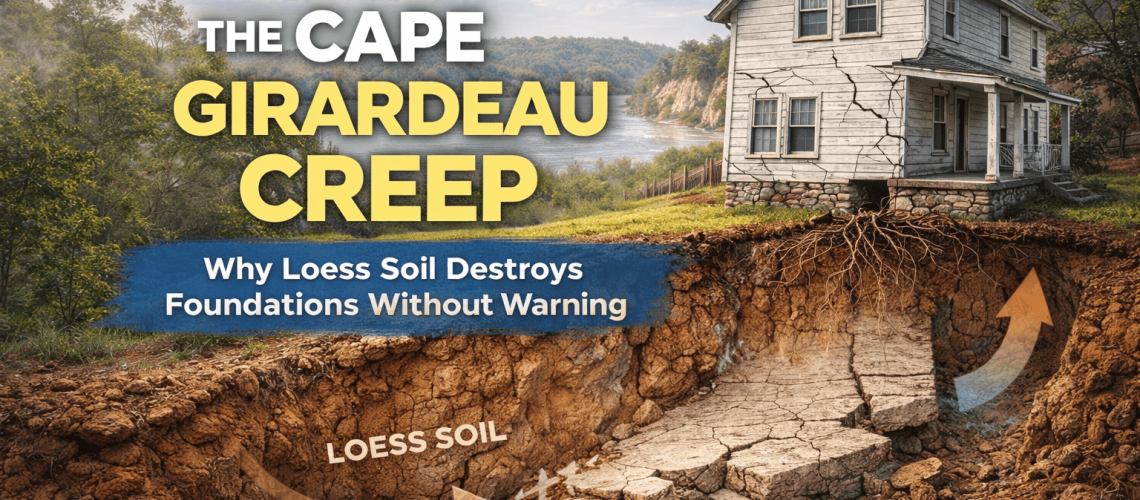
In Cape Girardeau, foundation problems don’t usually announce themselves with dramatic cracks or sudden failure. They show up quietly—doors that won’t stay aligned, floors that feel subtly off, hairline cracks that seem to “grow” over time.
This slow, persistent movement is often blamed on age or construction quality. In reality, one of the biggest drivers is something far more specific to Southeast Missouri: loess soil.
Loess doesn’t behave like clay. And because many inspectors treat it like it does, serious long-term risks are frequently misunderstood or missed altogether.
What Loess Soil Is (and Why It’s Different)
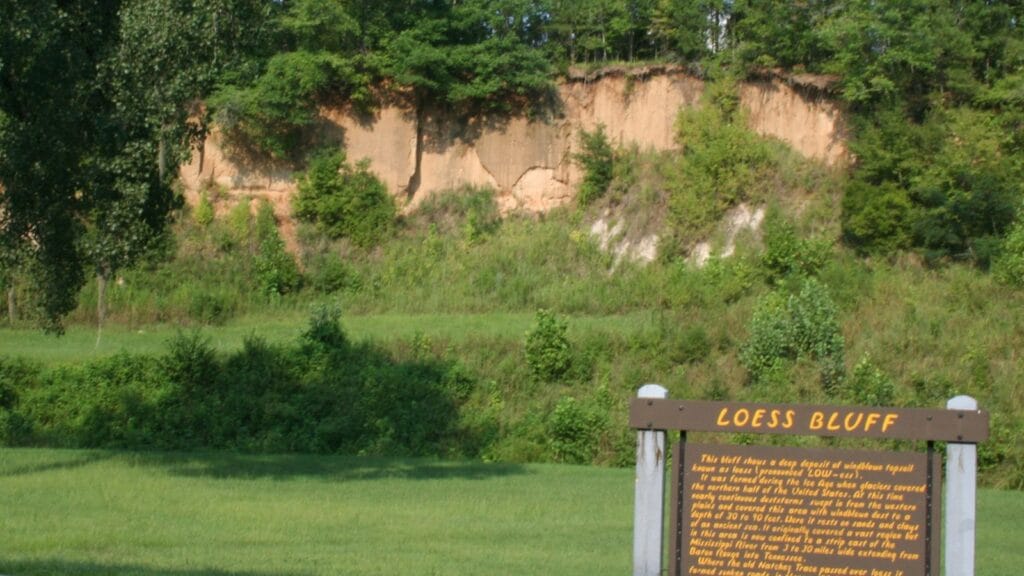
Loess is a wind-blown silt, deposited over thousands of years along river systems like the Mississippi. Cape Girardeau sits directly in one of the most significant loess regions in the country.
Unlike clay, loess:
- Has very fine particles
- Appears stable when dry
- Loses strength rapidly when wet
- Is prone to creep, not sudden failure
This makes it deceptive. Homes can sit for decades without obvious problems—until moisture conditions change.
Why Loess Causes “Creep” Instead of Cracks
Clay foundations often fail dramatically: cracks open, slabs heave, walls shift. Loess behaves differently.
When loess soil becomes saturated:
- Particle bonds weaken
- Shear strength drops
- Soil slowly migrates downslope or inward
- Foundations experience gradual, uneven settlement
This process is known as creep—and it’s one of the hardest foundation issues to diagnose visually.
There’s no single moment of failure. Just steady movement over time.
The Mississippi River Factor
Cape Girardeau’s proximity to the Mississippi River makes loess behavior even more complex.
River-adjacent conditions introduce:
- Elevated humidity
- Seasonal groundwater fluctuations
- Long-term moisture migration through silty soils
Homes near bluffs, slopes, or older fill areas are especially vulnerable. Even properties that appear flat at grade may be affected by subsurface movement.
Why Standard Inspections Often Miss Loess Problems
Most inspection training focuses on:
- Expansive clay
- Settlement cracks
- Structural displacement
Loess doesn’t always produce those classic signs.
Instead, inspectors may see:
- Minor interior cracking
- Slight floor slope
- Aging-related cosmetic issues
Without understanding loess behavior, these signs are often dismissed as “normal for the age of the home.”
Sometimes they are. Sometimes they aren’t.
Loess vs Clay: Why the Wrong Assumption Matters
Treating loess like clay leads to bad conclusions.
Clay-related movement is often seasonal and reversible.
Loess-related movement is often progressive.
That difference matters because:
- Seasonal movement may stabilize
- Progressive creep rarely self-corrects
- Drainage changes can accelerate settlement
- Repairs aimed at clay behavior may do nothing for loess creep
Misdiagnosis doesn’t just waste money—it delays the right solution.
Where This Risk Is Highest in Cape Girardeau
Loess-related foundation issues are most common in:
- Homes near river bluffs
- Properties on or near slopes
- Older neighborhoods with historic grading
- Areas with poor surface drainage
- Sites with modified runoff patterns
Nearby growth areas like Jackson, Missouri also see related issues, especially in new construction where grading and drainage are still settling into place.
What a Structural Evaluation Looks for in Loess Areas
A proper evaluation doesn’t rely on a single crack or measurement. It looks at:
- Soil moisture patterns
- Topography and slope direction
- Foundation type and bearing behavior
- Interior movement patterns over time
- Drainage and runoff management
The goal isn’t to alarm—it’s to determine whether movement is cosmetic, historical, or ongoing.
Why Loess Soil Is a Long-Term Risk, Not a Cosmetic One
The danger with loess isn’t dramatic failure. It’s slow damage that compounds:
- Minor settlement becomes structural misalignment
- Framing stress increases gradually
- Doors, windows, and floors continue to shift
- Repairs become more complex the longer movement continues
By the time damage looks “serious,” the soil behavior has often been active for years.
The Bottom Line
Cape Girardeau foundations don’t usually fail suddenly. They creep.
Loess soil creates a unique risk profile that can’t be evaluated with a checklist or a one-size-fits-all explanation. Understanding how this soil behaves—and how moisture, slope, and drainage interact with it—is critical to making informed decisions.
The real danger isn’t loess itself.
It’s assuming your foundation is stable simply because nothing looks wrong yet.
In Southeast Missouri, patience is not proof of stability.