Gas lines are one of those systems that don’t forgive assumptions.
They don’t squeak when they’re loose. They don’t drip when they’re wrong. And when they fail, the consequences are immediate and serious.
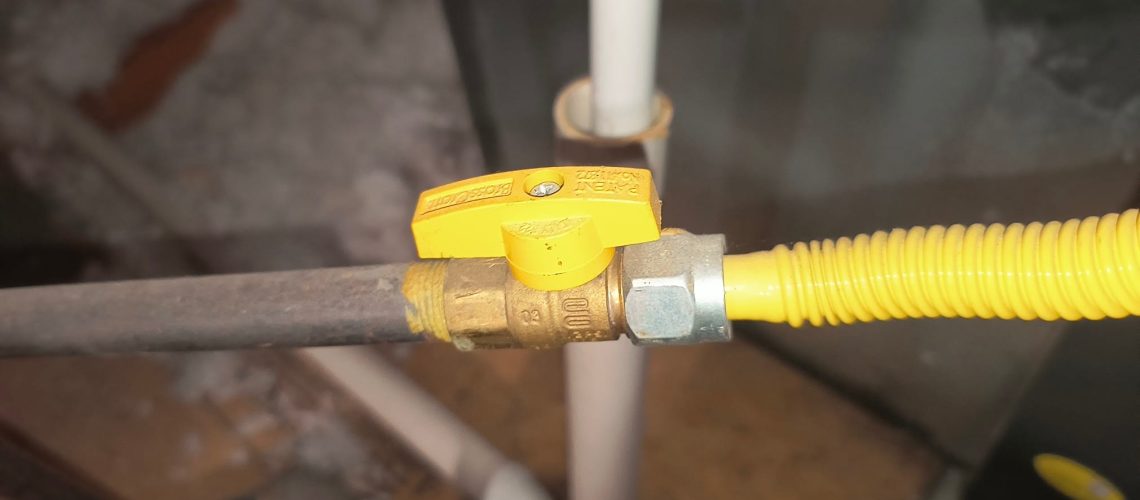
That’s why I slow way down any time I’m inspecting gas piping — especially when I see yellow flexible gas line mixed with traditional black iron.
The Two Gas Line Types I See Most Often
In residential homes around the Mid-South, gas piping usually falls into two categories:
- Black iron pipe (rigid steel)
- Yellow CSST (corrugated stainless steel tubing)
Both are allowed. Both can be safe. Both can also be installed dangerously wrong.
The material isn’t the problem — the installation usually is.
A Real Inspection Where the Material Wasn’t the Issue
I inspected a home in Jackson, TN where the seller proudly mentioned the gas lines had been “upgraded to flex.”
Yellow CSST ran cleanly through the crawlspace and attic. Looked neat at first glance.
But it wasn’t bonded.
No proper bonding jumper. No connection to the grounding system. Just flexible gas line floating electrically isolated through the house.
That’s not a cosmetic issue. That’s a lightning and surge risk.
Why Bonding Matters So Much With Yellow CSST
Yellow CSST must be properly bonded to the home’s electrical grounding system.
Without bonding:
- Lightning strikes can arc through the tubing
- Pinholes can form
- Gas leaks can occur without obvious damage
- Fire risk increases dramatically
I’ve reviewed an inspection report from one of our inspectors in the Nashville area where a lightning event caused a pinhole leak in unbonded CSST. No explosion — just gas slowly filling the structure.
That’s the scary part. Silent failures.
Black Iron Isn’t Automatically Better
Black iron pipe gets treated like the “old reliable” option — and most of the time, it is.
But I still find problems:
- Poorly supported runs
- Improper thread sealant
- Rust and corrosion
- Sediment traps missing
- Long unsupported horizontal spans
We inspected a home in the Cape Girardeau area where black iron piping had sagged over time and stressed a joint near the furnace. It hadn’t failed yet — but it was loaded and waiting.
Rigid doesn’t mean indestructible.
The Dangerous Mixing of Materials
One of the most common issues I see is improper transitions.
Mixing CSST and black iron requires:
- Proper fittings
- Proper support
- Proper bonding
- Correct routing away from sharp edges
I’ve seen yellow CSST run tight against sheet metal edges, masonry corners, and even electrical conduit.
In Dyersburg, I inspected a home where CSST had been routed through a drilled joist hole without a protective bushing. Vibration alone was enough to make that a long-term failure point.
Appliance Connections Are Where Problems Hide
Even when the main gas piping looks good, appliance connections often tell a different story.
I regularly find:
- Unapproved flexible connectors
- Excessive connector length
- Connectors reused multiple times
- Kinked or stretched flex lines
- Missing shutoff valves
One of my inspectors in the Little Rock area documented a gas water heater connected with a flex line stretched tight like a guitar string. No slack. No allowance for movement.
That’s not safe — it’s just quiet.
What I’m Actually Checking During a Gas Line Inspection
I don’t just identify the material and move on.
I look for:
- Proper bonding (especially on CSST)
- Secure support and strapping
- Correct transitions
- Protection from physical damage
- Shutoff valves at appliances
- Sediment traps where required
- Signs of corrosion or past leakage
If access is limited, that gets documented clearly. Gas systems don’t get the benefit of the doubt.
What Buyers Need to Understand
Gas piping failures aren’t gradual like plumbing leaks.
When gas systems fail:
- The margin for error is small
- The consequences are big
- Repairs aren’t optional
Yellow CSST isn’t unsafe. Black iron isn’t perfect. Safety lives in the details, not the material choice.
The Inspector’s Bottom Line
Gas lines don’t announce problems politely.
That’s why I don’t assume newer is better or older is safer. I verify bonding. I check support. I trace lines. I look for shortcuts.
Because when it comes to gas, “looks fine” isn’t good enough — and guessing is never acceptable.